Ad

Showing posts with label solar forecast. Show all posts

Thursday, May 9, 2013

Ring of Fire Solar Eclipse Today. Solar Forecast


RING OF FIRE SOLAR ECLIPSE--TODAY! On May 9-10, the Moon will pass directly in front of the sun over the South Pacific, producing a "ring of fire" solar eclipse. At greatest eclipse, more than 95% of the sun's surface will be covered. The Coca-Cola Space Science Center is hosting a live webcast of the event from Australia! Tune in on May 9th beginning at 5 pm EDT. More: animationmap,details.

MAGNETIC ACTIVITY: A ragged, dynamic filament of magnetism is dancing along the sun's southwestern limb today. It is so large, more than 250,000 km from end to end, that amateur astronomers are able to see it in great detail using backyard solar telescopes. John Stetson sends this snapshot from Falmouth, Maine:
The magnetic underpinnings of this arching prominence may be connected to nearby sunspot AR1736, which is itself unstable and poses a threat for M-class solar flares. If the anchor is unstable, the overlying structure could collapse. Observers with solar telescopes are encouraged to monitor the southwestern limb for developments.

Solar wind
speed: 451.5 km/sec
density: 3.4 protons/cm3
explanation | more dataUpdated: Today at 0037 UT
X-ray Solar Flares
6-hr max: C9 
2316 UT May09 
24-hr: C9 
2316 UT May09 
explanation | more dataUpdated: Today at: 2359 UT


Near Earth Asteroids
Potentially Hazardous Asteroids (PHAs) are space rocks larger than approximately 100m that can come closer to Earth than 0.05 AU. None of the known PHAs is on a collision course with our planet, although astronomers are finding new ones all the time.
On May 10, 2013 there were 1397 potentially hazardous asteroids.
Recent & Upcoming Earth-asteroid encounters:
Asteroid
Date(UT)
Miss Distance
Size
2013 JR7
May 10
9.1 LD
18 m
2004 BV102
May 25
69.9 LD
1.4 km
1998 QE2
May 31
15.2 LD
2.1 km
2009 FE
Jun 4
9.6 LD
230 m
2000 FM10
Jun 5
50.3 LD
1.3 km
2002 KL3
Jun 6
66.4 LD
1.1 km
1999 WC2
Jun 12
39.2 LD
1.9 km
2006 RO36
Jun 18
70.9 LD
1.2 km
2001 PJ9
Jul 17
29.2 LD
1.1 km
2006 BL8
Jul 26
9.3 LD
48 m
2003 DZ15
Jul 29
7.6 LD
153 m
2005 WK4
Aug 9
8.1 LD
420 m
Notes: LD means "Lunar Distance." 1 LD = 384,401 km, the distance between Earth and the Moon. 1 LD also equals 0.00256 AU. MAG is the visual magnitude of the asteroid on the date of closest approach.

Source:  SpaceWeather.com

3-day GOES X-ray Plot
The GOES X-ray Flux plot contains 5 minute averages of solar X-ray output in the 1-8 Angstrom (0.1-0.8 nm) and 0.5-4.0 Angstrom (0.05-0.4 nm) passbands. Data from the SWPC Primary and Secondary GOES X-ray satellites are shown. Some data dropouts from the Primary satellite will occur during satellite eclipses.
Other plots of interest: A black background version of this plot; GOES 1-min X-rays; SWPC Real-time Monitors. 
SWPC X-ray alerts are issued at the M5 (5x10E-5 Watts/m2) and X1 (1x10E-4 Watts/m2) levels, based upon 1-minute data. Large X-ray bursts cause short wave fades for HF propagation paths through the sunlit hemisphere. Some large flares are accompanied by strong solar radio bursts that may interfere with satellite downlinks.
source: http://www.swpc.noaa.gov/rt_plots/xray_5m.html


List Of The Potentially Hazardous Asteroids (PHAs)


Friday, January 11, 2013

Earth Directed Solar Flares. Asteroid DA14...Watch Out. Solar Maximum.


INCREASING CHANCE OF FLARES: Big sunspot AR1654 is growing more active. It is now crackling with M-class solar flares, such as this one recorded by NASA's Solar Dynamics Observatory this morning at 09:11 UT:


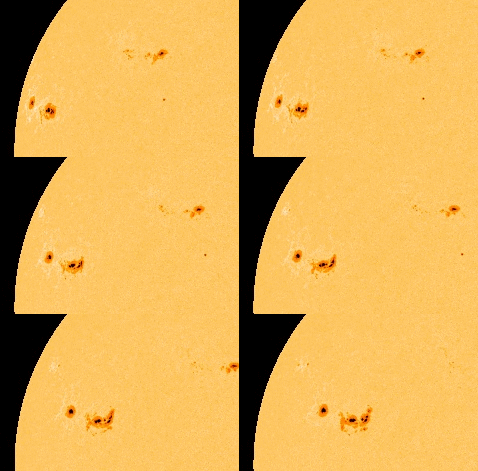
AR1654 is getting bigger as it turns toward Earth: movie. Not only is the chance of flares increasing, but also the chance of an Earth-directed eruption.This could be the sunspot that breaks the recent lengthy spell of calm space weather around our planet

X-ray Solar Flares
6-hr max: M1 
1508 UT Jan11 
24-hr: M1 
0911 UT Jan11 
explanation | more dataUpdated: Today at: 2000 UT


Daily Sun: 11 Jan 13

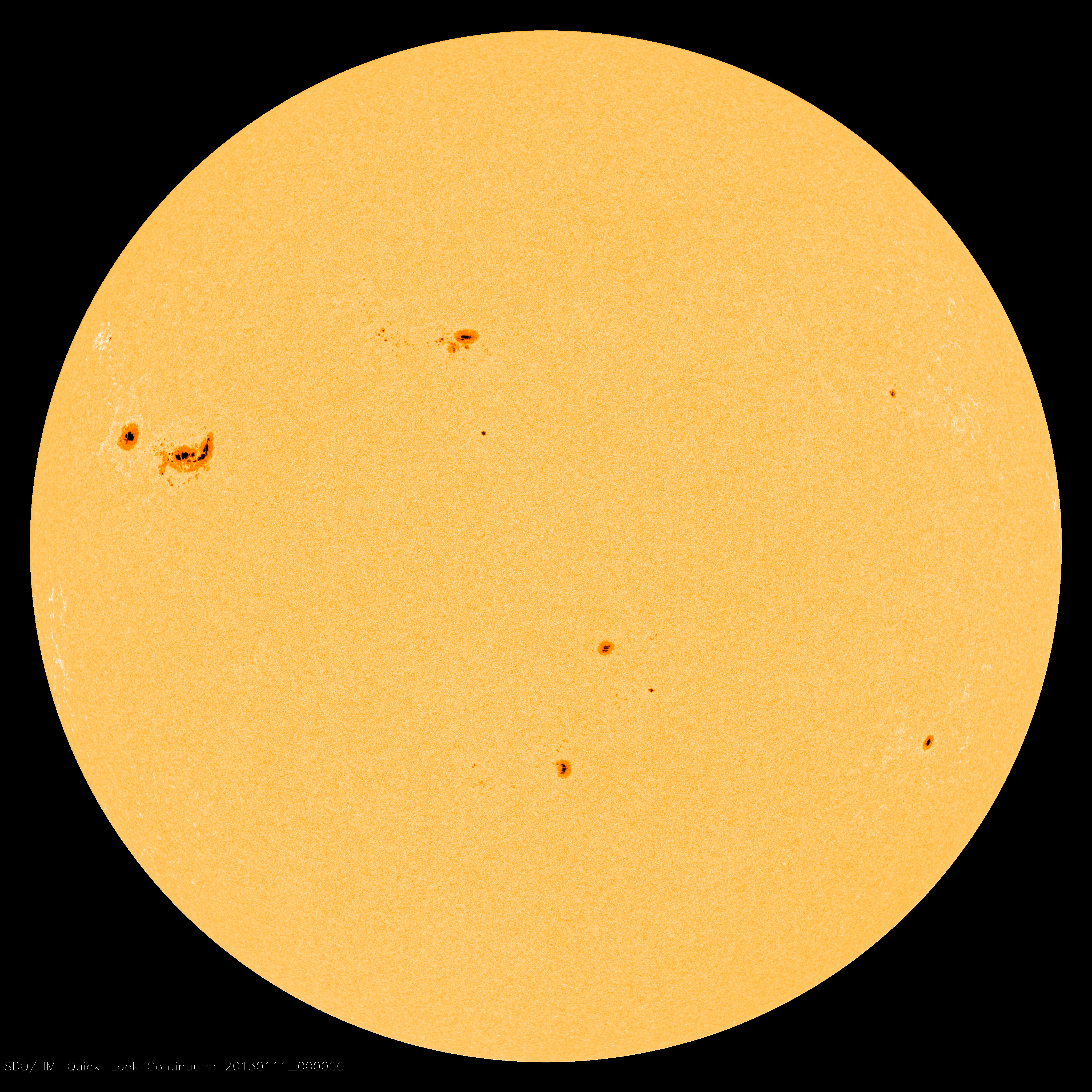
Sunspots AR1652 and AR1654 have beta-gamma magnetic fields that harbor energy for M-class solar flares. Credit: SDO/HMI

SPACE WEATHERNOAA Forecasts
Updated at: 2013 Jan 10 2200 UTC
FLARE
0-24 hr
24-48 hr
CLASS M
50 %
50 %
CLASS X
05 %
05 %

Asteroid 2012 DA14 to sweep close on February 15, 2013

It’ll pass within the moon’s distance from Earth – closer than the orbits of geosynchronous satellites. But it won’t strike us in 2013.

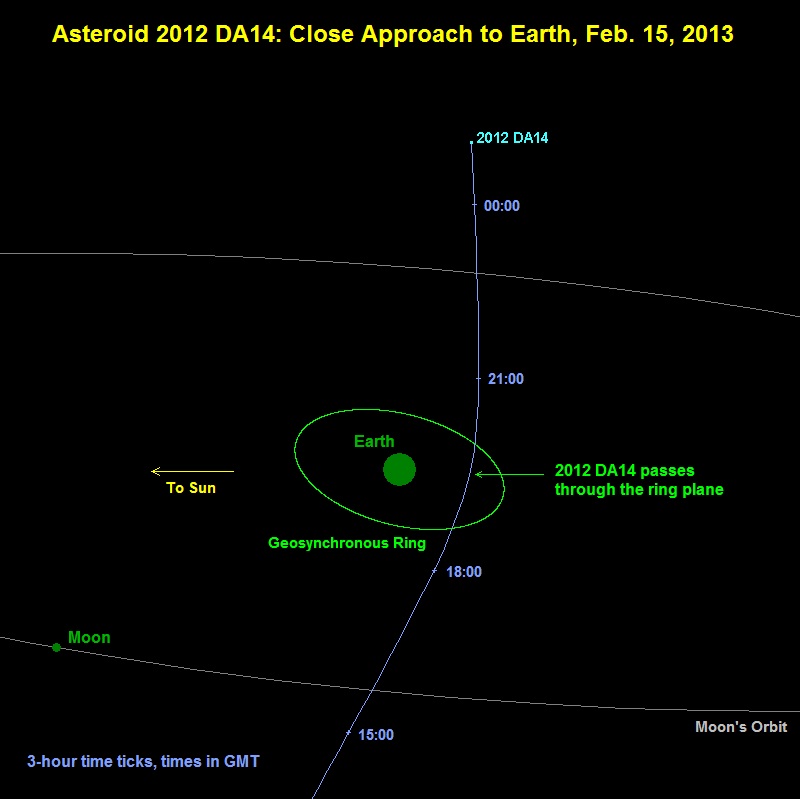
A near-Earth asteroid – called 2012 DA14 by astronomers – will pass very close to Earth on February 15, 2013. Astronomers estimate that, when it’s closest to us, it’ll be within the orbit of the moon (which is about 240,000 miles away), and within the orbits of geosynchronous satellites (about 26,000 miles up). 2012 DA14 will be about 21,000 miles (35,000 kilometers) away. It will not strike Earth in 2013. Astronomers’ calculations of asteroid orbits can be trusted. After all, even decades ago, they knew enough about calculating orbits to send people to the moon and bring them safely back, and today we are able place our space vehicles in orbit around objects as small as asteroids.
So, no, 2012 DA14 won’t strike us in 2013. There was a remote possibility it might strike us in 2020, but that possibility has been ruled out also.

Asteroid 2012 DA14 will pass closest on February 15, 2013. As the image above shows, it will pass much closer than the orbit of the moon - closer even that orbiting geosynchronous satellites (22,000 miles). View larger. Image Credit: NASA
What will happen when Asteroid 2012 DA14 passes closely in 2013?
What will happen when it passes us? The short answer is … nothing. On the day it passes, most of us won’t see it or be aware of its passage, in any way. The asteroid won’t alter the tides. It won’t cause volcanoes. It’ll just sweep closely past us – as millions of asteroids have done throughout Earth’s four-and-a-half-billion-year history – some in your own lifetime.
The asteroid will be within range for small telescopes and solidly mounted binoculars, used by experienced observers who have access to appropriate stars charts. Here’s what NASA says about its visibility:
On [February 15, 2013], the asteroid will travel rapidly from the southern evening sky into the northern morning sky with its closest Earth approach occurring about 19:26 UTC when it will achieve a magnitude of less than seven, which is somewhat fainter than naked eye visibility. About 4 minutes after its Earth close approach, there is a good chance it will pass into the Earth’s shadow for about 18 minutes or so before reappearing from the eclipse. When traveling rapidly into the northern morning sky, 2012 DA14 will quickly fade in brightness.
What do we know about asteroid 2012 DA14?
Asteroid 2012 DA14 is a little guy, compared to some asteroids, although its size has not been pinned down precisely. It is thought to be about 45 meters across (nearly 150 feet across), with an estimated mass of about 130,000 metric tons.
If a space object 150 feet wide were to strike our planet, it wouldn’t be Earth-destroying. But it has been estimated that it would produce the equivalent of 2.4 megatons of TNT. How does that compare with other known impact events on Earth? In 1908, in a remote part of Russia, an explosion killed reindeer and flattened trees. But no crater was ever found. Scientists now believe a small comet struck Earth. That event has been estimated at 3 to 20 megatons. So 2012 DA14 is in the same approximate realm as the Tunguska comet (which, actually, might have been an asteroid instead). It would not destroy Earth, but it could flatten a city.
Of course, about 70% of our world is covered by oceans. That means the most likely landing spot of any incoming asteroid is in the water – not on a city or other populated area.
Astronomers at the Observatorio Astronómico de La Sagra in Spain discovered 2012 DA14 in early 2012. We know 2012 DA14′s orbit is similar to that of Earth. That is one reason the asteroid eluded astronomers until recently. You can be sure that many astronomers are carefully tracking 2012 DA14 now.
The orbit of 2012 DA14 is an inclined ellipse. In other words, it’s tilted sightly with respect to Earth’s orbit around the sun, and, like Earth’s orbit, it’s not circular but elliptical – like a circle that someone sat down on. According to Bad Astronomer Phil Plait, who appears to have used a computer program to look at its orbit:
The asteroid spends most of its time well away from our planet. However, the path of the rock does bring it somewhat close to the Earth twice per orbit, or about every six months. The last time it passed us was on February 16 [2012], when it was about 2.5 million km (1.5 million miles) away, equal to about 6 times the distance to the moon. That’s usually about the scale of these encounters — it misses us by quite a margin.
If we know it will miss us in 2013 and in 2020, why are astronomers still watching? In fact, the orbit of 2012 DA14 is not entirely pinned down, although it is known well enough to say for sure: it will not hit us next year, or in 2020.
But it will come close on February 15, 2013! It should be close enough to catch the attention of virtually everyone on Earth in February 2013, on what’s sure to be a media field day.
Will 2012 DA14 strike Earth in 2020?
No. In March 2012, when a collision between 2012 DA14 and Earth in 2020 was still remotely possible, I asked astronomer Donald Yeomans to clarify the risk. Yeomans is, among other things, manager of NASA’s Near-Earth Object Program Office at NASA’s Jet Propulsion Laboratory. In March 2012, he told EarthSky that a 2020 collision between Earth and asteroid 2012 DA14 was …
… approximately one chance in 83,000, with additional remote possibilities beyond 2020. However, by far the most likely scenario is that additional observations, especially in 2013, will allow a dramatic reduction in the orbit uncertainties and the complete elimination of the 2020 impact possibility.
It turned out they didn’t have to wait until 2013. By May, 2012, astronomers had ruled out even the remote possibility of a 2020 collision.
Still, 2012 DA14 and asteroids like it are sobering.
Bottom line: The near Earth asteroid 2012 DA14 will have a very close pass near Earth on February 15, 2013. It will sweep approximately 21,000 miles from us – much closer than the moon’s orbit and closer than geosynchronous satellites. It will not strike Earth. Its orbit around the sun can bring it no closer to the Earth’s surface on February 15, 2013 than 3.2 Earth radii.


Solar Variability and Terrestrial Climate

The March Towards Max

The March Towards Max
These six images from SDO, chosen to show a representative image about every six months, track the rising level of solar activity since the mission first began to produce consistent images in May, 2010. The period of solar maximum is expected in 2013. The images were taken in the 171 Angstrom wavelength of extreme ultraviolet light.

Sun-Climate (tsi, strip)
Space-borne measurements of the total solar irradiance (TSI) show ~0.1 percent variations with solar activity on 11-year and shorter timescales. These data have been corrected for calibration offsets between the various instruments used to measure TSI. SOURCE: Courtesy of Greg Kopp, University of Colorado.


Sun-Climate (pacific anomaly, strip)
Composite averages for December-January-February for peak solar years. SOURCE: G.A. Meehl, J.M. Arblaster, K. Matthes, F. Sassi, and H. van Loon, Amplifying the Pacific climate system response to a small 11 year solar cycle forcing, Science 325:1114-1118, 2009; reprinted with permission from AAAS.


Sun-Climate (sunspot numbers, strip)
The yearly averaged sunspot number for a period of 400 years (1610-2010). SOURCE: Courtesy of NASA Marshall Space Flight Center.


Saturday, July 7, 2012

X-Class Solar Flare Explosion From the Sun.


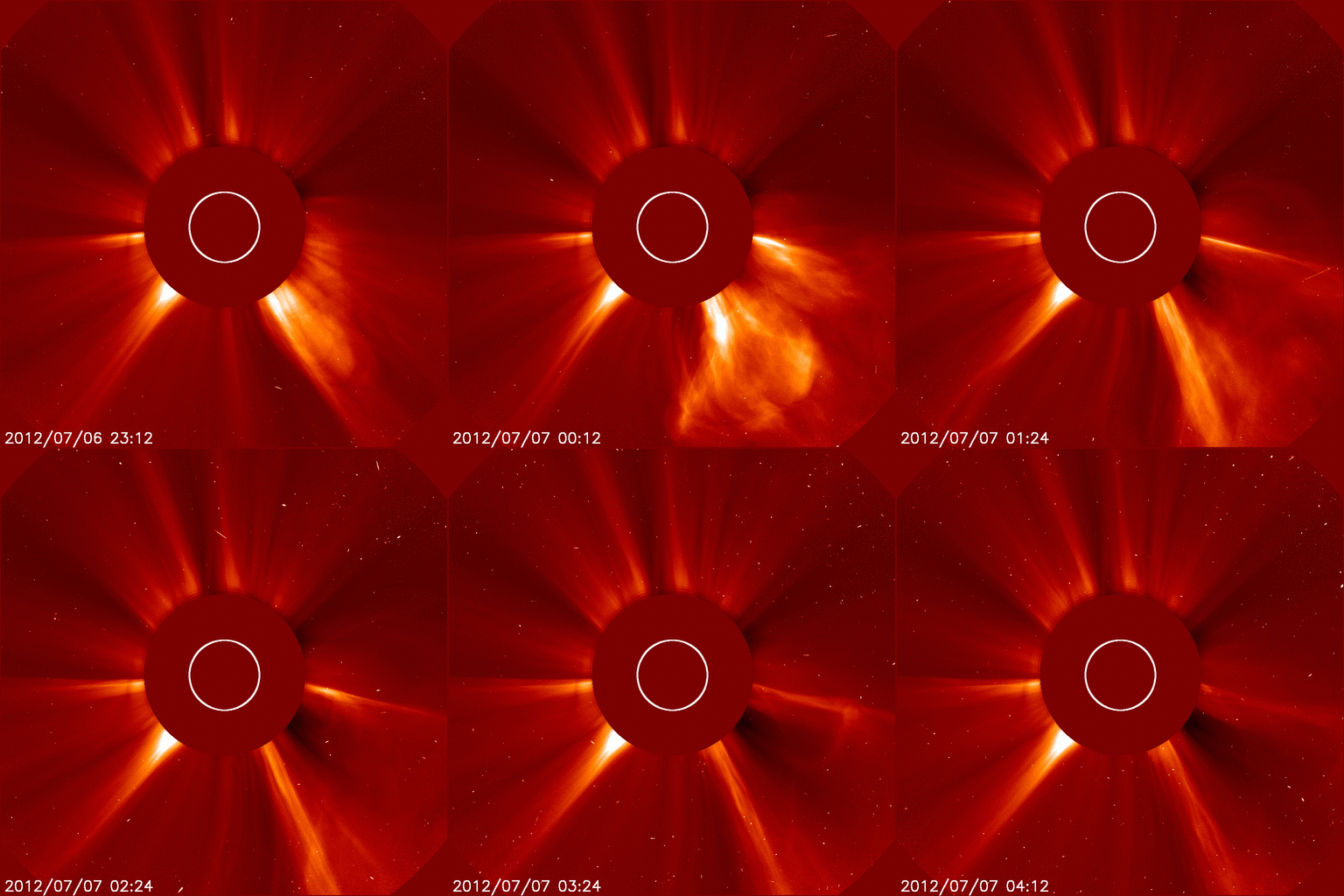
X-FLARE: For days, giant sunspot AR1515 has looked capable of producing a really strong explosion. On July 6th it finally did. Yesterday, the sunspot's magnetic canopy erupted, producing a brief but potent X1.1-class solar flare. NASA's Solar Dynamics Observatory recorded the extreme ultraviolet flash:
The explosion hurled a CME into space. According to this movie from the Solar and Heliospheric Observatory, the cloud appears to be heading south and away from Earth. However, we cannot yet rule out a glancing blow to our planet on July 8th or 9th. Stay tuned for further analysis.
Look at the CME movie one more time. The speckles near the end are caused by energetic protons accelerated by the flare. Guided toward Earth by solar magnetic fields, the protons are peppering Earth-orbiting satellites, causing "snow" in imaging systems and posing a slim threat for single-event upsets (computer glitches).

SPACE WEATHERNOAA Forecasts
Updated at: 2012 Jul 06 2200 UTC
FLARE
0-24 hr
24-48 hr
CLASS M
80 %
80 %
CLASS X
25 %
25 %

Sunday, June 3, 2012

Massive Solar Coronal Holes Shaped Like A Chicken Creating Solar Wind.


Space Weather Real Time Image Gallery 

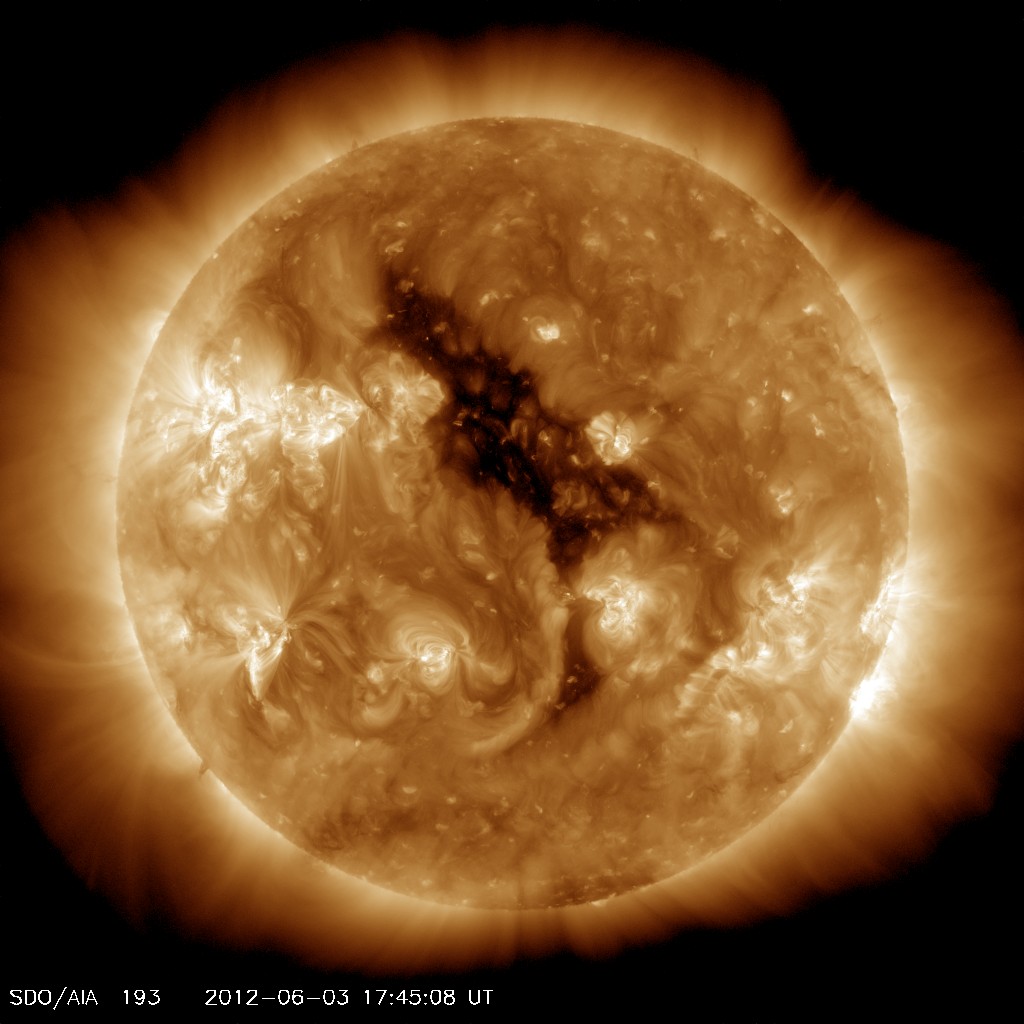
'CH' STANDS FOR ... CHICKEN? A big dark hole in the sun's atmosphere, a 'coronal hole', is turning toward Earth spewing solar wind. According to NASA's official rubber chicken, it looks an awful lot like a bird:
Coronal holes are places where the sun's magnetic field opens up and allows the solar wind to escape. A chicken-shaped stream of solar wind flowing from this coronal hole will reach Earth on June 5th - 7th, possibly stirring geomagnetic storms. High-latitude sky watchers should be alert for auroras.

Solar wind
speed: 410.5 km/sec
density: 1.2 protons/cm3
explanation | more dataUpdated: Today at 1956 UT
X-ray Solar Flares
6-hr max: M3 
1755 UT Jun03 
24-hr: M3 
1755 UT Jun03 
explanation | more dataUpdated: Today at: 2000 UT

Thursday, May 10, 2012

Solar Update: May 10, 2012 Super Solar Flares With Extreme Ultraviolet Flashes. Solar Pole Shift.


Solar wind
speed: 627.0 km/sec
density: 0.0 protons/cm3
Updated: Today at 1735 UT

X-ray Solar Flares
6-hr max: C4 
1340 UT May10 
24-hr: M5 
0418 UT May10 
Updated: Today at: 1700 UT


SOLAR ACTIVITY INTENSIFIES: Huge sunspot AR1476 is crackling with M-class solar flares and appears to be on the verge of producing something even stronger. The sunspot's 'beta-gamma-delta' magnetic field harbors energy for X-class flares, the most powerful kind. Earth is entering the line of fire as the sunspot rotates across the face of the sun.

This morning, May 10th around 0418 UT, sunspot 1476 unleashed an impulsive M5-class solar flare. NASA's Solar Dynamics Observatory recorded the extreme ultraviolet flash:


Apparently, the almost-X class explosion did not hurl a significant CME toward Earth. NOAA forecasters estimate a 65% chance of more M-class flares and a 10% chance of X-flares during the next 24 hours

Planetary K-index
Now: Kp= 2 quiet
24-hr max: Kp= 4 
unsettled
Interplanetary Mag. Field

Btotal4.3 nT
Bz1.3 nT south 

Updated: Today at 1737 UT

SPACE WEATHERNOAA Forecasts
Updated at: 2012 May 09 2200 UTC
FLARE
0-24 hr
24-48 hr
CLASS M
65 %
65 %
CLASS X
10 %
10 %


WHAT DOES A SUNSPOT SOUND LIKE? On May 9th, amateur astronomer Thomas Ashcraft of New Mexico detected strong shortwave radio bursts coming from the sunspot. Click to hear the "solar static" that roared out of his loudspeaker:
Dynamic spectrum courtesy of Wes Greenman, Alachua Radio Observatory
"The strongest burst so far occured around 1631 UT on May 9th," reports Ashcraft. "I am observing at 28 MHz and 21.1 MHz. As I send this note I am hearing more bursting, indicating powerful magnetic dynamism within active region 1476."
Solar radio bursts are caused by plasma instabilities that ripple through the sun's atmosphere in the aftermath of powerful flares. With AR1476 poised for more eruptions, this 'radio activity' is likely to continue for days

The Sun’s Four Pole Magnetic Field, Solar Pole Shift And The New Little Ice Age…

The Sun, the light at the centre of our solar system is fast approaching the end of its 11 year solar cycle. With the height of solar activity reached, the solar maximum, is it now time for our Sun to slumber?
NASA, not short of an opinion on all things scientific expect the current solar cycle to end mid-2013, while Japanese researchers armed with their own observations dispute NASA’s predictions. Suggesting instead that May this year will see the Sun’s pole shift, temporarily creating a quad pole magnetic field until the pole reversal completes and the next solar cycle begins.
An international research team led by Saku Tsuneta, a professor at National Astronomical Observatory of Japan (NAOJ) has been performing the monthly solar observations since September 2008, making use of Hinode, the Japanese solar observing satellite. Saku and his team of researchers  have discovered that the sun’s pole shift will occur 12 months sooner than expected,  May 2012.


The end of the solar cycle is signaled by a flipping of the magnetic poles of the Sun, the Sun then enters the Solar Minimum with solar flare activity dropping to its lowest point. During the pole shift the Sun may exhibit unusual activity including the appearance of 4 magnetic poles, 2 North and 2 South. Like a two headed chicken this is most unusual.
Even more incredible is the claim that, according to their observations, the Sun is currently exhibiting similar solar activity to that observed during the Maunder Minimum, which occurred during the coldest years of the Little Ice Age in the 17th century.
Solar flare activity is far easier to observe, than other solar processes, from the Earth’s surface. Solar observations actually date back as far back as the 17th century,  enabled by the invention of the telescope. Giovanni Domenico Cassini and a team of observers in France collected many of the early observations, including those during the Maunder Minimum.
The Maunder Minimum occurred between 1645 and 1715 and is characterized as being a period with incredibly low levels of solar flare activity. During the 30 years in the middle of Maunder Minimum only 50 solar flares were observed, compared to the 40,000 to 50,000 that would be expected during a solar maximum.
There is still much to understand about the Sun and its solar flares, especially how they relate to the Earth and it’s weather. There is thought to be a connection between the Maunder Minimum and the Little Ice Age, lack of solar flare activity and the Earth’s cold periods.  During the coldest years of the Little Ice Age (LIA), which occurred from 1350 to 1850 the Themes in London froze solid along with New York’s Hudson river, Manhattan become only an ice skate away.  The great famine of 1315 marked a treacherous start  to the LIA.
Several causes have been proposed for the LIA, cyclical lows in solar activity, a large number of volcanic events and changes to the oceans currents are the leading possibilities. Interestingly it is also possible that all three theories are intertwined, causing the cold event to last much longer than it otherwise would have.
Little is understood about the process of solar pole shift, only since the launch of solar observing satellites such as Hinode, along with NASA’s SOHO and SDO, have we been able to closely observe the process in action. This is the first end of a solar cycle observed with so mans mechanical eye’s in the sky. It may well be time to rug up and enjoy the solar show.