Any doubts that the Poles are shifting?
Have you watched the placement of the Sun and the Moon lately? How about the weather?
Are you experiencing strange, unseasonable weather?
These are evidence of pole shifting.
Watch and read the evidence below. There is strong evidence that the poles are shifting and that the rate of shift is accelerating.
What does this mean for us? Obviously, weather changes and plant growth patterns, drought versus flooding, levels of oceans, increased earthquakes that correlate to volcanic activity acceleration and more.
Analyze for yourself the information I have placed below. This is now a high scientific priority.
Feb-04-2011
Magnetic Polar Shifts Causing Massive Global Superstorms
Terrence Aym Salem-News.com
Superstorms can also cause certain societies, cultures or whole countries to collapse. Others may go to war with each other.
Superstorm
Courtesy: Weather Snob
(CHICAGO) - NASA has been warning about it…scientific papers have been written about it…geologists have seen its traces in rock strata and ice core samples…
Now "it" is here: an unstoppable magnetic pole shift that has sped up and is causing life-threatening havoc with the world's weather.
Forget about global warming—man-made or natural—what drives planetary weather patterns is the climate and what drives the climate is the sun's magnetosphere and its electromagnetic interaction with a planet's own magnetic field.
When the field shifts, when it fluctuates, when it goes into flux and begins to become unstable anything can happen. And what normally happens is that all hell breaks loose.
Magnetic polar shifts have occurred many times in Earth's history. It's happening again now to every planet in the solar system including Earth.
The magnetic field drives weather to a significant degree and when that field starts migrating superstorms start erupting.
The superstorms have arrived
The first evidence we have that the dangerous superstorm cycle has started is the devastating series of storms that pounded the UK during late 2010.
On the heels of the lashing the British Isles sustained, monster storms began to lash North America. The latest superstorm — as of this writing — is a monster over the U.S. that stretched across 2,000 miles affecting more than 150 million people.
Yet even as that storm wreaked havoc across the Western, Southern, Midwestern and Northeastern states, another superstorm broke out in the Pacific and closed in on Australia.
The southern continent had already dealt with the disaster of historic superstorm flooding from rains that dropped as much as several feet in a matter of hours. Tens of thousands of homes were damaged or destroyed. After the deluge tiger sharks were spotted swimming between houses in what was once a quiet suburban neighborhood.
Shocked authorities now numbly concede that much of the water may never dissipate and have wearily resigned themselves to the possibility that region will now contain a new inland sea.
But then only a handful of weeks later another superstorm; the megamonster cyclone Yasi, struck northeastern Australia. The damage it left in its wake is being called by rescue workers a war zone.
The incredible superstorm packed winds near 190mph. Although labeled as a category-5 cyclone, it was theoretically a category-6. The reason for that is storms with winds of 155mph are considered category-5, yet Yasi was almost 22 percent stronger than that.
A cat's cradle
Yet Yasi may only be a foretaste of future superstorms. Some climate researchers, monitoring the rapidly shifting magnetic field, are predicting superstorms in the future with winds as high as 300 to 400mph.
Such storms would totally destroy anything they came into contact with on land.
The possibility more storms like Yasi or worse will wreak havoc on our civilization and resources is found in the complicated electromagnetic relationship between the sun and Earth. The synergistic tug-of-war has been compared by some to an intricately constructed cat's cradle. And it's in a constant state of flux.
The sun's dynamic, ever-changing electric magnetosphere interfaces with the Earth's own magnetic field affecting, to a degree, the Earth's rotation, precessional wobble, dynamics of the planet's core, its ocean currents and—above all else—the weather.
Cracks in Earth's Magnetic Shield
The Earth's northern magnetic pole was moving towards Russia at a rate of about five miles annually. That progression to the East had been happening for decades.
Suddenly, in the past decade the rate sped up. Now the magnetic pole is shifting East at a rate of 40 miles annually, an increase of 800 percent. And it continues to accelerate.
Recently, as the magnetic field fluctuates, NASA has discovered "cracks" in it. This is worrisome as it significantly affects the ionosphere, troposphere wind patterns, and atmospheric moisture. All three things have an effect on the weather.
Worse, what shields the planet from cancer-causing radiation is the magnetic field. It acts as a shield deflecting harmful ultra-violet, X-rays and other life-threatening radiation from bathing the surface of the Earth. With the field weakening and cracks emerging, the death rate from cancer could skyrocket and mutations of DNA can become rampant.
Another federal agency, NOAA, issued a report caused a flurry of panic when they predicted that mammoth superstorms in the future could wipe out most of California. The NOAA scientists said it's a plausible scenario and would be driven by an "atmospheric river" moving water at the same rate as 50 Mississippi rivers flowing into the Gulf of Mexico.
Magnetic field may dip, flip and disappear
The Economist wrote a detailed article about the magnetic field and what's happening to it. In the article they noted:
"There is, however, a growing body of evidence that the Earth's magnetic field is about to disappear, at least for a while. The geological record shows that it flips from time to time, with the south pole becoming the north, and vice versa. On average, such reversals take place every 500,000 years, but there is no discernible pattern. Flips have happened as close together as 50,000 years, though the last one was 780,000 years ago. But, as discussed at the Greenland Space Science Symposium, held in Kangerlussuaq this week, the signs are that another flip is coming soon."
Discussing the magnetic polar shift and the impact on weather, the scholarly paper "Weather and the Earth's magnetic field" was published in the journal Nature. Scientists too are very concerned about the increasing danger of superstorms and the impact on humanity.
Superstorms will not only damage agriculture across the planet leading to famines and mass starvation, they will also change coastlines, destroy cities and create tens of millions of homeless.
Superstorms can also cause certain societies, cultures or whole countries to collapse. Others may go to war with each other.
A Danish study published in the scientific journal Geology, found strong correlation between climate change, weather patterns and the magnetic field.
"The earth's climate has been significantly affected by the planet's magnetic field, according to a Danish study published Monday that could challenge the notion that human emissions are responsible for global warming.
"'Our results show a strong correlation between the strength of the earth's magnetic field and the amount of precipitation in the tropics,' one of the two Danish geophysicists behind the study, Mads Faurschou Knudsen of the geology department at Aarhus University in western Denmark, told the Videnskab journal.
"He and his colleague Peter Riisager, of the Geological Survey of Denmark and Greenland (GEUS), compared a reconstruction of the prehistoric magnetic field 5,000 years ago based on data drawn from stalagmites and stalactites found in China and Oman."
In the scientific paper "Midday magnetopause shifts earthward of geosynchronous orbit during geomagnetic superstorms with Dst = -300 nT" the magnetic intensity of solar storms impacting Earth can intensify the effects of the polar shift and also speed up the frequency of the emerging superstorms.
Pole reversal may also be initiating new Ice Age
According to some geologists and scientists, we have left the last interglacial period behind us. Those periods are lengths of time—about 11,500 years—between major Ice Ages.
One of the most stunning signs of the approaching Ice Age is what's happened to the world's processional wobble.
The Earth's wobble has stopped
As explained in the geology and space science website
earthchangesmedia.com, "The Chandler wobble was first discovered back in 1891 by Seth Carlo Chandler an American astronomer.
The effect causes the Earth's poles to move in an irregular circle of 3 to 15 meters in diameter in an oscillation. The Earth's Wobble has a 7-year cycle which produces two extremes, a small spiraling wobble circle and a large spiraling wobble circle, about 3.5 years apart.
The above video shows people who rely on the position of the Sun and the stars for their survival and those factors have changed so much in the past decade that they are having to adjust ways that have been past down from the times of their ancient ancestors.
Not that I believe in groups that are complete doomsdayers, but observations that are made here are very interesting because they are made on what has happened...
Nancy Lieder
7 of 10 STATUS as of January 5, 2012
Posted by Nancy Lieder on January 6, 2012 at 11:30am
View Blog
Mariana Trench Collapse
Is the trench collapsing? Certainly buoys 52402 and 52403 are are signaling that. The Philippine Plate lies to the east of the Philippine Islands, and the Mariana Plate lies to the east of the Mariana Islands, and the Mariana Trench lies to the east of the Mariana Plate.
Mariana Trench
http://en.wikipedia.org/wiki/Mariana_Trench
The Mariana Trench or Marianas Trench is the deepest part of the world's oceans. It is located in the western Pacific Ocean, to the east of the Mariana Islands.
The Zetas predicted that the folding of the Mariana Trench would be SUDDEN. The Zetas also stated that the folding of the Philippine and Mariana plates in 7 of 10 Scenario 3 is KEY to acceleration of the 7 of 10 scenarios.
ZetaTalk Prediction 11/27/2010:
http://www.zetatalk3.com/ning/27no2010.htm
The folding of the Pacific plates that accompany the sinking of Indonesia during the 7 of 10 scenarios involves, as we have explained, the Mariana and Philippine plates tilting and flattening westward. The Mariana Trench is a zone where the Pacific Plate is subducting under the Mariana Plate. The Pacific Plate curves down at this point, plunging under the Mariana Islands which ride on the Mariana Plate. The trench will be suddenly closed, so that rather than a trench there will be the Pacific Plate scraping along the Mariana Plate.
ZetaTalk Prediction 9/17/2011:
http://www.zetatalk4.com/ning/17sp2011.htm
We have stated that the Sunda Plate will complete its sinking by the time the S American roll is at its peak, but not before. The folding of the Philippine and Mariana plates also must be almost complete before the S American roll can accelerate. Number 3 is likely to complete hand-in-hand with number 2 rather suddenly at a time when the Indo-Australia Plate lifts and plunges under the Himalayas.
Buoy 52402 shows that something dramatic occurred on December 13, 2011. Buoy 52402 is at Latitude 11.74N Longitude 154E out in the Pacific, just east of the trench and approximately 1/3 of the way to Hawaii from the Philippine Islands. What would cause this buoy to show a sudden drop of 15 meters (45 feet) on December 13!
A clue lies in the heaping waters shown by Buoy 52403, which lies along the trench to the SW of 52402. Water squirting out of a collapsing trench would end up in this vicinity, and it did! The waters on the Carolina Platelet are also not as deep as the deep Pacific, and would take more time to disburse a heap, thus. Per the Zetas, the trench did indeed collapse on December 13.
ZetaTalk Comment 12/31/2011:
http://www.zetatalk7.com/ning/31de2011.htm
When the trench collapses, the Pacific Plate suddenly takes a sharper angle when subducting under the Mariana Plate, pushing the Mariana Plate to accelerate its tilt and fold, which then accelerates the Philippine Plate’s tilt and fold. At the point of collapse there is suddenly MORE water just above the trench, moving in all directions. But such an adjustment is seldom smooth. Waves themselves have heaps and troughs as there is a tendency for water to move as a mass, cohesive. When the trench collapsed, it created a heap, but for buoy 52402 there was a trough reaction, the 15 meter drop on December 13, 2011. The water also moved south, along the deep trench, like along a funnel.
The Mariana Islands, on the lifting eastern edge of the Philippine Plate just to the west of the Mariana Plate, have been beset with quakes since, even during lulls affecting the rest of the world.
Have the heaping waters been noted by those nearby, on the Philippine Islands? Certainly the Mindanao tsunami...http://www.zetatalk8.com/newsletr/issue274.htm
on December 17 was caused by the disbursing waters. And just a quick end of the year snapshot for incidents in the Philippine Islands show continuing references to capsizing boats, “swelling seawater”, and a “storm surge” without an accompanying storm.
Waves Destroy 26 Houses in Aklan
December 28, 2011
http://www.philstar.com/nation/article.aspx?publicationSubCategoryI...
Apart from the damaged houses, several commercial establishments have been affected by the swelling seawater. Residents were obliged to put up piles of sandbags along the coastlines.
12 Saved as Boat Capsizes off Cebu
December 3,1 2011
http://www.philstar.com/nation/article.aspx?publicationSubCategoryI...
Twelve people were rescued after their motorized boat capsized off Lapu-Lapu City in Cebu.
State of Calamity Declared in Parts of Leyte, Cebu
December 31, 2011
http://www.philstar.com/nation/article.aspx?publicationSubCategoryI...
The low pressure area caused 14 flooding incidents, four landslides, three sea mishaps, and a storm surge, and damaged a seawall.
^^^^^^^^^^^^^^^^^^
7 of 10 Year in Review
7 of 10 Scenario 1, the tilting of India to put the Indus Valley in Pakistan at a 10 foot elevation loss occurred the latter half of 2010, as was acknowledged by NASA
http://www.zetatalk.com/newsletr/issue217.htm
by the end of 2010.
Monday, 12 December 2005
Magnetic north pole drifting fast
Aurora borealis, AP
Alaska could lose its northern lights, scientists say
The Earth's north magnetic pole is drifting away from North America so fast that it could end up in Siberia within 50 years, scientists have said.
The shift could mean that Alaska will lose its northern lights, or auroras, which might then be more visible in areas of Siberia and Europe.
The magnetic poles are different from geographic poles, the surface points marking the axis of Earth's rotation.
Magnetic poles are known to migrate and, occasionally, swap places.
"This may be part of a normal oscillation and it will eventually migrate back toward Canada," Joseph Stoner, a palaeomagnetist at Oregon State University, told a meeting of the American Geophysical Union (AGU) in San Francisco.
Wandering poles
Previous studies have shown that the strength of the Earth's magnetic shield has decreased 10% over the past 150 years.
During the same period, the north magnetic pole wandered about 1,100km (685 miles) into the Arctic, according to the new analysis.
The rate of the magnetic pole's movement has increased in the last century compared with fairly steady movement in the previous four centuries, the Oregon researchers said.
The Oregon team examined the sediment record from several Arctic lakes. Since the sediments record the Earth's magnetic field at the time, scientists used carbon dating to track changes in the magnetic field.
They found that the north magnetic field shifted significantly in the last thousand years. It generally migrated between northern Canada and Siberia, but has occasionally moved in other directions.
Rate of change
At the present rate, the north magnetic pole could swing out of northern Canada into Siberia.
If that happens, Alaska could lose its northern lights, or auroras, which occur when charged particles streaming away from the Sun collide with gases in the ionosphere, causing them to glow.
The north magnetic pole was first discovered in 1831 and when it was revisited in 1904, explorers found it had moved by 50km (31 miles).
17 December 2010
Swarm satellite mission to try to sense ocean magnetism
By Jonathan Amos Science correspondent, BBC News, San Francisco
European scientists are going to try to measure the movement of the oceans by tracing their magnetism alone.
The effort will be achieved using three super-sensitive spacecraft called Swarm, which should launch in 2012.
The magnetic signal of the tides sweeping around the globe has been seen before, but the new mission would aim to observe far more detail.
It should provide additional data on how the oceans transfer heat around the Earth, a key feature of the climate.
"When salty ocean water flows through the magnetic field of the Earth, an electric field is generated and this electric field again makes a magnetic field," explained Dr Hermann Lühr, from the German Research Centre for Geosciences (GFZ) and a leading investigator on Swarm.
"We hope to have the possibility to measure the ocean currents which are so important for climate dynamics, because oceans are transporting a lot of heat. The German Champ mission was the first to see at least the tidal signal, but with Swarm we want to be able to monitor the currents themselves."
The new mission is one of the several innovative European Space Agency (Esa) endeavours being discussed this week here at the American Geophysical Union (AGU) Fall Meeting, the largest annual gathering of Earth and planetary scientists.
The major part of Earth's global magnetic field is generated by convection of molten iron within the planet's outer liquid core, but there are other components that contribute to the overall signal, including the magnetism retained in rocks.
...This approach is expected to make it much easier for Swarm to separate out all the different components of the global magnetic field.
Scientists say they still have much to learn about Earth's magnetism.
The global field, which shields the planet from high-energy particles emanating from the Sun, appears to be getting weaker, particularly over the South Atlantic where Champ data was used to show there had been a 12% reduction during the course of three decades.
It is in this so-called South Atlantic Anomaly that orbiting spacecraft experience most of their technical failures and where astronauts on the space station receive their largest dose of radiation.
The Swarm satellites have the look of giant mechanical rats
Don't believe the Mayan's? After the above, watch this and re-evaluate what you think.
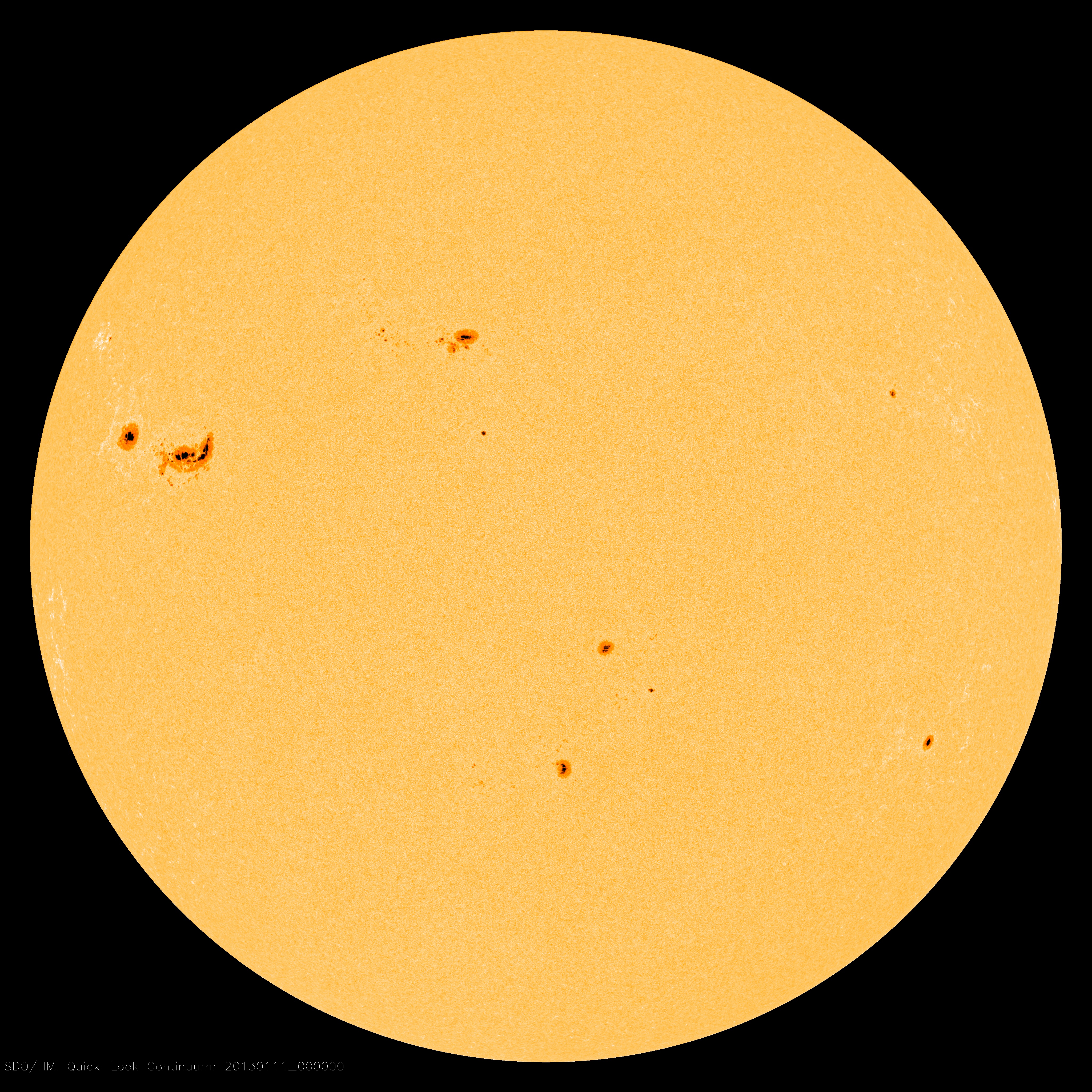
The Sun Does a Flip
NASA scientists who monitor the Sun say that our star's awesome magnetic field is flipping -- a sure sign that solar maximum is here.


 Listen to this story (requires RealPlayer)
 February 15, 2001
-- You can't tell by looking, but scientists say the Sun has just undergone an important change. Our star's magnetic field has flipped.
The Sun's magnetic north pole, which was in the northern hemisphere just a few months ago, now points south. It's a topsy-turvy situation, but not an unexpected one.
"This always happens around the time of solar maximum," says David Hathaway, a solar physicist at the Marshall Space Flight Center. "The magnetic poles exchange places at the peak of the sunspot cycle. In fact, it's a good indication that Solar Max is really here."
"When looking at polar shift 2012, NASA and the government are covering up what they know will happen simply because they don't want to contend with widespread panic. There is little that would result in telling the public that these theories hold truth from scientific evidence except for creating huge waves of panic around the globe, which would result in hoarding of food and supplies, and general mayhem. So the government is working with NASA to keep this under wraps. But that doesn't mean you can't form your own opinion on the matter and take steps to prepare yourself to survive when the worst happens in 2012 by learning to live off the land.
Chris Mallory is a writer and researcher on
Polar Shift 2012 Nasa"
Article Source: http://EzineArticles.com/4739770