Asteroid to pass close by Earth on Friday
* Nearest approach at 2:24 p.m. EST/1924 GMT on Friday
* No chance of impact, scientists say
* Encounter will cause asteroid's orbit to change
By Irene Klotz
BOSTON, Feb 14 (Reuters) - A newly discovered asteroid about half the size of a football field will pass nearer to Earth than any other known object of its size on Friday, giving scientists a rare opportunity for close-up observations without launching a probe.

At its closest approach, which will occur at 2:24 p.m. EST/1924 GMT, the asteroid will pass about 17,200 miles (27,520 km) above the planet traveling at 8 miles (13 km) per second, bringing it nearer than the networks of television and weather satellites that ring the planet.
Although Asteroid 2012 DA14 is the largest known object of its size to pass this close, scientists say there is no chance of an impact, this week or in the foreseeable future.
Currently, DA14 matches Earth's year-long orbit around the sun, but after Friday's encounter its flight path will change, said astronomer Donald Yeomans, with NASA's Jet Propulsion Laboratory in Pasadena, California.
"The close approach will perturb its orbit so that actually instead of having an orbital period of one year, it'll lose a couple of months," Yeomans said. "The Earth is going to put this one in an orbit that is considerably safer," he said.
The non-profit Space Data Association, which tracks satellites for potential collisions, analyzed the asteroid's projected path and determined no spacecraft would be in its way.
"There is no reason to believe that this asteroid poses a threat to any satellites in Earth orbit," Space Data operations manager T.S. Kelso said in a statement.
read more at THIS LINK
FROM NASA
IMAGES
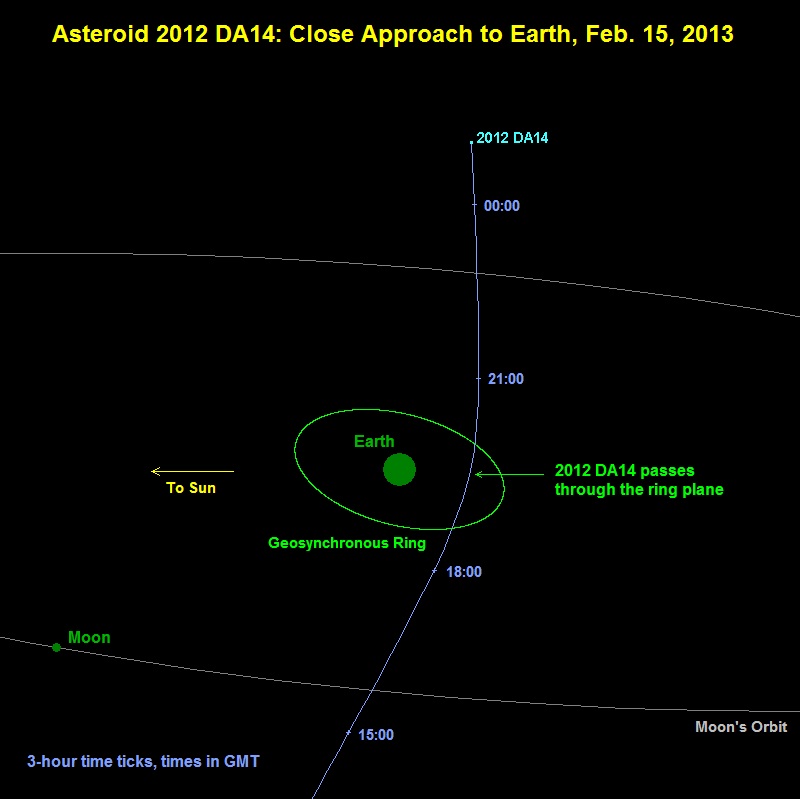
 Graphic depicts the trajectory of asteroid 2012 DA14 on Feb 15, 2013. In this view, we are looking down from above Earth's north pole. Image credit: NASA/JPL-Caltech
› Larger view
 Graphic depicts the trajectory of asteroid 2012 DA14 during its close approach, as seen edge-on to Earth's equatorial plane. The graphic demonstrates why the asteroid is invisible to northern hemisphere observers until just before close approach: it is approaching from "underneath" our planet. On the other hand, after close approach it will be favorably placed for observers in the northern hemisphere. Image credit: NASA/JPL-Caltech
› Larger view
FREQUENTLY ASKED QUESTIONS
Q: What is asteroid DA14
A: Asteroid 2012 DA14 is a small near-Earth object – approximately 150 feet (45 meters) in diameter. On Feb. 15, 2013, the asteroid will pass by our planet at a remarkably close distance, but the asteroid’s path is understood well enough that there is no chance of a collision with the Earth.
Q: What date and what time will the asteroid be closest to Earth?
A: Asteroid 2012 DA14 will be closest to Earth on Feb. 15 at approximately 19:24 UTC (2:24 p.m. EST/11:24 a.m. PST). This time may change by a minute or two as the asteroid is tracked on its approach and predictions are refined.
At the time of closest approach, the asteroid will be over the eastern Indian Ocean, off Sumatra -- approx. latitude: -6 deg South. / longitude: 97.5 deg East.
Q: How far away will asteroid 2012 DA14 be at time of closest approach?
A: Asteroid 2012 DA14 will be only about 17,200 miles (27,700 kilometers) above Earth's surface at the time of closest approach on Feb 15, 2013. This distance is well outside Earth's atmosphere, but it is inside the belt of satellites in geostationary orbit, which is located 22,200 miles (35,800 kilometers) above Earth’s surface. The close-approach distance is only about one-tenth the distance between Earth and moon. Another way to express the distance between asteroid and Earth at time of closest approach is 4.4 Earth radii from Earth’s surface – or about twice the diameter of the Earth.
Q: Could asteroid DA14 impact Earth?
A: No. The orbit of asteroid 2012 DA14 is well understood – it will not come any closer than 17,150 miles (27,650 kilometers) above Earth's surface during its flyby on Feb 15, 2013.
The asteroid’s orbit around the sun is roughly similar to that of Earth, and it makes relatively close approaches to our planet’s orbit twice per orbit. But, the 2013 flyby is by far the closest the asteroid will approach our planet for many decades. The next notable close approach to Earth will be on February 15, 2046, when the asteroid will pass no closer than 620,000 miles (1,000,000 kilometers) from the center-point of Earth.
While this is the closest possible distance based on observations and calculations as of February 4, 2013, future observations will refine the calculation and may increase the minimum distance of the flyby. As of Feb 9, 2013, the minimum distance is now 1.6 million km or 995,000 miles from the center of Earth. For the most current calculations for this asteroid, visit: http://ssd.jpl.nasa.gov/sbdb.cgi?sstr=2012%20DA14;orb=1;cov=0;log=0;cad=1;rad=0#cad
Q: What makes 2012 DA14 special?
A: The flyby of asteroid 2012 DA14 is the closest ever predicted Earth approach for an object this large.
Q: How long will asteroid 2012 DA14 be within the Earth/moon system?
A: Asteroid 2012 DA14's will be within the Earth/moon system for about 33 hours. Its orbit will bring it within the Earth/moon system (approach within one lunar distance, 237,000 miles of the Earth) on Feb. 15 at about 0300 UTC (7 p.m. PST on Thursday, Feb. 14). The asteroid will exit the Earth/moon system on Feb. 16 at about 1200 UTC (4 a.m. PST).
Q: Is there a chance that asteroid 2012 DA14 could be eclipsed by Earth?
A: Because of its trajectory, there is no chance that asteroid 2012 DA14 will pass through Earth’s shadow.
Q: How big is asteroid 2012 DA14?
A: Asteroid 2012 DA14 is currently estimated to be about 150 feet (45 meters) across and has an estimated mass of about 130,000 metric tons. If radar observations of this asteroid are successful, we might have a more accurate estimate of the asteroid’s size after its close approach.
Q: How fast will the asteroid be traveling at closest approach?
A: Asteroid 2012 DA 14 is traveling at about 17,450 miles per hour (28,100 kilometers per hour), or 4.8 miles per second (7.82 kilometers per second) relative to Earth.
Q: Who discovered asteroid DA14?
A: Asteroid 2012 DA14 was discovered by the La Sagra Sky Survey operated by the Astronomical Observatory of Mallorca in Spain on Feb. 23, 2012. The asteroid was about 2.7 million miles (4.3 million kilometers) distant when it was detected. Their observations were reported to the NASA funded Minor Planet Center, operated by the Smithsonian Astrophysical Observatory for the International Astronomical Union, where all observations from observatories worldwide are combined to maintain the database on all known asteroids and comets in our solar system.
Q: How many asteroids are out there similar in size to asteroid DA14?
A: Scientists believe there are approximately 500,000 near-Earth asteroids the size of 2012 DA14. Of those, less than one percent have been discovered.
Q: How many times do asteroids the size of DA14 fly this close?
A: Scientists at NASA's Near-Earth Object Program Office in Pasadena, Calif. estimate that an asteroid the size of 2012 DA14 flies this close every 40 years on average and that one will impact Earth, on average, about once in every 1,200 years.
Q: Is there a chance that asteroid DA14 will collide with one or more satellites?
A: There is very little chance that asteroid 2012 DA14 will impact a satellite or spacecraft. Because the asteroid is approaching from below Earth, it will pass between the outer constellation of satellites located in geosynchronous orbit (22,245 miles/35,800 kilometers) and the large concentration of satellites orbiting much closer to Earth. (The International Space Station, for example, orbits at the close-in altitude of 240 miles/386 kilometers.). There are almost no satellites orbiting at the distance at which the asteroid will pass.
Q: What will asteroid DA14’s close pass do to Earth’s rotation/tides/fault lines/etc.
A: The gravitational influence upon Earth and its inhabitants by the flyby of asteroid 2012 DA14 will be infinitesimally small.
Q: What would happen if DA14 were to impact Earth?
A: Asteroid 2012 DA14 will not impact Earth, but if another asteroid of a size similar to that of 2012 DA14 (about 150 feet across) were to impact Earth, it would release approximately 2.5 megatons of energy in the atmosphere and would be expected to cause regional devastation.
A comparison to the impact potential of an asteroid the size of 2012 DA14 could be made to the impact of a near-Earth object that occurred in 1908 in Tuguska, Siberia. Known in the asteroid community as the "Tunguska Event," this impact of an asteroid just slightly smaller than 2012 DA14 (approximately 100 – 130 feet/30-40 meters across) is believed to have flattened about 825 square miles (2200 square kilometers) of forest in and around the Podkamennaya Tunguska River in what is now Krasnoyarsk Krai, Russia.
Q: Can I see the asteroid during its close approach?
A: Asteroid 2012 DA14 is small, so even though it will make a close flyby of Earth, the asteroid's apparent magnitude is expected to peak at about only 7.4 – too dim to be viewed by the naked eye. To view the asteroid, you will need a good pair of binoculars, or even better, a moderately powered telescope.
During the closest approach, and dependant on local weather, the asteroid will be visible from parts of Europe, Africa and Asia. The asteroid will appear to be moving relatively quickly as it crosses the sky from the south to the north.
Q: What is NASA doing about asteroid 2012 DA14?
A: As there is no chance of impact, there is nothing that needs to be done about the asteroid. However, the flyby of 2012 DA14 is a great opportunity for science. NASA's Goldstone Solar System Radar, located in California's Mojave Desert, will observe the asteroid on Feb. 16, 18, 19 and 20. Due to the asteroid's small size, the radar images generated are expected to be no more than a few pixels across. It will also be observed by numerous optical observatories worldwide to attempt to determine its spin rate and composition.