Ad

Showing posts with label Gravity. Show all posts

Thursday, February 14, 2013

Asteroid 2012 DA14. Historical Event. Passing Within Geosynchronous Ring.


Asteroid to pass close by Earth on Friday


* Nearest approach at 2:24 p.m. EST/1924 GMT on Friday
* No chance of impact, scientists say
* Encounter will cause asteroid's orbit to change
By Irene Klotz
BOSTON, Feb 14 (Reuters) - A newly discovered asteroid about half the size of a football field will pass nearer to Earth than any other known object of its size on Friday, giving scientists a rare opportunity for close-up observations without launching a probe.

Location of asteroid
At its closest approach, which will occur at 2:24 p.m. EST/1924 GMT, the asteroid will pass about 17,200 miles (27,520 km) above the planet traveling at 8 miles (13 km) per second, bringing it nearer than the networks of television and weather satellites that ring the planet.
Although Asteroid 2012 DA14 is the largest known object of its size to pass this close, scientists say there is no chance of an impact, this week or in the foreseeable future.
Currently, DA14 matches Earth's year-long orbit around the sun, but after Friday's encounter its flight path will change, said astronomer Donald Yeomans, with NASA's Jet Propulsion Laboratory in Pasadena, California.
"The close approach will perturb its orbit so that actually instead of having an orbital period of one year, it'll lose a couple of months," Yeomans said. "The Earth is going to put this one in an orbit that is considerably safer," he said.
The non-profit Space Data Association, which tracks satellites for potential collisions, analyzed the asteroid's projected path and determined no spacecraft would be in its way.
"There is no reason to believe that this asteroid poses a threat to any satellites in Earth orbit," Space Data operations manager T.S. Kelso said in a statement.
read more at THIS LINK


FROM NASA
IMAGES 

Graphic depicts the trajectory of asteroid 2012 DA14Graphic depicts the trajectory of asteroid 2012 DA14 on Feb 15, 2013. In this view, we are looking down from above Earth's north pole. Image credit: NASA/JPL-Caltech
› Larger view

Graphic depicts the trajectory of asteroid 2012 DA14Graphic depicts the trajectory of asteroid 2012 DA14 during its close approach, as seen edge-on to Earth's equatorial plane. The graphic demonstrates why the asteroid is invisible to northern hemisphere observers until just before close approach: it is approaching from "underneath" our planet. On the other hand, after close approach it will be favorably placed for observers in the northern hemisphere. Image credit: NASA/JPL-Caltech
› Larger view


FREQUENTLY ASKED QUESTIONS 

Q: What is asteroid DA14
 A: Asteroid 2012 DA14 is a small near-Earth object – approximately 150 feet (45 meters) in diameter. On Feb. 15, 2013, the asteroid will pass by our planet at a remarkably close distance, but the asteroid’s path is understood well enough that there is no chance of a collision with the Earth.


Q: What date and what time will the asteroid be closest to Earth?
 A: Asteroid 2012 DA14 will be closest to Earth on Feb. 15 at approximately 19:24 UTC (2:24 p.m. EST/11:24 a.m. PST). This time may change by a minute or two as the asteroid is tracked on its approach and predictions are refined.

At the time of closest approach, the asteroid will be over the eastern Indian Ocean, off Sumatra -- approx. latitude: -6 deg South. / longitude: 97.5 deg East.


Q: How far away will asteroid 2012 DA14 be at time of closest approach?
 A: Asteroid 2012 DA14 will be only about 17,200 miles (27,700 kilometers) above Earth's surface at the time of closest approach on Feb 15, 2013. This distance is well outside Earth's atmosphere, but it is inside the belt of satellites in geostationary orbit, which is located 22,200 miles (35,800 kilometers) above Earth’s surface. The close-approach distance is only about one-tenth the distance between Earth and moon. Another way to express the distance between asteroid and Earth at time of closest approach is 4.4 Earth radii from Earth’s surface – or about twice the diameter of the Earth.


Q: Could asteroid DA14 impact Earth?
 A: No. The orbit of asteroid 2012 DA14 is well understood – it will not come any closer than 17,150 miles (27,650 kilometers) above Earth's surface during its flyby on Feb 15, 2013.

The asteroid’s orbit around the sun is roughly similar to that of Earth, and it makes relatively close approaches to our planet’s orbit twice per orbit. But, the 2013 flyby is by far the closest the asteroid will approach our planet for many decades. The next notable close approach to Earth will be on February 15, 2046, when the asteroid will pass no closer than 620,000 miles (1,000,000 kilometers) from the center-point of Earth.

While this is the closest possible distance based on observations and calculations as of February 4, 2013, future observations will refine the calculation and may increase the minimum distance of the flyby. As of Feb 9, 2013, the minimum distance is now 1.6 million km or 995,000 miles from the center of Earth. For the most current calculations for this asteroid, visit: http://ssd.jpl.nasa.gov/sbdb.cgi?sstr=2012%20DA14;orb=1;cov=0;log=0;cad=1;rad=0#cad


Q: What makes 2012 DA14 special?
 A: The flyby of asteroid 2012 DA14 is the closest ever predicted Earth approach for an object this large.


Q: How long will asteroid 2012 DA14 be within the Earth/moon system?
 A: Asteroid 2012 DA14's will be within the Earth/moon system for about 33 hours. Its orbit will bring it within the Earth/moon system (approach within one lunar distance, 237,000 miles of the Earth) on Feb. 15 at about 0300 UTC (7 p.m. PST on Thursday, Feb. 14). The asteroid will exit the Earth/moon system on Feb. 16 at about 1200 UTC (4 a.m. PST).


Q: Is there a chance that asteroid 2012 DA14 could be eclipsed by Earth?
 A: Because of its trajectory, there is no chance that asteroid 2012 DA14 will pass through Earth’s shadow.


Q: How big is asteroid 2012 DA14?
 A: Asteroid 2012 DA14 is currently estimated to be about 150 feet (45 meters) across and has an estimated mass of about 130,000 metric tons. If radar observations of this asteroid are successful, we might have a more accurate estimate of the asteroid’s size after its close approach.


Q: How fast will the asteroid be traveling at closest approach?
 A: Asteroid 2012 DA 14 is traveling at about 17,450 miles per hour (28,100 kilometers per hour), or 4.8 miles per second (7.82 kilometers per second) relative to Earth.


Q: Who discovered asteroid DA14?
 A: Asteroid 2012 DA14 was discovered by the La Sagra Sky Survey operated by the Astronomical Observatory of Mallorca in Spain on Feb. 23, 2012. The asteroid was about 2.7 million miles (4.3 million kilometers) distant when it was detected. Their observations were reported to the NASA funded Minor Planet Center, operated by the Smithsonian Astrophysical Observatory for the International Astronomical Union, where all observations from observatories worldwide are combined to maintain the database on all known asteroids and comets in our solar system.


Q: How many asteroids are out there similar in size to asteroid DA14?
 A: Scientists believe there are approximately 500,000 near-Earth asteroids the size of 2012 DA14. Of those, less than one percent have been discovered.


Q: How many times do asteroids the size of DA14 fly this close?
 A: Scientists at NASA's Near-Earth Object Program Office in Pasadena, Calif. estimate that an asteroid the size of 2012 DA14 flies this close every 40 years on average and that one will impact Earth, on average, about once in every 1,200 years.


Q: Is there a chance that asteroid DA14 will collide with one or more satellites?
 A: There is very little chance that asteroid 2012 DA14 will impact a satellite or spacecraft. Because the asteroid is approaching from below Earth, it will pass between the outer constellation of satellites located in geosynchronous orbit (22,245 miles/35,800 kilometers) and the large concentration of satellites orbiting much closer to Earth. (The International Space Station, for example, orbits at the close-in altitude of 240 miles/386 kilometers.). There are almost no satellites orbiting at the distance at which the asteroid will pass.


Q: What will asteroid DA14’s close pass do to Earth’s rotation/tides/fault lines/etc.
 A: The gravitational influence upon Earth and its inhabitants by the flyby of asteroid 2012 DA14 will be infinitesimally small.


Q: What would happen if DA14 were to impact Earth?
 A: Asteroid 2012 DA14 will not impact Earth, but if another asteroid of a size similar to that of 2012 DA14 (about 150 feet across) were to impact Earth, it would release approximately 2.5 megatons of energy in the atmosphere and would be expected to cause regional devastation.

A comparison to the impact potential of an asteroid the size of 2012 DA14 could be made to the impact of a near-Earth object that occurred in 1908 in Tuguska, Siberia. Known in the asteroid community as the "Tunguska Event," this impact of an asteroid just slightly smaller than 2012 DA14 (approximately 100 – 130 feet/30-40 meters across) is believed to have flattened about 825 square miles (2200 square kilometers) of forest in and around the Podkamennaya Tunguska River in what is now Krasnoyarsk Krai, Russia.


Q: Can I see the asteroid during its close approach?
 A: Asteroid 2012 DA14 is small, so even though it will make a close flyby of Earth, the asteroid's apparent magnitude is expected to peak at about only 7.4 – too dim to be viewed by the naked eye. To view the asteroid, you will need a good pair of binoculars, or even better, a moderately powered telescope.

During the closest approach, and dependant on local weather, the asteroid will be visible from parts of Europe, Africa and Asia. The asteroid will appear to be moving relatively quickly as it crosses the sky from the south to the north.


Q: What is NASA doing about asteroid 2012 DA14?
 A: As there is no chance of impact, there is nothing that needs to be done about the asteroid. However, the flyby of 2012 DA14 is a great opportunity for science. NASA's Goldstone Solar System Radar, located in California's Mojave Desert, will observe the asteroid on Feb. 16, 18, 19 and 20. Due to the asteroid's small size, the radar images generated are expected to be no more than a few pixels across. It will also be observed by numerous optical observatories worldwide to attempt to determine its spin rate and composition.

Friday, October 7, 2011

Cause of Arctic Ice Loss & Climate Change Due To Change In Earth's Axis.

Scientists say an unusually prolonged period of extremely low temperatures in a part of the atmosphere called the stratosphere caused a record ozone loss over the Arctic. Scientists say an unusually prolonged period of extremely low temperatures in a part of the atmosphere called the stratosphere caused a record ozone loss over the Arctic. (Beth Ipsen/Arctic Sounder/Associated Press)

Unusual winter weather in the atmosphere high above the Earth's surface caused an "unprecedented" loss of protective ozone over the Arctic this year, scientists say.

http://www.cbc.ca/news/technology/story/2011/10/03/arctic-ozone-hole.html?cmp=googleeditorspick

DO YOU THINK THERE IS A CONNECTION BETWEEN THE STORY ABOVE AND THE NEXT?

Massive Japanese earthquake altered Earth's gravity

Scientists now seeing if they can detect changes as crust settles back into place ...

By
OurAmazingPlanet
updated 10/6/2011 3:45:38 PM ET 2011-10-06T19:45:38
The devastating earthquake that struck Japan earlier this year was powerful enough to slightly alter the pull of gravity under the affected area, scientists have found.
Anything that has mass has a gravity field that attracts objects toward it. The strength of this field depends on a body's mass. Since the Earth's mass is not spread out evenly, its gravity field is stronger in some places and weaker in others.

The magnitude 9.0 Tohoku-Oki temblor in March was the most powerful earthquake to hit Japan and the fifth-most powerful quake ever recorded. To see how the temblor might have deformed the Earth there, scientists used the Gravity Recovery and Climate Experiment (GRACE) satellites to analyze the area's gravity field before and after the quake.

The researchers found the Tohoku-Oki quake reduced the gravity field there by an average of two- millionths of a gal by slightly thinning the Earth's crust. In comparison, the strength of the gravitational pull at the Earth's surface is, on average, 980 gals. (The gal, short for Galileo, is a unit of acceleration; one gal is defined as one centimeter per second squared.)

AND DON'T YOU THINK THAT THE ABOVE TWO MAY BE ALSO CONNECTED TO THIS ONE?

NASA: Quake Shifted Earth's Axis, Shortened Day

Mar 1, 2010 – 6:37 PM
(March 1) -- Apart from claiming the lives of hundreds of people and wreaking enormous property damage, Chile's massive earthquake has likely altered the distribution of the Earth's overall mass, scientists from NASA say.  http://www.aolnews.com/2010/03/01/nasa-quake-shifted-earths-axis-shortened-day/


How Japan's huge quake altered the planet

An energy map provided by NOAA shows the intensity of the tsunami caused by Japan's earthquake (Reuters/NOAA)
The force of Friday's historic temblor has shifted the Earth's axis and moved coastlines up to 13 feet

Last week's devastating earthquake and tsunami in Japan has actually moved the island closer to the United States and shifted the planet's axis.
The quake caused a rift 15 miles below the sea floor that stretched 186 miles long and 93 miles wide, according to the AP. The areas closest to the epicenter of the quake jumped a full 13 feet closer to the United States, geophysicist Ross Stein at the United States Geological Survey told The New York Times.


DOESN'T THE CHANGE IN THE AXIS OF THE EARTH AFFECT THE DIRECTION THE SUN RISES AND SETS AND THEREFORE WOULDN'T IT BE CORRECT TO ASSUME THAT THE ICE CAPS MAY BE MELTING FROM THAT REASON AND THAT THE STRANGE WEATHER (OTHER THAN HAARP RELATED) MAY BE RELATED TO THE CHANGING OF THE AXIS?

Some Inuit say they hope scientists coming to Nunavut for research as part of International Polar Year can help shed light on changes they're seeing in the sun — particularly, how it's been showing up more often in the usually always-dark winters.

For the past several years, residents in the High Arctic have observed that the winter dark season is ending earlier than usual, with the sun coming up at a different place than what people are used to seeing.


"The people [are] talking about earlier sunrise, more light in the dark season, instead of being more total darkness than before," Grise Fiord resident Larry Audlaluk said Thursday, adding that he has heard similar observations from people in other Far North communities.

"There are notices of more daylight earlier, and the dark season is not the real dark season that we used to know."

A bit further south, Igloolik Mayor Paul Quassa said hunters have noticed the same phenomenon.
"This year, the sun started coming up so fast that it's almost like April when it's mid-February," he said.

http://www.cbc.ca/news/technology/story/2007/03/09/nu-sun.html?ref=rss
 WHAT DO YOU THINK????

Monday, June 27, 2011

UPDATE:6-27-2011-ASTEROID TO PASS WITHIN 7,500 MILES OF PLANET EARTH

UPDATE: JUNE 27, 2011****************************************

ASTEROID FLYBY: Asteroid 2011 MD is flying past Earth today, Monday June 27. At 1:00 p.m. EDT (1700 UT) the ~10-meter space rock was only 12,000 kilometers (7,500 miles) above the planet's surface. NASA analysts said there was no chance it would strike Earth, and indeed it didn't.
Astronomers around the world are monitoring the object as it flies by. Using a remotely-controled telescope in Cerro Tololo, Chile, Joe Pollock of Appalachian State University obtained this light curve:
"Asteroid 2001 MD appears to be rotating with a 23.3 or 11.6 minute period," notes Pollock.
After closest approach to Earth, the spinning asteroid will recede through the zone of geosynchronous satellites. The chances of a collision with a satellite or manmade space junk are extremely small, albeit not zero. Stay tuned for updates.
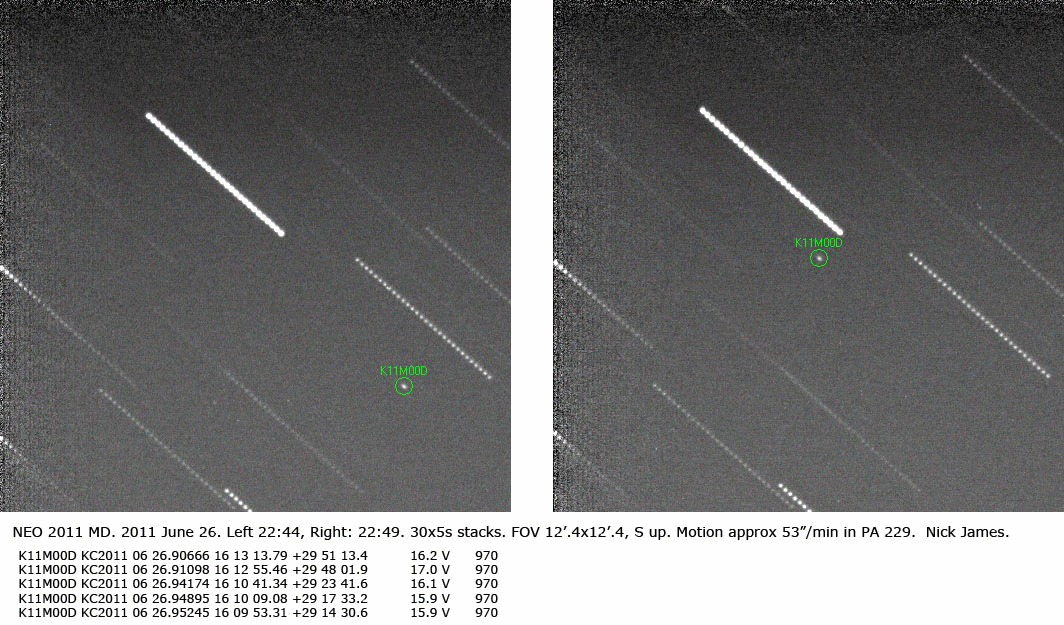
flyby movies and images: from Marco Langbroek of Sierra Stars Obs., California;from Efrain Morales Rivera of Aguadilla, Puerto Rico; from Nick Howes of Siding Spring Australia; from Rafael Ferrando of the Observatory Pla d'Arguines in Segorbe, Spain; from Libor Vyskocil of the Observatory Upice in the Czech Republic; from Nick James of Chelmsford, UK; from Rolando Ligustri of Talmassons Observatory, Italy 
http://spaceweather.com/

update end

******************************************************************

Asteroid To Pass Within 7,500 Miles Of Earth

By MARK DUNPHY - Fri Jun 24, 11:12 am
A newly discovered asteroid will pass within 12,000 kilometres (7,500 miles) of Earth on Monday, June 27th next.  However, NASA says the space rock poses no threat to the planet.
2011MD was sighted for the first time on Wednesday by a robotic telescope in New Mexico, USA. The International Astronomical Union’s Minor Planet Center in Massachusetts, USA, put out an alert Thursday.
It will be daylight in the UK and Ireland (12.30 GMT) when the asteroid makes passes over the southern Atlantic Ocean, near the coast of Antarctica.
NASA say the encounter is so close that Earth’s gravity will sharply alter the asteroid’s trajectory.
According to spaceweather.com: “As the asteroid recedes from Earth, it will pass through the zone of geosynchronous satellites. The chances of a collision with a satellite or manmade space junk are extremely small, albeit not zero.”
“Judging from the brightness of the asteroid, it measures only 5 to 20 meters in diameter. According to JPL’s Near Earth Object Program office, one would expect an object of this size to come this close to Earth about every 6 years on average. For a brief time, it will be bright enough to be seen even with a medium-sized backyard telescope”, the website stated.
Earlier this month (2 June), a 10-metre wide asteroid passed between the earth and moon.
Asteroid 2009 BD, which was first observed on 16 January 2009  passed approximately within 0.9 lunar distances (the distance between Earth and the Moon) of earth.  Astronomers believe the rock is a rare “co-orbital asteroid” which follows the orbit of the Earth, not receding more than 0.1 AU (15 million km) away.
Two asteroids, several meters in diameter and in unrelated orbits, passed within the moon’s distance of Earth, September 8 2010. In April 2010 an asteroid roughly as long as a tennis court zoomed past Earth at about the distance of the moon.   The space rock to pass at or within lunar distance previous to this was 2009 JL2, an asteroid about 17 to 37 meters across, in May 2009.
There is a roughly 50 percent chance of a 30-meter-plus asteroid striking Earth each century, according to Clark Chapman, a space scientist at the Southwest Research Institute in Boulder, Colorado, USA.
............................................................................................................................................................

Close encounter of asteroid with Earth on June 27: NASA
Published: Friday, Jun 24, 2011, 17:25 IST 
Place: Mumbai | Agency: PTI

The newly-discovered asteroid 2011 MD will pass only 12,000 kilometres above the Earth's surface on June 27, NASA said today.
NASA analysts said that there is no chance the space rock will strike the Earth.
Nevertheless, the encounter is so close that Earth's gravity will sharply perturb the asteroid's trajectory, they said in the space agency's official website spaceweather.com.
At closest approach, 2011 MD will pass in broad daylight over the southern Atlantic Ocean near the coast of Antarctica. As the asteroid recedes from Earth, it will pass through the zone of geosynchronous satellites.
"The chances of a collision with a satellite or man-made space junk are extremely small, albeit not zero," NASA said.
Judging from the brightness of the asteroid, it measures only 5 to 20 meters in diameter.
According to NASA's JPL's Near Earth Object Program office, one would expect an object of this size to come this close to Earth about every six years on an average.
For a brief time, it will be bright enough to be seen even with a medium-sized backyard telescope, NASA said.
...................................................................................................................................................................................................

Is Asteroid 2011 MD Space Junk?

When I was working up the details for yesterday's story on asteroid 2011 MD, I gasped when I looked at the orbit diagram. Not only does this body's orbit intersect Earth's, but it's also in the same plane (within a few degrees), and moving at almost the same velocity. Somehow, it seemed unlikely to be an accident!

Asteroid 2011 MD
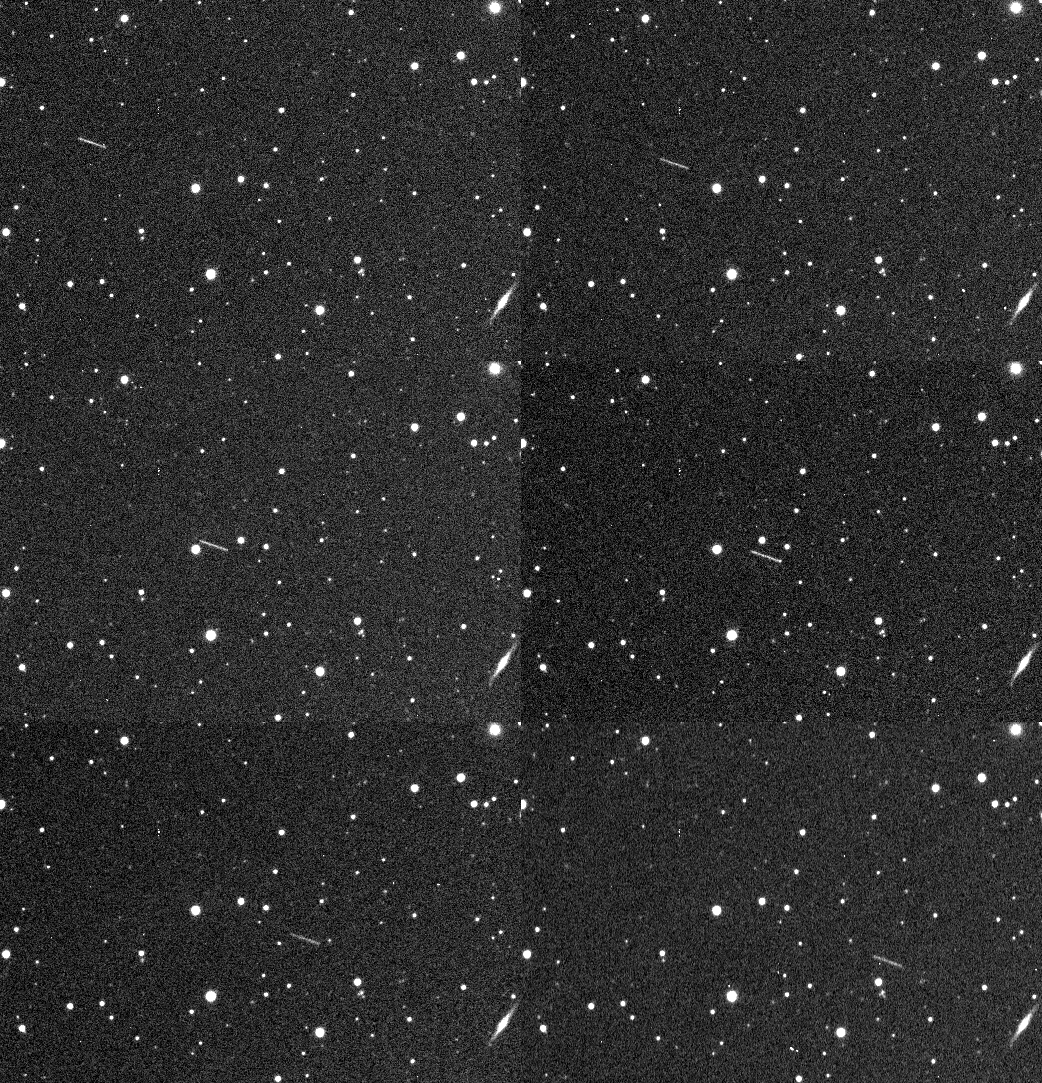
When word spread about the approaching asteroid 2011 MD, Peter Birtwhistle used his 16-inch (0.4-m) f/6 Schmidt-Cassegrain telescope to capture it. Each of these two frames is a combination of five 20-second exposures, taken on June 23, 2011, from 1:41 to 1:45 Universal Time.
Peter Birtwhistle
Alan MacRobert, who sits across the hall from me, immediately suggested that it is indeed no accident — that this "asteroid" is actually the upper stage of a rocket. These upper stages are abandoned to become space junk after they've released their payloads. Most of them remain in Earth orbit, but it's perfectly possible for them to escape and start looping around the Sun all on their own. Since they start out with almost the same velocity as Earth, they tend to stay in similar orbits.

Bill Gray, a well-known expert on orbital dynamics, pointed out the same possibility, and suggested that it should be possible to tell the difference. Rockets are hollow, so they're much less massive than asteroids of similar size. Enough so that they "feel" the push of sunlight, which can affect their orbits significantly. As of Friday morning, Gray's preliminary calculations indicate that this probably is indeed a true asteroid, and not a rocket.

....................................................................................................................................
Mumbai, June 24 (IANS) A rare celestial spectacle awaits skygazers Monday when a newly-found asteroid - 2011-MD - will pass between 10,000-12,000 km above earth, a scientist said Friday. It will be visited in India.
"The celestial encounter is going to be so close that earth's gravity will sharply alter the asteriod's trajectory," said Bharat Adur, director of Akash Ganga Centre forAstronomy (AGCA).

At its closest point, 2011-MD - a chunk of rock estimated to be 8 to 18 m across - will pass in daylight over the southern Atlantic Ocean, near Antarctica.

As it recedes away from earth, it will pass through the zone of geosynchronous satellites. But the chances of a collision with a satellite or manmade space-junk are extremely small but not zero, Adur said.

"Judging from its brightness, it measures only 5 to 20 meters in diameter. One would expect an object of this size to come this close to earth about every 6 years on average. For a brief time, it will be bright enough to be seen even with a medium-sized backyard telescope," Adur told IANS.

http://mangalorean.com/news.php?newstype=local&newsid=247111
.......................................................................................................................................................


ASTEROID FLYBY: Newly-discovered asteroid 2011 MD will pass only 12,000 kilometers (7,500 miles) above Earth's surface on Monday June 27 at about 9:30 a.m. EDT. NASA analysts say there is no chance the space rock will strike Earth. Nevertheless, the encounter is so close that Earth's gravity will sharply alter the asteroid's trajectory:
At closest approach, 2011 MD will pass in broad daylight over the southern Atlantic Ocean near the coast of Antarctica. As the asteroid recedes from Earth, it will pass through the zone of geosynchronous satellites. The chances of a collision with a satellite or manmade space junk are extremely small, albeit not zero.
Judging from the brightness of the asteroid, it measures only 5 to 20 meters in diameter. According to JPL's Near Earth Object Program office, one would expect an object of this size to come this close to Earth about every 6 years on average. For a brief time, it will be bright enough to be seen even with a medium-sized backyard telescope. [observing tips] [3D orbit]