Ad

Showing posts with label atmosphere. Show all posts

Thursday, November 12, 2015

UFO, Friday the 13th, Indian Ocean

It's interesting that conspiracy comes from just about anything these days.  Yes, there are UFO's, some of which are most definitely not of this world or are very mysterious.   However, the end?
Here's information regarding the UFO that is to crash into the Indian Ocean on Friday the 13th.  

"MYSTERY OBJECT TO HIT EARTH ON FRIDAY THE 13TH: A piece of space junk named "WT1190F" is going to hit Earth on Nov. 13th (0620UT). It will burn up in the atmosphere off the coast of Sri Lanka, with some debris possibly reaching the water's surface. According to the European Space Agency, "its mass is not sufficient to cause any threat to the area, but the show will still be spectacular, since for a few seconds the object will become quite bright in the noon sky." Astrophysicist Jonathan McDowell told Nature that "the object is only 1 to 2 metres in size, and its trajectory shows that it has a low density, and is perhaps hollow. That suggests an artificial object, 'a lost piece of space history that's come back to haunt us." At the moment, suspicions are focused on old Moon missions. For instance, it could be a spent rocket stage or lunar module from the Apollo program. Perhaps the impact itself will provide some clues. Stay tuned!"

UFO to crash into the Indian Ocean on November 13: Is it the end?

"Here is all you should definitely know about it:
  • The object is set to crash in the Indian Ocean, around 65 kilometres off the south of Sri Lanka
  • It is up to 7 feet long. According to the scientists, it could also be a piece of rocket from a recent lunar mission, or a part of an Apollo program spacecraft that has been into the space for over 40 years, or even a piece of Saturn V rocket which enabled man to walk on the moon, which was reported orbiting Earth in 2002
  • The contact of this object with the surface of the Earth will be a rare opportunity to observe its impact
  • The object was rediscovered by astronomers at the Catalina Sky Survey, earlier in October
  • Astronomers at the European Space Agency (ESA) are now monitoring the space junk's journey
  • The agency said that WT1190F 'poses very little risk to anyone'
  • Its collision will also help scientists improve the understanding of how space objects, man-made or natural, interacts with Earth's atmosphere
  • Researchers also say that the object's movement suggests that it is hollow inside."
INTERESTING>>>

"Despite claiming to see a UFO/drone, no concrete evidence was discovered to support the claims. Officers of the Intelligence Bureau, Bureau for Civil Aviation Security (BCAS), Delhi Police, and the Central Industrial Security Force (CISF) met to discuss the event and the IAF has been advised to keep strict vigil. It is interesting to note that the Delhi Police has prohibited the use of any laser beams or similar objects, by an individual or group, in and around the IGI airport. If eye-witness incidents are to be believed, this is a direct violation of the law. But the more important question is about the origins of these flying objects and laser beams. Some mysterious space junk, dubbed a UFO, is about to crash into the Indian Ocean on November 13, 2015. But the sightings at IGI were no ordinary space debris. It will be naive of us to dismiss this as an act of mischief. But to fuel theories regarding UFO sightings will only please the conspiracy camp, and upset the other lot."

Double Doubt The Following...
"The mystery metallic object is expected to crash into the sea on Friday, November 13, which is the third Friday 13 this year.
The high number of Friday 13s this year - there was one in 2014 and just one next year -  has sent some religious conspiracy theorists into overdrive.
They claim, while the impact may not lead to the end of the world itself, it could be a sign before the "Second Coming of Christ and Judgement Day."
Although astronomers have yet to identify the source of the mystery space debris, it is believed to have been part of something we once sent into space which has come back to haunt us."

Monday, June 17, 2013

Weather modification nuclear testing, HAARP timeline and more.

2.45GHz @ 500,000watts across several miles..

NASA Goldstone RADAR experiment from 1975.

A fully successful transmission of electricity (wireless) across several miles to a Rectenna. HAARP in Alaska is another example of a modern day Rectenna: http://rezn8d.net/2012/01/20/haarp-timeline-an-animated-history-of-ionospheric-destruction/

 NEXRAD RADAR operates in the 2-3GHz spectrum @ 750,000watts


Uploaded on Jul 22, 2010
Japanese artist Isao Hashimoto has created a beautiful, undeniably scary time-lapse map of the 2053 nuclear explosions which have taken place between 1945 and 1998, beginning with the Manhattan Project's "Trinity" test near Los Alamos and concluding with Pakistan's nuclear tests in May of 1998. This leaves out North Korea's two alleged nuclear tests in this past decade (the legitimacy of both of which is not 100% clear).

Each nation gets a blip and a flashing dot on the map whenever they detonate a nuclear weapon, with a running tally kept on the top and bottom bars of the screen. Hashimoto, who began the project in 2003, says that he created it with the goal of showing"the fear and folly of nuclear weapons." It starts really slow — if you want to see real action, skip ahead to 1962 or so — but the buildup becomes overwhelming.

HAARP Timeline – An Animated History of Ionospheric Destruction

THIS ARTICLE IS PART OF THE SERIES: THE RADIATION DATABASE: HAARP RESEARCH HQ

PLEASE READ THE BIRTH OF HAARP BEFORE PROCEEDING


I found this excellent article on the history and evolution of upper atmosphere research and weapons of mass destruction.  The article is text only, with no links, so for your viewing pleasure, I will animate this history with pictures and links.  Anything in a block quote or in italics was added Enjoy!

Background on the HAARP Project

BY ROSALIE BERTELL, PH.D., GNSH,
NOVEMBER 5, 1996

Military interest in space became intense during and after World War II
because of the introduction of rocket science, the companion to nuclear
technology. The early versions include the buzz bomb and guided missiles.
They were thought of as potential carriers of both nuclear and conventional
bombs.
Rocket technology and nuclear weapon technology developed simultaneously
between 1945 and 1963. During this time of intensive atmospheric nuclear
testing, explosions at various levels above and below the surface of the
earth were tried. Some of the now familiar descriptions of the earth’s
protective atmosphere, such as the existence of the Van Allen belts, were
based on information gained through stratospheric and ionospheric
experimentation.
The earth’s atmosphere consists of the troposphere, from sea level to about
16 km above the earth’s surface; the stratosphere (which contains the ozone
level) which extends from about the 16 to 48 km above the earth; and the
ionosphere which extends from 48 km to over 50,000 km above the surface of
the earth.
solar wind and our magnetosphere
The earth’s protective atmosphere or “skin” extends beyond 3,200 km above
sea level to the large magnetic fields, called the Van Allen Belts, which
can capture the charged particles sprayed through the cosmos by the solar
and galactic winds. These belts were discovered in 1958 during the first
weeks of the operation of America’s first satellite, Explorer I. They
appear to contain charged particles trapped in the earth’s gravity and
magnetic fields. Primary galactic cosmic rays enter the solar system from
interstellar space, and are made up of protons with energies above 100 MeV,
extending up to astronomically high energies. They make up about 10% of the
high energy rays. Solar rays are generally of lower energy, below 20 MeV
(which is still high energy in earth terms). These high energy particles
are affected by the earth’s magnetic field and by geomagnetic latitude
(distance above or below the geomagnetic equator). The flux density of low
energy protons at the top of the atmosphere is normally greater at the
poles than at the equator. The density also varies with solar activity, a
minimum when solar flares are at a maximum.
layers of our atmosphere
The Van Allen belts capture charged particles (protons, electrons and alpha
particles) and these spiral along the magnetic force lines toward the polar
regions where the force lines converge. They are reflected back and forth
between the magnetic force lines near the poles. The lower Van Allen Belt
is about 7700 km above the earth’s surface, and the outer Van Allen Belt is
about 51,500 km above the surface. According to the Encyclopaedia
Britannica, the Van Allen belts are most intense along the equator, and
effectively absent over the poles. They dip to 400 km over the South
Atlantic Ocean, and are about 1,000 km high over the Central Pacific Ocean.
In the lower Van Allen Belt, the proton intensity is about 20,000 particles
with energy above 30 MeV per second per square centimetre. Electrons reach
a maximum energy of 1 MeV, and their intensity has a maximum of 100 million
per second per square centimetre. In the outer Belt, proton energy averages
only 1 MeV. For comparison, most charged particles discharged in a nuclear
explosion are range between 0.3 and 3 MeV, while diagnostic medical X-ray
has peak voltage around 0.5 MeV.
read more at HAARP

Thursday, May 17, 2012

New Count of Potentially Hazardous Asteroids


A New Count of Potentially Hazardous Asteroids


May 16, 2012:  Observations from NASA's Wide-field Infrared Survey Explorer (WISE) have led to the best assessment yet of our solar system's population of potentially hazardous asteroids. Also known as "PHAs," these asteroids have orbits that come within five million miles (about eight million kilometers) of Earth, and they are big enough to survive passing through Earth's atmosphere and cause damage on a regional, or greater, scale.

The asteroid-hunting portion of the WISE mission, called NEOWISE, sampled 107 PHAs to make predictions about the population as a whole. Findings indicate there are roughly 4,700 PHAs, plus or minus 1,500, with diameters larger than 330 feet (about 100 meters). So far, an estimated 20 to 30 percent of these objects have been found.
PHA (scatter, 558px)
In this simulated view of the near-Earth asteroid population, potentially hazardous asteroids (PHAs) are denoted in orange. Less dangerous near-Earth asteroids are blue. Earth's orbit is green. [more]
While previous estimates of PHAs predicted similar numbers, they were rough approximations. NEOWISE has generated a more credible estimate of the objects' total numbers and sizes. Because the WISE space telescope detected the infrared light, or heat, of asteroids, it was able to pick up both light and dark objects, resulting in a more representative look at the entire population.
"The NEOWISE analysis shows us we've made a good start at finding those objects that truly represent an impact hazard to Earth," said Lindley Johnson, program executive for the Near-Earth Object Observation Program at NASA Headquarters. "But we've many more to find, and it will take a concerted effort during the next couple of decades to find all of them that could do serious damage or be a mission destination in the future."
PHA (orbits, 200px)
This orbit diagram illustrates the difference between a PHA and less hazardous near-Earth asteroids (NEA). [more]
The new analysis suggests that about twice as many PHAs as previously thought reside in low-inclination orbits, which are roughly aligned with the plane of Earth's orbit.
"Our team was surprised to find the overabundance of low-inclination PHAs," said Amy Mainzer, NEOWISE principal investigator, at NASA's Jet Propulsion Laboratory. "Because they will tend to make more close approaches to Earth, these targets can provide the best opportunities for the next generation of human and robotic exploration."
The NEOWISE analysis suggests a possible origin for the low-inclinaton PHAs: Many of them could have originated from a collision between two asteroids in the main belt lying between Mars and Jupiter. A larger body with a low-inclination orbit may have broken up in the main belt, causing some of the fragments to drift into orbits closer to Earth and eventually become PHAs.
The lower-inclination PHAs appear to be somewhat brighter and smaller than other near-Earth asteroids. The discovery that PHAs tend to be bright says something about their composition; they are more likely to be either stony, like granite, or metallic. This type of information is important in assessing the space rocks' potential hazards to Earth. The composition of the bodies would affect how quickly they might burn up in our atmosphere if an encounter were to take place.
"The NEOWISE project, which wasn't originally planned as part of WISE, has turned out to be a huge bonus," said Mainzer.  "Everything we can learn about these objects helps us understand their origins and fate."

The NEOWISE results have been accepted for publication in the Astrophysical Journal.
SOURCE: http://science.nasa.gov/science-news/science-at-nasa/2012/16may_pha/


On May 17, 2012 there were 1287 potentially hazardous asteroids.
Recent & Upcoming Earth-asteroid encounters:
Asteroid
Date(UT)
Miss Distance
Mag.
Size
2012 JU
May 13
0.5 LD
--
10 m
2012 KA
May 17
0.6 LD
--
8 m
2010 KK37
May 19
2.3 LD
--
31 m
4183 Cuno
May 20
47.4 LD
--
5.7 km
2012 JV11
May 22
6.7 LD
--
69 m
2002 VX94
May 26
72.8 LD
--
1.1 km
2002 AC
Jun 16
62.2 LD
--
1.2 km
1999 BJ8
Jun 16
68.8 LD
--
1.1 km
2005 GO21
Jun 21
17.1 LD
--
2.2 km
2003 KU2
Jul 15
40.3 LD
--
1.3 km
2004 EW9
Jul 16
46.8 LD
--
2.1 km
2002 AM31
Jul 22
13.7 LD
--
1.0 km
37655 Illapa
Aug 12
37 LD
--
1.2 km
Notes: LD means "Lunar Distance." 1 LD = 384,401 km, the distance between Earth and the Moon. 1 LD also equals 0.00256 AU. MAG is the visual magnitude of the asteroid on the date of closest approach.
SOURCE:http://spaceweather.com/

Wednesday, May 16, 2012

Venus Transit of the Sun, June 5-6, 2012


WARNING: NEVER look at the Sun without proper protection! A good protection is an eclipse glasses, or a special solar filter. Looking through a stain glass or black film is harmful , because it leaves the invisible, harmful ultraviolet radiation. This you can not see and feel, but you notice later, when you no longer see.


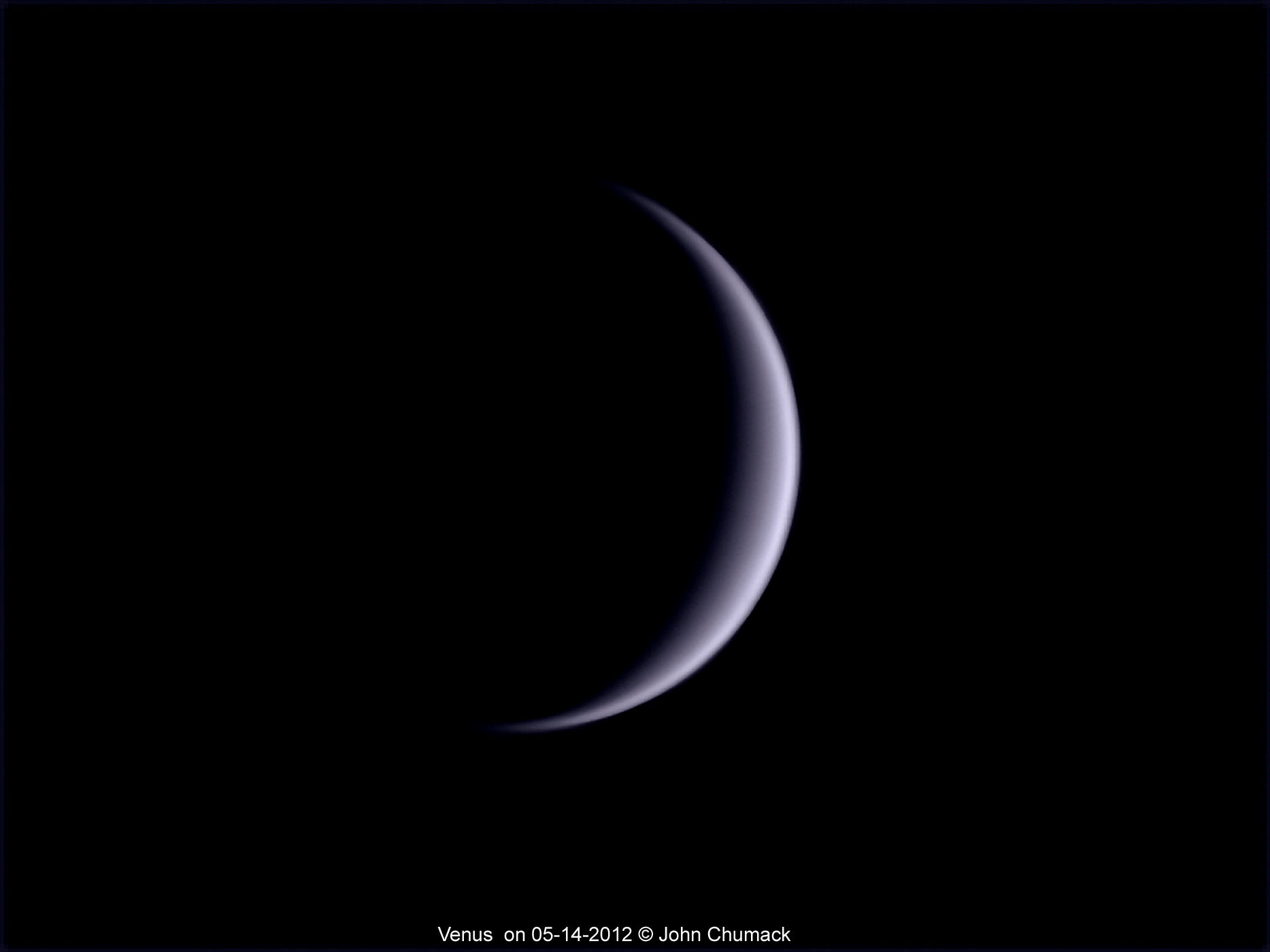
VENUS TRANSFORMED: Something special is happening to Venus in the evening sky. The second planet is diving toward the sun for a much-anticipated transit on June 5-6. As Venus turns its night side toward Earth, the planet is transforming into a beautifully slender and colorful crescent:


John Chumack of Dayton, Ohio, took the picture on May 14th using a 10-inch telescope. "I was blown away by the sight of Venus," he says. "The planet was 14% illuminated, 47 arcseconds in diameter, and blazing at -4.43 magnitude."

The crescent shape of Venus is easy to see in good binoculars or small telescopes. No special observing experience is required. Just find Venus in the western sky after sunset (you can't miss it), point and look. A good tripod to hold the optics steady is recommended.

As the evening wears on and Venus sinks toward the horizon, the refractive effect of Earth's atmosphere splits the crescent into the colors of the rainbow. Kevin R. Witman of Cochranville, Pennsylvania, observed the phenomenon on May 11th: "Earth's atmospheric refraction of Venus's ample light made a beautiful imagethrough my 10-inch telescope."

more images: from Sadegh Ghomizadeh of Tehran, Iran;


The Venus Transit of June 6, 2012


Introduction

On Wednesday, June 6, 2012 finds a transit of Venus on the Sun site. Venus then moves between the Sun and the Earth, so much so that the contours of the planet can be seen against the bright surface of the Sun. This is a fairly rare event, this example is only the twenty-sixth venus transition since the beginning of our era. Unfortunately, this transition occurs to us, especially at night, so we in Belgium and the Netherlands early in the morning only the last part of the transition can be seen.

Animation of the Venus transition in equatorial coordinatesVenus moves about once every 584 days between the Earth and the Sun by. This is called a lower conjunction . Venus is usually at a lower conjunction, however, not seen on the solar disk.This is because the orbital plane which Venus orbits the Sun at an angle to the ecliptic , so the plane in which the Earth orbits the Sun. Venus rotates in nearly 225 days once around the Sun (a venus year) and is one half of that time above the ecliptic, the other half below it. Twice a year, Venus is Venus crosses the ecliptic from north to south or from south to north movement.We then say that Venus is in the declining or ascending node of its orbit is. Only when the lower conjunction of Venus takes place in (or very close to) one of the nodes, we see on Earth Venus transition. In all other cases, Venus seen from Earth moves above or below the Sun along. This is similar to the reason why not every full moon a lunar eclipse poses .


At this time (between the years 1518 and 2984) are venus transitions in pairs, between which the two transitions in a pair is about 8 years. Note that in eight years, five benedenconjuncties made, because 8 × 365 days is equal to 5 × 584 days. The transition of 2012 is the second of a pair, the previous changeover took place on June 8, 2004 and was completely visible in our regions. The last couple of transitions was in 1874 and 1882, both in December. At this moment, Venus in the descending node in June and the ascending node in december. Two transitions of a pair are always at the same node, the 2004 and 2012 are thus in the descending nodes (see the downward movement of Venus across the solar disk in the figures and animations on this page), and so in June, the transitions from 1874 and 1882 were in the ascending node.


The Venus Transit of 2012

On June 6, 2012 Venus moves as said on the solar disk, and only the end of this transition is, in clear weather, visible from the Netherlands and Belgium. The whole event takes place between 0:03 am and 6:55 am and lasts nearly seven hours. Below are the exact time for transition tips as well as to find images that the path of Venus across the Sun show. The images chosen for two different coordinate systems: ecliptic coordinates, the plane of the solar system as axis and thus the most logical choice for events in the solar system, and horizontal (azimuthal) coordinates, the position above the horizon display, and so very well suited for an observer at a particular place on Earth. The exact figures are for Utrecht. Times for other places in the Netherlands and Belgium to deviate up to 15 seconds on this. The times are rounded to the whole second, because the unpredictable fluctuations in the rotational speed of the Earth is a Contributing uncertainty (The difference dT between Terrestial Time and Universal Time (UT) . This dT can only be establish in retrospect, I use here the estimate 66.6s).

For the beginning and the end of the transition time, two dots indicated. These are time match which the outer edge of the Sun by Venus are 'touched' and so the first or last bite from the Sun is taken, and when the inner edge of the Sun is touched and thus the beginning or end of the period covered Venus is completely visible to the Sun. The maximum occurs when the distance between the center of Venus and the center of the Sun is minimal. (See Figure 1a and 2a, and Table 1).


Data of the transition


Map of the Venus transition in ecliptic coordinates

Map of the Venus transition in ecliptic coordinates
Figure 1a: the beginning, maximum and end of the transition in ecliptic coordinatesFigure 1b: the position of Venus on the hour in ecliptic coordinates


Click image for larger version


Map of the Venus transition in horizontal coordinates

Map of the Venus transition in horizontal coordinates
Figure 2a: the beginning, maximum and end of the transition in horizontal coordinatesFigure 2b: the position of Venus on the hour in horizontal coordinates


PhenomenonTimeAzimutHeightDistance centerDistance edge

1: early entry0:03:55337.8 °-12.5 °16'14 .8 "+00'29 .1 "
2: end entry0:21:43341.9 °-13.4 °15'16 .5 "-00'29 .1 "

3: Maximum3:29:5626.2 °-11.3 °08'53 .1 "-06'52 .6 "

4: early exit6:37:2064.3 °8.9 °15'16 .5 "-00'29 .1 "
5: end exit6:54:5967.6 °11.4 °16'14 .8 "+00'29 .1 "


Table 1: Data for entry, exit and maximum


Table 1 shows the main data show. For each of the five symptoms, the time indicated in hours, minutes and seconds Central European summer time ( CEST ). Then the azimuth indicated, the place where the two above / below the horizon, in degrees, 0 ° = 360 ° = North, 90 ° east and 180 ° is south. Then, the height of the two degrees above the horizon, the distance between the center of Venus and the center of the Sun, and the distance from the center of Venus to the edge of the Sun. A negative edge distance means that the center of Venus in front of the solar disk.

Other data for the maximum of the transition are:

Diameter of the Sun:31'31 .3 "
Diameter of Venus:58.3 "
Distance to the Sun:1.01475 AE
Distance to Venus:0.28871 AE
The Sun rises in the morning at 5:21 hours on, at an azimuth of 50 ° (in the northeast), later followed by Venus.


2012 TRANSITS OF VENUS


Geographic Visibility of 2012 June 06

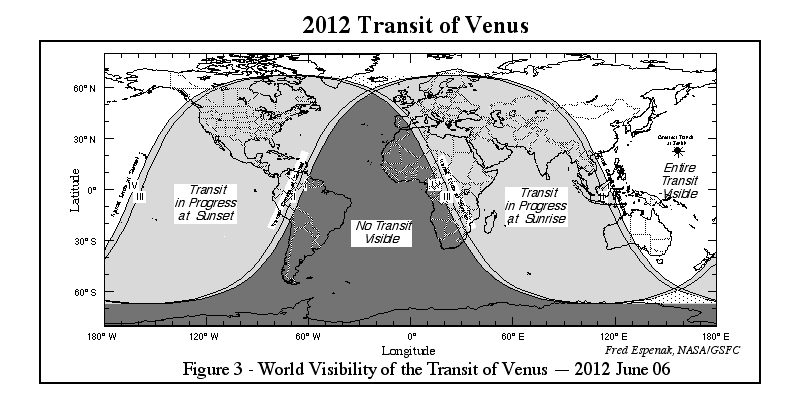
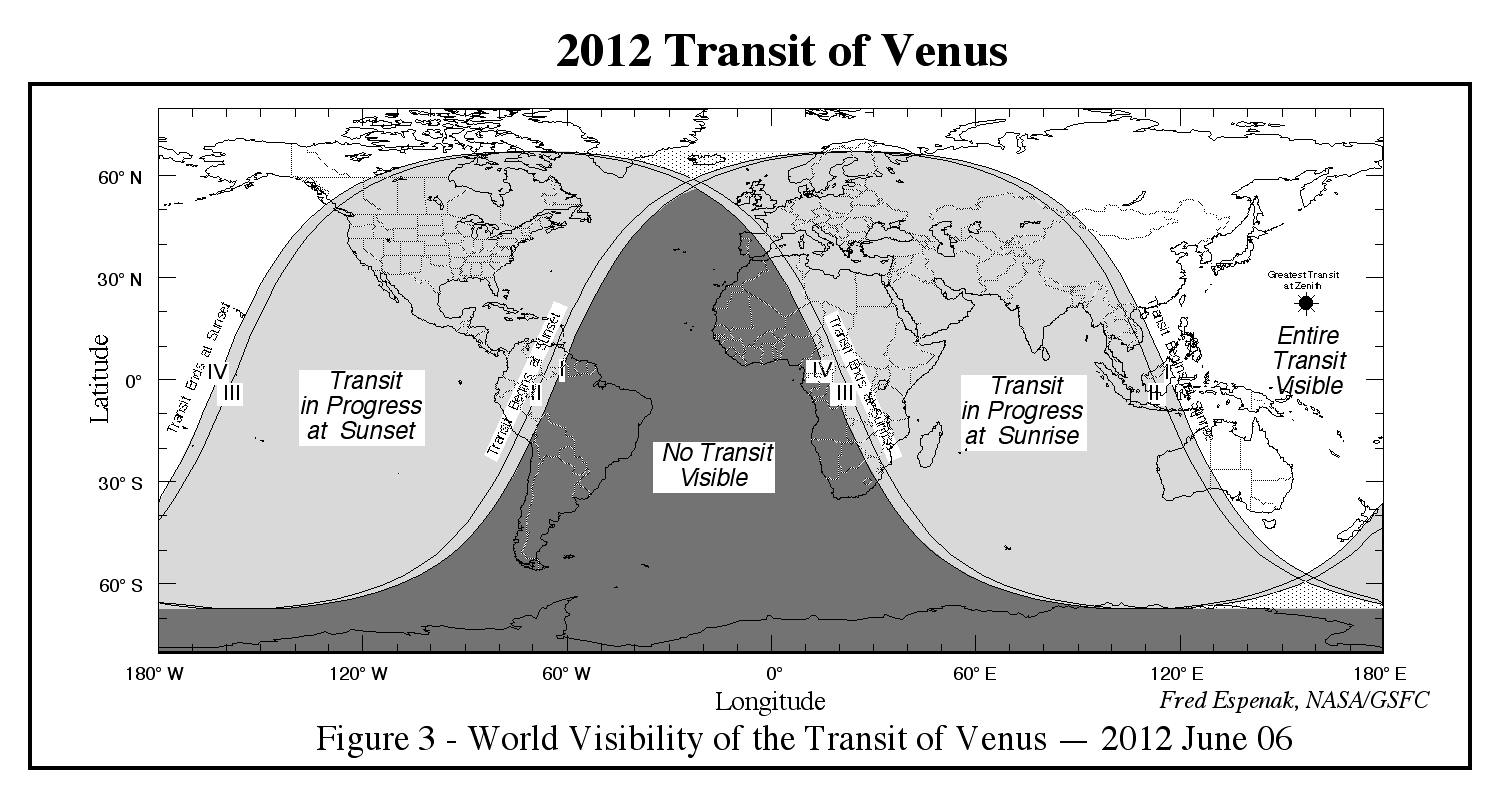
The global visibility of the 2012 transit is illustrated with the world map in Figure 3 (Low Res or High Res). The entire transit (all four contacts) is visible from northwestern North America, Hawaii, the western Pacific, northern Asia, Japan, Korea, eastern China, Philippines, eastern Australia, and New Zealand. The Sun sets while the transit is still in progress from most of North America, the Caribbean, and northwest South America. Similarly, the transit is already in progress at sunrise for observers in central Asia, the Middle East, Europe, and eastern Africa,. No portion of the transit will be visible from Portugal or southern Spain, western Africa, and the southeastern 2/3 of South America.
Note that due to the International Date Line the Western Hemisphere will see the transit on June 5.
The horizontal parallax of Venus (~30 arc-sec) introduces a topocentric correction of up to ±7 minutes with respect to the geocentric contact times for observers at different geographic locations. Topocentric contact times (Universal Time) and corresponding altitudes of the Sun are presented for over one hundred cities in Table 2A (international) and Table 2B (USA).

Frequency of Transits

Transits of Venus are only possible during early December and early June when Venus's orbital nodes pass across the Sun. If Venus reaches inferior conjunction at this time, a transit will occur. Transits show a clear pattern of recurrence at intervals of 8, 121.5, 8 and 105.5 years. The next pair of Venus transits occur over a century from now on 2117 Dec 11 and 2125 Dec 08.
Edmund Halley first realized that transits of Venus could be used to measure the Sun's distance, thereby establishing the absolute scale of the solar system from Kepler's third law. Unfortunately, his method proved impractical since contact timings of the desired accuracy are impossible due to the effects of atmospheric seeing and diffraction. Nevertheless, the 1761 and 1769 expeditions to observe the transits of Venus gave astronomers their first good value for the Sun's distance.
The planet Mercury can also transit the Sun. Since Mercury orbits the Sun more quickly than does Venus, it undergoes transits much more frequently. There are about 13 or 14 transits of Mercury each century. All Mercury transits fall within several days of 8 May and 10 November. During November transits, Mercury is near perihelion and exhibits a disk only 10 arc-seconds in diameter. By comparison, the planet is near aphelion during May transits and appears 12 arc-seconds across. However, the probability of a May transit is smaller by a factor of almost two. Mercury's slower orbital motion at aphelion makes it less likely to cross the node during the critical period. November transits recur at intervals of 7, 13, or 33 years while May transits recur only over the latter two intervals. The next two transits of Mercury are on 2003 May 07 and 2006 Nov 08. For details on the first event, see:

Sunday, March 4, 2012

New Near-Earth Asteroid February 2013. Danger or No Danger?


By above Youtube poster...

Uploaded by dutchsinse on Mar 4, 2012
thanks to pinksapphiret for getting this out on youtube:

Quote the article:TheExtinctionProtocol

Scientists are predicting that the asteroid 2012 DA14 has a good chance of colliding with earth in eleven months. 

Watch the skies in February 2013! 

According to RT, NASA has confirmed that the 60 meter (or 197 feet) asteroid, which was spotted by Spanish stargazers in February this year, has a good chance of colliding with earth. The scientists suggest confronting this asteroid with either big guns or, more strangely, with paint. 

The problem with either option is that there is no time to build a spaceship for the operation. A spaceship could either shoot the asteroid down or simply crash into it -- this would either break it into pieces or throw it off course. 

NASA expert David Dunham suggested: "We could paint it." The paint would change the asteroid's ability to reflect sunlight, alter its spin and change its temperature. However, even taking the asteroid off course could be dangerous when it returns in 2056, according to Aleksandr Devaytkin the head of the observatory in Russia's Pulkovo, as told to Izvestia in Russia recently.

The asteroid's closest approach to earth is scheduled for 15 February 2013, when they predict that the distance between it and earth will be under 27,000 km (16,700 miles). With the asteroid zooming that low, it will be too late to do anything with it besides trying to predict its final destination and the consequences of impact. 

However, NASA's David Dunham did say: "The asteroid may split into pieces entering the atmosphere. In this case, most parts of it will never reach the planet's surface." But theories are that if the entire asteroid did crash into the planet, the impact will be as hard as in the Tunguska blast, which in 1908 knocked down trees over a total area of 2,150 sq km (830 sq miles) in Siberia.

So keep your head down and watch the skies. "

2012 , 19:55   |   Science   |   4

The Americans offered to paint the asteroid, and Russian - to blow up

NASA experts with Russian colleagues decide what to do with potentially dangerous for the Earth's celestial body - the 60-meter asteroid 2012 DA14The Americans offered to paint the asteroid, and Russian - to blow upPlanet Earth. Source: NASA Goddard Space Flight Center Image

NASA experts have recognized that asteroid 2012 DA14, Spanish Open a week ago, astronomers can fall to Earth. The fall may occur after February 2013 will change the orbit of its flight. This statement was made by Dr. David Dunham, director of projects for the Study of NASA deep space, speaking March 1 at the Moscow State Institute of Electronics and Mathematics (MIEM).

- Due to the interaction with the Earth by gravity trajectory of its flight will be greatly changed, it must be well calculated, in order to understand how big a threat of collision with the following approximation of the Earth - says Dunham. - Maybe an asteroid will fall apart in our orbit around a lot of tiny pieces of it break away or a few large pieces and burned. Necessary to carry out its spectral analysis, then we can determine the type of asteroid, its mineral structure, which will assume his behavior in the atmosphere and methods of influence on him to prevent a possible threat.

NASA experts agree that if we consider the convergence of the Earth 2012 DA14 c in February next year, when the asteroid is on us only 29 thousand miles, then take things too late. on the design, development and preparation for the launch of a special spacecraft that could somehow affect the celestial body, it would take at least two years.

Proven systems to counter asteroids do not - this kind of development there are still only in preliminary design. For example, in Russia, projects satellite-killers trained in the Makeev Rocket Center and NPO. Lavochkin. In addition, we have no weapons against satellites, we have no system for tracking threats from space and learn about them in advance. The case of asteroid 2012 DA14 indicative in this sense: according to Secretary of the Expert Council on Space Sciences for Threats Sergei Naroenkova, the object is flying in its present orbit is not the first year (estimated, about three years), and places its trajectory almost overlaps with the trajectory our planet. But to discover an asteroid was only last week.

- If the object will fly to us from the sun, then we are unlikely to be ready to reflect, - said Alexander Devyatkin, deputy director of the Pulkovo Observatory. - In the daytime we can not detect an asteroid because of the huge background of the sky. More reliable in preventing the threats will be possible only when the spacecraft will be launched for continuous monitoring of Earth-threatening objects.

In February of next year 2012 DA14 can fly past the planet and the encounter with her ​​in one of the following turns. By this turn of events, scientists are encouraged to prepare in advance.- The easiest way to do classically - to destroy an asteroid hitting his body, or other device with a nuclear charge - says Robert Farquhar, head of the NASA mission to Pluto, Mercury, developer of the program mission, NEAR and MESSENGER. - An asteroid flies with great speed and in a collision with a massive spaceship would fly just under the force of its own kinetic energy. But now we are dealing with a small asteroid - 60 m in diameter, so the calculation must be very precise.

Dunham offers an asteroid repaint.

- The paint will change the reflectivity of the asteroid. Because of this, solar power will begin to act differently on it and change the trajectory of the body - he said.

Russian scientists consider painting the asteroids effective, but not the most effective measure, favoring the elimination of more radical methods.

- The idea to paint an asteroid of this size is technically feasible, but not radical. This will change the trajectory of its rotation, but almost certainly within a few decades, the threat of a collision will be even greater - Eismont says Nathan, senior researcher at the Institute of Space Research. - It is necessary to know very well what reflective, he had become and what not to do worse. We should not forget that during the flight of asteroids tend to rotate and the colored side is not always facing the sun, which causes additional problems.

According Devyatkina to effectively meet threats from outer space should be as soon as possible to create a system for monitoring and multiple spacecraft. 

source: IZVESTA


Bad Astronomy
For the tl;dr crowd, let’s get this out of the way right away: asteroid 2012 DA14 is almost certainlynot going to hit the Earth next February. And by "almost certainly", I mean it: the odds of an impact are so low they are essentially zero. This does not rule out an impact at some future date, but for now we’re safe.

So what’s the story?
A small near-Earth asteroid was discovered in late February by astronomers at the Observatorio Astronómico de La Sagra in Spain, less than two weeks ago. Designated 2012 DA14, it’s estimated to be about 45 meters (150 feet) in diameter, and has an orbit that is similar to Earth’s.

Its orbit is an inclined ellipse, tilted a bit compared to Earth’s orbit around the Sun (the positions of Earth and DA14 are shown for August of 2012 — I picked that randomly to make the orbits clear), and it spends most of its time well away from our planet. However, the path of the rock does bring it somewhat close to the Earth twice per orbit, or about every six months. The last time it passed us was on February 16 – two weeks ago — when it was about 2.5 million km (1.5 million miles) away, equal to about 6 times the distance to the Moon. That’s usually about the scale of these encounters — it misses us by quite a margin.

February 2013: a close shave
Next year, on February 15, 2013, DA14 will actually get pretty close to Earth. It will pass us at a distance of about 27,000 km (17,000 miles) — well beneath many of our own orbiting satellites! To the best of my knowledge, this is the closest pass of a decent-sized asteroid ever seen before the actual pass itself.
However, let’s again be very clear: it will miss. In astronomical terms, 27,000 km is pretty close, but in real human terms it’s a clean miss.
[UPDATE: The rt.com article I linked below has changed substantively since I posted my own article here. They have attributed their quotations more clearly, and have taken out most of the more breathless rhetoric. I applaud them for doing so, though I wish they had been more clear in the first place.]
Unsurprisingly, though very irritatingly, I’ve seen a lot of websites writing about this as if the asteroid will hit. For example, rt.com has a very confused article about DA14 claiming it will somehow both miss us and hit us:
The rock’s closest approach to the planet is scheduled for February 15, 2013, when the distance between the planet and space wanderer will be under 27,000 km (16,700 miles). [...] With the asteroid zooming that low, it will be too late to do anything with it besides trying to predict its final destination and the consequences of impact.
Blechh. They write that in a way to make an impact seem likely, but that’s not the case at all! I’ve seen several other websites making similarly contradictory or confused claims (Note:I originally included this SFBay article as an example. It’s not confused, but by using the phrase "potentially fateful day" it struck me as exaggerating the fear). The rt.com article even comes right out and says "NASA confirms… [DA14] has a good chance of colliding with Earth". This is simply not true. I’ll note they don’t actually give a reference to that, so it’s not clear who, if anyone, actually said that, or where they got that information. Either way, it’s wrong.

The fuzzy future
So we’re safe for now. But what about future passes?
That’s harder to say. Predicting where an asteroid will be at some future time depends on a lot of things, including how good the observations are now and how long we’ve been watching it. When we observe an asteroid with a telescope, we can measure its position, but not with perfect accuracy. The Earth’s atmosphere blurs the image a bit, and other factors make it impossible to get an exact measurement. So we observe it many times, over as long a period as possible, to hammer down those uncertainties.
There will always be some small amount of fuzziness to the orbit of an asteroid, though, and the farther ahead in the future you look the bigger that fuzziness gets. For next year, we know the orbit of DA14 well enough to know it’ll miss, but for future orbits it’s harder to say.
As things stand, right now the JPL website lists the next close pass as February 2020, but we don’t know the orbit well enough at this moment to know how close that pass will be*. As things stand, the odds of an impact even then are very, very low (like, 1 in 100,000 — less than your odds of getting hit by lightning in your lifetime). We can’t technically rule it out just yet because, again, the orbit isn’t known well enough to look that far into the future. Of course, astronomers are observing the asteroid right now, and will continue to do so. No doubt we’ll have better orbital information pretty soon.

Keep watching the skies!
So again, because I can’t say this strongly enough: asteroid 2012 DA14 is not an impact threat for February 2013. However, we definitely need to keep our eyes on this guy to see if it poses a threat at some future date. If it does, then you can be sure you’ll be hearing about it from me, and from other websites too. But make sure you find reliable websites. Too many are too ready to breathlessly report this as doomsday when it’s anything but.
So, at least for February 2013, we can safely say:

* I’ll note the European NEO-DyS group uses different mathematical techniques, and they don’t even list that date as a near pass. Instead, they say it’ll be six months later, in September. Again, this shows that given our current observations of DA14, predicting its position that far in the future is very uncertain.
Source: Discover Magazine