Ad

Showing posts with label space. Show all posts

Thursday, June 2, 2016

EMP. Mass Casualty Event.

While it wouldn't be an immediate mass extinction event, or extinction level event, an EMP would have catastrophic effects on our way of life.  This would take us back to lifestyle that used to be enjoyed 100 years ago.  While some of the peace and quiet would be nice, why isn't our country taking more of a proactive stance regarding this type of event?  After all, there will inevitably be millions of casualties directly and indirectly from the effect of this EMP event.


Even the U.S. Government Accountability Office says that work to mitigate the danger of an EMP and other threats to the electrical grid needs to have more attention, much more attention right now. More threats to the electrical grid include

  • EMP
  • Solar Storm
  • Large Space Objects Colliding with Earth (Asteroids, Alien Ships:)
  • Terrorism
  • Cyber Attacks
  • The Age of Our Electrical Grid (and expense of rebuilding)
  • Squirrels (true)
  • Nuclear Attack
The Department of Homeland Security (DHS) and the Department of Energy are not doing anything towards reaching a safety goal or plan for the impending event, as recommended by the EMP Commission.

Communication is more important than much of what our technology is used for, other than for medical.  Without communication methods, there would be no news on what happened to cause an event or how big the event was.  There would be no leaders to gather people even at the city level (in most cities).  The communication would have to start from scratch from the natural leaders within various neighborhoods. 


After all, most of the things listed as threats to our electrical grid would cause permanent damage. In the case of an EMP caused by any of those threats that can cause an EMP, there will be widespread (even country-wide and further) damage. Even telephones would not function (except for the antique ones with the ear piece that you take off the hook and the mouth piece that you speak into).

EMPs have been a concern of Presidential Administrations since George W. Bush. Estimates say that a large scale EMP there cause at least 2/3 of the population to die within the first year.  If that doesn't say concern, look into the details and into whether your family and friends are dependent on technology to live.

Who do we rely on in an emergency that would not be able to respond?

  • Police
  • Fire Department
  • Hospitals
  • Paramedics
  • Doctors Offices
  • Etc
The GAO has put together a plan, as of March of 2016 to protect critical infrastructure in the case of an EMP. The document is here. In this document, there are strategies regarding the possible causes of EMPs, but the strategies are a paragraph long at best with basically statement reaffirming that an EMP is possible in those scenarios, therefore offering no real strategy.  This is due to the fact that the fixes to prepare for any of the possible scenarios is extraordinarily expensive and time consuming. Few security exercises have been performed to prepare as well.  In other words, we are on our own to rebuild society if there is a large-scale EMP.

Any country with nuclear capability can hit us with an EMP, or hit any other nation with an EMP. This would completely bring our nation to its knees.

Just days ago was a Hospital Emergency Response Training exercise for mass casualty events, run by FEMA.  The document is here. I don't see EMP as part of the exercise topics, so I hope what they taught covered emergency for mass casualty without electricity. What they really should mandate is localized training on how to build communications and electrical, as well as transportation from scratch, because that is what it will be.

The bill (H.R. 1073) shown below has yet to pass through Senate, after passing through the House last year.  I think more priority needs to go into our nation's military defense.  This EMP issue is a straight forward one that can come from most of our enemies with the touch of a button.  Talk about a "reset". I don't want to wake up one day to a literal do over.  I think I can speak for most out there when I say that it's time for the powers that be to wake up and get ready for what is around the corner.


Shown Here: 
Passed House amended (11/16/2015)(This measure has not been amended since it was reported to the House on August 4, 2015. The summary of that version is repeated here.)

Critical Infrastructure Protection Act or CIPA(Sec. 2) Amends the Homeland Security Act of 2002 to define "EMP" to mean: (1) an electromagnetic pulse caused by intentional means, including acts of terrorism; and (2) a geomagnetic disturbance caused by solar storms or other naturally occurring phenomena.

Directs DHS to: (1) include in national planning frameworks the threat of EMP events; and (2) conduct outreach to educate owners and operators of critical infrastructure, emergency planners, and emergency response providers of the threat of EMP events.

Directs DHS to conduct research and development to mitigate the consequences of EMP events, including: (1) an objective scientific analysis of the risks to critical infrastructures from a range of EMP events; (2) determination of the critical national security assets and vital civic utilities and infrastructures that are at risk from EMP events; (3) an evaluation of emergency planning and response technologies that would address the findings and recommendations of experts, including those of the Commission to Assess the Threat to the United States from Electromagnetic Pulse Attack; (4) an analysis of available technology options to improve the resiliency of critical infrastructure to EMP; and (5) the restoration and recovery capabilities of critical infrastructure under differing levels of damage and disruption from various EMP events.

Includes among the responsibilities of DHS relating to intelligence and analysis and infrastructure protection, to prepare and submit to specified congressional committees: (1) a recommended strategy to protect and prepare the critical infrastructure of the American homeland against EMP events, and (2) biennial updates on the status of such strategy.

Requires DHS to report within 180 days after enactment of this Act on the progress made in meeting, and on an estimated date for completing, the requirements set forth under this Act.


Saturday, August 3, 2013

Hole In The Sun, Violence, Start of David Alignment

Here is a great video showing the signs of the times.

http://www.youtube.com/watch?v=armluRz20Fg&feature=share&list=TLgpZI6jz1uCc


Another great one!!! The Sun with the Dark area...unexplained by scientists except in theory.


Spacecraft Sees Giant 'Hole' In the Sun

Spacecraft Sees Giant 'Hole' In the Sun (Video)
A space telescope aimed at the sun has spotted a gigantic hole in the solar atmosphere — a dark spot that covers nearly a quarter of our closest star, spewing solar material and gas into space.
The so-called coronal hole over the sun's north pole came into view between July 13 and 18 and was observed by the Solar and Heliospheric Observatory, or SOHO. NASA released avideo of the sun hole as seen by the SOHO spacecraft, showing the region as a vast dark spot surrounded by solar activity.
Coronal holes are darker, cooler regions of the sun's atmosphere, or corona, containing little solar material. In these gaps, magnetic field lines whip out into the solar wind rather than looping back to the sun's surface. Coronal holes can affect space weather, as they send solar particles streaming off the sun about three times faster than the slower wind unleashed elsewhere from the sun's atmosphere, according to a description from NASA.
"While it’s unclear what causes coronal holes, they correlate to areas on the sun where magnetic fields soar up and away, failing to loop back down to the surface, as they do elsewhere," NASA's Karen Fox at the agency's Goddard Space Flight Center in Greenbelt, Md., explained in an image description.
These holes are not uncommon, but their frequency changes with the solar activity cycle. The sun is currently reaching its 11-year peak in activity, known as the solar maximum. Around the time of this peak, the sun's poles switch their magnetism. The number of coronal holes typically decreases leading up to the switch.
After the reversal, new coronal holes appear near the poles. Then as the sun approaches the solar minimum again, the holes creep closer to the equator, growing in both size and number, according to NASA.
The $1.27-billion (1 billion euros) SOHO satellite was launched in 1995 and is flying a joint mission between NASA and the European Space Agency (ESA). It watches solar activity from an orbit about the Lagrange Point 1, a gravitationally stable spot between Earth and the sun that is about 932,000 miles (1.5 million kilometers) from our planet.
Follow Megan Gannon on Twitter and Google+. Follow us @Spacedotcom, Facebook or Google+. Originally published on SPACE.com.
Follow us @Spacedotcom, Facebook or Google+. Originally published on SPACE.com. - See more at: http://www.space.com/22005-comet-ison-risky-road-ahead.html#sthash.PT2YlKVt.dpuf


The Star Of David Alignment...

Sunday, February 10, 2013

Star Wars Fans... the Real X-Wing and Possibly the Real Death Star Created


$11 million sought to build X-wing, counter Kickstarter Death Star


(Credit: Lucasfilm)
There's no disturbing lack of faith among Kickstarter supporters.
After all, a crowdfunded project to construct the Death Star that was launched less than a week ago already has nearly 1,500 backers and an astonishing $364,772 in pledges.
Well, the Rebels aren't taking that threat sitting down. A rival Kickstarter campaign to build X-wing fighters has just taken off. Its goal is to build one of the famous spaceships from "Star Wars" and then more.
"If George Lucas produced 'Star Wars IV, A New Hope,' for $11,000,000 we figure we can finance a prototype of an X-Wing and train a pilot," organizer Simon Kwan, a product designer in Shanghai, writes on the campaign page.
"One update we'd like to include for our updated X-Wing is iPhone and Siri integration."
The stretch goal is to build a squadron of X-wings for $4,485,672,683, the worldwide box office take of all the films in the franchise, according to The Numbers, a film sales tracking site.
A further goal is "13 million Galactic Standard Credits: A Class YT-1300 Freighter (heavily modified) and a crew consisting of a Corellian smuggler and a Wookie co-pilot."
Tech Crunch, however, politely points out that such credits have been estimated at only 62 cents, making the Falcon cost only $8 million, which is of course less than the campaign's basic goal.
Details, details. What matters is we get an X-wing built, stat!
At least then we'll have a chance of countering a real threat to our planet: asteroids.
Source: CT


Death Star not dead? Star Wars fans raise $380k for open source project, aim for more

Published: 10 February, 2013, 16:00
The Death Star. (Image from starwars.wikia.com)
Sci-Fi fans pushing for the creation of a Star Wars inspired “Death Star” have raised almost US$400,000 on a fundraising site to make it happen. It comes after Washington turned down a petition for its construction, citing astronomical costs.
Undeterred by Washington’s lack of enthusiasm, supporters of the proposed Death Star have generated an account on Kickstarter – a funding platform for creative projects, which asks for direct financial support from others in order to bring an idea to life.  
The open source Death Star page is initially aiming to raise 20,000,000 pounds ($31.5 million). The money would be used to design more “detailed plans and enough chicken wire to protect reactor exhaust ports.”
It may seem like a lot of money, but it’s just a drop in the bucket compared to the Death Star’s estimated construction cost of 543 quadrillion pounds ($850 quadrillion), which was quoted by the US government.
Backers of Kickstarter projects usually receive a reward for pledging their money – and the Death Star project is offering its own set of incentives.
The prize is rather modest for those who pledge 1 pound ($1.58) or more. According to the Kickstarter page, they receive only “our thanks and the knowledge that we’re one step closer to a safer planet.”
However, more generous spenders receive a more impressive reward. Those who pledge 10 pounds or more are promised to have their name “etched onto the underneath of one of the MSE-6-series repair droids used on the finished station.”
With 49 days to go, the project currently has 1,473 backers – 968 of whom are in line to have their name etched into Death Star history. Thus far, the project has raised 240,816 pounds ($380,392) of its first goal.
It’s a low-risk situation for supporters, because unless the entire goal amount is reached backers don’t have to pay a penny.
And if the idea seems a little too ‘out there’ to be taken seriously, that’s because it is.
“The main challenge is assuring Kickstarter that this is a joke and not a serious project. As proof, the goal has been set high enough to make successful funding almost impossible,” the page reads underneath the project’s ‘Risks and Challenges’ section.
The Kickstarter project comes after the US government rejected a petition to create the Death Star, giving three reasons why the project wasn’t viable:
• The construction of the Death Star has been estimated to cost more than $850 quadrillion.
• The Administration does not support blowing up planets.
• Why would we spend countless taxpayer dollars on a Death Star with a fundamental flaw that can be exploited by a one-man starship?
The response was authored by Paul Shawcross, who oversees the science and space departments at the White House, and was titled, 'This Isn’t the Petition Response You’re Looking For.'
Washington had to respond to the petition, which was posted on the White House’s ‘We the People’ website. The US previously vowed to give an official response to any petition generating 25,000 signatures or more – including those lobbying for Death Star construction. The petition received 34,435 signatures. The signature threshold for petitions has since been raised to 100,000, making it more difficult to receive a response from the administration. 
source: RT

Open-source Death Star project launched on Kickstarter

Now that the U.S. government has wimped out on building a Death Star, a Kickstarter project has emerged to raise funds to construct the deadly spaceship using open-source hardware and software.

Angry Birds Death Star
The Angry Birds Death Star is a lot easier to get ahold of.
(Credit: Rovio)
"Star Wars" fans don't like taking "no" for an answer. The White House may have denied a petition to build a Death Star, but that hasn't stopped Dark Side wannabes from taking matters into their own hands. There's now a Kickstarter project gathering funds to build an open-source Death Star.
The project has a modest initial goal of just $30 million. That will fund initial plans and the massive amount of chicken wire needed to protect the reactor exhaust ports. The first stretch goal is where things get more serious. If the project raises $850,000,000,000,000,000, then work will begin on the actual construction. OK, that's a mighty big "if," but a geek can dream, right?
In a bid to keep costs down, the Death Star will be constructed with only open-source hardware and software. That means the plans would be available to anyone who wants to build a Death Star of their very own. I'm pretty sure there's an alternate universe somewhere where every person has their own open-source Death Star. It's probably the same universe where Spock has a goatee.
read more at CT

Washington bureaucrats reject public request to build Death Star due to excessive cost

Published: 12 January, 2013, 18:17
Edited: 13 January, 2013, 00:08
Death Star - visionary project rejected by the Obama administration.
The office of the US President has rejected a popular public petition to construct a Death Star due to a high construction cost of $850 quadrillion, a major design flaw and the fact that “the Administration does not support blowing up planets.”
The proposal to construct the Star Wars-inspired space station-cum-death ray was lodged in November last year through We the People, a recently-implemented system that allows ordinary Americans to petition the government with any request, providing it gets enough popular support. 
The authors promised that building the Death Star would “spur job creation in the fields of construction, engineering, space exploration, and more, and strengthen our national defense.” 
The petition has collected 34,435 signatures, well above the 25,000 threshold that necessitates a response from the White House.
But despite endorsement from the public, the government has been reluctant to make the necessary investment in the pioneering space platform.
Titled ‘This Isn't the Petition Response You're Looking For’ and authored by Paul Shawcross, who oversees science and space departments at the White House, the official response gives three reasons for why the project isn’t viable: 
• The construction of the Death Star has been estimated to cost more than $850,000,000,000,000,000. We're working hard to reduce the deficit, not expand it.
• The Administration does not support blowing up planets.
• Why would we spend countless taxpayer dollars on a Death Star with a fundamental flaw that can be exploited by a one-man starship?
Instead, Shawcross calls for Americans to revel in the existence of the rather more modest International Space Station, which although impressive, does not possess a death ray, or in fact weapons of any sort.
This is not the only time We the People has been used to push forward unlikely proposals. Recent petitions have called for British TV interviewer Piers Morgan to be deported for his gun control stance (more than 100,000 signatures) for Texas to secede (more than 120,000 signatories) and to recount the presidential election, which 68,000 petitioners claim Barack Obama won through a combination of fraud and administrative error.
read more at: RT

Friday, January 11, 2013

Earth Directed Solar Flares. Asteroid DA14...Watch Out. Solar Maximum.


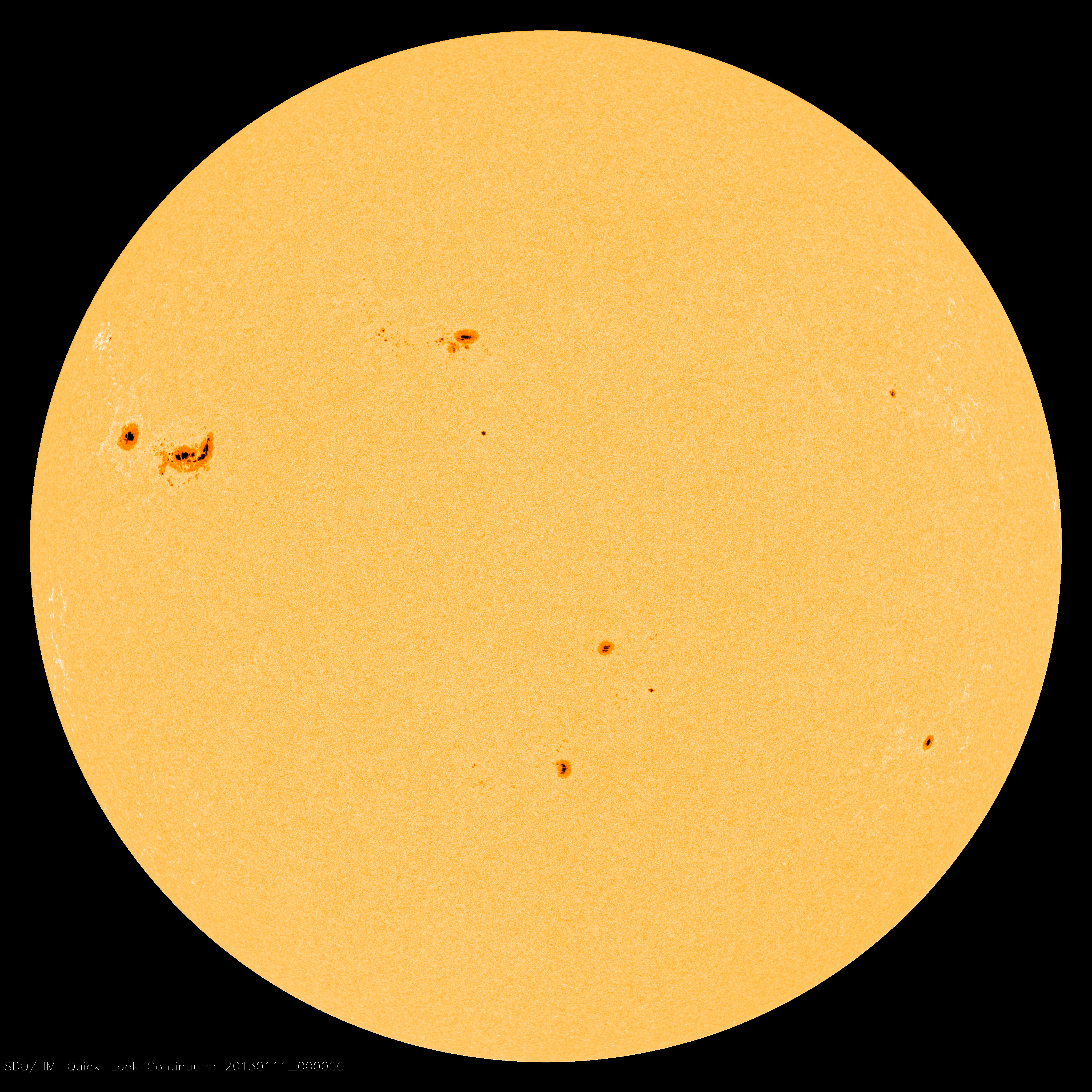
INCREASING CHANCE OF FLARES: Big sunspot AR1654 is growing more active. It is now crackling with M-class solar flares, such as this one recorded by NASA's Solar Dynamics Observatory this morning at 09:11 UT:


AR1654 is getting bigger as it turns toward Earth: movie. Not only is the chance of flares increasing, but also the chance of an Earth-directed eruption.This could be the sunspot that breaks the recent lengthy spell of calm space weather around our planet

X-ray Solar Flares
6-hr max: M1 
1508 UT Jan11 
24-hr: M1 
0911 UT Jan11 
explanation | more dataUpdated: Today at: 2000 UT


Daily Sun: 11 Jan 13

Sunspots AR1652 and AR1654 have beta-gamma magnetic fields that harbor energy for M-class solar flares. Credit: SDO/HMI

SPACE WEATHERNOAA Forecasts
Updated at: 2013 Jan 10 2200 UTC
FLARE
0-24 hr
24-48 hr
CLASS M
50 %
50 %
CLASS X
05 %
05 %

Asteroid 2012 DA14 to sweep close on February 15, 2013

It’ll pass within the moon’s distance from Earth – closer than the orbits of geosynchronous satellites. But it won’t strike us in 2013.

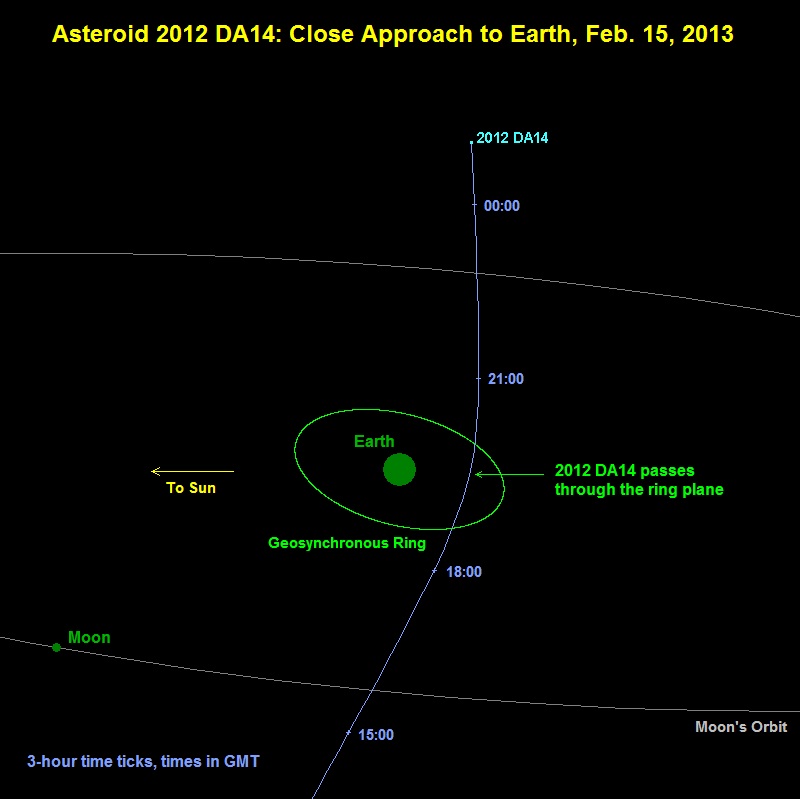
A near-Earth asteroid – called 2012 DA14 by astronomers – will pass very close to Earth on February 15, 2013. Astronomers estimate that, when it’s closest to us, it’ll be within the orbit of the moon (which is about 240,000 miles away), and within the orbits of geosynchronous satellites (about 26,000 miles up). 2012 DA14 will be about 21,000 miles (35,000 kilometers) away. It will not strike Earth in 2013. Astronomers’ calculations of asteroid orbits can be trusted. After all, even decades ago, they knew enough about calculating orbits to send people to the moon and bring them safely back, and today we are able place our space vehicles in orbit around objects as small as asteroids.
So, no, 2012 DA14 won’t strike us in 2013. There was a remote possibility it might strike us in 2020, but that possibility has been ruled out also.

Asteroid 2012 DA14 will pass closest on February 15, 2013. As the image above shows, it will pass much closer than the orbit of the moon - closer even that orbiting geosynchronous satellites (22,000 miles). View larger. Image Credit: NASA
What will happen when Asteroid 2012 DA14 passes closely in 2013?
What will happen when it passes us? The short answer is … nothing. On the day it passes, most of us won’t see it or be aware of its passage, in any way. The asteroid won’t alter the tides. It won’t cause volcanoes. It’ll just sweep closely past us – as millions of asteroids have done throughout Earth’s four-and-a-half-billion-year history – some in your own lifetime.
The asteroid will be within range for small telescopes and solidly mounted binoculars, used by experienced observers who have access to appropriate stars charts. Here’s what NASA says about its visibility:
On [February 15, 2013], the asteroid will travel rapidly from the southern evening sky into the northern morning sky with its closest Earth approach occurring about 19:26 UTC when it will achieve a magnitude of less than seven, which is somewhat fainter than naked eye visibility. About 4 minutes after its Earth close approach, there is a good chance it will pass into the Earth’s shadow for about 18 minutes or so before reappearing from the eclipse. When traveling rapidly into the northern morning sky, 2012 DA14 will quickly fade in brightness.
What do we know about asteroid 2012 DA14?
Asteroid 2012 DA14 is a little guy, compared to some asteroids, although its size has not been pinned down precisely. It is thought to be about 45 meters across (nearly 150 feet across), with an estimated mass of about 130,000 metric tons.
If a space object 150 feet wide were to strike our planet, it wouldn’t be Earth-destroying. But it has been estimated that it would produce the equivalent of 2.4 megatons of TNT. How does that compare with other known impact events on Earth? In 1908, in a remote part of Russia, an explosion killed reindeer and flattened trees. But no crater was ever found. Scientists now believe a small comet struck Earth. That event has been estimated at 3 to 20 megatons. So 2012 DA14 is in the same approximate realm as the Tunguska comet (which, actually, might have been an asteroid instead). It would not destroy Earth, but it could flatten a city.
Of course, about 70% of our world is covered by oceans. That means the most likely landing spot of any incoming asteroid is in the water – not on a city or other populated area.
Astronomers at the Observatorio Astronómico de La Sagra in Spain discovered 2012 DA14 in early 2012. We know 2012 DA14′s orbit is similar to that of Earth. That is one reason the asteroid eluded astronomers until recently. You can be sure that many astronomers are carefully tracking 2012 DA14 now.
The orbit of 2012 DA14 is an inclined ellipse. In other words, it’s tilted sightly with respect to Earth’s orbit around the sun, and, like Earth’s orbit, it’s not circular but elliptical – like a circle that someone sat down on. According to Bad Astronomer Phil Plait, who appears to have used a computer program to look at its orbit:
The asteroid spends most of its time well away from our planet. However, the path of the rock does bring it somewhat close to the Earth twice per orbit, or about every six months. The last time it passed us was on February 16 [2012], when it was about 2.5 million km (1.5 million miles) away, equal to about 6 times the distance to the moon. That’s usually about the scale of these encounters — it misses us by quite a margin.
If we know it will miss us in 2013 and in 2020, why are astronomers still watching? In fact, the orbit of 2012 DA14 is not entirely pinned down, although it is known well enough to say for sure: it will not hit us next year, or in 2020.
But it will come close on February 15, 2013! It should be close enough to catch the attention of virtually everyone on Earth in February 2013, on what’s sure to be a media field day.
Will 2012 DA14 strike Earth in 2020?
No. In March 2012, when a collision between 2012 DA14 and Earth in 2020 was still remotely possible, I asked astronomer Donald Yeomans to clarify the risk. Yeomans is, among other things, manager of NASA’s Near-Earth Object Program Office at NASA’s Jet Propulsion Laboratory. In March 2012, he told EarthSky that a 2020 collision between Earth and asteroid 2012 DA14 was …
… approximately one chance in 83,000, with additional remote possibilities beyond 2020. However, by far the most likely scenario is that additional observations, especially in 2013, will allow a dramatic reduction in the orbit uncertainties and the complete elimination of the 2020 impact possibility.
It turned out they didn’t have to wait until 2013. By May, 2012, astronomers had ruled out even the remote possibility of a 2020 collision.
Still, 2012 DA14 and asteroids like it are sobering.
Bottom line: The near Earth asteroid 2012 DA14 will have a very close pass near Earth on February 15, 2013. It will sweep approximately 21,000 miles from us – much closer than the moon’s orbit and closer than geosynchronous satellites. It will not strike Earth. Its orbit around the sun can bring it no closer to the Earth’s surface on February 15, 2013 than 3.2 Earth radii.


Solar Variability and Terrestrial Climate

The March Towards Max

The March Towards Max
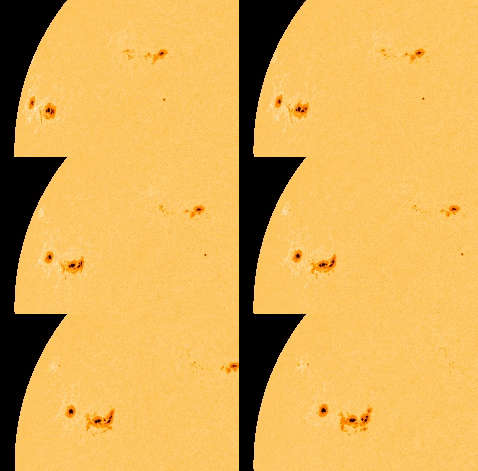
These six images from SDO, chosen to show a representative image about every six months, track the rising level of solar activity since the mission first began to produce consistent images in May, 2010. The period of solar maximum is expected in 2013. The images were taken in the 171 Angstrom wavelength of extreme ultraviolet light.

Sun-Climate (tsi, strip)
Space-borne measurements of the total solar irradiance (TSI) show ~0.1 percent variations with solar activity on 11-year and shorter timescales. These data have been corrected for calibration offsets between the various instruments used to measure TSI. SOURCE: Courtesy of Greg Kopp, University of Colorado.


Sun-Climate (pacific anomaly, strip)
Composite averages for December-January-February for peak solar years. SOURCE: G.A. Meehl, J.M. Arblaster, K. Matthes, F. Sassi, and H. van Loon, Amplifying the Pacific climate system response to a small 11 year solar cycle forcing, Science 325:1114-1118, 2009; reprinted with permission from AAAS.


Sun-Climate (sunspot numbers, strip)
The yearly averaged sunspot number for a period of 400 years (1610-2010). SOURCE: Courtesy of NASA Marshall Space Flight Center.


Sunday, July 29, 2012

Geomagnetic Storm Warning. Solar Activity Picks Up.


GEOMAGNETIC STORM WARNING: NOAA forecasters estimate a 45% chance of polar geomagnetic storms on July 29-30 in response to a high-speed solar wind stream buffeting Earth's magnetic field. Even stronger storming could occur on July 31st when a CME associated with yesterday's M6-flare arrives. High-latitude sky watchers should be alert for auroras for the next three nights. 

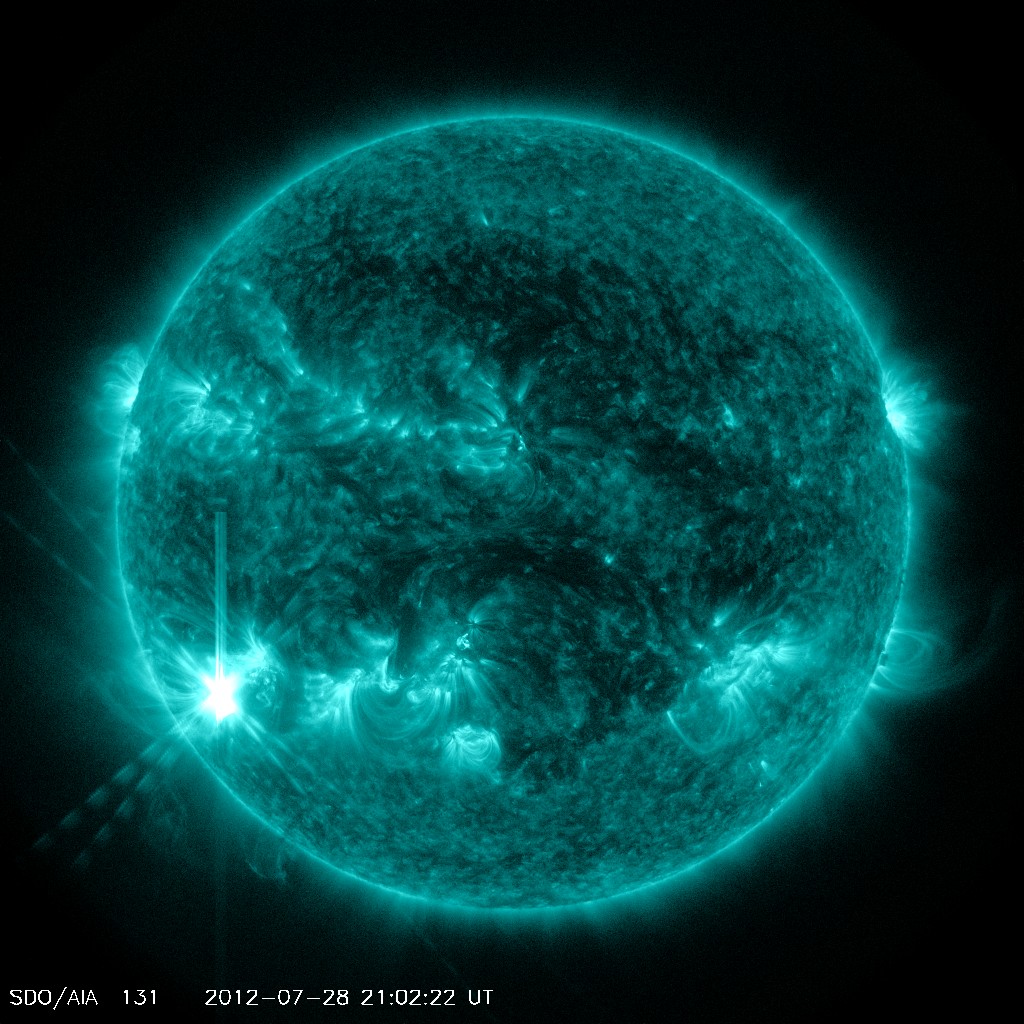
SOLAR ACTIVITY PICKS UP: Sunspot AR1532 is crackling with M-class solar flares. The latest, an M6-class eruption on July 28th (2056 UT), produced a bright flash of extreme ultraviolet radiation, shown here in a snapshot from the Solar Dynamics Observatory:


Update: Contrary to earlier reports, this explosion did produce a CME and the cloud is heading for Earth. According to a forecast track prepared by analysts at the Goddard Space Weather Lab, the CME will reach our planet on July 31st at 1500 UT (+/- 7 hours). Weak to moderate geomagnetic storms are possible when the cloud arrives.


Pick of The Week


FLARE AND PROTON EVENT (JULY 27, 2012)

C2: Quicktime (large) (8.2M), Quicktime (small) (731K), MP4 (2.6M), M4V (879K) 
Magnetic active region 1520-1521 erupted again (July 19, 2012) at the edge of the Sun, this time producing an M7-class flare that almost crossed the threshold into X-territory (largest). Associated with the flare was a coronal mass ejection observed by SOHO's two coronagraphs. The small, white particles splattering the CCD for hours after the eruption are high-energy protons moving at half the speed of light. The front edge of the mass ejection was clocked at over 2 million miles an hour.

Super-sized Loops

Super-sized Loops
Magnetic field lines between two active regions extended across about one-third of the Sun to make their connections (July 23-24, 2012). The magnetically powerful active regions were just rotating into view, giving us a wonderful profile of their activity. The lower active region also spurts out several bursts of plasma as well. The looping arcs above each active region shows off the field lines nicely too. The video clip covers about 36 hours of activity in extreme ultraviolet light.