Ad

Showing posts with label solar activity. Show all posts

Thursday, May 23, 2013

7.4 Magnitude (possibly two back-to-back) Hits South of the Figi Islands. No Destructive Tsunami Detected.


Source of graphic: Nexrad, Intellicast


000
WEHW42 PHEB 231727
TIBHWX
HIZ001>003-005>009-012>014-016>021-023>026-231927-

TSUNAMI INFORMATION STATEMENT NUMBER   1
NWS PACIFIC TSUNAMI WARNING CENTER EWA BEACH HI
727 AM HST THU MAY 23 2013

TO - CIVIL DEFENSE IN THE STATE OF HAWAII

SUBJECT - TSUNAMI INFORMATION STATEMENT

THIS STATEMENT IS FOR INFORMATION ONLY. NO ACTION REQUIRED.

AN EARTHQUAKE HAS OCCURRED WITH THESE PRELIMINARY PARAMETERS

   ORIGIN TIME - 0719 AM HST 23 MAY 2013
   COORDINATES - 23.1 SOUTH  176.6 WEST
   LOCATION    - SOUTH OF THE FIJI ISLANDS
   MAGNITUDE   - 7.4  MOMENT

EVALUATION

 BASED ON ALL AVAILABLE DATA A DESTRUCTIVE PACIFIC-WIDE TSUNAMI IS
 NOT EXPECTED AND THERE IS NO TSUNAMI THREAT TO HAWAII. REPEAT. A
 DESTRUCTIVE PACIFIC-WIDE TSUNAMI IS NOT EXPECTED AND THERE IS NO
 TSUNAMI THREAT TO HAWAII.

THIS WILL BE THE ONLY STATEMENT ISSUED FOR THIS EVENT UNLESS
ADDITIONAL DATA ARE RECEIVED.

$$

Source: http://www.breakingnews.com

M7.4 - 282km SW of Vaini, Tonga2013-05-23 17:19:04 UTC

Event Time

  1. 2013-05-23 17:19:04 UTC
  2. 2013-05-23 05:19:04 UTC-12:00 at epicenter
  3. 2013-05-23 11:19:04 UTC-06:00 system time

Location

23.025°S 177.109°W depth=171.4km (106.5mi)

Nearby Cities

  1. 282km (175mi) SW of Vaini, Tonga
  2. 287km (178mi) SW of Nuku`alofa, Tonga
  3. 712km (442mi) SE of Suva, Fiji
  4. 812km (505mi) SE of Nadi, Fiji
  5. 818km (508mi) SSE of Lambasa, Fiji
  6. Tectonic Summary

    The May 23, 2013 Mw 7.4 earthquake southwest of Vaini, Tonga, occurred as a result of normal faulting at a depth of approximately 170 km. At the location of this earthquake, the Pacific and Australia plates are converging at a rate of approximately 73 mm/yr in an east-west direction, resulting in the westward subduction of the Pacific plate beneath Tonga at the Tonga-Kermadec trench. The depth and faulting mechanism of the May 23rd earthquake indicate it ruptured a fault within the subducting Pacific lithosphere rather than on the shallower thrust interface between the two plates.
    The Tonga-Kermadec arc has frequent moderate-to-large earthquakes, and has hosted over a dozen M6.5+ earthquakes within 500 km of the May 23rd earthquake over the past 40 years. Most of these also occurred at intermediate depths; the largest was an Mw 7.7 earthquake in October of 1997, approximately 110 km to the north-northeast of the May 23 2013 event. None are known to have caused significant damage. Intermediate-depth (70-300 km) and deep-focus (depth > 300 km) earthquakes are distinguished from shallow earthquakes (0-70 km) by the nature of their tectonic setting, and are in general less hazardous than their shallow counterparts, though they may be felt at great distances from their epicenters. The Tonga-Kermadec slab in the region of the May 23 2013 earthquake is seismically active to depths of over 650 km. 

    Seismotectonics of the Eastern Margin of the Australia Plate

    The eastern margin of the Australia plate is one of the most sesimically active areas of the world due to high rates of convergence between the Australia and Pacific plates. In the region of New Zealand, the 3000 km long Australia-Pacific plate boundary extends from south of Macquarie Island to the southern Kermadec Island chain. It includes an oceanic transform (the Macquarie Ridge), two oppositely verging subduction zones (Puysegur and Hikurangi), and a transpressive continental transform, the Alpine Fault through South Island, New Zealand.
    Since 1900 there have been 15 M7.5+ earthquakes recorded near New Zealand. Nine of these, and the four largest, occurred along or near the Macquarie Ridge, including the 1989 M8.2 event on the ridge itself, and the 2004 M8.1 event 200 km to the west of the plate boundary, reflecting intraplate deformation. The largest recorded earthquake in New Zealand itself was the 1931 M7.8 Hawke's Bay earthquake, which killed 256 people. The last M7.5+ earthquake along the Alpine Fault was 170 years ago; studies of the faults' strain accumulation suggest that similar events are likely to occur again.
    North of New Zealand, the Australia-Pacific boundary stretches east of Tonga and Fiji to 250 km south of Samoa. For 2,200 km the trench is approximately linear, and includes two segments where old (>120 Myr) Pacific oceanic lithosphere rapidly subducts westward (Kermadec and Tonga). At the northern end of the Tonga trench, the boundary curves sharply westward and changes along a 700 km-long segment from trench-normal subduction, to oblique subduction, to a left lateral transform-like structure.
    Australia-Pacific convergence rates increase northward from 60 mm/yr at the southern Kermadec trench to 90 mm/yr at the northern Tonga trench; however, significant back arc extension (or equivalently, slab rollback) causes the consumption rate of subducting Pacific lithosphere to be much faster. The spreading rate in the Havre trough, west of the Kermadec trench, increases northward from 8 to 20 mm/yr. The southern tip of this spreading center is propagating into the North Island of New Zealand, rifting it apart. In the southern Lau Basin, west of the Tonga trench, the spreading rate increases northward from 60 to 90 mm/yr, and in the northern Lau Basin, multiple spreading centers result in an extension rate as high as 160 mm/yr. The overall subduction velocity of the Pacific plate is the vector sum of Australia-Pacific velocity and back arc spreading velocity: thus it increases northward along the Kermadec trench from 70 to 100 mm/yr, and along the Tonga trench from 150 to 240 mm/yr.
    The Kermadec-Tonga subduction zone generates many large earthquakes on the interface between the descending Pacific and overriding Australia plates, within the two plates themselves and, less frequently, near the outer rise of the Pacific plate east of the trench. Since 1900, 40 M7.5+ earthquakes have been recorded, mostly north of 30°S. However, it is unclear whether any of the few historic M8+ events that have occurred close to the plate boundary were underthrusting events on the plate interface, or were intraplate earthquakes. On September 29, 2009, one of the largest normal fault (outer rise) earthquakes ever recorded (M8.1) occurred south of Samoa, 40 km east of the Tonga trench, generating a tsunami that killed at least 180 people.
    Across the North Fiji Basin and to the west of the Vanuatu Islands, the Australia plate again subducts eastwards beneath the Pacific, at the North New Hebrides trench. At the southern end of this trench, east of the Loyalty Islands, the plate boundary curves east into an oceanic transform-like structure analogous to the one north of Tonga.
    Australia-Pacific convergence rates increase northward from 80 to 90 mm/yr along the North New Hebrides trench, but the Australia plate consumption rate is increased by extension in the back arc and in the North Fiji Basin. Back arc spreading occurs at a rate of 50 mm/yr along most of the subduction zone, except near ~15°S, where the D'Entrecasteaux ridge intersects the trench and causes localized compression of 50 mm/yr in the back arc. Therefore, the Australia plate subduction velocity ranges from 120 mm/yr at the southern end of the North New Hebrides trench, to 40 mm/yr at the D'Entrecasteaux ridge-trench intersection, to 170 mm/yr at the northern end of the trench.
    Large earthquakes are common along the North New Hebrides trench and have mechanisms associated with subduction tectonics, though occasional strike slip earthquakes occur near the subduction of the D'Entrecasteaux ridge. Within the subduction zone 34 M7.5+ earthquakes have been recorded since 1900. On October 7, 2009, a large interplate thrust fault earthquake (M7.6) in the northern North New Hebrides subduction zone was followed 15 minutes later by an even larger interplate event (M7.8) 60 km to the north. It is likely that the first event triggered the second of the so-called earthquake "doublet".
    source: 

Friday, March 15, 2013

Solar Activity Alert


WILL THE SKY TURN GREEN ON ST. PATRICK'S DAY? A magnetic filament snaking around sunspot AR1692 erupted on March 15th at about 0600 UT. The slow explosion, which took hours to unfold, produced an M1-class solar flare and a bright CME. SOHO (the Solar and Heliospheric Observatory) photographed the expanding cloud, which is heading directly toward Earth:


The CME left the sun traveling some 900 km/s (2 million mph). Three-dimensional computer models based on observations from SOHO and NASA's twin STEREO probes predict the CME will cross the void between sun and Earth in two days or less. NOAA forecasters estimate a 70% chance of polar geomagnetic storms when the cloud arrives on March 17th. This means the sky could turn green on St. Patrick's Day! High latitude (and possibly even middle latitude) sky watchers should be alert for auroras this weekend. 

Solar wind
speed: 447.1 km/sec
density: 1.6 protons/cm3
explanation | more dataUpdated: Today at 0117 UT


EVIDENTLY THE SOLAR WIND IS AFFECTING US MUCH MORE THAN IS USUALLY PUBLICLY LET ON...


Meeting on Solar Wind Turbulence in Kennebunkport, Maine, USA

 
06/04/2013 - 00:00
06/07/2013 - 23:59
Etc/GMT+1
Our goal is somewhat different from more familiar conferences and is designed with the SHINE model in mind. We are inviting very few speakers who we are asking to give review and introductory talks for each topic we hope to discuss. Those invited review talks will be largely non-controversial and focus upon agreed-upon results. They are also likely to contain challenges for the participants to explain. Then, the bulk of the time is left unscheduled and we ask the participants to give short, focused talks that lead to discussion and debate on the fundamental aspects of the subject at hand.
We expect that everyone who attends will have ample opportunity to enter into the debate and we hope to stimulate a lively discussion of fundamental physics.
We hope you will join us. Bring multiple 5-minute talks that attempt to make specific points so you can enter into the debate clearly and propel the discussion forward. No one is expected to be given a large block of time to speak. The goal is meaningful and focused debate. Remember, you may not convince everyone, but there will be many participants who want to understand your point of view. Our goal is to debate and illuminate, providing inspiration to all.

THE SOLAR PROBE PLUS WORKSHOP
THE first Solar Probe Plus Workshop will take place at the Beckman Institute auditorium, California Institute of Technology, Pasadena, from March 26th to 29th, 2013. SPP1 will introduce the Heliophysics community to the mission and prepare for the exciting discoveries that the Solar Probe Plus mission will make. The Workshop will explore the scientific objectives of the Solar Probe Mission and how the direct exploration of the corona and inner heliosphere will lead to advances in our understanding of coronal heating and solar wind acceleration, the magnetic and plasma structure of the heliosphere, and the acceleration of energetic particles at shocks and flares. The workshop will inspire research that will make use of the SPP observations within the context of the NASA Heliophysics Observatory System and identify key areas for preparatory research. Synergistic observations from other ground based and space based assets will also be addressed.

The meeting is composed of 4 sessions:
  1. Heating and acceleration of the solar corona and solar wind.
  2. Structure and dynamics of the plasma and magnetic fields at the sources of the solar wind.
  3. Particle acceleration and transport from the corona into the inner heliosphere
  4. Solar Probe Plus Synergies: maximizing scientific return in conjunction with the Heliophysics Observatory System and ground based assets.


SH11: Solar Wind Structure and Its Coronal Origins


The recent solar cycle 23-24 transition, together with the availability of multiperspective, multipoint in-situ observations and sophisticated 3D coronal and heliospheric models, has opened our eyes to the complex origins of the solar wind, even at solar minima. In particular we now see that a weak field solar cycle may in fact add complexity because of the existence of many low-to-mid latitude coronal holes and coronal pseudostreamers. Indeed the corona through most of the recent minimum had the appearance of a high solar activity phase even though sunspot number remained low. This session will focus on the many aspects of this condition, and consequences for past and future cycles during which the solar dynamo produces weak fields.

MANY OTHER MEETINGS HAVE BEEN HELD ON THE SUBJECT.


Saturday, January 12, 2013

Sunspot AR1654 Threatens to Shoot Off Huge Eruptions Towards Earth


ACTIVE SUNSPOT: Big sunspot AR1654 is crackling with C- and M-class solar flares, and it poses a threat for even stronger eruptions. NOAA forecasters estimate a 5% chance of X-flares today. 

Flares are illuminating the sunspot's magnetic canopy like flash bulbs at a rock concert; the phenomenon is evident in this 37-hour extreme ultraviolet movie from NASA's Solar Dynamics Observatory:


Since it first appeared four days ago, sunspot AR1654 has been facing away from Earth. But now it is turning toward us, increasing the "geo-effectiveness" of its explosions. This could be the sunspot that breaks the recent lengthy spell of calm space weather around our planet.

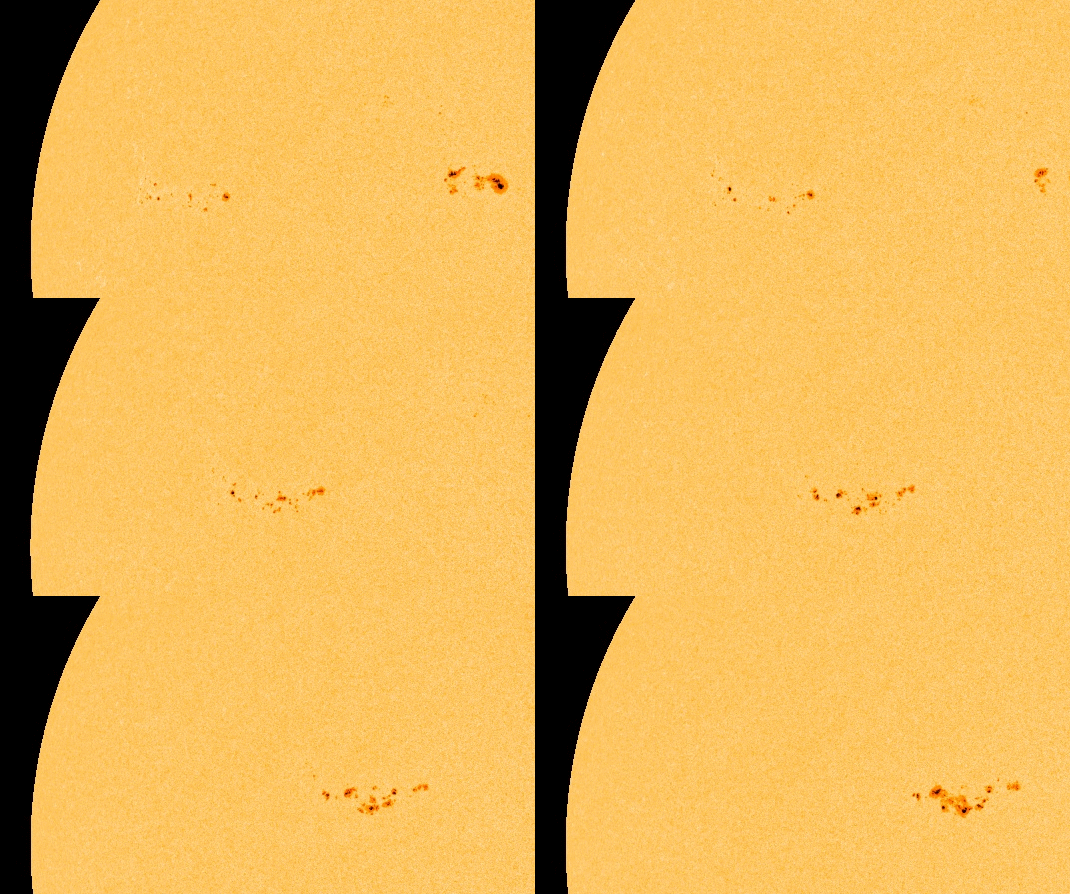
Amateur astronomers with backyard solar telescopes are encouraged to monitor in the days ahead. It is not only crackling, but also growing. As of Jan 12th, the behemoth stretches more than 180,000 km (14 Earth diameters) from end to end. Dennis Simmons sends this picture of the behemoth from Brisbane, Australia:


"Although the air was milky from nearby bush fires burning north of Brisbane, the seeing turned out to be good enough for a high-resolution shot," says Simmons. "I dedicate this image to the brave Australian fire fighters, working in horrendous, hot and windy conditions whilst fighting fires burning out of control across the south-east states of our country. I salute your selfless courage."


SPACE WEATHER
NOAA Forecasts
Updated at: 2013 Jan 12 2200 UTC
FLARE
0-24 hr
24-48 hr
CLASS M
65 %
65 %
CLASS X
10 %
10 %

source: http://spaceweather.com/

Wednesday, November 21, 2012

Solar Activity Increasing Extensively.


Visit NBCNews.com for breaking news, world news, and news about the economy

This intense period of solar activity isn't unexpected; it's all part of the natural solar cycle that ebbs and flows over an approximate 11-year cycle. The peak of this cycle, called "solar maximum," is expected in 2013, but in the run-up to the crescendo, the sun has been increasingly active.
Solar max represents a period when the sun's magnetic field is at its most stressed, so magnetic features like coronal loops and prominences are often observed in the sun's atmosphere (the corona). Explosive events like CMEs and flares also become commonplace. The solar wind -- a stream of charged particles that constantly flow into interplanetary space -- also becomes amplified.
All of these factors can impact our planet's magnetic field, increasing the chances of radiation and geomagnetic storms -- magical light shows in the form of aurorae are often a result of this geomagnetic battle. Solar storms can also impact our increasingly high-tech society, a fact not lost on the world's space weather prediction efforts.
source: http://news.discovery.com/space/will-the-sun-unleash-a-thanksgiving-flare-121121.html


Fire in the Sky

Scientists warn of a solar flare large enough to paralyze our electrified world

By Joan Trossman Bien 11/21/2012
If you have never heard of an electromagnetic pulse, or EMP, then you have not spent any time worrying about an EMP causing the end of civilization as we know it.
  
But scientists and some policymakers worry about such a thing happening, and for very good reason.
 
If an EMP were to occur over the United States, caused either by a particularly violent solar storm or by a small nuclear device detonated many miles above the ground, chances are high that the country’s entire electrical grid would fail, as a massive surge of electricity would fry the huge transformers that keep the grid humming. Satellites we rely on for navigation and communication would be damaged beyond repair, and society would crumble into a dysfunctional scramble for survival. The very necessities of life, such as clean water, food, medications, transportation, even government, would all either disappear or be in very short supply. 
 
There are sharp differences of opinion among experts regarding the likelihood of an EMP occurring anytime soon. But, nuclear attack aside, given the fact that extreme solar events happen once or twice a decade, “It is just a question of not if, but when the Earth happens to be in the path of these kinds of [solar] storms,” according to Dan Baker, director of Laboratory for Atmospheric and Space Physics (LASP) at the University of Colorado.

Big changes
What exactly is a solar flare and why should anyone care? 
 
Marco Velli, a senior researcher at NASA’s Jet Propulsion Laboratory whose expertise is in solar research, has been named principal investigator for NASA’s Solar Probe Plus, scheduled to launch in 2018. The project will place a satellite into orbit around the sun — inside its corona, far closer than ever before — as part of a mission to study solar weather.
 
“A solar flare is essentially an explosion,” Velli explained, adding that it sends out a huge amount of plasma or high-energy gas from the sun called coronal mass ejections (CMEs). “The energy is equivalent to several thousand atomic bombs … accelerating high energy particles to very high speeds, like cosmic rays.”
 
The potential damage, Velli added, depends on where the blast actually hits.
 
“When one of these big CMEs takes off and is directed toward Earth, it can cause big changes in the Earth’s magnetic field. This can induce currents in the Earth’s ionosphere and also in things on the ground, like big power stations, and it can disrupt the grid. It is the kind of thing that can fry the transformers so they cannot be used again. That’s bad,” he said.
 
Dr. Edwin Krupp, director of the Griffith Observatory in Griffith Park, put this fairly common event of solar flares into perspective. 
 
“For thousands of years, the only impact was the display of the aurora borealis. It didn’t have much of an influence on life on Earth until the era of high technology,” Krupp said.
 
Baker described how our lives have changed so quickly. 
 
“I like to say that modern humans have embedded us within a cyber-electric cocoon that surrounds the entire Earth. In many ways, every one of our modern technologies can be affected by solar storms,” he said.
 
Experts agree that the most damaging aspects of a solar storm are large CMEs, which, Baker said, “are very large blobs of material that are expelled from the sun and can be huge in dimension. It is often noted that the largest of these can be moving at many millions of miles an hour.”
 
Explaining how CMEs damage electronics, Baker said, “When one of these big CMEs takes off, when it is directed towards the Earth, it can cause big changes in the Earth’s magnetic field. It can charge up the Earth’s magnetosphere with strong, high-energy particles as well. This can induce currents in the Earth’s ionosphere and also in things on the ground, like big power stations, and it can disrupt the grid.”

Solar superstorm
The Big Daddy of modern solar storms, called the Carrington Event for well-known British amateur astronomer Richard Carrington, occurred on Sept. 1, 1859.
 
At the time, Carrington was just setting up his London solar observatory to chart an active solar storm. The telescope aimed at the sun projected an image that Carrington could trace on paper.  As he was drawing the sunspots, according to modern-day accounts from a number of Web sites covering the subject, “two patches of intensely bright and white light” appeared on his screen. They were located in one large group of sunspots. Carrington left the room to notify another scientist, but by the time he returned about five minutes later, the event had ended. Another amateur astronomer, Roger Hodgson, also observed the phenomenon. Over at Kew Observatory in London, a magnetometer needle dangled from a thread. It began to flail and bounce. They had just observed the beginnings of a solar super storm. 
Fire in the Sky 
Before dawn the next morning, the skies went psychedelic with auroras as far south as Hawaii and Panama. Bright swirls of reds, greens and purples lit up the still-dark early morning skies. Baker reported at a geophysics meeting in 2010 that the light was so bright, “people in the northeastern US could read newspaper print just from the light of the aurora.”
 
The Charleston Mercury ran a first-person account from a woman on Sullivan’s Island in South Carolina. “The eastern sky appeared of a blood red color,” she wrote. “It seemed brightest exactly in the east, as though the full moon, or rather the sun, was about to rise. It extended almost to the zenith. The whole island was illuminated. The sea reflected the phenomenon, and no one could look at it without thinking of the passage in the Bible, which says, ‘the sea was turned to blood.’ The shells on the beach, reflecting light, resembled coals of fire.”
 
The New York Times reported that people stood on rooftops and gathered on sidewalks to watch “the heavens … arrayed in a drapery more gorgeous than they had been for years.”
 
The most sophisticated mode of communication at the time was the telegraph, and when the supercharged CME hit the Earth’s magnetic field, telegraph wires surged with the electrical currents. It blew out the machines at some places. At others, the sparks caused fires. When operators turned off their batteries, the telegraph machines continued to work. 
The Carrington Event was extraordinarily huge. Ice core samples have revealed it was double the size of any other solar storm in the preceding 500 years. And scientists say it will happen again, possibly soon.

Dodging bullets
Solar flares are not unusual.  On March 13, 1989, a CME blew out power in Quebec, leaving 6 million people in the dark. In 1921, a solar storm hit, but didn’t cause much damage. Today, such an occurrence would have darkened half of North America. 
 
Last summer, Baker said there was a very close call. “Just on July 22, there was a very ugly, mean-looking active region on the sun that had moved across the face of the sun. A satellite was watching it. A huge flare, and then a CME, came at the spacecraft and it was moving at the highest recorded speed that has been seen in the modern Space Age. It reached the satellite in 17 hours. That’s an hour faster than the Carrington Event, and it led to extremely intense magnetic fields in the interplanetary medium. For all intents and purposes, that was a Carrington Event that just missed us. We dodged the proverbial bullet there. Now we know there have been others like this.”
 
Can it happen again? “Some people say that the Carrington Event is a moldy old event and these things happen only once in 1,000 years,” Baker said. “I think recent work has suggested quite the contrary. The probability of any of these occurring during one 11-year cycle of solar storms is like 10 percent, a pretty significant probability. It’s not a rare thing.”
 
Ultimately, whether triggered by a rogue nation’s high-altitude detonation of a small nuclear weapon or set off by a rare but possible extremely strong solar flare, the result will be the same if we continue to do nothing. 

A perfect solar storm
Not all experts agree with Baker about the chances of a Carrington Event-type of CME causing the lights to go out. In fact, there has been some recent commentary about the analysis of solar flares that have occurred over the past 50 years. 
 
Solar storms occur in cycles of about 11 years. We are now entering what has been described as a very active part of the 11 year cycle. It is called the solar maximum, and the scientific community believes that it could be quite potent.
Baker described a worst-case scenario:
 
“When these huge clouds of material move out at such high speeds, a powerful shockwave can form in front of them. The CMEs can also have embedded within them much stronger magnetic fields, and this entire cloud can, in turn, lead to the acceleration of charged particles. It is sort of the perfect solar storm that’s headed directly at Earth. Those currents get coupled into very long power lines on a continental scale, the power grid. That is the one thing that we worry about most from solar storms — the effect these CMEs can have on the power grid.”


M-CLASS SOLAR FLARES: The magnetic canopy of big sunspot AR1618 is crackling with M-class solar flares. This image taken by NASA's Solar Dynamics Observatory shows the extreme ultraviolet flash from one of them, an M1.6-class flare on Nov. 20th at 1928 UT:
This eruption, and another one like it about 7 hours earlier, might have propelled faint coronal mass ejections (CMEs) toward Earth. If so, the impacts would likely commence on Nov. 23rd, with a chance of high-latitude geomagnetic storms following their arrival. Stay tuned for updates. Aurora alerts: textvoice.
FAST-GROWING SUNSPOT (Updated Nov. 21): Only a few days ago, sunspot AR1618 was almost invisible. Now it is a behemoth more than 10 times wider than Earth. A movie from NASA's Solar Dynamics Observatory shows the sunspot's development on Nov. 20-21:
As the sunspot evolves, so does its intense magnetic field--and this means strong flares are in the offing. Fast-changing magnetic fields on the sun have a tendency toreconnect and erupt. NOAA forecasters estimate a 70% chance of M-class flares and a 15% chance of X-flares during the next 24 hours. Because of the sunspot's nearly central location on the solar disk, any eruptions will likely be Earth-directed.Solar flare alerts: textvoice.


SPACE WEATHERNOAA Forecasts
Updated at: 2012 Nov 21 2200 UTC
FLARE
0-24 hr
24-48 hr
CLASS M
70 %
70 %
CLASS X
30 %
30 %


source: http://spaceweather.com/

latest solar x-ray graph

source: http://www.swpc.noaa.gov/

Double Prominence Eruptions

Double Prominence Eruptions
The Sun erupted with two prominence eruptions, one after the other over a four-hour period (Nov. 16, 2012). The action was captured in the 304 Angstrom wavelength of extreme ultraviolet light. It seems possible that the disruption to the Sun's magnetic field might have triggered the second event since they were in relatively close proximity to each other. The expanding particle clouds heading into space do not appear to be Earth-directed.

Sunday, July 29, 2012

Geomagnetic Storm Warning. Solar Activity Picks Up.


GEOMAGNETIC STORM WARNING: NOAA forecasters estimate a 45% chance of polar geomagnetic storms on July 29-30 in response to a high-speed solar wind stream buffeting Earth's magnetic field. Even stronger storming could occur on July 31st when a CME associated with yesterday's M6-flare arrives. High-latitude sky watchers should be alert for auroras for the next three nights. 

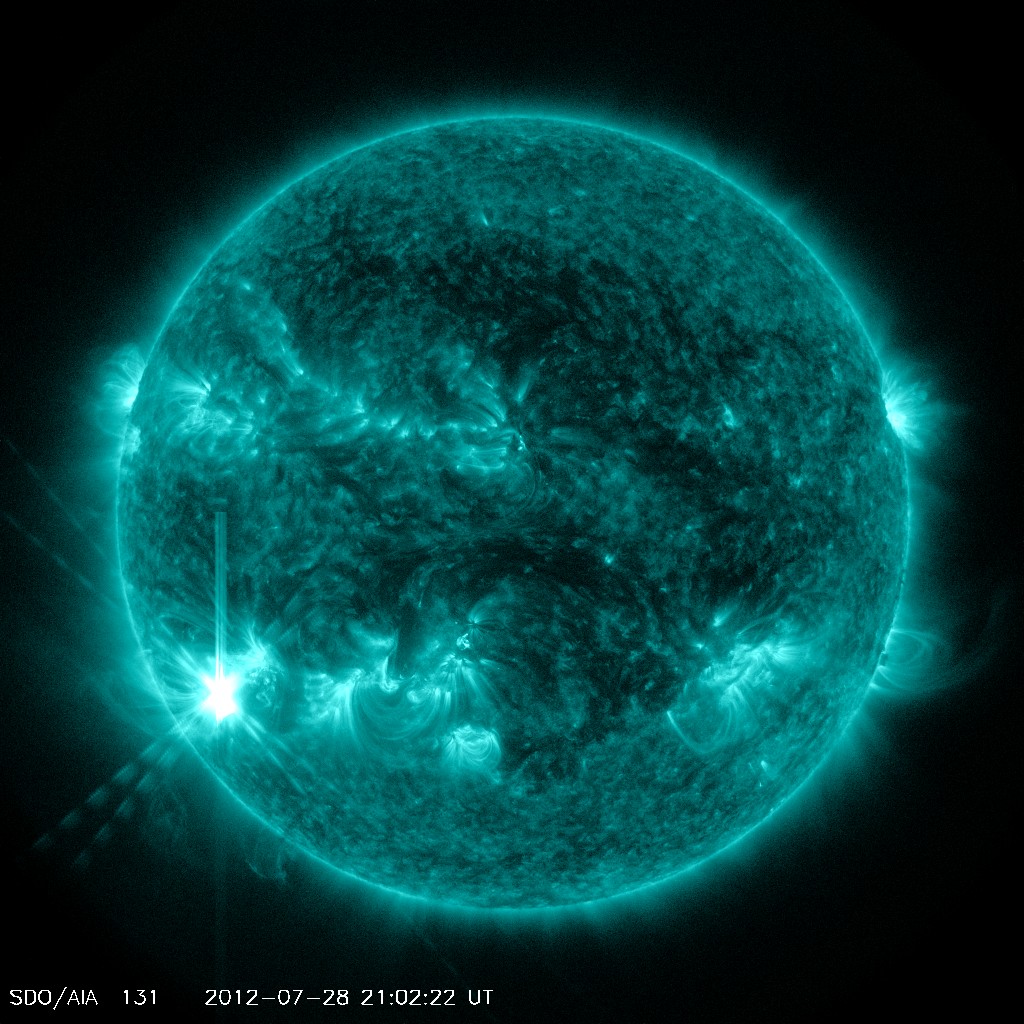
SOLAR ACTIVITY PICKS UP: Sunspot AR1532 is crackling with M-class solar flares. The latest, an M6-class eruption on July 28th (2056 UT), produced a bright flash of extreme ultraviolet radiation, shown here in a snapshot from the Solar Dynamics Observatory:


Update: Contrary to earlier reports, this explosion did produce a CME and the cloud is heading for Earth. According to a forecast track prepared by analysts at the Goddard Space Weather Lab, the CME will reach our planet on July 31st at 1500 UT (+/- 7 hours). Weak to moderate geomagnetic storms are possible when the cloud arrives.


Pick of The Week


FLARE AND PROTON EVENT (JULY 27, 2012)

C2: Quicktime (large) (8.2M), Quicktime (small) (731K), MP4 (2.6M), M4V (879K) 
Magnetic active region 1520-1521 erupted again (July 19, 2012) at the edge of the Sun, this time producing an M7-class flare that almost crossed the threshold into X-territory (largest). Associated with the flare was a coronal mass ejection observed by SOHO's two coronagraphs. The small, white particles splattering the CCD for hours after the eruption are high-energy protons moving at half the speed of light. The front edge of the mass ejection was clocked at over 2 million miles an hour.

Super-sized Loops

Super-sized Loops
Magnetic field lines between two active regions extended across about one-third of the Sun to make their connections (July 23-24, 2012). The magnetically powerful active regions were just rotating into view, giving us a wonderful profile of their activity. The lower active region also spurts out several bursts of plasma as well. The looping arcs above each active region shows off the field lines nicely too. The video clip covers about 36 hours of activity in extreme ultraviolet light.

Saturday, July 7, 2012

X-Class Solar Flare Explosion From the Sun.


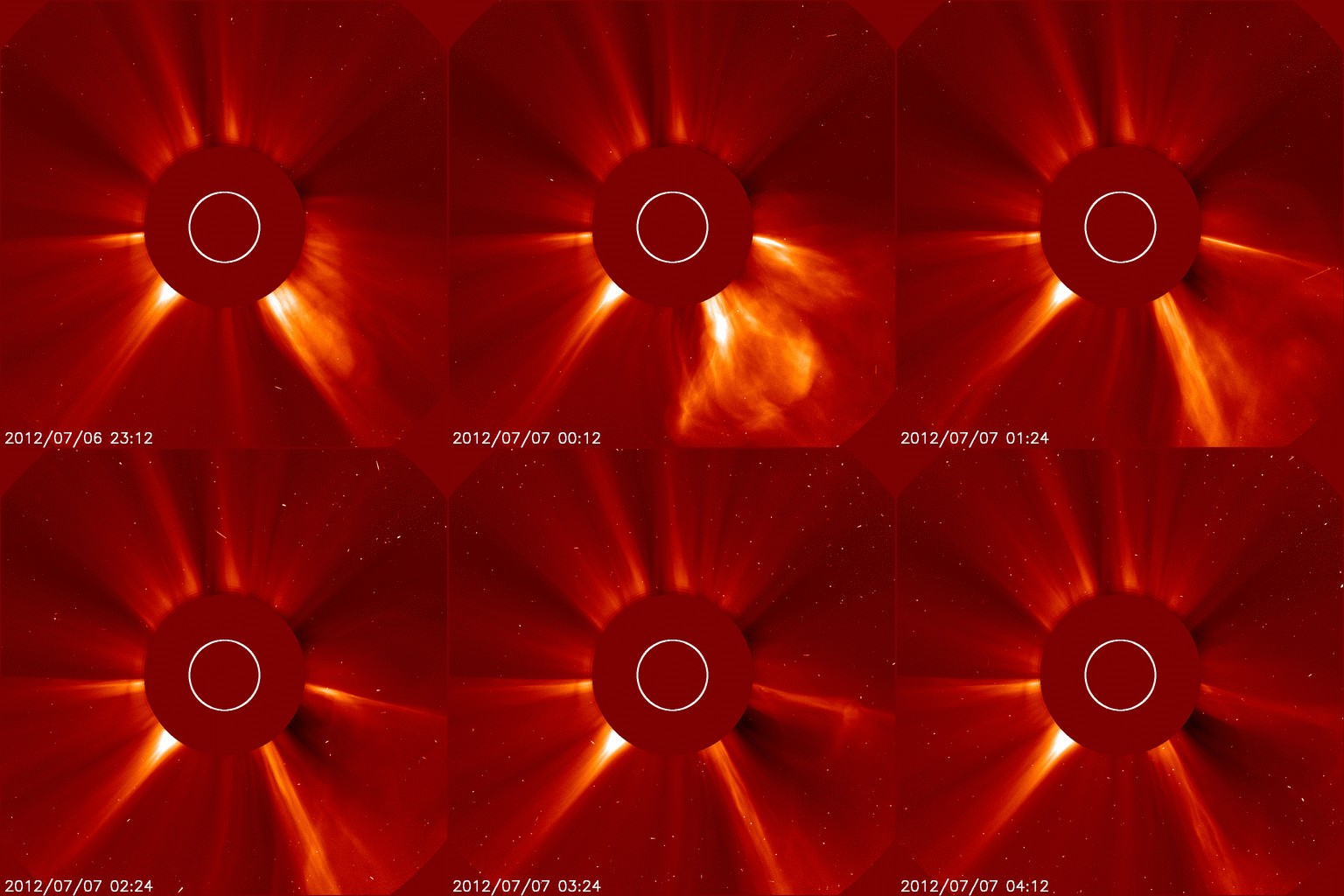
X-FLARE: For days, giant sunspot AR1515 has looked capable of producing a really strong explosion. On July 6th it finally did. Yesterday, the sunspot's magnetic canopy erupted, producing a brief but potent X1.1-class solar flare. NASA's Solar Dynamics Observatory recorded the extreme ultraviolet flash:
The explosion hurled a CME into space. According to this movie from the Solar and Heliospheric Observatory, the cloud appears to be heading south and away from Earth. However, we cannot yet rule out a glancing blow to our planet on July 8th or 9th. Stay tuned for further analysis.
Look at the CME movie one more time. The speckles near the end are caused by energetic protons accelerated by the flare. Guided toward Earth by solar magnetic fields, the protons are peppering Earth-orbiting satellites, causing "snow" in imaging systems and posing a slim threat for single-event upsets (computer glitches).

SPACE WEATHERNOAA Forecasts
Updated at: 2012 Jul 06 2200 UTC
FLARE
0-24 hr
24-48 hr
CLASS M
80 %
80 %
CLASS X
25 %
25 %

Saturday, June 30, 2012

SPACE QUAKES, EARTHQUAKES, SPACEWEATHER. A LOT GOING ON!

SPACE WEATHER, SPACEQUAKES, SKYQUAKES, ETC. THERE IS A LOT GOING ON...


Uploaded by  on Jul 29, 2010
http://highercalling88.com/ Researchers using NASA's fleet of five THEMIS spacecraft have discovered a form of space weather that packs the punch of an earthquake and plays a key role in sparking bright Northern Lights. They call it "the spacequake." A spacequake is a temblor in Earth's magnetic field. It is felt most strongly in Earth orbit, but is not exclusive to space. The effects can reach all the way down to the surface of Earth itself.

"Magnetic reverberations have been detected at ground stations all around the globe, much like seismic detectors measure a large earthquake," says THEMIS principal investigator Vassilis Angelopoulos of UCLA.

It's an apt analogy because "the total energy in a spacequake can rival that of a magnitude 5 or 6 earthquake," according to Evgeny Panov of the Space Research Institute in Austria. Panov is first author of a paper reporting the results in the April 2010 issue of Geophysical Research Letters (GRL).

In 2007, THEMIS discovered the precursors of spacequakes. The action begins in Earth's magnetic tail, which is stretched out like a windsock by the million mph solar wind. Sometimes the tail can become so stretched and tension-filled, it snaps back like an over-torqued rubber band. Solar wind plasma trapped in the tail hurtles toward Earth. On more than one occasion, the five THEMIS spacecraft were in the line of fire when these "plasma jets" swept by. Clearly, the jets were going to hit Earth. But what would happen then? The fleet moved closer to the planet to find out.
"Now we know," says THEMIS project scientist David Sibeck of the Goddard Space Flight Center. "Plasma jets trigger spacequakes."
According to THEMIS, the jets crash into the geomagnetic field some 30,000 km above Earth's equator. The impact sets off a rebounding process, in which the incoming plasma actually bounces up and down on the reverberating magnetic field. Researchers call it "repetitive flow rebuffing." It's akin to a tennis ball bouncing up and down on a carpeted floor. The first bounce is a big one, followed by bounces of decreasing amplitude as energy is dissipated in the carpet.

"We've long suspected that something like this was happening," says Sibeck. "By observing the process in situ, however, THEMIS has discovered something new and surprising."

The surprise is plasma vortices, huge whirls of magnetized gas as wide as Earth itself, spinning on the verge of the quaking magnetic field.

"When plasma jets hit the inner magnetosphere, vortices with opposite sense of rotation appear and reappear on either side of the plasma jet," explains Rumi Nakamura of the Space Research Institute in Austria, a co-author of the study. "We believe the vortices can generate substantial electrical currents in the near-Earth environment."

Acting together, vortices and spacequakes could have a noticeable effect on Earth. The tails of vortices may funnel particles into Earth's atmosphere, sparking auroras and making waves of ionization that disturb radio communications and GPS. By tugging on surface magnetic fields, spacequakes generate currents in the very ground we walk on. Ground current surges can have profound consequences, in extreme cases bringing down power grids over a wide area.

After THEMIS discovered the jets and quakes, Joachim Birn of the Los Alamos National Lab in New Mexico conducted a computer simulation of the rebounding process. Lo and behold, vortices appeared in good accord with THEMIS measurements. Moreover, the simulations suggest that the rebounding process can be seen from Earth's surface in the form of ripples and whirls in auroral displays. Ground stations report just such a phenomenon.

"It's a complicated process, but it all fits together," says Sibeck.

The work isn't finished. "We still have a lot to learn," he adds. "How big can spacequakes become? How many vortices can swirl around Earth at once--and how do they interact with one another?"
CREDIT: NASA SCIENCE http://science.nasa.gov/science-news/science-at-nasa/2010/27jul_spacequakes/
-------------------


Image credit: CC 3.0 R N Marshman

Skyquakes


Posted on Friday, 11 March, 2011 |  1 comment
Columnist: William B Stoecker


We live for the most part on the surface of the land, although we travel through the sky and on the surface of the sea. Rarely do most of us venture underground, and never to any great depth. Only two men have been to the deepest trench in the sea, and only a handful have ventured far beyond our atmosphere. And strange and sometimes frightening mysteries emerge from under the sea, under the Earth, and, especially, from the sky. It is in the sky (and sometimes emerging from or entering the sea) that we see UFOs. Blocks of ice, fish, frogs, and other things fall from the sky, with no explanation. And then there are the “skyquakes”…loud, booming sounds, rather like cannon fire, with no known origin.

The small town of Moodus, Connecticut is plagued by loud booms that seem to come from the area of Cave Hill and Mt. Tom. Skeptics attribute these noises to shallow earthquakes, and there was a real earthquake there on 5/6/1791, but no tremors have been recorded when the noises are heard. The local Algonquin and other Indians believed that the noises were caused by the demon Hobomock, and called the area “Matchimoodus” or”Matchemadoset,” meaning “place of bad noises.”

Barisal, on the Bay of Bengal in Bangladesh at the mouth of the Ganges River, has the “Barisal Guns.” Beginning at least as far back as the eighteen seventies, there were reports of “cannon fire” in groups of two or three, coming from the south or southwest (the Bay), usually from February through October, and seldom from November through January, with no earthquakes detected or thunderstorms reported. The monsoon usually arrives in June and lasts through September, covering only part of the time when the “guns” are commonly heard.

Similar mysterious booming sounds are called “mistpoeffers” in Belgium and the Netherlands, or “marinas” or “brontodi” in Italy, “retembos” in the Philippines, and “fog guns” in several other places. Loud booms have been reported from Western Australia and the State of Victoria, from New Brunswick, Canada near Passamquoddy Bay, Cedar Keys in Florida, Lough Neagh in Ireland, the Adriatic, northern Georgia (the one in the United States), and Franklinville, New York. In New York State they are called the “Seneca Guns.” Lewis and Clark reported a mysterious booming sound on 7/4/1805.


-------------------------------

MASSIVE PROMINENCE: Amateur astronomers around the world are monitoring a massive, active prominence dancing along the sun's southeastern limb. If you have a solar telescope, take a look. The latest images suggest an eruption might be in the offing. Stay tuned for action.

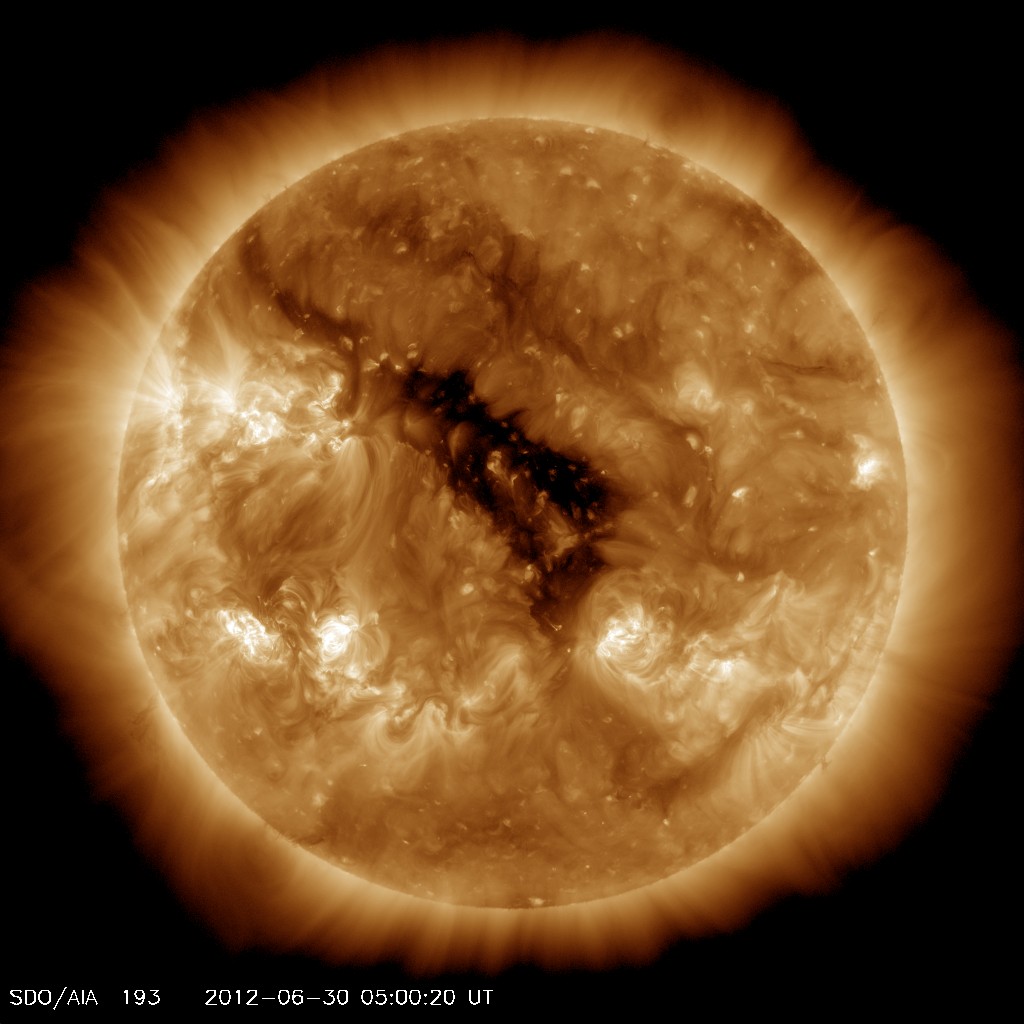
DARK HOLE IN THE SUN'S ATMOSPHEREUltraviolet telescopes onboard NASA's Solar Dynamics Observatory are monitoring a vast dark hole--a "coronal hole"--in the sun's upper atmosphere. It has just turned directly toward Earth:
Coronal holes are places where the sun's magnetic field opens up and allows the solar wind to escape. A stream of solar wind flowing from this particular gap is en route to Earth, due to arrive on July 2nd or 3rd. The impact could spark geomagnetic storms and auroras. 

ACTIVE SUNSPOT: Sunspot AR1513 is crackling with impulsive M-class solar flares. NASA's Solar Dynamics Observatory recorded the extreme ultraviolet flash from one of them at 0920 UT on June 29th:
This M2-class flare illuminated Earth's upper atmosphere with a pulse of X-rays and extreme ultraviolet radiation. Waves of ionization rippled over Europe, altering the propagation of low-frequency radio signals around the continent. Using a receiver tuned to 60 kHz, Rob Stammes detected the sudden ionospheric disturbance over Norway. His antennas also picked up radio waves from the flare itself at 26 MHz and 56 MHz.
More ionization waves and solar radio bursts are in the offing. NOAA forecasters estimate a 40% chance of continued M-flares during the next 24 hours.

Solar wind
speed: 637.1 km/sec
density: 3.5 protons/cm3
explanation | more dataUpdated: Today at 2025 UT
X-ray Solar Flares
6-hr max: M1 
1832 UT Jun30 
24-hr: M1 
1832 UT Jun30 
explanation | more dataUpdated: Today at: 2000 UT