Ad

Showing posts with label coronal hole. Show all posts

Sunday, March 17, 2013

Strong Geomagnetic Storm Creating Northern Lights As Far South As Colorado.


STRONG CME IMPACT: As predicted, a coronal mass ejection (CME) hit Earth's magnetic field at 0600 UT on March 17th. The impact lifted the solar wind speed from 300 km/s to 700 km/s and sparked a moderately strong (Kp=6) geomagnetic storm. Northern Lights spilled across the Canadian border into the United States as far south as Colorado:


"Just after 4 am local time, the skies turned green and red behind the twin stone monoliths of Rabbit Ears Peak near Steamboat Springs, Colorado," reports photographer and astronomy professsor Jimmy Westlake.

In the contiguous United States, auroras also appeared above New York, Washington, Minnesota, Wisconsin, Wyoming, Michigan and the Dakotas. Scan the realtime photo gallery and count the states.

The show's not over. Geomagnetic storming is underway as Earth passes through the wake of the CME. High-latitude sky watchers should remain alert for auroras

Auroras 
Taken by John Welling on March 17, 2013 @ Ashland,Wi.

Colorado Aurora
Taken by Jimmy Westlake on March 17, 2013 @ Rabbit Ears Pass near Steamboat Springs, Colorado


Aurora
Taken by Robert Farrimond on March 17, 2013 @ Vantage, Washington State

Aurora
Taken by Paul Robinson on March 17, 2013 @ 6 miles north of Saratoga, WY


Solar wind
speed: 604.5 km/sec
density: 2.2 protons/cm3
explanation | more dataUpdated: Today at 0156 UT

3-day Estimated Planetary K-index graph


Geomagnetic Storm Forecasts
The geomagnetic storm probabilities are the estimated chances of at least one 3-hour K index, at the indicated level, for each of the next 3 days.

Active: K = 4.
Minor storm: K = 5.
Major or Severe storm: K > 6.
The "K index" is a 3-hourly quasi-logarithmic local index of geomagnetic activity relative to an assumed quiet-day curve for the recording site. Range is from 0 to 9. The K index measures the deviation of the most disturbed horizontal component of the magnetic field.


SWPC ACE RTSW MAG 24-hour Updating Plot


Coronal Holes: 16 Mar 13
Solar wind flowing from this coronal hole could reach Earth on March 19-20. Credit: SDO/AIA.


main source: http://www.spaceweather.com


Friday, March 15, 2013

Solar Activity Alert


WILL THE SKY TURN GREEN ON ST. PATRICK'S DAY? A magnetic filament snaking around sunspot AR1692 erupted on March 15th at about 0600 UT. The slow explosion, which took hours to unfold, produced an M1-class solar flare and a bright CME. SOHO (the Solar and Heliospheric Observatory) photographed the expanding cloud, which is heading directly toward Earth:


The CME left the sun traveling some 900 km/s (2 million mph). Three-dimensional computer models based on observations from SOHO and NASA's twin STEREO probes predict the CME will cross the void between sun and Earth in two days or less. NOAA forecasters estimate a 70% chance of polar geomagnetic storms when the cloud arrives on March 17th. This means the sky could turn green on St. Patrick's Day! High latitude (and possibly even middle latitude) sky watchers should be alert for auroras this weekend. 

Solar wind
speed: 447.1 km/sec
density: 1.6 protons/cm3
explanation | more dataUpdated: Today at 0117 UT


EVIDENTLY THE SOLAR WIND IS AFFECTING US MUCH MORE THAN IS USUALLY PUBLICLY LET ON...


Meeting on Solar Wind Turbulence in Kennebunkport, Maine, USA

 
06/04/2013 - 00:00
06/07/2013 - 23:59
Etc/GMT+1
Our goal is somewhat different from more familiar conferences and is designed with the SHINE model in mind. We are inviting very few speakers who we are asking to give review and introductory talks for each topic we hope to discuss. Those invited review talks will be largely non-controversial and focus upon agreed-upon results. They are also likely to contain challenges for the participants to explain. Then, the bulk of the time is left unscheduled and we ask the participants to give short, focused talks that lead to discussion and debate on the fundamental aspects of the subject at hand.
We expect that everyone who attends will have ample opportunity to enter into the debate and we hope to stimulate a lively discussion of fundamental physics.
We hope you will join us. Bring multiple 5-minute talks that attempt to make specific points so you can enter into the debate clearly and propel the discussion forward. No one is expected to be given a large block of time to speak. The goal is meaningful and focused debate. Remember, you may not convince everyone, but there will be many participants who want to understand your point of view. Our goal is to debate and illuminate, providing inspiration to all.

THE SOLAR PROBE PLUS WORKSHOP
THE first Solar Probe Plus Workshop will take place at the Beckman Institute auditorium, California Institute of Technology, Pasadena, from March 26th to 29th, 2013. SPP1 will introduce the Heliophysics community to the mission and prepare for the exciting discoveries that the Solar Probe Plus mission will make. The Workshop will explore the scientific objectives of the Solar Probe Mission and how the direct exploration of the corona and inner heliosphere will lead to advances in our understanding of coronal heating and solar wind acceleration, the magnetic and plasma structure of the heliosphere, and the acceleration of energetic particles at shocks and flares. The workshop will inspire research that will make use of the SPP observations within the context of the NASA Heliophysics Observatory System and identify key areas for preparatory research. Synergistic observations from other ground based and space based assets will also be addressed.

The meeting is composed of 4 sessions:
  1. Heating and acceleration of the solar corona and solar wind.
  2. Structure and dynamics of the plasma and magnetic fields at the sources of the solar wind.
  3. Particle acceleration and transport from the corona into the inner heliosphere
  4. Solar Probe Plus Synergies: maximizing scientific return in conjunction with the Heliophysics Observatory System and ground based assets.


SH11: Solar Wind Structure and Its Coronal Origins


The recent solar cycle 23-24 transition, together with the availability of multiperspective, multipoint in-situ observations and sophisticated 3D coronal and heliospheric models, has opened our eyes to the complex origins of the solar wind, even at solar minima. In particular we now see that a weak field solar cycle may in fact add complexity because of the existence of many low-to-mid latitude coronal holes and coronal pseudostreamers. Indeed the corona through most of the recent minimum had the appearance of a high solar activity phase even though sunspot number remained low. This session will focus on the many aspects of this condition, and consequences for past and future cycles during which the solar dynamo produces weak fields.

MANY OTHER MEETINGS HAVE BEEN HELD ON THE SUBJECT.


Saturday, June 30, 2012

SPACE QUAKES, EARTHQUAKES, SPACEWEATHER. A LOT GOING ON!

SPACE WEATHER, SPACEQUAKES, SKYQUAKES, ETC. THERE IS A LOT GOING ON...


Uploaded by  on Jul 29, 2010
http://highercalling88.com/ Researchers using NASA's fleet of five THEMIS spacecraft have discovered a form of space weather that packs the punch of an earthquake and plays a key role in sparking bright Northern Lights. They call it "the spacequake." A spacequake is a temblor in Earth's magnetic field. It is felt most strongly in Earth orbit, but is not exclusive to space. The effects can reach all the way down to the surface of Earth itself.

"Magnetic reverberations have been detected at ground stations all around the globe, much like seismic detectors measure a large earthquake," says THEMIS principal investigator Vassilis Angelopoulos of UCLA.

It's an apt analogy because "the total energy in a spacequake can rival that of a magnitude 5 or 6 earthquake," according to Evgeny Panov of the Space Research Institute in Austria. Panov is first author of a paper reporting the results in the April 2010 issue of Geophysical Research Letters (GRL).

In 2007, THEMIS discovered the precursors of spacequakes. The action begins in Earth's magnetic tail, which is stretched out like a windsock by the million mph solar wind. Sometimes the tail can become so stretched and tension-filled, it snaps back like an over-torqued rubber band. Solar wind plasma trapped in the tail hurtles toward Earth. On more than one occasion, the five THEMIS spacecraft were in the line of fire when these "plasma jets" swept by. Clearly, the jets were going to hit Earth. But what would happen then? The fleet moved closer to the planet to find out.
"Now we know," says THEMIS project scientist David Sibeck of the Goddard Space Flight Center. "Plasma jets trigger spacequakes."
According to THEMIS, the jets crash into the geomagnetic field some 30,000 km above Earth's equator. The impact sets off a rebounding process, in which the incoming plasma actually bounces up and down on the reverberating magnetic field. Researchers call it "repetitive flow rebuffing." It's akin to a tennis ball bouncing up and down on a carpeted floor. The first bounce is a big one, followed by bounces of decreasing amplitude as energy is dissipated in the carpet.

"We've long suspected that something like this was happening," says Sibeck. "By observing the process in situ, however, THEMIS has discovered something new and surprising."

The surprise is plasma vortices, huge whirls of magnetized gas as wide as Earth itself, spinning on the verge of the quaking magnetic field.

"When plasma jets hit the inner magnetosphere, vortices with opposite sense of rotation appear and reappear on either side of the plasma jet," explains Rumi Nakamura of the Space Research Institute in Austria, a co-author of the study. "We believe the vortices can generate substantial electrical currents in the near-Earth environment."

Acting together, vortices and spacequakes could have a noticeable effect on Earth. The tails of vortices may funnel particles into Earth's atmosphere, sparking auroras and making waves of ionization that disturb radio communications and GPS. By tugging on surface magnetic fields, spacequakes generate currents in the very ground we walk on. Ground current surges can have profound consequences, in extreme cases bringing down power grids over a wide area.

After THEMIS discovered the jets and quakes, Joachim Birn of the Los Alamos National Lab in New Mexico conducted a computer simulation of the rebounding process. Lo and behold, vortices appeared in good accord with THEMIS measurements. Moreover, the simulations suggest that the rebounding process can be seen from Earth's surface in the form of ripples and whirls in auroral displays. Ground stations report just such a phenomenon.

"It's a complicated process, but it all fits together," says Sibeck.

The work isn't finished. "We still have a lot to learn," he adds. "How big can spacequakes become? How many vortices can swirl around Earth at once--and how do they interact with one another?"
CREDIT: NASA SCIENCE http://science.nasa.gov/science-news/science-at-nasa/2010/27jul_spacequakes/
-------------------


Image credit: CC 3.0 R N Marshman

Skyquakes


Posted on Friday, 11 March, 2011 |  1 comment
Columnist: William B Stoecker


We live for the most part on the surface of the land, although we travel through the sky and on the surface of the sea. Rarely do most of us venture underground, and never to any great depth. Only two men have been to the deepest trench in the sea, and only a handful have ventured far beyond our atmosphere. And strange and sometimes frightening mysteries emerge from under the sea, under the Earth, and, especially, from the sky. It is in the sky (and sometimes emerging from or entering the sea) that we see UFOs. Blocks of ice, fish, frogs, and other things fall from the sky, with no explanation. And then there are the “skyquakes”…loud, booming sounds, rather like cannon fire, with no known origin.

The small town of Moodus, Connecticut is plagued by loud booms that seem to come from the area of Cave Hill and Mt. Tom. Skeptics attribute these noises to shallow earthquakes, and there was a real earthquake there on 5/6/1791, but no tremors have been recorded when the noises are heard. The local Algonquin and other Indians believed that the noises were caused by the demon Hobomock, and called the area “Matchimoodus” or”Matchemadoset,” meaning “place of bad noises.”

Barisal, on the Bay of Bengal in Bangladesh at the mouth of the Ganges River, has the “Barisal Guns.” Beginning at least as far back as the eighteen seventies, there were reports of “cannon fire” in groups of two or three, coming from the south or southwest (the Bay), usually from February through October, and seldom from November through January, with no earthquakes detected or thunderstorms reported. The monsoon usually arrives in June and lasts through September, covering only part of the time when the “guns” are commonly heard.

Similar mysterious booming sounds are called “mistpoeffers” in Belgium and the Netherlands, or “marinas” or “brontodi” in Italy, “retembos” in the Philippines, and “fog guns” in several other places. Loud booms have been reported from Western Australia and the State of Victoria, from New Brunswick, Canada near Passamquoddy Bay, Cedar Keys in Florida, Lough Neagh in Ireland, the Adriatic, northern Georgia (the one in the United States), and Franklinville, New York. In New York State they are called the “Seneca Guns.” Lewis and Clark reported a mysterious booming sound on 7/4/1805.


-------------------------------

MASSIVE PROMINENCE: Amateur astronomers around the world are monitoring a massive, active prominence dancing along the sun's southeastern limb. If you have a solar telescope, take a look. The latest images suggest an eruption might be in the offing. Stay tuned for action.

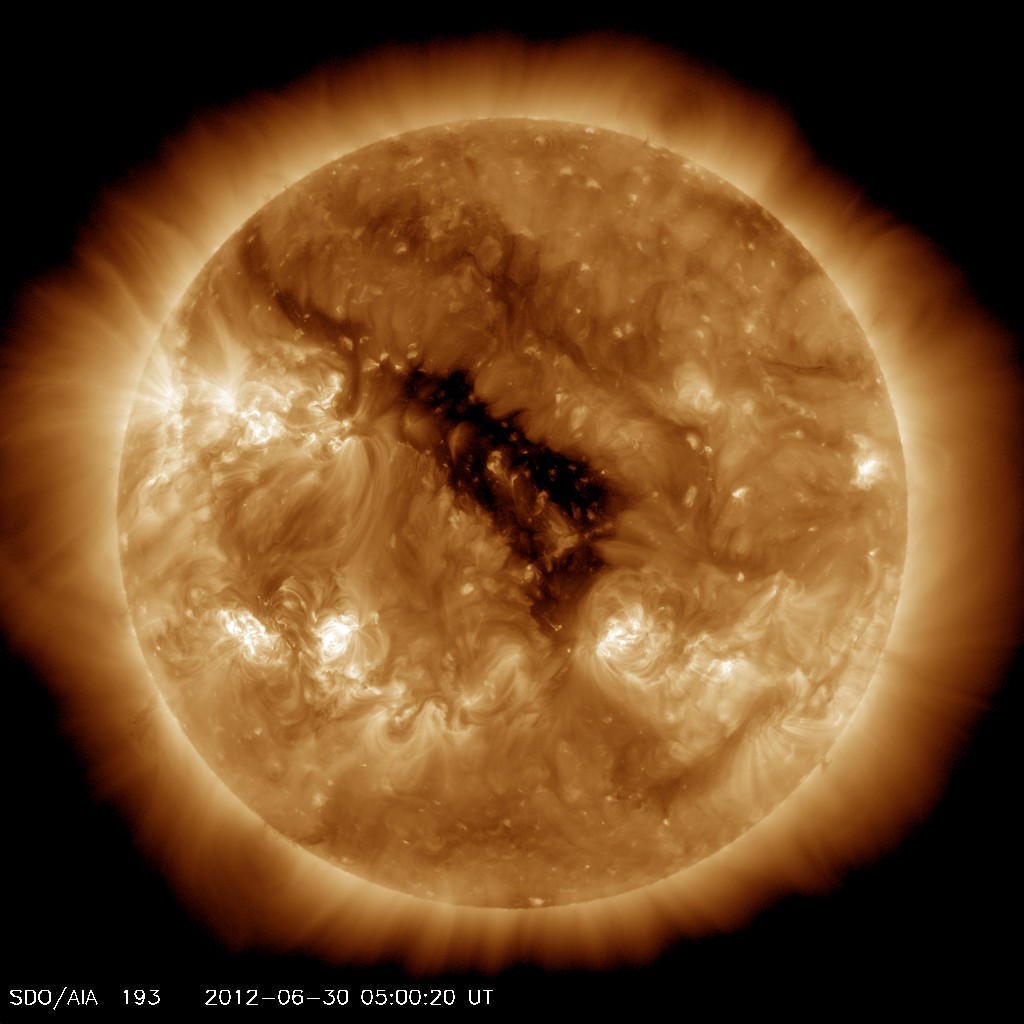
DARK HOLE IN THE SUN'S ATMOSPHERE: Ultraviolet telescopes onboard NASA's Solar Dynamics Observatory are monitoring a vast dark hole--a "coronal hole"--in the sun's upper atmosphere. It has just turned directly toward Earth:
Coronal holes are places where the sun's magnetic field opens up and allows the solar wind to escape. A stream of solar wind flowing from this particular gap is en route to Earth, due to arrive on July 2nd or 3rd. The impact could spark geomagnetic storms and auroras. 

ACTIVE SUNSPOT: Sunspot AR1513 is crackling with impulsive M-class solar flares. NASA's Solar Dynamics Observatory recorded the extreme ultraviolet flash from one of them at 0920 UT on June 29th:
This M2-class flare illuminated Earth's upper atmosphere with a pulse of X-rays and extreme ultraviolet radiation. Waves of ionization rippled over Europe, altering the propagation of low-frequency radio signals around the continent. Using a receiver tuned to 60 kHz, Rob Stammes detected the sudden ionospheric disturbance over Norway. His antennas also picked up radio waves from the flare itself at 26 MHz and 56 MHz.
More ionization waves and solar radio bursts are in the offing. NOAA forecasters estimate a 40% chance of continued M-flares during the next 24 hours.

Solar wind
speed: 637.1 km/sec
density: 3.5 protons/cm3
explanation | more dataUpdated: Today at 2025 UT
X-ray Solar Flares
6-hr max: M1 
1832 UT Jun30 
24-hr: M1 
1832 UT Jun30 
explanation | more dataUpdated: Today at: 2000 UT


Sunday, June 3, 2012

Massive Solar Coronal Holes Shaped Like A Chicken Creating Solar Wind.


Space Weather Real Time Image Gallery 

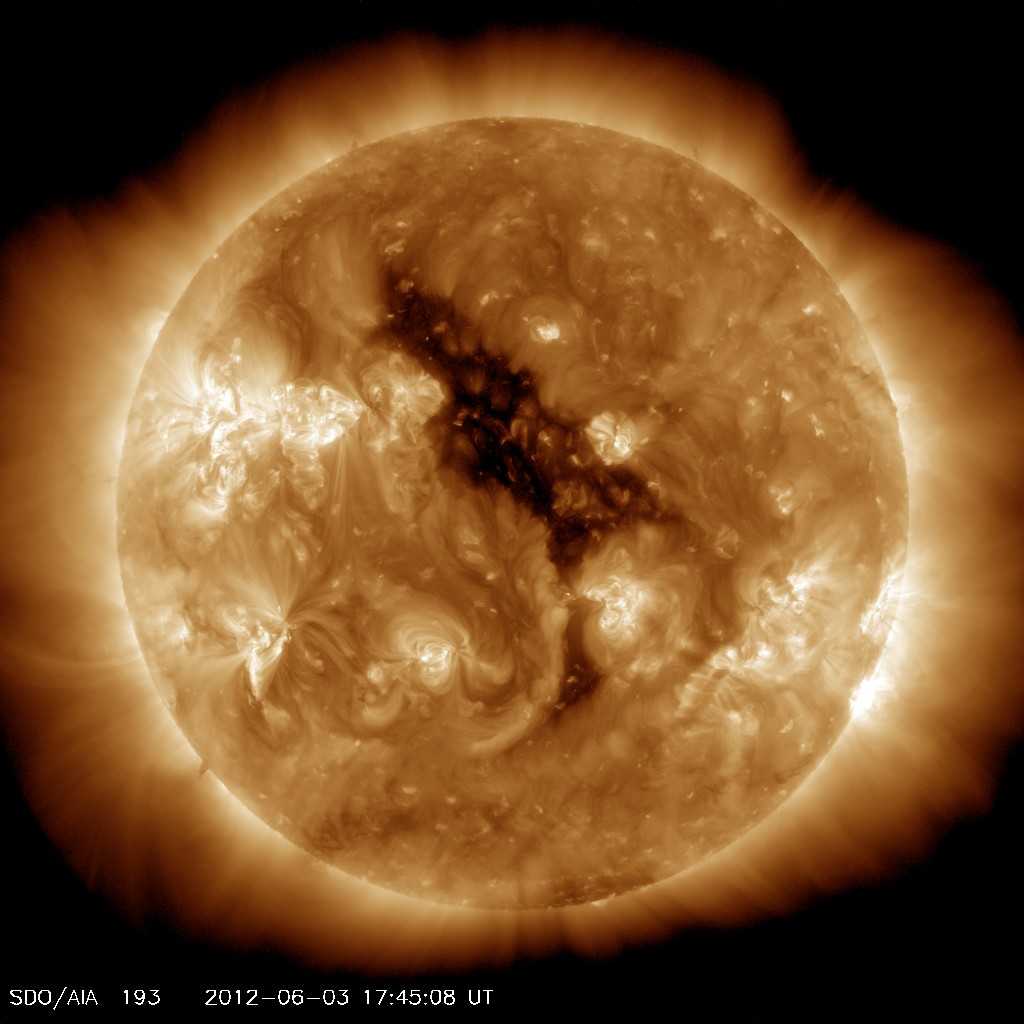
'CH' STANDS FOR ... CHICKEN? A big dark hole in the sun's atmosphere, a 'coronal hole', is turning toward Earth spewing solar wind. According to NASA's official rubber chicken, it looks an awful lot like a bird:
Coronal holes are places where the sun's magnetic field opens up and allows the solar wind to escape. A chicken-shaped stream of solar wind flowing from this coronal hole will reach Earth on June 5th - 7th, possibly stirring geomagnetic storms. High-latitude sky watchers should be alert for auroras.

Solar wind
speed: 410.5 km/sec
density: 1.2 protons/cm3
explanation | more dataUpdated: Today at 1956 UT
X-ray Solar Flares
6-hr max: M3 
1755 UT Jun03 
24-hr: M3 
1755 UT Jun03 
explanation | more dataUpdated: Today at: 2000 UT