Ad

Showing posts with label x-class solar flare. Show all posts

Thursday, July 12, 2012

X-Class Solar Flare Shoots Geomagnetic Storm Barreling Towards Earth.


UPDATE: 7-13-2012

X-Class Solar Flare, Strongest Kind, Erupts From Giant Sunspot 'AR1520'

Posted:  Updated: 07/13/2012 2:24 pm

Solar Flare


By: Tariq Malik 
Published: 07/12/2012 02:36 PM EDT on SPACE.com
This story was updated at 5 p.m. ET.
The sun unleashed a huge flare Thursday (July 12), the second major solar storm to erupt from our star in less than a week.
The solar flare peaked at 12:52 p.m. EDT (1652 GMT) as an X-class sun storm, the most powerful type of flare the suncan have.
"It erupted from Active Region 1520, which rotated into view on July 6," NASA officials said in an alert. Active Region 1520, or AR1520, is a giant sunspot currently facing Earth.  
According to NASA and the Space Weather Prediction Center (SPWC), which is operated by the U.S. National Oceanic and Atmospheric Administration, today's sun storm registered as an X1.4-class solar flare. It is more powerful than the X1.1 flare that erupted on July 6 from another giant sunspot known as AR1515, making this latest tempest the strongest solar storm of the summer so far.
The sunspot region AR1520 could be up to 186,411 miles (300,000 kilometers) long at its peak, solar astrophysicist C. Alex Young of NASA's Goddard Space Flight Center told SPACE.com. It is about 50 percent larger than last week's sunspot AR1515.
"It's quite extensive," Young said, adding that sunspots the size of AR1520 are normal as the sun nears its peak of its weather cycle in 2013.
But while sunspot AR1520 may sound like a solar behemoth, it is actually a relatively modest sunspot example, and promises more sun storms to come, Dean Pesnell, project scientist for NASA's Solar Dynamics Observatory, told SPACE.com.
"It's certainly not done. It's only halfway across the face of the sun right now," Pesnell said from the Goddard center in Greenbelt, Md., which oversees the sun-watching SDO mission. "We'll be able to watch it from the Earth for at least another week."
The SDO spacecraft captured a video of the huge X1.4 solar flare and is one of several spacecraft keeping a constant watch on the sun's weather cycle.
Because the solar flare erupted toward Earth, it sent a wave of charged particles toward our planet that could slightly amp up northern lights displays. It caused a strong radio blackout for some high-frequency communications systems, according to SWPC officials.
NASA and SWPC officials said the flare did trigger a huge eruption of solar plasma, known as a coronal mass ejection or CME, which is expected to reach Earth at 1 a.m. EDT (0500 GMT) on Saturday (July 14).Young said that an early analysis suggests the coronal mass ejection sent a wave of plasma toward Earth at a speed of 3.1 million mph (5 million kph or about 1,400 km per second). While it may spark a minor geomagnetic storm, power planets, satellites and astronauts need not worry, he added.
"At this point, I think the impact is going to be relatively minor," Young said.
X-class solar flares  are the strongest type of storms that occur on the sun. When aimed at Earth, the most powerful X-class flares can endanger satellites and astronauts in space, interfere with navigation and communications signals, and damage power system infrastructure on our planet.
Today's solar flare marks the sixth X-class solar flare of the year. While it is the strongest yet of the summer season, which began in late June, it is not the most powerful sun storm of 2012. That title is currently held by a March event that unleashed an intense X5.4-class solar flare.
The sun is currently in the midst of an active phase of its 11-year solar weather cycle. The current cycle is called Solar Cycle 24.


Solar storm barreling toward Earth this weekend


LOS ANGELES (AP) - A solar storm is racing toward Earth this weekend, but scientists say not to worry.
The blast of charged solar particles was due to arrive Saturday morning and shake Earth's magnetic field. Space weather forecasters say it will be a minor event and they don't expect disruptions to power grids or communications systems.
The storm began Thursday when the sun unleashed a huge flare that sent a stream of particles speeding toward Earth at 3 million mph.
There's a bright side to stormy space weather: It tends to create colorful northern lights. Scientists say shimmering colorful auroras may be visible at the United States-Canada border and northern Europe this weekend.
source: http://www.ksl.com/index.php?sid=21227824&nid=1012&title=solar-storm-barreling-toward-earth-this-weekend


update ended.......................................................end here..........................................................

X-FLARE! Big sunspot AR1520 unleashed an X1.4-class solar flare on July 12th at 1653 UT. Because this sunspot is directly facing Earth, everything about the blast was geoeffective. For one thing, it hurled a coronal mass ejection (CME) directly toward our planet. According to a forecast track prepared by analysts at the Goddard Space Weather Lab, the CME will hit Earth on July 14th around 10:20 UT (+/- 7 hours) and could spark strong geomagnetic storms. Sky watchers should be alert for auroras this weekend. 

The explosion also strobed Earth with a pulse of extreme UV radiation, shown here in an image captured by NASA's Solar Dynamics Observatory:


The UV pulse partially ionized Earth's upper atmosphere, disturbing the normal propagation of radio signals around the planet. Monitoring stations in Norway and Ireland recorded the sudden ionospheric disturbance.

Finally, solar protons accelerated by the blast are swarming around Earth. The radiation storm, in progress, ranks "S1" on NOAA space weather scales, which means it poses no serious threat to satellites or astronauts. This could change if the storm continues to intensify. 


SPACE WEATHERNOAA Forecasts
Updated at: 2012 Jul 12 2200 UTC
FLARE
0-24 hr
24-48 hr
CLASS M
80 %
80 %
CLASS X
35 %
35 %

source:  http://spaceweather.com/

The Classification of X-ray Solar Flares
or "Solar Flare Alphabet Soup"
A solar flare is an explosion on the Sun that happens when energy stored in twisted magnetic fields (usually above sunspots) is suddenly released. Flares produce a burst of radiation across the electromagnetic spectrum, from radio waves to x-rays and gamma-rays. [more information]


Scientists classify solar flares according to their x-ray brightness in the wavelength range 1 to 8 Angstroms. There are 3 categories: X-class flares are big; they are major events that can trigger planet-wide radio blackouts and long-lasting radiation storms. M-class flares are medium-sized; they can cause brief radio blackouts that affect Earth's polar regions. Minor radiation storms sometimes follow an M-class flare. Compared to X- and M-class events, C-class flares are small with few noticeable consequences here on Earth.


This figure shows a series of solar flares detected by NOAA satellites in July 2000:


Each category for x-ray flares has nine subdivisions ranging from, e.g., C1 to C9, M1 to M9, and X1 to X9. In this figure, the three indicated flares registered (from left to right) X2, M5, and X6. The X6 flare triggered a radiation storm around Earth nicknamed the Bastille Day event.


 Class
Peak (W/m2)between 1 and 8 Angstroms


 B
 I < 10-6


 C
 10-6 < = I < 10-5


 M
 10-5 < = I < 10-4


 X
 I > = 10-4

source: http://spaceweather.com/glossary/flareclasses.html


Solar X-ray Flux

3-day Solar Xray Flux graph


Friday, November 4, 2011

UPDATE: CHANCE OF ANOTHER X-CLASS SOLAR FLARE UPGRADED...Monster Active Sun Spot Region Has Rotated Toward Earth & Sent Us An X-Class Solar Flare

UPDATE: 11/4/2011
CHANCE OF FLARES: NOAA forecasters have upgraded the chance of X-class solar flares today to 20%. The source would be AR1339, one of the biggest sunspots in many years. The active region rotated over the sun's eastern limb two days ago and now it is turning toward Earth.
The sunspot has already unleashed one X-flare on Nov. 3rd around 2027 UT. A movie from NASA's Solar Dynamics Observatory shows the extreme ultraviolet flash:
The flare created waves of ionization in Earth's upper atmosphere, altering the normal propagation of radio waves over Europe and the Americas. In Ireland, the flare's effect was felt even after dark.
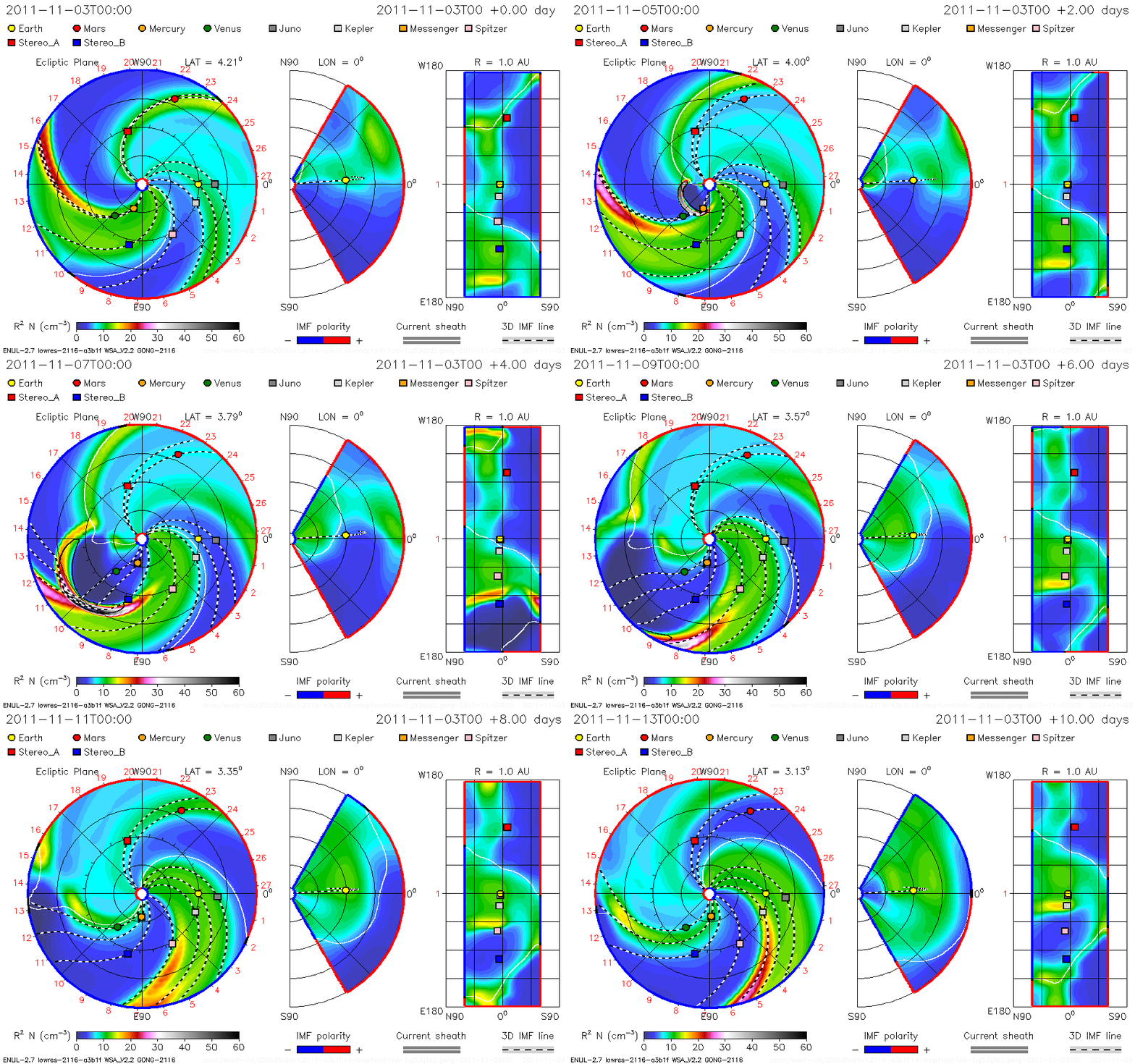
A cloud of plasma or "CME" raced away from the blast site at 1100 km/s. The CME is not heading for Earth. It is, however, heading for Mercury and Venus. Click on the arrow to view a movie of the CME's forecast track:
Analysts at the Goddard Space Weather Lab say the CME will hit Mercury on Nov. 4th around 16:14 UT. NASA's MESSENGER probe in orbit around Mercury will be monitoring the effects of the impact. If the CME overwhelms Mercury's relatively weak magnetic field, it could scour material off the planet's surface creating a temporary atmosphere and adding material to Mercury's comet-like tail. The CME should hit Venus on Nov. 5th; the gossamer cloud will probably break harmlessly against the top of planet's ultra-dense atmosphere.
******************************************************************************
X-FLARE: Earth-orbiting satellites have just detected an X2-class solar flare. The source is huge sunspot AR1339, described below. Stay tuned for updates.

MAGNIFICENT SUNSPOT: One of the largest sunspots in years is rotating over the sun's northeastern limb. NASA's Solar Dynamics Observatory took this picture of AR1339 during the early hours of Nov. 3rd:
Measuring some 40,000 km wide and at least twice that in length, the sprawling sunspot group is an easy target for backyard solar telescopes. Two or three of the sunspot's dark cores are wider than Earth itself.
Naturally, such a large sunspot has potential for strong flares. NOAA forecasters estimate a 50% chance of M-class solar flares during the next 24 hours. One such eruption has already occured: An M4-flare at 2200 UT on Nov. 2nd produced a bright flash of extreme UV radiation (SDO movie) and hurled a coronal mass ejection (CME) into space. The CME is not heading our way. Future CMEs could have greater effect as AR1339 turns toward Earth in the days ahead.


2011-11-03 15:06   A benevolent monster of a region?
A monster of an active region, NOAA number 11339, has rotated on to the Earth-facing side of the Sun.  This is the largest active region in almost seven years, since January 2005.  It has produced only a few minor flares so far, but SWPC will be keeping a close eye on it to watch for any threatening behavior.  This region is likely to remain a threat for the 11 days or so it will take to rotate back to the far side of the Sun.
http://www.swpc.noaa.gov/
UPDATE: 11-4-2011

CHANCE OF FLARES: NOAA forecasters have upgraded the chance of X-class solar flares today to 20%. The source would be AR1339, one of the biggest sunspots in many years. The active region rotated over the sun's eastern limb two days ago and now it is turning toward Earth. Solar flare alerts: text, voice.

The sunspot has already unleashed one X-flare on Nov. 3rd around 2027 UT. A movie from NASA's Solar Dynamics Observatory shows the extreme ultraviolet flash:
The flare created waves of ionization in Earth's upper atmosphere, altering the normal propagation of radio waves over Europe and the Americas. In Ireland, the flare's effect was felt even after dark.

A cloud of plasma or "CME" raced away from the blast site at 1100 km/s. The CME is not heading for Earth. It is, however, heading for Mercury and Venus. Click on the arrow to view a movie of the CME's forecast track:
Analysts at the Goddard Space Weather Lab say the CME will hit Mercury on Nov. 4th around 16:14 UT. NASA's MESSENGER probe in orbit around Mercury will be monitoring the effects of the impact. If the CME overwhelms Mercury's relatively weak magnetic field, it could scour material off the planet's surface creating a temporary atmosphere and adding material to Mercury's comet-like tail. The CME should hit Venus on Nov. 5th; the gossamer cloud will probably break harmlessly against the top of planet's ultra-dense atmosphere.

Tuesday, September 27, 2011

Strong Geomagnetic Storm Hits Earth.

NASA warns of geomagnetic storm after behemoth solar flare

NASA says geosynchronous satellites could therefore be directly exposed to solar wind plasma with latest blast

By Layer 8 on Tue, 09/27/11 - 9:14am.

sunspt 1302NASA today said a strong-to-severe geomagnetic storm is in progress following a massive solar flare and coronal mass ejection (CME).   CMEs are a solar phenomenon that can send solar particles into space and affect electronic systems in satellites and on Earth.  Simulations indicate that solar wind plasma has penetrated close to geosynchronous orbit starting at 9am today. Geosynchronous satellites could therefore be directly exposed to solar wind plasma and magnetic fields.

High-latitude sky watchers should be alert for auroras after nightfall, NASA stated.
The National Oceanic and Atmospheric Administration's Space Weather forecast center went further saying: A CME that erupted from NOAA Active Region 1302 on Saturday September 24 in conjunction with an M7 strength solar flare, arrived this morning at 1237 UT (8:37am Eastern Time). It has kicked off moderate (G2) geomagnetic storms for low latitudes, but high latitudes are seeing severe (G4) levels of activity. Aurora watchers in Asia and Europe are most favorably positioned for this event, though it may persist long enough for viewers in North America. The bulk of the CME missed the Earth, meaning the storm intensity and duration are less than what they would have been in the case of a direct hit. Region 1302 remains capable of producing more activity and will be in a favorable position for that activity to have impacts on Earth for the next 3-5 days.

NASA's Solar Dynamics Observatory (SDO) recorded the extreme ultraviolet flash.
This particular sunspot, 1302 has already produced two X-flares (X1.4 on Sept. 22nd and X1.9 on Sept. 24th). The entire active region stretches more than 100,000 km from end to end. None of the blasts have been squarely Earth-directed, but this could change as the sunspot turns toward our planet in the days ahead. AR1302 is growing and shows no immediate signs of quieting down, NASA said.

The sunspot's magnetic field is currently crackling with sub-X-class flares that could grow into larger eruptions as the sunspot continues to turn toward Earth, NASA stated. The Goddard Space Weather Lab reported a strong compression of Earth's magnetosphere.

According to the space agency: "The biggest flares are known as "X-class flares" based on a classification system that divides solar flares according to their strength. The smallest ones are A-class (near background levels), followed by B, C, M and X. Similar to the Richter scale for earthquakes, each letter represents a 10-fold increase in energy output. So an X is ten times an M and 100 times a C. Within each letter class there is a finer scale from 1 to 9.  C-class and smaller flares are too weak to noticeably affect Earth. M-class flares can cause brief radio blackouts at the poles and minor radiation storms that might endanger astronauts."
Earlier this year NASA noted that the Sun hadn't blasted out any X-flares for four years but produced two of the powerful blasts in less than one month: Feb. 15th and March 9th. This continues the recent trend of increasing solar activity associated with our sun's regular 11-year cycle, and confirms that Solar Cycle 24 is indeed heating up, as solar experts have expected. Solar activity will continue to increase as the solar cycle progresses toward solar maximum, expected in the 2013 time frame.

NASA and NOAA - as well as the US Air Force Weather Agency and others -- keep a constant watch on the sun to monitor for X-class flares and their associated magnetic storms. With advance warning many satellites and spacecraft can be protected from the worst effects, NASA stated.
Follow Michael Cooney on Twitter: nwwlayer8 

Sunspot 1302 unleashed towards Earth, detected on shortwave radio


Greenbelt - Scientists are monitoring a sunspot that produced an X1.9-category solar storm that was unleashed over the weekend and could be headed towards Earth. Sunspot 1302 was so strong that it has been detected shortwave radio on this planet.

Digital Journal has reported in the past about intense solar storms and so far nothing catastrophic has occurred. The worst thing that has transpired thus far has been loss of radio signals in some parts of the United States.

On Monday, NASA issued a news release that updated us on a strong X1.9-category solar storm that erupted from active region (sunspot) 1302 Saturday morning that was recorded by the space administration’s Solar Dynamics Observatory.

The published video presented viewers with a shadowy shock rave that moved away from the impact site. This has led scientists to believe that the blast produced a coronal mass ejection (CME) that could hurt our magnetic field this week.

Although none of the blasts were directed towards the Earth, the sunspot will turn toward us within the next few days. NASA officials say that AR1302 is continuing to grow and that there is no evidence that it will quiet down anytime soon. It is in a position to produce more CMEs.

The Goddard Space Weather Lab detected solar wind plasma sneaking into the geosynchronous orbit that could affect satellites because they will experience solar wind plasma and magnetic fields.

As the sunspot continues to produce intense solar storms, audio has been recorded of the solar event. Thomas Ashcraft in New Mexico was able to record the sounds of the activity on his shortwave radio.
Sky gazers in high-latitude areas should look out for auroras come nightfall.

Continuity Central also issued a news release for businesses. It noted NASA’s list of possible impact by space weather. It reiterated NASA’s warning that intense solar activity could cause blackouts across the globe and could last for months as engineers attempt to repair the situation.

This would lead to the disruption of commerce since numerous institutions would be offline, airplanes would not be able to utilize GPS navigation and there would be no power for hundreds of millions of people.

NASA
Many auroral displays appear green, but sometimes, as in this Sept. 26 image from the International Space Station, other colors such as red can appear.

Red sky at night ... astronaut's delight

"Red sky at night, sailor's delight": That's one of the oldest sayings in the book when it comes to weather prediction, but this picture adds a new twist. The red sky is an aurora, seen from above by astronauts on the International Space Station. And the weather that's causing this phenomenon is space weather from the sun.

Auroras arise when electrically charged particles from the sun interact with atoms in the upper atmosphere, sparking emissions of light at various wavelengths. The displays are most likely to be visible around Earth's magnetic poles, where the interaction is strongest. The sun has been going through an upswing of activity over the past couple of months, which has generated a colorful series of northern and southern lights.

North or south, the most common shade of auroral light is green. That's the wavelength that's typically emitted when solar particles mix it up with oxygen atoms. But if there are lower-energy collisions with oxygen atoms or nitrogen atoms, the emissions edge toward the reddish end of the spectrum. That's what's happening in this picture, captured on Monday. You should be able to make out the space station's solar panels toward the upper left corner of the photo.

Space weather can create disruptions for satellite communication systems as well as electric grids on Earth, but so far the most noticeable effect from this year's solar storms has been a string of glorious auroras. We weathered the latest geomagnetic storm overnight, and SpaceWeather.com is offering up a selection of snapshots — including this red-and-green stunner from Russia's Kola Peninsula.

NOAA SWPC Space Weather Bulletin #11- 4

image
Official Space Weather Advisory issued by NOAA Space Weather Prediction Center
Boulder, Colorado, USA

SPACE WEATHER ADVISORY BULLETIN #11- 4
2011 September 26 at 03:00 p.m. MDT (2011 September 26 2100 UTC)

**** EARLY AUTUMN GEOMAGNETIC STORM ****

A Coronal Mass Ejection (CME) that erupted from NOAA Active Region 1302 on Saturday September 24 in conjunction with an M7 strength solar flare, arrived this morning at 1237 UT (8:37am Eastern Time). It has kicked off moderate (G2) geomagnetic storms for low latitudes, but high latitudes are seeing severe (G4) levels of activity. Aurora watchers in Asia and Europe are most favorably positioned for this event, though it may persist long enough for viewers in North America. The bulk of the CME missed the Earth, meaning the storm intensity and duration are less than what they would have been in the case of a direct hit. Region 1302 remains capable of producing more activity and will be in a favorable position for that activity to have impacts on Earth for the next 3-5 days.

Data used to provide space weather services are contributed by NOAA, USAF, NASA, NSF, USGS, the International Space Environment Services and other observatories, universities, and institutions. More information is available at SWPC's Web site http://swpc.noaa.gov
SPACEREF.COM
The Northern Lights

Northern Lights pictures illuminate web

The Northern Lights
Credits: 
Air Force

Right now, we here at mid-Northern latitudes could be gettingquite a treat as a strong blast of the solar wind making a direct hit on Earth, sparking displays of aurora, also known as the Northern Lights, that could be seen as far South as Nebraska. Unfortunately for us in the Cleveland area, the weather has not cooperated thus far, which meant no lights thanks to the clouds.

Now for some good news: where the weather was good, people were taking pictures.

Of all the astronomy-themed websites out there, Spaceweathermay be the best when it comes to photo galleries for one simple reason: the galleries are created by the website's visitors, which means tons of cool images coming in from all over the world.

The aurora event of the past few nights were no exception.

Despite the solar storm still being in progress, Spaceweather already has several pages of aurora images on its website. For even more good news, the gallery is sure to grow as more people start submitting their images. So, for those of us who are looking to be clouded out the next few nights, at least there is the Internet. Hopefully, though, your sky will be clear so you can see the spectacularlights yourself.

Continue reading on Examiner.com Northern Lights pictures illuminate web - National photography | Examiner.com EXAMINER.COM


Monday, September 26, 2011

UPDATE: 09-26-2011 - Solar Flares. SIGNIFICANT SOLAR EVENT TAKING PLACE NOW. Significant Ground Currents. Satellites May Experience Issues With Solar Wind Plasma & Magnetic Fields.

SEVERE GEOMAGNETIC STORM TAKING PLACE RIGHT NOW...

ALERT:
Space Weather Message Code: WARK07
Serial Number: 33
Issue Time: 2011 Sep 26 1708 UTC

WARNING: Geomagnetic K-index of 7 or greater expected
Valid From: 2011 Sep 26 1715 UTC
Valid To: 2011 Sep 26 2100 UTC
Warning Condition: Onset
NOAA Scale: G3 or greater - Strong to Extreme
http://www.swpc.noaa.gov/alerts/warnings_timeline.html
 
 
SWPC ACE RTSW MAG 24-hour Updating Plot
3-day Satellite Environment graph and image map.3-day Estimated Planetary K-index graph


IMPACT: A coronal mass ejection (CME) hit Earth's magnetic field at approximately 12:15 UT on Sept. 26th. The impact caused significant ground currents in Norway. Also, the Goddard Space Weather Lab reports a "strong compression of Earth's magnetosphere. Simulations indicate that solar wind plasma [has penetrated] close to geosynchronous orbit starting at 13:00UT." Geosynchronous satellites could therefore be directly exposed to solar wind plasma and magnetic fields. Stay tuned for updates. 

SOLAR STATIC: Active sunspot 1302 has turned the sun into a shortwave radio transmitter. Shock waves rippling from the sunspot's exploding magnetic canopy are exciting plasma oscillations in the sun's atmosphere. The result: Bursts of static are issuing from the loudspeakers of shortwave radios on Earth. Amateur radio astronomer Thomas Ashcraft recorded this sample from his backyard observatory in New Mexico on Sept. 24th:


Dynamic spectrum: The horizontal axis is time (h:m:s), the vertical axis is frequency (MHz). Image credit: Wes Greenman

"Saturday was a super-strong solar day with near continuous flaring and radio sweeps," says Ashcraft. "The sound file (above) corresponds to an M3 flare at 1918 UTC. It was the strongest radio sweep of the observing day."


"Try listening to the radio bursts in stereo," he advises. "I was recording on two separate radios at 21.1 MHz and 21.9 MHz, and I put each one into its own channel of the audio file. This gives a spatial dimension as the bursts sweep down in frequency."

FORECAST...

SPACE WEATHER
NOAA Forecasts


Updated at: 2011 Sep 25 2235 UTC

FLARE
0-24 hr
24-48 hr
CLASS M
80 %
80 %
CLASS X
40 %
40 %


Geomagnetic Storms:
Probabilities for significant disturbances in Earth's magnetic field are given for three activity levels: active, minor storm, severe storm
Updated at: 2011 Sep 25 2235 UTC
Mid-latitudes

0-24 hr
24-48 hr
ACTIVE
45 %
30 %
MINOR
20 %
15 %
SEVERE
10 %
05 %

High latitudes

0-24 hr
24-48 hr
ACTIVE
45 %
30 %
MINOR
25 %
15 %
SEVERE
15 %
05 %
 

Satellite Environment Plot


3-day Satellite Environment graph and image map. link to Proton Plot link to Electron Plot link to GOES Mag. Plot link to Kp Plot

Boulder K plot
Proton Flux from GOES-13, Electron Flux and GOES Hp from GOES-13 & GOES-15

Space Weather Alerts and Warnings Timeline

Space Weather Alerts and Warnings Timeline


Big, Bright Flare

Big, Bright Flare
Just as an active region rotated into view, it unleashed a large (X1.4 class) solar flare (Sept. 22, 2011) as well as several smaller flares and a significant coronal mass ejection. Predictions are that the storm will likely not impact Earth. Following the bright flare, one can see brilliant coils of magnetic field lines regrouping themselves. Images were taken by NASA's Solar Dynamics Observatory in extreme ultraviolet light.


Thursday, September 8, 2011

UPDATE: Another day of VERY active solar activity with an M-Class Flare.

UPDATE: 9-8-2011
3:16PM GMT
SOLAR RADIO BURSTS: This week's sharp increase in solar activity has turned the sun into a radio transmitter. Bursts of shortwave static are coming from the unstable magnetic canopy of sunspot 1283.

Tuesday in New Mexico, amateur radio astronomer Thomas Ashcraft recorded some samples at 21 MHz: listen. Radio listeners should remain alert for this kind of solar activity as sunspot 1283 continues to seethe.

STRONG FLARE ACTIVITY CONTINUES: On Sept. 8th at 1546 UT, sunspot 1283 unleashed an M6-class solar flare. This continues the active region's 3-day trend of daily powerful eruptions. Yesterday's blast, an X1.8-class event, produced a bright flash of extreme UV radiation and hurled an inky-dark plume of plasma into space. Click to view the movie from NASA's Solar Dynamics Observatory:
Since Sept. 6th, sunspot 1283 has propelled at least three CMEs in the general direction of Earth. Glancing blows from the incoming clouds will commence sometime on Sept. 9th and continue through Sept. 11th, possibly sparking minor geomagnetic storms. Solar flare alerts: text, voice.
http://spaceweather.com/
******************END UPDATE********************************************


UPDATE: 9-7-2011
8:30PM GMT
ANOTHER X-FLARE: Earth-orbiting satellites have detected another strong flare from sunspot 1283. The X1.8 category blast occured at 2238 UT on Sept. 7th. [SDO movie]
*******************************END UPDATE******************************

SOLAR RADIO BURSTS: This week's sharp increase in solar activity has turned the sun into a radio transmitter. Bursts of shortwave static are coming from the unstable magnetic canopy of sunspot 1283. Yesterday in New Mexico, amateur radio astronomer Thomas Ashcraft recorded some samples at 21 MHz: listen. Radio listeners should remain alert for this kind of solar activity as sunspot 1283 continues to seethe.


STRONG SOLAR ACTIVITY: Sunspot 1283 is crackling with solar flares. Yesterday, Sept. 6th, the active region produced an M5.3-class eruption at 0150 UT followed by a X2.1-class event at 2220 UT. NASA's Solar Dynamics Observatory recorded this extreme UV flash from the X-flare:
The flares produced waves of ionization in Earth's upper atmosphere, briefly altering the propagation of low-frequency radio signals around our planet. Moreover, the two eruptions hurled clouds of plasma (CMEs) in our direction. CME impacts, geomagnetic storms and auroras are expected on Sept. 8-10. Stay tuned for updates. Solar flare alerts: textvoice.

X-flares of Solar Cycle 24: There have been only a small number of X-flares since the beginning of new Solar Cycle 24. Here is a complete list so far: Feb. 15, 2011 (X2), March 9, 2011 (X1), Aug. 9, 2011 (X7), Sept. 6, 2011 (X2). Before these four, the previous X-flare occured on Dec.14, 2006, (X1) during old Solar Cycle 23.


3-day Solar Xray Flux graph
http://www.swpc.noaa.gov/today.html#xray


Strong X2.1 Flare / Solar Update
09/06/2011 by Kevin VE3EN at 14:50 UTC
Comment on Message Board


Strong X-Class Flare:
A strong X2.1 Class Solar Flare took place at 22:20 UTC Tuesday and was centered around Sunspot 1283. Another CME looks to have resulted and a Sun facing Lasco C2 movie is below. A Type II and Type IV sweep frequency event occurred as well as a TenFlare (10.7cm Radio Burst). The proton levels are also at minor levels.

Partially Earth directed CME: When watching the new Lasco C2 movie which is below, the explosion caused by the X2.1 Solar Flare is a full halo CME and has the best chance of impacting earth in some way. The first CME created by the M5.3 will for the most part miss earth. As with any explosion, only time will tell as to what kind of impact they will have on earth. Many times they end up missing altogether.

Click HERE for an SDO image.
Click HERE for another image by EVE.
Solar Flux Correction: The solar flux value above was reading as 150. The correct value for Sept 6th is actually 112.
Solar Update: Solar activity has been high with multiple M-Class flares and one X-Class event over the past 48 hours. Two full halo Coronal Mass Ejections took place on Tuesday due to an M5.3 and X2.1 Solar Flares. Only a minor impact is expected. Sunspot 1283 may produce further M-Class activity. Elsewhere, all other sunspot groups are quiet.
http://www.solarham.com/


http://www.swpc.noaa.gov/drap/global.html

D-RAP Global (1 dB ABS)


map of global absorption predictions at 1 dB

Wednesday, September 7, 2011

March 10 X-Class Solar Flare. March 11 Huge Earthquake Activity. This Flare Is More Direct & Larger.

Does the solar flare activity cause earthquakes on Earth? There has been a bit of a rumble about that among scholars and amateurs alike. In previous patterns regarding the occurrence of X-Class Flares and earthquakes, there seems to be a very likely correspondence that between X-Class flares and large earthquakes. Since we have just encountered an X-Class Flare that was faced directly at Earth, I put out the warning right now that there will likely be a large increase in earthquake activity, even an extraordinarily large quake.


Coincidences happen, but follow what is going on as a scientific observation of patterns. When the X-Class Flare occurred on March 10, 2011, the next day, Japan experienced their enormous and destructive earthquake(s) and tsunami.

Watch what happens in the next few days and be working on your preparedness, i.e., 72 Hour Kits, Food and Water storage, family earthquake drills, etc. Let's see what happens in the next few days.

Tuesday, August 9, 2011

Dude! Major X-7 Solar Flare! Amazing Footage & Explanatory Information, As Well As A Forecast.

Time for the X-Class Flares...


MAJOR SOLAR FLARE: This morning at 0805 UT, sunspot 1263 produced a powerful X7-class solar flare. NASA's Solar Dynamics Observatory captured the explosion's extreme ultraviolet flash:
The brunt of the explosion was not Earth directed. Nevertheless, a minor proton storm is in progress around our planet, which could affect satellites in high-altitude orbits. Also, radiation from flare created waves of ionization in Earth's upper atmosphere, briefly disrupting communications at some VLF and HF radio frequencies.
SOHO coronagraphs show a CME emerging from the blast site. The cloud will probably miss Earth. At this time, however, we cannot rule out a glancing blow from the flank of the CME on or about August 11th. Stay tuned for updates.
http://spaceweather.com/
more data: from Rob Stammes of Laukvik, Lofoten, Norway; from Andy Smith of Devon, United Kingdom.  


NOAA Forecasts
Updated at: 2011 Aug 08 2200 UTC
FLARE
0-24 hr
24-48 hr
CLASS M
55 %
55 %
CLASS X
10 %
10 %


The Classification of X-ray Solar Flares
or "Solar Flare Alphabet Soup"
A solar flare is an explosion on the Sun that happens when energy stored in twisted magnetic fields (usually above sunspots) is suddenly released. Flares produce a burst of radiation across the electromagnetic spectrum, from radio waves to x-rays and gamma-rays. [more information]
Scientists classify solar flares according to their x-ray brightness in the wavelength range 1 to 8 Angstroms. There are 3 categories: X-class flares are big; they are major events that can trigger planet-wide radio blackouts and long-lasting radiation storms. M-class flares are medium-sized; they can cause brief radio blackouts that affect Earth's polar regions. Minor radiation storms sometimes follow an M-class flare. Compared to X- and M-class events, C-class flares are small with few noticeable consequences here on Earth.
This figure shows a series of solar flares detected by NOAA satellites in July 2000:
3-day Solar Xray Flux graph


Each category for x-ray flares has nine subdivisions ranging from, e.g., C1 to C9, M1 to M9, and X1 to X9. In this figure, the three indicated flares registered (from left to right) X2, M5, and X6. The X6 flare triggered a radiation storm around Earth nicknamed the Bastille Day event.


 Class
Peak (W/m2)between 1 and 8 Angstroms


 B
 I < 10-6


 C
 10-6 < = I < 10-5


 M
 10-5 < = I < 10-4


 X
 I > = 10-4

http://spaceweather.com/glossary/flareclasses.html