Ad

Showing posts with label m-class solar flare. Show all posts

Saturday, January 14, 2012

Solar Activity Update 1-14-2012 - Activity Uptick

Be looking at a 30% chance for M-Class solar flares in the next 72 hours.  

CORONAL HOLE: NASA's Solar Dynamics Observatory is monitoring a dark gash in the sun's atmosphere--a coronal hole. It's the dark vertical feature in this extreme UV image taken on Jan. 13th:
Coronal holes are places where the sun's magnetic field opens up and allows the solar wind to escape. This yawning hole is about 120,000 km wide and more than a million km long. Solar wind flowing from its UV-dark abyss will reach Earth on Jan. 16th or 17th, possibly sparking auroras for high-latitude sky watchers.


Friday, September 9, 2011

Geomagnetic Storm With Electrical Ground Currents Detected In Norway. Multiple M-Class Solar Flares In The Past 24 Hours. How To Prepare For A Super Geomagnetic Storm.


GEOMAGNETIC STORM: A polar geomagnetic storm (Kp=5) is in progressfollowing the impact of a CME around 1100 UT on Sept. 9th. This could be the first of several hits from a series of CMEs expected to reach Earth during the weekend. High-latitude sky watchers should be alert for auroras after nightfall. Aurora alerts:textvoice.

Update: Electrical ground currents caused by the storm have been detected in Norway.


ACTIVE SUNSPOT: Sunspot 1283 is producing flares so intense they are visible through solar telescopes in backyards 93 million miles away. Amateur astronomer Andy Devey photographed this one, and M6-class eruption, from Barnsley UK on Sept. 8th:
The magnetic canopy of sunspot 1283 has an unstable "beta-gamma-delta" configuration tthat harbors energy for more powerful eruptions. NOAA forecasters estimate a 75% chance of M-flares and a 25% chance of X-flares during the next 24 hours.


3-day GOES X-ray Plot3-day Estimated Planetary K-index graph
www.spaceweather.com


3-day GOES Magnetometer Hp component plot


The GOES Hp plot contains the 1-minute averaged parallel component of the magnetic field in nanoTeslas (nT), as measured at GOES-13 (W75) and GOES-15 (W89). The Hp component is perpendicular to the satellite orbit plane and Hp is essentially parallel to Earth's rotation axis. If these data drop to near zero, or less, when the satellite is on the dayside it may be due to a compression of Earth's magnetopause to within geosynchronous orbit, exposing satellites to negative and/or highly variable magnetic fields. On the nightside, a near zero, or less, value of the field indicates strong currents that are often associated with substorms and an intensification of currents in the Earth's geomagnetic tail.
http://www.swpc.noaa.gov/rt_plots/mag_3d.html


Noon and midnight local time at the satellite are plotted as N and M. Default scaling is 0 to 200 nanoTesla. Non-default scaling to include infrequent extreme values is lableled in red to emphasize the change in scale.

For real time monitors, click here...http://www.swpc.noaa.gov/rt_plots/index.html

Recommended Actions Immediately Prior to Massive Solar Storm

Emergency preparedness prior to the imminent storm...
1. Extra Batteries
2. Gasoline
3. Cooking Fuel
4. Prescription Medicine
5. Liquid Cash
6. Water
7. Bleach
8. Food
9. Can Opener
10. If you commute via subway, or other electrically depended corridor, you should carry a pair of supportive walking shoes.
11. Avoid elevators when you know that the storm is coming
12. Airlines – Avoid flying during a massive solar storm with a similar intensity to the Great Solar Storm of 1859. If you chose to fly, you will expose yourself to higher levels of nuclear particle radiation and the electronics within the aircraft will also be subjected to greater failure rate due to this radiation exposure.
13. Have an emergency back-up way for communication and a meeting spot for your loved ones that is planned in the case of emergency.
14. Radio  Battery powered or hand crank radios ar e a vital communication/ informational link during a major blackout.
15. Rechargeable batteries
16. Disconnecting Power
17. Automatic Back-up Generators
18. Buckets for carrying water
19. Vitamins
20. Toilet paper
21. Reading books
22. Prepare to take care of your pets as well.
23. Climate needs, i.e., extra water in warm/hot climates, extra blankets and gas or wood fireplace during cold climates.
24. Garage Door.  Know how to open it without power.

You'll be glad that you prepared ahead of time in the case of any emergency.


Tuesday, September 6, 2011

M5.3-Class Solar Flare Throws Extreme UV Radiation CME Directly At Earth.

EARTH-DIRECTED FLARE: This morning at 0150 UT, sunspot 1283 produced an M5.3-class solar flare. A movie from NASA's Solar Dynamics Observatory shows the flash of extreme UV radiation. Because of the sunspot's central location on the solar disk, the eruption was Earth-directed and a CME might be heading our way. Stay tuned for updates.
3-day Solar Xray Flux graph
www.spaceweather.com


Earth directed M-class solar flare erupts from the Sun today
Published on September 6, 2011 1:05 am PT 
- By Jim Duran - Writer
- Article Editor and Approved - Ron Jackson
(TheWeatherSpace.com) -- Sunspot 1283 has shot off an M-Class solar flare, which is directed at Earth.

M-Class solar flares like this could cause a moderate effect on our radio and electrical grid systems but NOAA does not forecast a major geomagnetic storm with it.

The flare was from a sunspot group crossing the central disk of the Sun as we speak, Sunspot 1983. The sunspot group has a beta-gamma field which could produce M and X-Class solar flares.

Any large solar flares will be Earth directed in the next few days.

http://www.theweatherspace.com/news/TWS-09_06_2011_mclass.html


Sunday, September 4, 2011

M3-Class Solar Flare Disrupting Radio Stations In Norway.


SOLAR FLARE: This morning at 1145 UT, an active region on the sun's western limb unleashed an M3-class solar flare. NASA's Solar Dynamics Observatory recorded the flash of extreme UV radiation:
Although the blast site was not directly facing Earth, radiation from the explosion nevertheless ionized Earth's upper atmosphere. This altered the propagation of radio signals around Europe, where it was high-noon at the time of the flare. "I detected a sharp change in signal levels from two radio stations on the VLF band," reports Rob Stammes of Lofoten, Norway.
In addition to the UV flash, the explosion also hurled a CME into space: SOHO movie. The cloud is not heading for Earth, so no auroras will result from this particular event. That's not to say, however, that no auroras are in the offing. Read on....http://www.spaceweather.com/
3-day Solar Xray Flux graph

NOAA Space Weather Scale for Radio Blackouts

Category
Effect
Physical measure
Average Frequency
(1 cycle=11 years)
Scale
Descriptor
Duration of event will influence severity of effects
  

Radio Blackouts

GOES X-ray peak brightness by class and by flux*
Number of events when flux level was met; (number of storm days)
R 5
Extreme
HF Radio:Complete HF (high frequency**) radio blackout on the entire sunlit side of the Earth lasting for a number of hours. This results in no HF radio contact with mariners and en route aviators in this sector.
Navigation: Low-frequency navigation signals used by maritime and general aviation systems experience outages on the sunlit side of the Earth for many hours, causing loss in positioning. Increased satellite navigation errors in positioning for several hours on the sunlit side of Earth, which may spread into the night side.
X20
(2 x 10⁻³)
Less than 1 per cycle
R 4
Severe
HF Radio: : HF radio communication blackout on most of the sunlit side of Earth for one to two hours. HF radio contact lost during this time.
Navigation: Outages of low-frequency navigation signals cause increased error in positioning for one to two hours. Minor disruptions of satellite navigation possible on the sunlit side of Earth.
X10
(10-3)
8 per cycle
(8 days per cycle)
R 3
Strong
HF Radio: Wide area blackout of HF radio communication, loss of radio contact for about an hour on sunlit side of Earth.
Navigation: Low-frequency navigation signals degraded for about an hour.
X1
(10-4)
175 per cycle
(140 days per cycle)
R 2
Moderate
HF Radio: Limited blackout of HF radio communication on sunlit side, loss of radio contact for tens of minutes.
Navigation: Degradation of low-frequency navigation signals for tens of minutes.
M5
(5 x 10⁻⁵)
350 per cycle
(300 days per cycle)
R 1
Minor
HF Radio: Weak or minor degradation of HF radio communication on sunlit side, occasional loss of radio contact.
Navigation: Low-frequency navigation signals degraded for brief intervals.
M1
(10-5)
2000 per cycle
(950 days per cycle)
* Flux, measured in the 0.1-0.8 nm range, in W·m-2. Based on this measure, but other physical measures are also considered.
** Other frequencies may also be affected by these conditions.


Saturday, April 16, 2011

Solar Update 4-16-2011 - M-Class Flare

M-FLARE: The magnetic canopy of sunspot 1190 erupted on April 15th, producing an M-class solar flare (SDO movie). The brief blast did not, however, hurl a cloud of plasma toward Earth. NOAA forecasters estimate a 55% chance of more M-flares during the next 24 hours.

Thursday, March 24, 2011

Solar Activity Update!!!!

Solar Activity is picking up again.  We are now starting to see M-Class solar flares.  Here is an incredible picture...


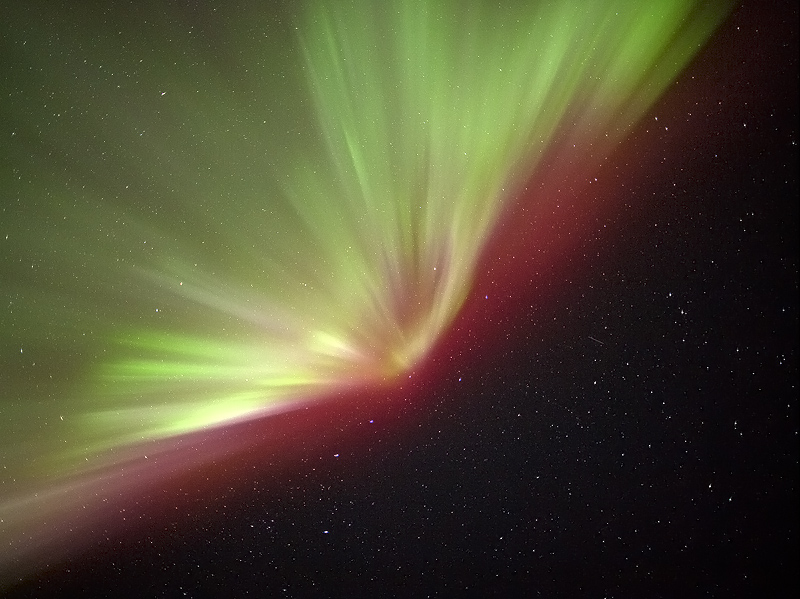
HIGH-LATITUDE AURORA ALERT: Earth is entering a stream of solar wind blowing ~500 km/s, and the encounter is stirring up geomagnetic activity around the Arctic Circle. High-latitude sky watchers should be alert for auroras.
Photographer Antony Spencer reports "an amazing display" over Enontekio, Finland, on March 22-23:
"I was leading a group of photographers who have come over from the U.K and we decided to drive inland from Tromsø to beat the clouds," says Spencer. "The display we witnessed was absolutely incredible. I have never seen this much color in the aurora before."
more images: from Sylvain Serre of Salluit, Nunavik, Quebec, Canada


3-day Solar Xray Flux graph