Ad

Showing posts with label solar flare forecast. Show all posts

Saturday, April 21, 2012

Sunspot Genesis. Solar Flare Forecast.


SUNSPOT GENESIS: The solar disk is peppered with sunspots and at least three of them are crackling with C-class solar flares. Make that four. A new sunspot, AR1465, has just broken through the stellar surface to join the action. Cai-Uso Wohler photographed the emergence from his backyard observatory in Bispingen, Germany:
NOAA forecasters estimate a 30% chance of an M-class flare during the next 24 hours. As the youngest and least stable of the sunspots, AR1465 is the most likely source. Stay tuned for solar activity. Solar flare alerts: textvoice.
more images: from the Charlie Bates Solar Astronomy Project of Washington, DC;from Jim Werle of Henderson, Nevada; from Alan Friedman of Buffalo, NY; from Jett Aguilar of Quezon City, Philippines

Monday, September 26, 2011

UPDATE: 09-26-2011 - Solar Flares. SIGNIFICANT SOLAR EVENT TAKING PLACE NOW. Significant Ground Currents. Satellites May Experience Issues With Solar Wind Plasma & Magnetic Fields.

SEVERE GEOMAGNETIC STORM TAKING PLACE RIGHT NOW...

ALERT:
Space Weather Message Code: WARK07
Serial Number: 33
Issue Time: 2011 Sep 26 1708 UTC

WARNING: Geomagnetic K-index of 7 or greater expected
Valid From: 2011 Sep 26 1715 UTC
Valid To: 2011 Sep 26 2100 UTC
Warning Condition: Onset
NOAA Scale: G3 or greater - Strong to Extreme
http://www.swpc.noaa.gov/alerts/warnings_timeline.html
 
 
SWPC ACE RTSW MAG 24-hour Updating Plot
3-day Satellite Environment graph and image map.3-day Estimated Planetary K-index graph


IMPACT: A coronal mass ejection (CME) hit Earth's magnetic field at approximately 12:15 UT on Sept. 26th. The impact caused significant ground currents in Norway. Also, the Goddard Space Weather Lab reports a "strong compression of Earth's magnetosphere. Simulations indicate that solar wind plasma [has penetrated] close to geosynchronous orbit starting at 13:00UT." Geosynchronous satellites could therefore be directly exposed to solar wind plasma and magnetic fields. Stay tuned for updates. 

SOLAR STATIC: Active sunspot 1302 has turned the sun into a shortwave radio transmitter. Shock waves rippling from the sunspot's exploding magnetic canopy are exciting plasma oscillations in the sun's atmosphere. The result: Bursts of static are issuing from the loudspeakers of shortwave radios on Earth. Amateur radio astronomer Thomas Ashcraft recorded this sample from his backyard observatory in New Mexico on Sept. 24th:


Dynamic spectrum: The horizontal axis is time (h:m:s), the vertical axis is frequency (MHz). Image credit: Wes Greenman

"Saturday was a super-strong solar day with near continuous flaring and radio sweeps," says Ashcraft. "The sound file (above) corresponds to an M3 flare at 1918 UTC. It was the strongest radio sweep of the observing day."


"Try listening to the radio bursts in stereo," he advises. "I was recording on two separate radios at 21.1 MHz and 21.9 MHz, and I put each one into its own channel of the audio file. This gives a spatial dimension as the bursts sweep down in frequency."

FORECAST...

SPACE WEATHER
NOAA Forecasts


Updated at: 2011 Sep 25 2235 UTC

FLARE
0-24 hr
24-48 hr
CLASS M
80 %
80 %
CLASS X
40 %
40 %


Geomagnetic Storms:
Probabilities for significant disturbances in Earth's magnetic field are given for three activity levels: active, minor storm, severe storm
Updated at: 2011 Sep 25 2235 UTC
Mid-latitudes

0-24 hr
24-48 hr
ACTIVE
45 %
30 %
MINOR
20 %
15 %
SEVERE
10 %
05 %

High latitudes

0-24 hr
24-48 hr
ACTIVE
45 %
30 %
MINOR
25 %
15 %
SEVERE
15 %
05 %
 

Satellite Environment Plot


3-day Satellite Environment graph and image map. link to Proton Plot link to Electron Plot link to GOES Mag. Plot link to Kp Plot

Boulder K plot
Proton Flux from GOES-13, Electron Flux and GOES Hp from GOES-13 & GOES-15

Space Weather Alerts and Warnings Timeline

Space Weather Alerts and Warnings Timeline


Big, Bright Flare

Big, Bright Flare
Just as an active region rotated into view, it unleashed a large (X1.4 class) solar flare (Sept. 22, 2011) as well as several smaller flares and a significant coronal mass ejection. Predictions are that the storm will likely not impact Earth. Following the bright flare, one can see brilliant coils of magnetic field lines regrouping themselves. Images were taken by NASA's Solar Dynamics Observatory in extreme ultraviolet light.


Sunday, September 4, 2011

M3-Class Solar Flare Disrupting Radio Stations In Norway.


SOLAR FLARE: This morning at 1145 UT, an active region on the sun's western limb unleashed an M3-class solar flare. NASA's Solar Dynamics Observatory recorded the flash of extreme UV radiation:
Although the blast site was not directly facing Earth, radiation from the explosion nevertheless ionized Earth's upper atmosphere. This altered the propagation of radio signals around Europe, where it was high-noon at the time of the flare. "I detected a sharp change in signal levels from two radio stations on the VLF band," reports Rob Stammes of Lofoten, Norway.
In addition to the UV flash, the explosion also hurled a CME into space: SOHO movie. The cloud is not heading for Earth, so no auroras will result from this particular event. That's not to say, however, that no auroras are in the offing. Read on....http://www.spaceweather.com/
3-day Solar Xray Flux graph

NOAA Space Weather Scale for Radio Blackouts

Category
Effect
Physical measure
Average Frequency
(1 cycle=11 years)
Scale
Descriptor
Duration of event will influence severity of effects
  

Radio Blackouts

GOES X-ray peak brightness by class and by flux*
Number of events when flux level was met; (number of storm days)
R 5
Extreme
HF Radio:Complete HF (high frequency**) radio blackout on the entire sunlit side of the Earth lasting for a number of hours. This results in no HF radio contact with mariners and en route aviators in this sector.
Navigation: Low-frequency navigation signals used by maritime and general aviation systems experience outages on the sunlit side of the Earth for many hours, causing loss in positioning. Increased satellite navigation errors in positioning for several hours on the sunlit side of Earth, which may spread into the night side.
X20
(2 x 10⁻³)
Less than 1 per cycle
R 4
Severe
HF Radio: : HF radio communication blackout on most of the sunlit side of Earth for one to two hours. HF radio contact lost during this time.
Navigation: Outages of low-frequency navigation signals cause increased error in positioning for one to two hours. Minor disruptions of satellite navigation possible on the sunlit side of Earth.
X10
(10-3)
8 per cycle
(8 days per cycle)
R 3
Strong
HF Radio: Wide area blackout of HF radio communication, loss of radio contact for about an hour on sunlit side of Earth.
Navigation: Low-frequency navigation signals degraded for about an hour.
X1
(10-4)
175 per cycle
(140 days per cycle)
R 2
Moderate
HF Radio: Limited blackout of HF radio communication on sunlit side, loss of radio contact for tens of minutes.
Navigation: Degradation of low-frequency navigation signals for tens of minutes.
M5
(5 x 10⁻⁵)
350 per cycle
(300 days per cycle)
R 1
Minor
HF Radio: Weak or minor degradation of HF radio communication on sunlit side, occasional loss of radio contact.
Navigation: Low-frequency navigation signals degraded for brief intervals.
M1
(10-5)
2000 per cycle
(950 days per cycle)
* Flux, measured in the 0.1-0.8 nm range, in W·m-2. Based on this measure, but other physical measures are also considered.
** Other frequencies may also be affected by these conditions.


Friday, August 19, 2011

Solar Update 8-19-2011 Including Solar Flare Activity &Forecast


Solar Blares: Listening to the Sun May Improve Space Weather Forecasts

A new method of tracking the propagation of sound waves in the sun's interior provides advance warning of sunspots

Sunspots emerging on the face of the sunSPOTTING THE SPOTS: Surface (gray) and subsurface (blue) activity before and after the emergence of a sunspot. Above, the emerging sunspot is clearly detectable some 60,000 kilometers below the surface, but the surface itself is calm. About two days later, the activity has risen to the surface.Image: The SOHO/MDI Team, SOHO is a project of international cooperation between ESA and NASA
Peering deep into the sun's churning plasma, solar physicists have discovered a way to forecast the emergence of sunspots before they reach the solar surface.

Sunspots are dark patches marking magnetically active regions that often host solar flares and violent belches called coronal mass ejections. Trimming lead times on sunspot detection would allow for better forecasts of space 
weather—bursts of radiation and charged particles from the sun that can cause real problems on and around Earth. Bad spells of space weather can damage power grids, endanger satellites and aircraft, and pose radiation threats to astronauts in orbit.

A group of Stanford University researchers has found that they can identify the signature of sunspots forming at depths of 60,000 kilometers or so, a full day or two before the sunspots bloom on the surface. The researchers reported their findings in the August 19 issue of Science.

"This is the first time that we have detected sunspots before they appear on the solar disk," says Stathis Ilonidis, a Stanford graduate student who co-authored the new study with physicists Junwei Zhao and Alexander Kosovichev.

Ilonidis and his colleagues plumbed the sun's inner workings with a method called
time–distance helioseismology. Working from archival data from the sun-orbiting SOHO spacecraft, the researchers measured how long it takes sound waves to travel from one point on the solar surface to another, some 100,000 to 200,000 kilometers away, along a refracted, or bent, path through the interior. In four locations where a sunspot was soon to emerge, acoustic waves returned to the solar surface with anomalous rapidity—more than a dozen seconds faster than normal. "At these distances, the travel time [through the sun's interior] is about one hour," Ilonidis says. "If there is a sunspot region along one of these paths, the travel time will be a little bit shorter." The emerging sunspot region seems to boost the local speed of sound, thereby hastening the refracted return of sound waves passing through that part of the solar interior.

The researchers also charted sound waves passing through nine quiet regions of the sun, where no sunspots were developing, and found no significant anomalies in the waves' travel time. By looking for sound waves propagating with anomalous speed, solar physicists going forward might be able to predict where sunspots are going to appear and provide longer lead-time forecasts back on Earth.

But Ilonidis acknowledges that more research is needed to test the predictive power of the new method. "What we need to do in the future is have more statistics, to look at more regions—both regions with sunspots and without sunspots—and check the statistics, whether we have false positives or false negatives," he says. "We need to find what is the success rate with our technique."

The strong signature of sunspots rising from the depths highlights how poorly understood is the sun's inner structure. The emerging sunspots speed up sound waves far more than had been expected; a recent analysis had predicted that sunspot regions would hasten the arrival time of sound waves 
by only one second or thereabouts. But Ilonidis and his colleagues found anomalies of 12 to 16 seconds for sound waves passing through a sunspot region. "That was a big surprise, because it's much higher than what we expected from the current theoretical models," he says.

What is more, the researchers found a sort of sweet spot for their soundings, a depth where the sunspot signal is strongest. But why emerging sunspots should reveal themselves clearly at one depth but not at others is a mystery. "We can detect sunspots at a depth of 60,000 kilometers, but if we try to detect them deeper or closer to the surface, the travel-time shift becomes weaker," Ilonidis says. "We don't understand why, only at a specific depth, the detection of sunspots is easier."

Solar physicist 
Philip Scherrer, who is also based at Stanford, notes that theoretical models of how sunspots appear are relatively successful at describing surficial solar activity but much less true to reality at depth. "So what happens deeper, how the dynamo is really generated from the interplay of rotation and convection and existing fields, isn't really understood," he says. "For all of these things you can tune up a model and make it work for a little while, but some basics are still missing."

Theoretical explanation or no, the new finding may soon afford airlines, satellite operators and other watchers of space weather advance warning of impending solar activity. "It will probably help us to make better forecasts for what the sun is going to do," Scherrer says. "Up until now we've waited until we see the magnetic field erupting."
Today's solar forecast...

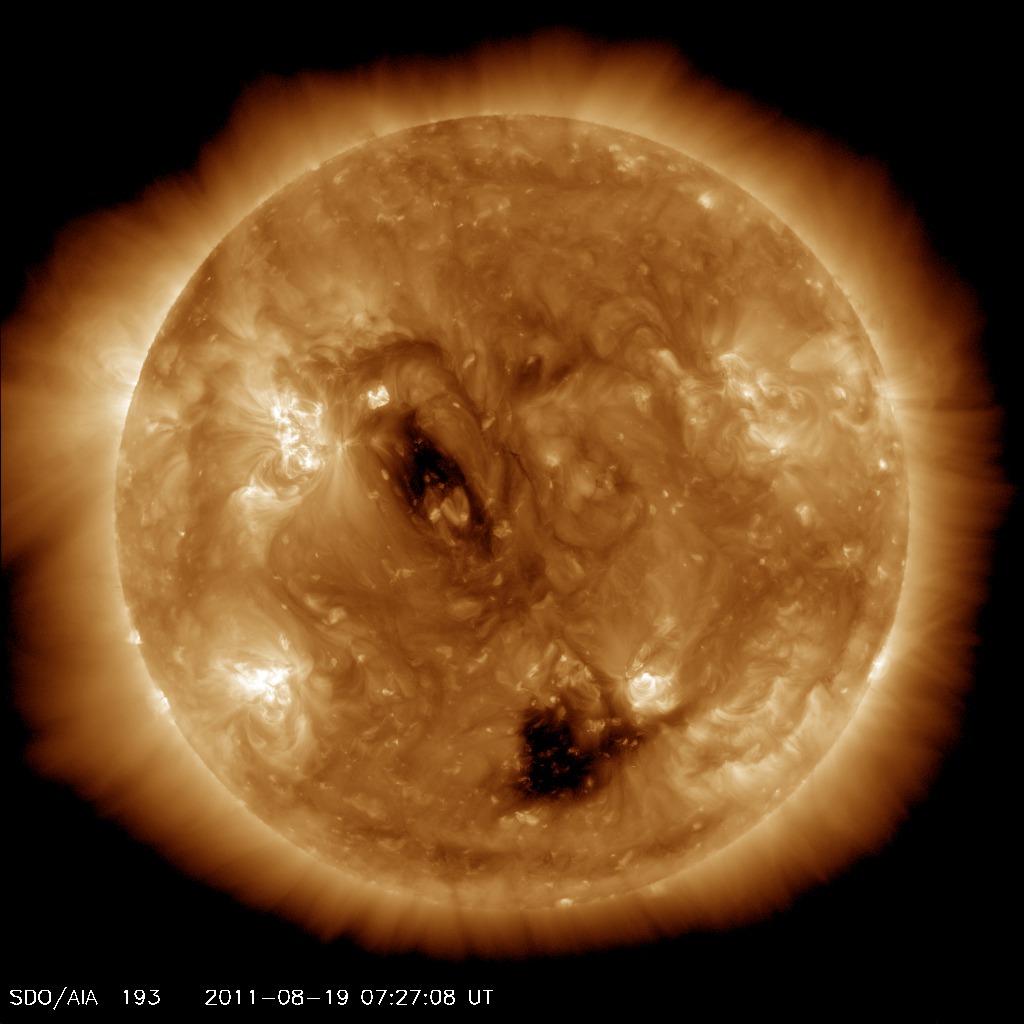
Coronal Holes: 19 Aug 11

A solar wind stream flowing from the indicated coronal hole should reach Earth on Aug. 22-23. Credit: SDO/AIA.

SPACE WEATHERNOAA Forecasts
Updated at: 2011 Aug 18 2200 UTC
FLARE
0-24 hr
24-48 hr
CLASS M
45 %
45 %
CLASS X
10 %
10 %

Geomagnetic Storms:Probabilities for significant disturbances in Earth's magnetic field are given for three activity levels:active, minor storm, severe storm
Updated at: 2011 Aug 18 2200 UTC
Mid-latitudes

0-24 hr
24-48 hr
ACTIVE
05 %
10 %
MINOR
01 %
05 %
SEVERE
01 %
05 %
High latitudes

0-24 hr
24-48 hr
ACTIVE
05 %
10 %
MINOR
05 %
05 %
SEVERE
01 %
01 %
http://spaceweather.com/


http://www.solen.info/solar/

Solar Update: Solar Activity has been very low during the past 24 hours with no major flare activity taking place. Sunspot 1271 remains the largest sunspot on the visible solar disk and could still produce C-Class flares and perhaps an M-Class event.
The Visible Solar Disk (Early Friday) - SDO


http://www.solarham.com/

Tuesday, August 9, 2011

Dude! Major X-7 Solar Flare! Amazing Footage & Explanatory Information, As Well As A Forecast.

Time for the X-Class Flares...


MAJOR SOLAR FLARE: This morning at 0805 UT, sunspot 1263 produced a powerful X7-class solar flare. NASA's Solar Dynamics Observatory captured the explosion's extreme ultraviolet flash:
The brunt of the explosion was not Earth directed. Nevertheless, a minor proton storm is in progress around our planet, which could affect satellites in high-altitude orbits. Also, radiation from flare created waves of ionization in Earth's upper atmosphere, briefly disrupting communications at some VLF and HF radio frequencies.
SOHO coronagraphs show a CME emerging from the blast site. The cloud will probably miss Earth. At this time, however, we cannot rule out a glancing blow from the flank of the CME on or about August 11th. Stay tuned for updates.
http://spaceweather.com/
more data: from Rob Stammes of Laukvik, Lofoten, Norway; from Andy Smith of Devon, United Kingdom.  


NOAA Forecasts
Updated at: 2011 Aug 08 2200 UTC
FLARE
0-24 hr
24-48 hr
CLASS M
55 %
55 %
CLASS X
10 %
10 %


The Classification of X-ray Solar Flares
or "Solar Flare Alphabet Soup"
A solar flare is an explosion on the Sun that happens when energy stored in twisted magnetic fields (usually above sunspots) is suddenly released. Flares produce a burst of radiation across the electromagnetic spectrum, from radio waves to x-rays and gamma-rays. [more information]
Scientists classify solar flares according to their x-ray brightness in the wavelength range 1 to 8 Angstroms. There are 3 categories: X-class flares are big; they are major events that can trigger planet-wide radio blackouts and long-lasting radiation storms. M-class flares are medium-sized; they can cause brief radio blackouts that affect Earth's polar regions. Minor radiation storms sometimes follow an M-class flare. Compared to X- and M-class events, C-class flares are small with few noticeable consequences here on Earth.
This figure shows a series of solar flares detected by NOAA satellites in July 2000:
3-day Solar Xray Flux graph


Each category for x-ray flares has nine subdivisions ranging from, e.g., C1 to C9, M1 to M9, and X1 to X9. In this figure, the three indicated flares registered (from left to right) X2, M5, and X6. The X6 flare triggered a radiation storm around Earth nicknamed the Bastille Day event.


 Class
Peak (W/m2)between 1 and 8 Angstroms


 B
 I < 10-6


 C
 10-6 < = I < 10-5


 M
 10-5 < = I < 10-4


 X
 I > = 10-4

http://spaceweather.com/glossary/flareclasses.html