Ad

Showing posts with label United States. Show all posts

Saturday, June 15, 2013

U.S. Getting Involved In Syrian Conflict

CIA preparing to deliver rebels arms through Turkey and Jordan

By  and Published: June 14

The CIA is preparing to deliver arms to rebel groups in Syria through clandestine bases in Turkey and Jordan that were expanded over the past year in an effort to establish reliable supply routes into the country for nonlethal material, U.S. officials said.
The bases are expected to begin conveying limited shipments of weapons and ammunition within weeks, officials said, serving as critical nodes for an escalation of U.S. involvement in a civil war that has lately seen a shift in momentum toward the forces of President Bashar al-Assad.

Syria experts cautioned that the opposition to Assad remains a chaotic mix of secular and Islamist elements, highlighting the risk that some American-provided munitions may be diverted from their intended recipients.
But U.S. officials involved in the planning of the new policy of increased military support announced by the Obama administration Thursday said that the CIA has developed a clearer understanding of the composition of rebel forces, which have begun to coalesce in recent months. Within the past year, the CIA also created a new office at its headquarters in Langley to oversee its expanding operational role in Syria.

“We have relationships today in Syria that we didn’t have six months ago,” Benjamin J. Rhodes, Obama’s deputy national security adviser, said during a White House briefing Friday. The United States is capable of delivering material “not only into the country,” Rhodes said, but “into the right hands.”

The confidence conveyed by Rhodes’s statement is in contrast to the concerns expressed by U.S. intelligence officials last year that the CIA and other U.S. spy agencies were still struggling to gain a firm understanding of opposition elements — a factor cited at the time as a reason the Obama administration was unwilling to consider providing arms.

“The Syrian puzzle has come into sharper focus in the past year, especially the makeup of various anti-regime groups,” said a U.S. official familiar with CIA assessments of the conflict. “And while the opposition remains far from monolithic, its military structures and coordination processes have improved.”

The official, like most others interviewed for this article, spoke on the condition of anonymity to discuss intelligence assessments and planning.

The increased certainty is one of several factors that led to the reversal of a U.S. policy against providing lethal aid that had been in place since the uprising began in Syria more than two years ago.

Rhodes said the change was driven by a new determination by U.S. intelligence agencies that Assad’s regime had used chemical weapons, including sarin gas, on at least four separate occasions. Obama also faced mounting pressure to intervene more aggressively as members of Congress and overseas allies became increasingly alarmed that Assad’s forces were gaining strength with expanded assistance from Russia and Iran.

For the CIA, the shift on Syria marks a return to a covert-action role that was familiar to the agency during Cold War-era conflicts but that gave way to increasingly direct lethal operations as the agency’s drone campaign surged in the years following the Sept. 11, 2001, attacks.

The agency’s mission in Syria carries substantial risks, including a long-standing fear that arms could fall into the hands of extremists who may seek to impose Islamist rule in Syria or turn those weapons against targets in Israel and other Western countries.

That concern accounts for initial limits imposed by Obama that will allow the delivery of rifles and other munitions, but not — at least for now — antitank or antiaircraft weapons that rebels have desperately sought.

Obama’s decision to approve CIA weapons shipments, spelled out in an updated covert-action finding recently signed by the president, may also signal that the administration is now prepared to endorse the delivery of heavier arms by regional allies.

“The Qataris and Saudis have been chomping at the bit,” said Will McCants, a research analyst at CNA Analysis and Solutions and former counterterrorism adviser at the State Department. “They’ve been wanting to give heavy weapons, including antitank and antiaircraft, from the beginning. And it’s us that has put the brakes on it.”

The CIA shipments will be aimed at bolstering the capabilities of an umbrella group known as the Supreme Military Council. The council is headed by Gen. Salim Idriss and other former Syrian military officers who favor the creation of a democratic government, although the network includes avowedly Islamist groups.
Some are members of the Syrian Liberation Front, a separate alliance that wants Islamist rule in Syria but is regarded as moderate and pragmatist.

Competing groups advocate the creation of an Islamist state. These include the Syrian Islamist Front as well as more radical groups such as Jabhat al-Nusra — literally “Victory Front” — an offshoot of al-Qaeda in Iraq that is listed as a terrorist group by the Obama administration. Another, Ahrar al-Sham, embraces a similar jihadist ideology and supports the imposition of austere, Taliban-like Islamic rule.

Those groups and potentially dozens of others have been in near-constant flux since the start of the war, adding to the confusion among U.S. analysts. But officials and experts said alliances among rebel organizations in recent months have created clearer ideological boundaries.

The CIA’s expanding role as conduit of nonlethal assistance over the past year has also given the agency deeper insight into the composition of groups and the flow of material, U.S. officials said.

The CIA does not have an established presence inside Syria, one official said. But it has been using bases in Turkey along the Syrian border, near where Idriss is based, since the outset of the conflict.

The agency’s weapons shipments are expected to be concentrated on routes out of Turkey, but U.S. officials said deliveries will also likely flow into southern Syria from Jordan, whose intelligence service has a long-standing relationship with the CIA.

“As the nonlethal aid has ramped up, U.S. intelligence has learned a lot more about who these guys are, who’s trustworthy and who’s not,” said a second U.S. official familiar with the shipment activity.

Less clear is the extent to which the CIA has technical means of monitoring the flow of arms shipments. U.S. military leaders have warned that they have no reliable way to track the heavy weaponry sought by rebel groups, including so-called MANPADs — the man-portable air-defense missiles that could help counter Assad’s air strength but could also be used by terrorist groups against civilian aviation targets.

As part of an effort to reassure the United States, regional allies presented a plan earlier this year in which rebels would be issued a small number of missiles and forced to return empty casings for each before receiving a new supply, said a Middle Eastern diplomat familiar with the plan.

“The Arabs have argued that MANPADs could be provided under highly controlled circumstances,” said the diplomat, who insisted on anonymity in describing private discussions with the United States. “The U.S. administration said it would investigate the matter, but they never responded.”


Craig Whitlock and Julie Tate contributed to this report.
source: Washington Post

SYRIAN TROOPS CAPTURE DAMASCUS SUBURB NEAR AIRPORT

— Jun. 15 3:18 PM EDT

Britain US Syria

Protesters demonstrate against western intervention in Syria, outside the US embassy in central London, Saturday, June 15, 2013.(AP Photo/Lefteris Pitarakis)

BEIRUT (AP) — Syrian troops pushed forward with their offensive against rebels Saturday, capturing a suburb near the Damascus international airport as the U.S. warned that the alleged use of chemical weapons by President Bashar Assad's forces and the involvement of the Iranian-backed militant group Hezbollah in the civil war threaten to put a proposed political settlement out of reach.
The U.S. and Russia have been pressing for a peace conference to end Syria's civil war in Geneva, but prospects for that have been dampened after a series of regime battlefield victories and hardened positions by both sides as the death toll from the more than 2-year-old conflict has surged to nearly 93,000.
President Barack Obama's decision this week to send lethal aid to Syrian rebels and the deepening involvement of trained Shiite fighters from Lebanon's Hezbollah group also has raised the stakes, setting up a proxy fight between Iran and the West that threatens to engulf more of the Middle East.
The U.S. reversal after months of saying it would not intervene in the conflict militarily came after Washington said it had conclusive evidence the Syrian regime had used chemical weapons, something Obama had said would be a "red line."
Syria has denied the accusations, saying Obama was lying about the evidence to justify his decision to arm the rebels. Syria's ally Russia also suggested Saturday that the evidence put forth by the United States of the use of chemical weapons doesn't meet stringent criteria for reliability.
U.S. Secretary of State John Kerry was quoted in a statement as saying the United States continues to work aggressively for a political solution with the goal of a second Geneva meeting. But "the use of chemical weapons and increasing involvement of Hezbollah demonstrates the regime's lack of commitment to negotiations and threatens to put a political settlement out of reach," he said in a telephone conversation Friday with Iraqi Foreign Minister Hoshyar Zebari.
read more at AP


Sunday, May 19, 2013

Solar Flare Propels Coronal Mass Ejection Towards Earth and Likely Will Cause Geomagnetic Storms Starting Today, May 19, 2013

CME IMPACT: A CME hit Earth's magnetic field on May 19th at 2250 UT (3:50 PM PDT). Polar geomagnetic storms and high-latitude auroras are possible in the hours ahead. Stay tuned for updates. 

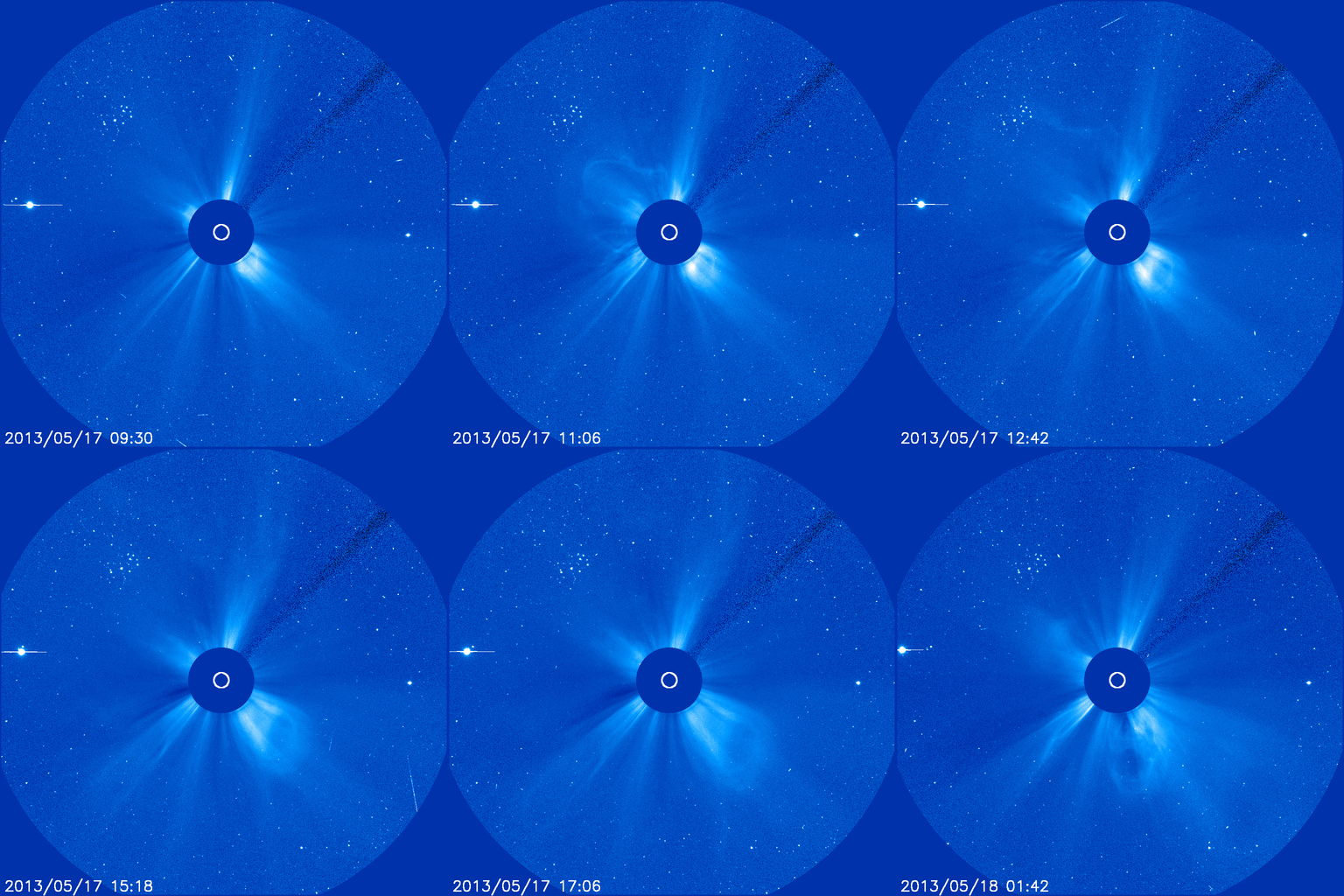
The CME was propelled toward Earth on May 17th by an M3-class solar flare in the magnetic canopy of sunspot AR1748. SOHO took this picture of the CME racing away from the sun at 1500 km/s (3.4 million mph):


It was hurled into space by an M3-class solar flare in the magnetic canopy of sunspot AR1748. In the video, the CME appears to hit Mercury, but it does not. It is merely passing in front of the innermost planet. The planet in the line of fire is Earth.

AURORAS INVADE THE USA: A CME hit Earth's magnetic field on May 18th at around 0100 UT. Although it was just a glancing blow, the impact was enough to spark a G1-class geomagnetic storm. In the United States, Northern Lights descended as far south as Pawnee Buttes, Colorado:


"The aurora was not visible to the naked eye," says photographer Robert Arn. "Only with a 30 second exposure did I know it was there. As I started to collect data, I noticed an electrical storm in the distance. The juxtaposition of the electrical storm and aurora made for a spectacular image. (The moon near the horizon illuminated the landscape.)"

Elsewhere in the United States, faint auroras were photographed in Michigan, Massachusetts, Washington, Vermont, and Iowa. Browse the aurora gallery for more sightings.


Planetary K-index
Now: Kp= 2 quiet
24-hr max: Kp= 4 
unsettled
explanation | more data
Interplanetary Mag. Field
Btotal13.8 nT
Bz3.3 nT south 
explanation | more data
Updated: Today at 2357 UT

SWPC ACE RTSW MAG 24-hour Updating Plot

3-day Estimated Planetary K-index graph


The K-index

The K-index is a code that is related to the maximum fluctuations of horizontal components observed on a magnetometer relative to a quiet day, during a three-hour interval. The conversion table from maximum fluctuation (nT) to K-index, varies from observatory to observatory in such a way that the historical rate of occurrence of certain levels of K are about the same at all observatories. In practice this means that observatories at higher geomagnetic latitude require higher levels of fluctuation for a given K-index. The conversion table for the Boulder magnetometer is shown below:
K
nT
0
0-5
1
5-10
2
10-20
3
20-40
4
40-70
5
70-120
6
120-200
7
200-330
8
330-500
9
>500
At SWPC, we monitor the preliminary values of the K-index, minute by minute, from a network of observatories that relay data in near-real time. The final K-indices are determined after the end of prescribed three hourly intervals (0000-0300, 0300-0600, ..., 2100-2400). The maximum positive and negative deviations during the 3-hour period are added together to determine the total maximum fluctuation. These maximum deviations may occur anytime during the 3-hour period.


Relationship between Kp and the Aurora [ref]
Right: From thousands of observations, Cornell University scientists have determined geographic subpoints for the southern edges of auroral displays. The curves represent four values of the planetary index (Kp). As this index increases, the aurora's southern edge moves southward

In this article we briefly explain some of the ideas behind the association of the aurora with geomagnetic activity and a bit about how the ‘K-index’ or ‘K-factor’ works. The aurora is understood to be caused by the interaction of high energy particles (usually electrons) with neutral atoms in the earth's upper atmosphere. These high energy particles can ‘excite’ (by collisions) valence electrons that are bound to the neutral atom. The ‘excited’ electron can then ‘de-excite’ and return back to its initial, lower energy state, but in the process it releases a photon (a light particle). The combined effect of many photons being released from many atoms results in the aurora display that you see.

The details of how high energy particles are generated during geomagnetic storms constitute an entire discipline of space science in its own right. The basic idea, however, is that the Earth’s magnetic field (let us say the ‘geomagnetic field’) is responding to a outwardly propagating disturbance from the Sun. As the geomagnetic field adjusts to this disturbance, various components of the Earth’s field change form, releasing magnetic energy and thereby accelerating charged particles to high energies. These particles, being charged, are forced to stream along the geomagnetic field lines. Some end up in the upper part of the earth’s neutral atmosphere and the auroral mechanism begins.

The disturbance of the geomagnetic field may also be measured by an instrument called a magnetometer. At our operations center we receive magnetometer data from dozens of observatories in one minute intervals. The data is received at or near to ‘real-time’ and allows us to keep track of the current state of the geomagnetic conditions. In order to reduce the amount of data that our customers have to deal with we convert the magnetometer data into three-hourly indices which give a quantitative, but less detailed measure of the level of geomagnetic activity. The K-index scale has a range from 0 to 9 and is directly related to the maximum amount of fluctuation (relative to a quiet day) in the geomagnetic field over a three-hour interval.

The K-index is therefore updated every three hours and the information is made available to our customers as soon as possible. The K-index is also necessarily tied to a specific geomagnetic observatory. For locations where there are no observatories, one can only estimate what the local K-index would be by looking at data from the nearest observatory, but this would be subject to some errors from time to time because geomagnetic activity is not always spatially homogenous. Another item of interest is that the location of the aurora usually changes geomagnetic latitude as the intensity of the geomagnetic storm changes. The location of the aurora often takes on an ‘oval-like’ shape and is appropriately called the auroral oval. A useful map of the approximate location of the auroral oval as a function of the Kp-index was published in the June 1968 copy Sky & Telescope (see page 348). The Kp index is derived through by an algorithm that essentially averages the K-indices from several stations. Note that as a storm becomes more intense, the edge of the auroral boundary typically moves to lower latitudes.

For further reading we can recommend a couple of books for you. An old, but classic text is The Polar Aurora, Oxford University Press, 1955, by Störmer. A more modern text is The Physics of Space Plasmas, 1991, by George Parks. If you are interested in real-time reporting of geomagnetic activity please make use of our 24-hour/day, 7 day/week services. We have an internet home page address (/), and a recorded message which is updated every three hours or as major activity occurs (303-497-3235). You can also reach us at 303-497-3204. We hope that you find this information helpful. If you have some further questions please don’t hesitate to let us know. Best wishes ! Chris Balch (cbalch@sec.noaa.gov)


SPACE WEATHER
NOAA Forecasts
Updated at: 2013 May 19 2200 UTC
FLARE
0-24 hr
24-48 hr
CLASS M
65 %
65 %
CLASS X
25 %
25 %
source: source: http://spaceweather.com/


3-day GOES X-ray Plot
The GOES X-ray Flux plot contains 5 minute averages of solar X-ray output in the 1-8 Angstrom (0.1-0.8 nm) and 0.5-4.0 Angstrom (0.05-0.4 nm) passbands. Data from the SWPC Primary and Secondary GOES X-ray satellites are shown. Some data dropouts from the Primary satellite will occur during satellite eclipses.
source: http://www.swpc.noaa.gov/rt_plots/xray_5m.html

SWPC ACE RTSW MAG & SWEPAM 24-hour Updating Plot

source: http://www.swpc.noaa.gov/ace/MAG_SWEPAM_24h.html


Geomagnetic Storms:
Probabilities for significant disturbances in Earth's magnetic field are given for three activity levels:activeminor stormsevere storm

Updated at: 2013 May 19 2200 UTC
Mid-latitudes
0-24 hr
24-48 hr
ACTIVE
35 %
15 %
MINOR
30 %
05 %
SEVERE
20 %
01 %
High latitudes
0-24 hr
24-48 hr
ACTIVE
05 %
15 %
MINOR
20 %
25 %
SEVERE
75 %
25 %


ACTIVE:

Geomagnetic Storm Forecasts
The geomagnetic storm probabilities are the estimated chances of at least one 3-hour K index, at the indicated level, for each of the next 3 days.

Active: K = 4.
Minor storm: K = 5.
Major or Severe storm: K > 6.

The "K index" is a 3-hourly quasi-logarithmic local index of geomagnetic activity relative to an assumed quiet-day curve for the recording site. Range is from 0 to 9. The K index measures the deviation of the most disturbed horizontal component of the magnetic field.
http://spaceweather.com/glossary/geostorm.html

MINOR:

Geomagnetic Storm Forecasts
The geomagnetic storm probabilities are the estimated chances of at least one 3-hour K index, at the indicated level, for each of the next 3 days.

Active: K = 4.
Minor storm: K = 5.
Major or Severe storm: K > 6.

The "K index" is a 3-hourly quasi-logarithmic local index of geomagnetic activity relative to an assumed quiet-day curve for the recording site. Range is from 0 to 9. The K index measures the deviation of the most disturbed horizontal component of the magnetic field.


http://spaceweather.com/glossary/geostorm.html

SEVERE:
Geomagnetic Storm Forecasts
The geomagnetic storm probabilities are the estimated chances of at least one 3-hour K index, at the indicated level, for each of the next 3 days.

Active: K = 4.
Minor storm: K = 5.
Major or Severe storm: K > 6.

The "K index" is a 3-hourly quasi-logarithmic local index of geomagnetic activity relative to an assumed quiet-day curve for the recording site. Range is from 0 to 9. The K index measures the deviation of the most disturbed horizontal component of the magnetic field.

http://spaceweather.com/glossary/geostorm.html


Tuesday, April 9, 2013

Japan Readying Patriot Missiles to Defend Against North Korea's Suspected Upcoming Nuclear Missile Test


Japan Deploys Patriot Missiles to Defend Tokyo from North Korean Threats

Military moves three PAC-3 batteries in defensive ring around central Tokyo - and more are likely to follow

By VASUDEVAN SRIDHARAN:
April 9, 2013 7:21 AM GMT
Members of the Japan Self-Defence Forces deploy PAC-3 missiles at the Defence Ministry in Tokyo - Reuters
Members of the Japan Self-Defence Forces deploy PAC-3 missiles at the defence ministry in Tokyo. - Reuters
Japan has deployed Patriot missiles in and around central Tokyo as a defensive measure should North Korea decide to launch an attack amid rising tensions in the Korean Peninsula.
Tokyo has moved three Patriot Advanced Capability-3 (PAC-3) surface-to-air missile launchers, according to the defence ministry. Two more batteries are likely to be stationed at other places.
The units are meant to defend the headquarters of the defence ministry and key military installations in the capital as well as the 30 million people who live in greater Tokyo.
"We are proceeding with measures including deployment of PAC-3 as we are on alert," said Tokyo's Defence Minister Itsunori Onodera.
He said another unit would be stationed in Okinawa prefecture as "the place that is most effective in responding to emergencies".
Although Japan has poured scorn on North Korea's threats thus far, the latest move is evidence that it could be preparing for the worst.
Tokyo had already deployed Aegis class destroyers equipped with missile interceptors in the Sea of Japan to counter the North Korean threats, and authorised its forces to shoot down any missile emanating from North Korea.  
"The government is making utmost efforts to protect our people's lives and ensure their safety. As North Korea keeps making provocative comments, Japan, cooperating with relevant countries, will do what we have to do. For the moment, the most important thing is to implement sanctions under the UN Security Council resolutions," Japanese Prime Minister Shinzo Abe told reporters.
Further details about the deployment have been withheld by the authorities because of the sensitive nature of the issue.
"We'd like to refrain from explaining further because it would give away details of the cards we hold. At any rate, we have taken thorough measures to ensure the safety of the people," said Chief Cabinet Secretary Yoshihide Suga.
The announcement from Tokyo, Washington's close ally in the region, has come after Seoul-based reports suggested that North Korea has moved two medium-range missiles off its eastern coast.
While former North Korean leader Kim Il-Sung's birthday falls on 15 April, experts believe Pyongyang's current leadership may resort to provocative actions coinciding with the occasion to boost its own reputation domestically.
read more at ibtimes


Ultimate Year Supply


Mountain House Sale - 20-25% OFF

North Korea suspected of preparing for nuclear test

South Korean government says there are signs the regime is getting ready for what would be its fourth nuclear weapon test
 in Seoul
guardian.co.uk
North Korea could be preparing to conduct a fourth nuclear test, following signs of activity at the country's main testing site, South Korea's unification minister, Ryoo Kihl-jae, said on Monday.
Ryoo told a meeting with MPs at the national assembly that Seoul had acquired evidence of increased movement of vehicles and personnel at Punggye-ri, the Yonhap news agency said.
The site on North Korea's north-east coast is where the country's three previous controlled nuclear detonations – in 2006, 2009 and on 12 February this year – took place.
Ryoo's comments came after a South Korean newspaper quoted an unnamed government source as saying that workers appeared to be preparing for another test at Punggye-ri.
The JoongAng Ilbo quoted the source as saying that South Korean intelligence had detected "increased activity of labour forces and vehicles" at the site.
"We are closely monitoring the ongoing situation, which is very similar to the situation ahead of the third nuclear test. We are trying to figure out whether it is a genuine preparation for a nuclear test or just a ploy to heap more pressure on us and the US," it said.
The prospect of a nuclear test is certain to add to tensions on the peninsula amid reports that the regime in Pyongyang could be planning to launch a medium-range missile from its east coat, possibly as early as Wednesday.
Any missile launch is expected to be a test rather than a targeted strike and could take place in the runup to the 101st anniversary of the birth of North Korea's founder, Kim Il-sung, on 15 April. Another significant date is the anniversary of the foundation of the Korean people's army 10 days later.
Last week, North Korea warned foreign embassies in Pyongyang it could not guarantee their safety from the threat of conflict after Wednesday this week and advised them to consider pulling their staff out of the capital.
read more at Guardian

Wednesday, March 27, 2013

North Korea Is Playing With Fire.

North Korea Puts Artillery Forces on High Alert, Threatens US


North Korea said today it has moved strategic rocket and artillery units into top combat position in preparation for a strike against the United States.

In a statement released by the Korean Central News Agency (KCNA), North Korea said, "From this moment, the Supreme Command of the Korean People's Army will be putting in combat duty posture No. 1 all field artillery units including long-range artillery strategic rocket units that will target all enemy objects in U.S. invasionary bases on its mainland, Hawaii and Guam."

The United States recently engaged in long-planned joint military exercises in the region. Also, the United States and South Korea Friday signed a military pact providing for a joint response to even low-level provocation from the North.

The move was predicted by analysts to provoke the North, and state news Monday released photos of the North Korean leader, Kim Jong Un, inspecting People's Army Unit 1501.

In response to the KCNA statement today, South Korea's Presidential Office downplayed the threat. "We have not detected any special movements in the North Korean military," the office said.

Kim Yong Hyun, a professor of North Studies at Dong Guk University in Seoul, said North Korea's statement "doesn't mean that they will conduct some sort of military attack right away. They are elevating the crisis situation with the harshest rhetoric as possible."

North Korea has made similar statements in the past but has not included the term "No.1" until now. South Korean military experts are analyzing what that might mean.

It is not the first time the military regime has put its forces on "combat-ready' posture."

Sunday, March 3, 2013

What Will the Sequester Do to the Military

U.S.: What the Sequester Will Do to the Military

March 1, 2013 | 1116 GMT

Summary

Sequestration, the automatic spending reductions scheduled to take effect March 1, will affect the U.S. military's ability to project force around the world. The current continuing resolution that Congress is using to fund the entire government until March 27 has already affected U.S. forces. The longer these funding cuts continue, the more degradation the U.S. military will incur, with longer-lasting effects. 

Analysis

Although Stratfor typically does not examine domestic U.S. issues, this one is geopolitically significant. The U.S. military, and particularly the Navy, is the most powerful force projection instrument in the world. When the sequester takes effect, it will immediately reduce military spending by 8 percent, with more than $500 billion in cuts to defense spending over 10 years divided equally among the military branches. The continuing resolution is already affecting the military since it has locked the military budget into 2011 spending levels and prevented spending increases or re-allocations among various budgets. On March 27, Congress will have to have a new budget in place, extend the continuing resolution or force a government shutdown; the most likely decision will be to maintain the continuing resolution. 

It is not the overall amount of the reductions that is damaging, necessarily; it is the way in which the cuts will be implemented. The across-the-board cuts required by the sequestration coupled with the limits set by the continuing resolution are constraining budget planners' options in how to absorb the spending reductions and thus are damaging all the military branches, programs, training, deployments and procurement. 

Funding Cuts and Force Readiness 

Just the threat of continued budget reductions has had an immediate effect on the military's readiness. The Navy decided not to deploy a second carrier to the Persian Gulf, backing down from its standard of two carriers in the region. Instead, the second carrier will serve in a surge capacity for the immediate future. The other branches have extended the deployments of units already in theaters and delayed others from rotating in as replacements since it is relatively less expensive to have units stay in place than move them and their equipment intercontinentally. 

Maintenance budgets across the forces have been reduced or suspended in anticipation of cuts. Training of all non-deploying forces who are not critical to the national strategic forces is also being heavily curtailed. These options were chosen because they are immediate cost-saving measures that can be reversed quickly as opposed to the big-budget procurement programs, in which changes can cause delays for years. In many cases, the Department of Defense would have to pay massive fines for withdrawing from binding contracts, and renegotiations are often very costly. The Defense Department hopes that the cuts will be short-lived, but the longer the spending constraints continue, the more the military's platforms and personnel units degrade in readiness. 

The medium- to long-term effects can be even more serious. Any given military platform, from a Stryker armored vehicle to an aircraft carrier, requires a lot of money in order to be ready for use at any time at its intended level of performance. These platforms require consistent use to maintain a certain readiness level because machines cannot sit idle for months to years and then operate effectively, if at all, especially if called on for immediate action. Moreover, the people that operate this equipment need to maintain their working knowledge and operational skill through continued use. This use causes wear and tear on the platform and requires consistent maintenance. All of this is necessary just to maintain the status quo. In the end, there must be a balance between a platform's readiness level and the amount of funding required for operations and maintenance, but if the money is no longer available there is no choice but to reduce readiness. 

Also, upgrades are needed so platforms can stay up to date and useable within the system the military is using to move, shoot and communicate. This is a constant cycle that, when interrupted, has very long-lasting consequences. For example, the Navy has said it is considering suspending operations of four of its nine carrier air wings while shutting down four of its carriers in various stages of the operations and maintenance process. This would essentially give the United States one carrier deployed with one on call for years. This will be sufficient if the world remains relatively quiet, but one large emergency or multiple small ones would leave the United States able to project limited force compared to previous levels. 

In the longer term, procurement programs for new equipment will either be delayed or cut altogether. This will put more pressure on existing platforms, requiring them to operate past their intended life spans, and will preclude or delay the introduction of better abilities into the military. Procurement cycles are very slow and take decades to implement; for instance, the Navy that the United States wants to have in 20 years is being planned now. An extreme example of the damage that a military force can incur because of a lack of procurement, operations, maintenance and upgrades is the current state of the Russian military. Russian forces still feel the effects of the Soviet Union's collapse and the subsequent decade of neglect. 

A Smaller Presence Around the World 

The U.S. military has a global presence, and sequestration would have appreciable effects on this in certain areas. Potentially, the hardest hit region will be the Pacific, which has been the focus of the United States' new strategy. If the United States wants to continue pivoting its focus toward the Pacific, the military would have to draw more resources than originally planned. No specific mention has been made of changing the U.S. military footprint in Japan, other than possibly curtailing combat air patrols, and U.S. forces are already consolidating their presence in South Korea to fewer bases south of Seoul and diminishing their role in relation to the South Korean military. The Navy's reduction in ship deployments to the region will just reinforce the current trend. 

The U.S. military's footprint is being reduced in a few other areas. The combat zone in Afghanistan has 66,000 troops, with 34,000 scheduled to come home by the end of the year. All but around 8,000 will return home by the end of 2014. The 5th Fleet headquartered in Bahrain is being affected by the Navy's decision to have only one carrier in the Persian Gulf. Europe is seeing a reduction from four brigade combat teams to two, which was already planned and is another reinforced trend. The U.S. ground presence in Africa and South America should be relatively unchanged, since these predominantly involve special operations forces -- the kind of deployment that is already being emphasized over larger conventional forces. 

Like this report? Subscribe to enjoy related reports and more:
  • U.S. Naval Update Map
  • The Origin of Wars
  • Syria: The Air Force's Importance to the Regime
The single biggest capability gap that will develop will be the U.S. military's surge capacity. If the Syria-Iraq-Lebanon corridor were to become more unstable, the United States will not be able to respond with the same force structure it had in the past. The U.S. military can still shift its assets to different regions to attain its strategic goals, but those assets will come from a smaller resource pool, and shifting them will lessen the presence in some other region. The military's ability to use one of its softer political tools -- joint military exercises -- will also be at risk. 

Reduced Relative Dominance 

This is not to say that the U.S. military will be wrecked immediately or that its condition is anywhere near that of the Russian military in the 1990s. A military's effectiveness is measured against its potential opponents, and the United States has enjoyed a large gap for decades. However, if a military is not growing in capabilities and other militaries or groups are, then its relative power is decreasing. This means that after sequestration is implemented or the continuing resolution is maintained, the U.S. military will remain dominant for years to come, but not as dominant as it has been relative to other forces. 

There are many ways the effects of funding cuts can be mitigated. Congress can continue to delay addressing budget issues and the military's concerns indefinitely, or it can make some changes, such as allowing the Department of Defense more discretion in how it implements these cuts. However, the budget cuts are already having preliminary effects, and the longer the cuts continue, the greater the potential for degradation of the U.S. military's force projection capabilities. Funding cuts are not necessarily abnormal for the United States while winding down into a postwar stance. Historically, the pattern has been a reduction in spending and retrenchment of a large volume of forces from abroad. However, Pentagon planners typically go into a postwar period with the stated goal of not damaging the force through these cuts and reductions. 

source: www.Stratfor.com

Saturday, January 12, 2013

Flu Epidemic

Picture

Flu Epidemic: Hospitals Crack Down On Workers Who Refuse Shots
CHICAGO — Patients can refuse a flu shot. Should doctors and nurses have that right, too? That is the thorny question surfacing as U.S. hospitals increasingly crack down on employees who won't get flu shots, with some workers losing theirjobs over their refusal.

"Where does it say that I am no longer a patient if I'm a nurse," wondered Carrie Calhoun, a longtime critical care nurse in suburban Chicago who was fired last month after she refused a flu shot.


Hospitals' get-tougher measures coincide with an earlier-than-usual flu season hitting harder than in recent mild seasons. Flu is widespread in most states, and at least 20 children have died.


Most doctors and nurses do get flu shots. But in the past two months, at least 15 nurses and other hospital staffers in fourstates have been fired for refusing, and several others have resigned, according to affected workers, hospital authorities and published reports.


read more at http://www.huffingtonpost.com/2013/01/12/flu-vaccine-nurses_n_2464663.html


Flu Epidemic: Officials, Drug Stores Say Call Ahead Before Getting Vaccine

The heightened demand for the flu vaccine has caused some providers to run out of doses, however officials said there are still plenty to go around and are encouraging people to call ahead before driving to a local clinic to get immunized.

National drug store chain Rite Aid is moving some of its supplies around to make sure each of their locations remain stocked, spokeswoman Ashley Flower said.


"In select areas, just like everybody else, we are experiencing a reduced amount of shots," Flower told ABC News Radio. "We would certainly advise our customers to call their local Rite Aid before coming in to see what the status of the vaccine is at their location."


read more at http://abcnews.go.com/Health/flu-epidemic-officials-drug-stores-call-ahead-vaccine/story?id=18198019


Flu Widespread

Flu widespread in 47 of 50 United States, but eases off in some areasThe flu is rapidly spreading across the nation, widespread in all but three states: California, Mississippi and Hawaii. But there's a tiny bit of good news — it's backing off a bit. It may have already peaked in some parts, like the Southern states.

Read more: http://www.nydailynews.com/life-style/health/flu-spreads-u-s-eases-areas-article-1.1238794#ixzz2Hp4yBwnD


READ MORE AT