Ad

Showing posts with label European Union. Show all posts

Tuesday, March 26, 2013

European Economic Crisis & Cyprus


Europe's Disturbing Precedent in the Cyprus Bailout

March 26, 2013 | 0900 GMT
By George Friedman
Founder and Chairman
The European economic crisis has taken different forms in different places, and Cyprus is the latest country to face the prospect of financial ruin. Overextended banks in Cyprus are teetering on the brink of failure for issuing loans they cannot repay, which has prompted the tiny Mediterranean country, a member of the European Union, to turn to Brussels for help. Late Sunday, the European Union and Cypriot president announced new terms for a bailout that would provide the infusion of cash necessary to prevent bankruptcies in Cyprus' banking sector and, more important, prevent a banking panic from spreading to the rest of Europe.
What makes this crisis different from the previous bailouts for Greece, Ireland or elsewhere are the conditions Brussels has attached for its assistance. Due to circumstances unique to Cyprus, namely the questionable origin of a large chunk of the deposits in its now-stricken banking sector and that sector's small size relative to the overall European economy, the European Union, led by Germany, has taken a harder line with the country. Cyprus has few sources of capital besides its capacity as a banking shelter, so Brussels required that the country raise part of the necessary funds from its own banking sector -- possibly by seizing money from certain bank deposits and putting it toward the bailout fund. The proposal has not yet been approved, but if enacted it would undermine a formerly sacred principle of banking in most industrial nations -- the security of deposits -- setting a new and possibly destabilizing precedent in Europe.

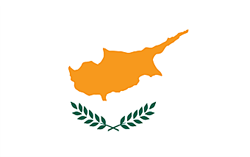
Cyprus FlagCyprus' Dilemma

For years before the crisis, Cyprus promoted itself as an offshore financial center by creating a tax structure and banking rules that made depositing money in the country attractive to foreigners. As a result, Cyprus' financial sector grew to dwarf the rest of the Cypriot economy, accounting for about eight times the country's annual gross domestic product and employing a substantial portion of the nation's work force. A side effect of this strategy, however, was that if the financial sector experienced problems, the rest of the domestic economy would not be big enough to stabilize the banks without outside help.
Europe's economic crisis spawned precisely those sorts of problems for the Cypriot banking sector. This was not just a concern for Cyprus, though. Even though Cyprus' banking sector is tiny relative to the rest of Europe's, one Cypriot bank defaulting on what it owed other banks could put the whole European banking system in question, and the last thing the European Union needs now is a crisis of confidence in its banks.
The Cypriots were facing chaos if their banks failed because the insurance system was insufficient to cover the claims of depositors. For its part, the European Union could not risk the financial contagion. But Brussels could not simply bail out the entire banking system, both because of the precedent it would set and because the political support for a total bailout wasn't there. This was particularly the case for Germany, which would carry much of the financial burden and is preparing for elections in September 2013 before an electorate that is increasingly hostile to bailouts.
Even though the German public may oppose the bailouts, it benefits immensely from what those bailouts preserve. As I have pointed out many times, Germany is heavily dependent on exports and the European Union is critical to those exports as a free trade zone. Although Germany also imports a great deal from the rest of the bloc, a break in the free trade zone would be catastrophic for the German economy. If all imports were cut along with exports, Germany would still be devastated because what it produces and exports and what it imports are very different things. Germany could not absorb all its production and would experience massive unemployment.


Read more: Europe's Disturbing Precedent in the Cyprus Bailout | Stratfor 

Tuesday, August 28, 2012

Poland's Strategy


August 28, 2012

By George Friedman
Polish national strategy pivots around a single, existential issue: how to preserve its national identity and independence. Located on the oft-invaded North European Plain, Poland's existence is heavily susceptible to the moves of major Eurasian powers. Therefore, Polish history has been erratic, with Poland moving from independence -- even regional dominance -- to simply disappearing from the map, surviving only in language and memory before emerging once again.
North European Plain
For some countries, geopolitics is a marginal issue. Win or lose, life goes on. But for Poland, geopolitics is an existential issue; losing begets national catastrophe. Therefore, Poland's national strategy inevitably is designed with an underlying sense of fear and desperation. Nothing in Polish history would indicate that disaster is impossible.
To begin thinking about Poland's strategy, we must consider that in the 17th century, Poland, aligned with Lithuania, was one of the major European powers. It stretched from the Baltic Sea almost to the Black Sea, from western Ukraine into the Germanic regions. By 1795, it had ceased to exist as an independent country, divided among three emerging powers: Prussia, Russia and Austria.

Poland-Lithuania Commonwealth
It did not regain independence until after World War I -- it was created by the Treaty of Versailles (1919) -- after which it had to fight the Soviets for its existence. Poland again was brought under the power of a foreign nation when Germany invaded in 1939. Its statehood was formalized in 1945, but it was dominated by the Soviets until 1989.
Informed by its history, Poland understands that it must retain its independence and avoid foreign occupation -- an issue that transcends all others psychologically and practically. Economic, institutional and cultural issues are important, but the analysis of its position must always return to this root issue.

Poland's Elusive Security

Poland has two strategic problems. The first problem is its geography. The Carpathian Mountains and the Tatra Mountains provide some security to Poland's south. But the lands to the east, west and southwest are flat plains with only rivers that provide limited protection. This plain was the natural line of attack of great powers, including Napoleonic France and Nazi Germany.
Poland's Strategy
During the 17th century, the Germans were fragmented in the Holy Roman Empire, while Russia was still emerging as a coherent power. The North European Plain was an opportunity for Poland. Poland could establish itself on the plain. It could protect itself against a challenge from any direction. But Poland becomes extremely difficult to defend when multiple powers converge from different directions. If Poland is facing three adversaries, as it did in the late 18th century with Prussia, Russia and Austria, it is in an impossible position.
For Poland, the existence of a powerful Germany and Russia poses an existential problem, the ideal solution to which is to become a buffer that Berlin and Moscow respect. A secondary solution is an alliance with one for protection. The latter solution is extremely difficult because dependence on Russia or Germany invites the possibility of absorption or occupation. Poland's third solution is to find an outside power to guarantee its interests.
This is what Poland did in the 1930s with Britain and France. This strategy's shortcomings are obvious. First, it may not be in the interests of the security guarantor to come to Poland's assistance. Second, it may not be possible at the time of danger for them to help Poland. The value of a third-party guarantee is only in deterring attack and, failing that, in the willingness and ability to honor the commitment.
Since 1991, Poland has sought a unique solution that was not available previously: membership in multilateral organizations such as the European Union and NATO. Such memberships are meant to provide protection outside the bilateral system. Most important, these memberships bring Germany and Poland into the same political entity. Ostensibly, they guarantee Polish security and remove the potential threat of Germany.
This solution was quite effective while Russia was weak and inwardly focused. But Polish history teaches that Russian dynamics change periodically and that Poland cannot assume Russia will remain weak or benign in perpetuity. Like all nations, Poland must base its strategy on the worst-case scenario.
The solution also is problematic in that it assumes NATO and the European Union are reliable institutions. Should Russia become aggressive, NATO's ability to field a force to resist Russia would depend less on the Europeans than on the Americans. The heart of the Cold War was a struggle of influence across the North European Plain, and it involved 40 years of risk and expense. Whether the Americans are prepared to do this again is not something Poland can count on, at least in the context of NATO.
Moreover, the European Union is not a military organization; it is an economic free trade zone. As such, it has some real value to Poland in the area of economic development. That isn't trivial. But the extent to which it contains Germany is now questionable. The European Union is extremely stressed, and its future is unclear. There are scenarios under which Germany, not wanting to shoulder the cost of maintaining the European Union, may loosen its ties with the bloc and move closer to the Russians. The emergence of a Germany not intimately tied to a multinational European entity but with increasing economic ties with Russia is Poland's worst-case scenario.
Obviously, close ties with NATO and the European Union are Poland's first strategic solution, but the viability of NATO as a military force is less than clear and the future of the European Union is clouded. This is at the heart of Poland's strategic problem. When it was independent in the 20th century, Poland sought multilateral alliances to protect itself from Russia and Germany. Among these alliances was the Intermarium, an interwar concept promoted by Polish Gen. Jozef Pilsudski that called for an alignment comprising Central European countries from the Baltic Sea to the Black Sea that together could resist Germany and Russia. The Intermarium concept never took hold, and none of these multilateral alliances has proved sufficient to address Polish concerns.

A Matter of Time

Poland has three strategies available to it. The first is to do everything it can to keep NATO and the European Union viable and Germany contained within them. Poland doesn't have the power to ensure this. The second is to create a relationship with Germany or Russia that guarantees its interests. Obviously, the ability to maintain those relationships is limited. The third strategy is to find an outside power prepared to guarantee its interests.
That power is currently the United States. But the United States, after the experiences in the Islamic world, is moving toward a more distant, balance-of-power approach to the world. This does not mean the United States is indifferent to what happens in northern Europe. The growth of Russian power and potential Russian expansionism that would upset the European balance of power obviously would not be in Washington's interest. But as the United States matures as a global power, it will allow the regional balance of power to stabilize naturally rather than intervene if the threat appears manageable.
In the 1930s, Poland's strategy was to find a guarantor as a first resort. It assumed correctly that its own military capability was insufficient to protect itself from the Germans or the Soviets, and certainly insufficient to protect itself from both. Therefore, it assumed that it would succumb to these powers without a security guarantor. Under these circumstances, no matter how much it increased its military power, Poland could not survive by itself.
The Polish analysis of the situation was not incorrect, but it missed an essential component of intervention: time. Whether an intervention on Poland's behalf consisted of an attack in the west or a direct intervention in Poland, the act of mounting such an intervention would take more time than the Polish army was able to buy in 1939.
This points to two aspects of any Polish relationship to the United States. On one hand, the collapse of Poland as Russia resurges would deprive the United States of a critical bulwark against Moscow on the North European Plain. On the other hand, intervention is inconceivable without time. The Polish military's ability to deter or delay a Russian attack sufficiently to give the United States -- and whatever European allies might have the resources and intent to join the coalition -- time to evaluate the situation, plan a response and then respond must be the key element of Polish strategy.
Poland may not be able to defend itself in perpetuity. It needs guarantors whose interests align with its own. But even if it has such guarantors, the historical experience of Poland is that it must, on its own, conduct a delaying operation of at least several months to buy time for intervention. A joint Russo-German attack, of course, simply cannot be survived, and such multifront attacks are not exceptional in Polish history. That cannot be dealt with. A single-front attack could be, but it will fall on Poland to mount it.
This is a question of economics and national will. The economic situation in Poland has improved dramatically over recent years, but building an effective force takes time and money. The Poles have time, since the Russian threat at this point is more theoretical than real, and their economy is sufficiently robust to support a significant capability.
The primary issue is national will. In the 18th century, the fall of Polish power had as much to do with internal disunity among the Polish nobility as it had to do with a multifront threat. In the interwar period, there was will to resist, but it did not always include the will to absorb the costs of defense, preferring to believe that the situation was not as dire as it was becoming. Today, the will to believe in the European Union and in NATO, rather than to recognize that nations ultimately must guarantee their own national security, is an issue for Poland to settle.
Read the rest: Poland's Strategy | Stratfor 

Tuesday, December 13, 2011

Russian Plans For Deployment of Mobile Ballistic Missiles


Russia's Plan to Disrupt U.S.-European Relations


By Lauren Goodrich | December 13, 2011
Tensions between the United States and Russia have risen in the past month over several long-standing problems, including ballistic missile defense (BMD) and supply lines into Afghanistan. Moscow and Washington also appear to be nearing another crisis involving Russian accession to the World Trade Organization (WTO).

The crises come as Washington struggles over its many commitments in the world and over whether to focus on present events in Afghanistan or future events in Central Europe. Russia has exploited the U.S. dilemma, using its leverage in both arenas. However, if Moscow takes its aggressive moves too far, it could spark a backlash from the United States or Central Europe.

Medvedev also said that if United States continues to refuse BMD cooperation with Russia, Moscow would carry out plans for the deployment of the Iskander mobile short-range ballistic missiles and the activation of an early-warning radar system in Kaliningrad, a Russian exclave on the Baltic Sea that borders NATO members Poland and Lithuania.

Read more »

Wednesday, April 1, 2009

EU presidency: US stimulus is 'the road to hell'

EU president calls Obama's plans to spend his way out of recession 'the road to hell'

Aoife White, AP Business Writer
Wednesday March 25, 2009, 3:38 pm EDT

BRUSSELS (AP) -- The head of the European Union slammed President Barack Obama's plan to spend nearly $2 trillion to push the U.S. economy out of recession as "the road to hell" that EU governments must avoid.

The blunt comments by Czech Prime Minister Mirek Topolanek to the European Parliament on Wednesday highlighted simmering European differences with Washington ahead of a key summit next week on fixing the world economy.

It was the strongest pushback yet from a European leader as the 27-nation bloc bristles from U.S. criticism that it is not spending enough to stimulate demand.

Shocked by the outburst, other European politicians went into damage control mode, with some reproaching the Czech leader for his language and others reaffirming their good diplomatic ties with the United States. The leaders of EU's major nations -- France, Britain and Germany, among others -- largely ignored Topolanek and his remarks.

Obama pays his first official visit to Europe next week, aiming to thrash out reforms to the global financial system with the Group of 20 nations and call on NATO allies to commit more troops to the U.S. war in Afghanistan.

Europeans leaders hope the new U.S. administration will agree with them on tightening oversight over the global financial system -- which they see as crucial to fixing the global economy.

Instead, the United States is focusing its efforts on economic stimulus and plans to spend heavily to try and lift itself out of recession with a $787 billion plan of tax rebates, health and welfare benefits, as well as extra energy and infrastructure spending.

To encourage banks to lend again, the U.S. government will also pump $1 trillion into the financial system by buying up treasury bonds and mortgage securities in an effort to clear some of the "toxic assets" -- devalued and untradeable assets -- from banks' balance sheets.

Obama insisted Tuesday that his massive budget proposal will put the ailing U.S. economy back on its feet. "This budget is inseparable from this recovery," he said, "because it is what lays the foundation for a secure and lasting prosperity."

But Topolanek took aim at Washington's deficit spending.

"All of these steps, these combinations and permanency is the road to hell," Topolanek said. "We need to read the history books and the lessons of history and the biggest success of the (EU) is the refusal to go this way."

"Americans will need liquidity to finance all their measures and they will balance this with the sale of their bonds but this will undermine the liquidity of the global financial market," Topolanek said.

Topolanek spoke the day after he was ousted by his own parliament. The Czech Republic currently holds the six-month rotating EU presidency but its leadership is in question, with Topolanek hanging on to a caretaker government at home after losing a "no confidence" Tuesday.

In Washington, State Department spokesman Gordon Duguid said he did not expect the Czech poltical turmoil to affect Obama's upcoming trip to Prague because the president was traveling to attend an EU event.

Analyst Nicolas Veron, a research fellow at the Bruegel think tank, said Topolanek's view is not widely shared by EU leaders.

"I don't think the damage can be as large as the very strong wording of this would lead one to think," he said. "Many people have doubts about the U.S. plan but what he said is much stronger."

Veron said European leaders worry that the U.S. plan may not work or could cost taxpayers heavily -- but he did not doubt the U.S.' "fiscal robustness" or that it still had extra room to maneuver to stoke economic growth.

Martin Schulz, leader of the Socialist group in the European parliament, immediately chided Topolanek, saying his comments were "not the level on which the EU ought to be operating with the United States."

"You have not understood what the task of the EU presidency is," he told the Czech premier.

EU Commission President Jose Manuel Barroso also said it was "not helpful ... to try to suggest that Americans and Europeans are coming with very different approaches to the crisis."

"On the contrary, what we are seeing is increased convergence," he told the parliament.

But Europe's resistance to the U.S. call for new stimulus measures is starting to weaken despite Germany's fierce opposition to any new spending program this year.

French President Nicolas Sarkozy said Tuesday he is prepared to support the economy with a new spending package. EU officials say they can't rule anything out -- even an EU-wide stimulus that could help nations like Ireland and Spain, which can't afford any extra stimulus.

British Prime Minister Gordon Brown has also supported U.S. calls to ramp up fiscal stimulus -- government spending and tax cuts -- although the Bank of England has warned that Britain's swelling public deficit may make it unable to afford new spending.

Associated Press writers Raf Casert in Strasbourg, France, Jane Wardell in London and Desmond Butler in Washington contributed to this report.