Ad

Showing posts with label uars re-entry. Show all posts

Saturday, September 24, 2011

UARS Debris. Collection of Videos From All Over The World. Videos of Real UARS Debris? You Judge.

Where did the UARS debris land? Here is information from all over the place...and I mean ALL over the place!  Where did it REALLY land?  It could be in any of these videos.  It may never be proven for sure.  Judge for yourself from this mass collection.


This is not even from last night/this morning...This is from September 14, 2011


Reaching here?


Texas?


Kitchener, ON


Piece Filmed In Denmark After It Landed...looks realistic, but then again, I have never actually seen real space junk after it has landed...


Is this another film of another couple of real pieces of UARS in Italy?


Egypt...the falling debris


Hungary...the fire ball


Trümmerteile am Himmel


UARS satellite falls over Pacific, possible debris in Canada


UARS penetrated the atmosphere over the Pacific Ocean. There are unsubstantiated reports of debris falling in western Canada.

UPDATE SEPTEMBER 24, 5 AM CDT (10 UTC)
The Joint Space Operations Center at Vandenberg Air Force Base in California says the bus-sized Upper Atmosphere Research Satellite (UARS) satellite plunged to Earth over the Pacific late Friday night (early Saturday in the eastern U.S. time zone, Europe and Africa).

There are unsubstantiated reports of debris falling over Okotoks, a town 20 miles (30 km) south of Calgary in western Canada. Locals in Okotoks are reporting the discovery of wreckage, including a large piece that left a substantial crater and a possible debris field extending to the northeast of there. There is also a video on YouTube supposedly showing falling debris. I’m not sure I believe the video is real, which makes me question the other reports … but time will tell.

NASA says UARS re-entry took place between 10:23 p.m. CDT September 23 and 12:09 a.m. CDT September 24 (3:23-5:09 UTC September 24). The satellite penetrated the atmosphere over the Pacific Ocean. NASA is working now to substantiate reports of falling debris.
http://earthsky.org/space/where-will-nasas-uars-satellite-land

Not 'UARS' to Keep: NASA Warns Against Collecting Falling Satellite's Debris

"If you find something you think may be a piece of UARS, do not touch it. Contact a local law enforcement official for assistance," NASA wrote on its website two weeks ago.

http://www.space.com/13064-falling-satellite-debris-uars-nasa-property.html 


Friday, September 23, 2011

UARS UPDATE 09-23-2011 at 11:49pm:NASA Update # 13 Working On New "Re-entry Location". (Becoming A Joke On Twitter)

NASA Update #13
Fri, 23 Sep 2011 10:55:17 PM MDT

As of 10:30 p.m. EDT on Sept. 23, 2011, the orbit of UARS was 85 miles by 90 miles (135 km by 140 km). Re-entry was expected between 11:45 p.m. Friday, Sept. 23, and 12:45 a.m., Sept. 24, Eastern Daylight Time (3:45 a.m. to 4:45 a.m. GMT). During that time period, the satellite was passing over Canada and Africa, as well as vast areas of the Pacific, Atlantic and Indian oceans. The risk to public safety was very remote. NASA is working to confirm the re-entry location and time and will provide an update shortly.
*****************end update************************

IT JUST DOESN'T WANT TO COME DOWN!...

A 6-ton NASA satellite on a collision course with Earth clung to space Friday, apparently flipping position in its ever-lower orbit and stalling its death plunge.


The old research spacecraft was targeted to crash through the atmosphere sometime Friday night or early Saturday, putting Canada and Africa in the potential crosshairs, although most of the satellite should burn up during re-entry. The United States wasn't entirely out of the woods; the possible strike zone skirted Washington state.


"It just doesn't want to come down," said Jonathan McDowell of the Harvard-Smithsonian Center for Astrophysics.


McDowell said the satellite's delayed demise demonstrates how unreliable predictions can be. That said, "the best guess is that it will still splash in the ocean, just because there's more ocean out there."


Until Friday, increased solar activity was causing the atmosphere to expand and the 35-foot, bus-size satellite to free fall more quickly. But late Friday morning, NASA said the sun was no longer the major factor in the rate of descent and that the satellite's position, shape or both had changed by the time it slipped down to a 100-mile orbit.


"In the last 24 hours, something has happened to the spacecraft," said NASA orbital debris scientist Mark Matney.


On Friday night, NASA said it expected the satellite to come crashing down between 11:45 p.m. and 12:45 a.m. EDT Saturday. It was going to be passing over the Atlantic, Pacific and Indian oceans at that time, as well as Canada and Africa.


"The risk to public safety is very remote," NASA said in a statement.


Any surviving wreckage is expected to be limited to a 500-mile swath.


The Upper Atmosphere Research Satellite, or UARS, will be the biggest NASA spacecraft to crash back to Earth, uncontrolled, since the post-Apollo 75-ton Skylab space station and the more than 10-ton Pegasus 2 satellite, both in 1979.


Read more: http://www.foxnews.com/scitech/2011/09/23/huge-tumbling-satellite-expected-to-fall-to-earth-friday-night-nasa-says/#ixzz1Yq72F85x


UARS SIGHTED OVER TEXAS: UARS is still in orbit. Observers in central Texas saw it streaking overhead (but not disintegrating) at 8:18 PM CDT on Sept. 23rd (1:18 UTC on Sept 24th). images: from Adrian New of San Antonio, Texas

UARS Tracking Resources:

UARS UPDATE 09-23-2011 at 9:00pm GMT: 
0220 GMT (10:20 p.m. EDT Fri.)
Strategic Command's final prediction has been issued for re-entry at approximately 12:16 a.m. EDT (0416 GMT). The satellite would be approaching the coast of North America at that time, crossing Washington before flying over Canada. But the margin of error remains plus or minus two hours.
http://spaceflightnow.com/uars/status.html
**************end update********************************
UARS UPDATE 09-23-2011 at 6:50pm GMT:
Pilots Receive Warning...
The Federal Aviation Administration issued an alert to pilots today warning flyers to be on the lookout for any signs of a huge NASA satellite expected to fall to Earth tonight or early tomorrow.


FAA officials released the special notice after NASA refined its estimates for the re-entry time of its Upper Atmosphere Research Satellite (UARS), a 20-year-old climate satellite the size of a school bus that will fall from space sometime in the next 18 hours.


"Aircraft are advised that a potential hazard may occur due to re-entry of satellite UARS into the Earth's atmosphere," the FAA said in the statement. "FAA is working with the Department of Defense and NASA to ensure the most current re-entry information is provided to operators as quickly as possible."


NASA and the U.S. military's Space Surveillance Network still do not know exactly where the UARS satellite will fall when it hits Earth's atmosphere. Earlier this week, NASA scientists predicted that the satellite would miss North America altogether, but the space agency announced today that there is a slight chance that the 6-ton spacecraft could fall over the United States.


FAA officials told pilots to keep an eye out for any fireballs or other signs of the satellite's re-entry.


"In the interest of flight safety, it is critical that all pilots/flight crew members report any observed falling space debris to the appropriate (air traffic control) facility and include position, altitude, time and direction of debris observed."


Any pilots, flight crew members or aircraft passengers who manage to observe the UARS satellite re-entry could get a spectacular view. Because the satellite is so large, its fiery re-entry should be visible as a bright fireball, even in daylight. If the satellite falls over the Earth's night side, the resulting light show could be spectacular, NASA officials have said.


http://www.msnbc.msn.com/id/44647295/ns/technology_and_science-space/
*****************************end update***********************
UARS UPDATE 09-23-2011 1PM GMT
As of 10:30 a.m. EDT on Sept. 23, 2011, the orbit of UARS was 100 miles by 105 miles (160 km by 170 km). Re-entry is expected late Friday, Sept. 23, or early Saturday, Sept. 24, Eastern Daylight Time. Solar activity is no longer the major factor in the satellite’s rate of descent. The satellite’s orientation or configuration apparently has changed, and that is now slowing its descent.

There is a low probability any debris that survives re-entry will land in the United States, but the possibility cannot be discounted because of this changing rate of descent. It is still too early to predict the time and location of re-entry with any certainty, but predictions will become more refined in the next 12 to 18 hours.

http://www.nasa.gov/mission_pages/uars/index.html

*********************end update**************************************


Increased solar activity brings re-entry of UARS NASA satellite closer

Update (8.34 am AEST): I have just checked the visibilty updates for Australia for viewing the UARS satellite in our evening sky. Unfortunately the significant change in the satellites orbit due to solar heating of the upper atmosphere means these no longer exist. We now have to wait for updates from NASA regarding when the satellite will re-enter and hope it occurs over Australia. There are a number of daylight passes and I will be watching when I have the opportunity to see if it is visible. Watch this space (pun intended)!


Origional post: NASA has announced that recent solar activity has brought forward the likely re-entry date of the Upper Atmosphere Research Satellite to 24 September 2011 (plus or minus one day). The expected re-entry date was previously the end of this month or early October. The exact wording on the UARS site is ‘As of Sept. 15, 2011, the orbit of UARS was 143 mi by 158 mi (230 km by 255 km). Re-entry is expected Sept. 24, plus or minus a day’.  The exact time won’t be known until shortly before reentry. My previous post about the UARS re-entry can be found here.


Keep in mind that the UARS satellite is visible in Australian skies over the next couple of nights. Information about how to get viewing information can be found here.


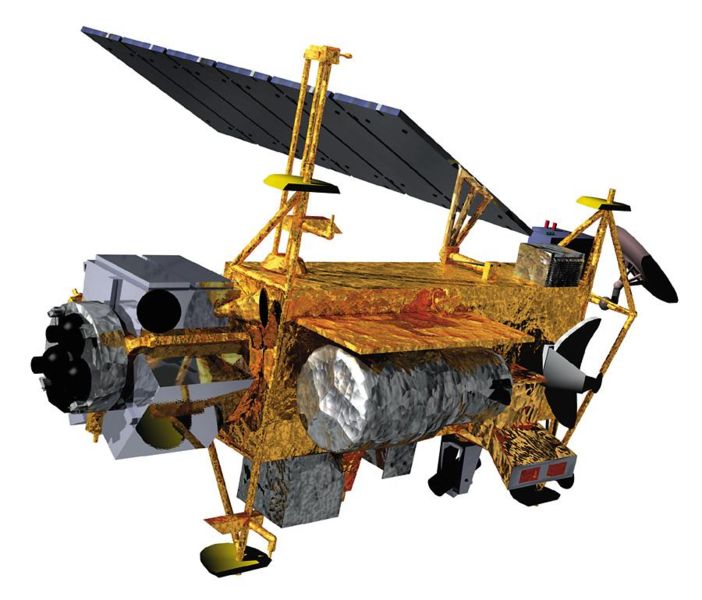
Upper Atmosphere Research Satellite (UARS) Image courtesy NASA
The increased solar activity has heated the upper atmosphere resulting in it expanding. This has increased atmospheric drag on the satellite shortening its life further.
http://nightskyonline.info/?p=2241


Orbital Decay - Altitude Prediction Graph


The prediction graph is a plot of perigee & apogee over time (thus dual lines) actual altitude oscillates 16 times per day.
There are three pairs of lines, the original prediction pair, the revised prediction (f=1.5) and the actual observed.


Updates on predicted re-entry times for UARS satellite

Predicted Reentry Time for UARS satellite as of September 22 10:06 CDT (15:06 UTC): September 23, 2011 5:07 p.m. CDT (22:07 UTC) ± 9 hours.
UPDATE SEPTEMBER 22, 2011 10:06 CDT (15:06 UTC) Predicted Reentry Time: September 23, 2011 5:07 p.m. CDT (22:07 UTC) ± 9 hours.


SEPTEMBER 22, 2011 5 CDT (10 UTC) NASA has now refined its prediction slightly for when this bus-sized satellite will fall to Earth. The predicted re-entry is now scheduled for 3 p.m. CDT (20:36 UTC) on September 23, 2011, plus or minus 20 hours.


It has been known for some time that the 6.5-ton satellite would leave orbit and return to Earth. Experts initially suggested a weeks-long window between late September and early October, then narrowed the window to the last week of this month. Later, NASA trimmed the interval to a three-day period centered on September 23.

Above is a somewhat disconcerting video – to me anyway – video showing the tumbling and clearly uncontrolled UARS satellite in orbit on September 15, 2011. It’s from Thierry Legault, a wonderful astrophotographer, who obtained this footage of UARS with his 14-inch telescope in northern France, when the satellite at an altitude of only 250 kilometers (155 miles) above Earth. You can see UARS body and its solar arrays.


The 20-year-old satellite – the Upper Atmosphere Research Satellite (UARS) – will make an uncontrolled re-entry through the Earth’s atmosphere. Pieces of the 6.5-ton satellite are expected to survive the fiery plunge and hit our planet, although no one knows exactly where.


Real time satellite tracking for UARS
UARS re-entry twitter feed


The chances of being hit by the falling UARS satellite are small. Nick Johnson, chief scientist with NASA’s Orbital Debris Program, told Universe Today last week:
Numerically, it comes out to a chance of one in 3,200 that one person anywhere in the world might be struck by a piece of debris.
When you think about the seven billion people on Earth today, you see how vanishingly small the probability of being struck really is. After all, most of Earth is ocean, so chances are UARS will go from the fires of re-entry directly to a watery grave in the ocean depths. It’s also important to note that no injury has ever been caused by orbital debris during the half-century that we humans have been placing objects in Earth orbit.

Tongue-in-cheek debris map for UARS re-entry developed by The WeatherSpace.com
NASA says the satellite is likely to begin re-entry on September 23, 2011, give or take a day. Hurtling at five miles (eight kilometers) per second, they say it could land anywhere between 57 degrees N. latitude and 57 degrees S. latitude – basically, most of the populated world.
http://earthsky.org/space/where-will-nasas-uars-satellite-land


Doomed satellite: Where and when will it plummet to Earth?

It is still too early to tell exactly where the dead satellite will fall. Scientists will likely have a much better idea of where the debris will land about two hours before the impact, NASA officials said.
http://www.csmonitor.com/Science/2011/0922/Doomed-satellite-Where-and-when-will-it-plummet-to-Earth

UARS Update: NASA Refines Crashing Satellite’s Debris Region and Location

by Nancy Atkinson on September 22, 2011

This video from Analytical Graphics, Inc. shows an updated animated analysis of the break up of the the 6 ton, bus-sized UARS satellite. It likely will burn up at an altitude between 80-45 kilometers, with an estimated 26 pieces of debris re-entering the atmosphere for land fall or splash down. The debris zone is predicted to be about 500 miles long.

The latest update on UARS put out by NASA is that as of 1:30 p.m. EDT Sept. 21, 2011, (17:30 GMT) the orbit of UARS was 120 mi by 130 mi (190 km by 205 km). Re-entry is expected sometime during the afternoon of Sept. 23, Eastern Daylight Time. NASA says the satellite will not be passing over North America during that time period, but that it is still too early to predict the time and location of re-entry with any more certainty. They will be able to further refine more details in the next 24 to 48 hours.

AGI has created an app for Android phones where you can track the UARS orbit track. See this link for more info.
http://www.universetoday.com/89113/uars-update-nasa-refines-crashing-satellites-debris-region-and-location/

Tuesday, September 20, 2011

The Sky Is Falling & You Have A 1-In-3200 Chance Of Being A Human Casualty. No Fear. FEMA Is Ready:)

The sky is falling!  The sky is falling!

Watch out 'cause this time, it's for real!  ...and this time you have a 1-in-3200 chance of being a human casualty...

RE-ENTRY ALERT: UARS, a NASA satellite the size of a small bus, will re-enter the atmosphere later this week. Best estimates place the re-entry time during the late hours of Sept. 23rd over a still-unknown region of Earth. "It is still too early to predict the time and location of re-entry," says NASA. "Predictions will become more refined over the next two days."

The disintegration of UARS is expected to produce a fireball that could be visible even in broad daylight. Not all of the spacecraft will burn up in the atmosphere, however; according to a NASA risk assessment, as many as 26 potentially hazardous pieces of debris could be scattered along a ground track some 500 miles long. The same report puts the odds of a human casualty at 1 in 3200.

On Sept. 15th, astrophotographer Theirry Legault video-recorded the doomed satellite during one of its last passes over France:

Photo details: Celestron 14" EdgeHD, Takahashi EM400 mount modified for fast tracking. Range to UARS: 252 km.
"The satellite appears to be tumbling, perhaps because a collision with satellite debris a few years ago," notes Legault. "The variations in brightness are rapid and easily visible to the human eye." (Other observers have reported UARS flashes almost as bright as Venus.)

For last-chance sightings of this brightly flashing satellite, please check the Simple Satellite Tracker or download the Satellite Flybys app for your smartphone.

NASA Update #6

Tue, 20 Sep 2011 02:00:29 PM MDT

As of Sept. 20, 2011, the orbit of UARS was 127 mi by 140 mi (205 km by 225 km). Re-entry is expected Sept. 23, plus or minus a day. It is still too early to predict the time and location of re-entry. Predictions will become more refined over the next two days.


U.S. Reentry Predictions

The official source of reentry predictions for uncontrolled space objects is
USSTRATCOM’s Joint Space Operations Center (JSpOC).

be prepared and released to the public (via the Space-Track.org website) at
the following intervals:

Normal procedure is for TIP (Tracking and Impact Prediction) messages to
T 3 days
T 2 days
T 1 day
T 12 hours
T 6 hours
T 2 hours
have large uncertainties. Even at T
time is on average +/- 25 minutes for nearly circular orbits. This equates to
+/- 12,000 km on the Earth.

TIP messages provide the best estimates of reentry time and location but2 hours, the uncertainty of reentry
hours of reentry.

National Aeronautics and Space Administration
UARS Casualty Risk Assessment


National Aeronautics and Space Administration
Summary

was designed, built, and launched.

No NASA or USG human casualty reentry risk limits existed when UARS
casualty risks from reentering space objects to less than 1 in 10,000.

NASA, the USG, and some foreign space agencies now seek to limit human
more massive than UARS are not frequent, but neither are they unusual.

UARS is a moderate-sized space object. Uncontrolled reentries of objects
massive.

Combined Dragon mockup and Falcon 9 second stage reentry in June 2010 was more
of an injury resulting from reentering space objects.

Since the beginning of the space age, there has been no confirmed report
carefully.

http://www.nasa.gov/mission_pages/uars/index.html

Leonard-david
NASA, DoD, and the IADC will be monitoring the decay and reentry of UARS
Estimated human casualty risk (updated to 2011): ~ 1 in 3200
Total mass of objects expected to survive: 532 kg
Number of potentially hazardous objects expected to survive: 26
NASA conducted a detailed reentry risk assessment for UARS in 2002.
A final, post-reentry assessment message is normally issued within a few
T 4 days
National Aeronautics and Space Administration