Ad

Showing posts with label nuclear bomb. Show all posts

Monday, June 3, 2013

Astounding Numbers of Nuclear Arms Revealed for Over 8 Countries. Nuclear Arms Race Still On.

Nuclear arms race 'alarming' 

Three of the world's nuclear powers - China, India and Pakistan - have increased their arsenals over the past year, while the other five have cut their strength or kept them stable, the Stockholm International Peace Research Institute says.
China now has 250 nuclear warheads against 240 in 2012, while Pakistan has increased its warheads by about 10 to between 100 and 120 and India has also added roughly 10 for a total of 90 to 110, the institute said in its annual report on Monday.
According to the Stockholm group, the arms race is all the more disturbing because of what it called a ''fragile'' peace in Asia, characterised by growing tensions since 2008 between India and Pakistan, China and Japan, and the two Koreas, among others.
''While states have avoided direct conflict with each other and have stopped supporting insurgent movements on each other's territory, decades-old suspicions linger and economic integration has not been followed up with political integration,'' the institute said.
Only the two old superpowers have cut their warheads, Russia reducing its number from 10,000 to 8500, and the US scaling back from 8000 to 7700. The warheads controlled by France stayed at 300, while Britain's remained at 225 and Israel's at 80.
The institute acknowledged the figures were largely estimates.
While the global total of warheads was down, it said this did not translate into a significantly diminished nuclear threat.
Agence France-Presse
India’s Agni-V missile
(Photo: Indian Ministry of Defense/AP/dapd)

WEAPONS

Asian countries pile up nuclear arms

The arms race in Asia has increased since 2008 mainly due to growing tensions between China and Japan, the two Koreas, and India and Pakistan, says the Stockholm International Peace Research Institute in its report.
The Stockholm International Peace Research Institute (SIPRI) says in its latest report that China, India and Pakistan have added more nuclear weapons to their stock in the last few years.
The annual report claims that while China appears to be expanding its nuclear arsenal, India and Pakistan are increasing both their nuclear as well as their conventional weapons.
Pakistan is also enhancing its plutonium production at the central Khushab city, which is home to the Heavy Water and Natural Uranium Research Reactor - an important component of the Islamic state's special weapons program.
Chinese Premier Li Keqiang (R) and Indian Prime Minister Manmohan Singh wave towards the media during Li's ceremonial reception at the forecourt of India's presidential palace Rashtrapati Bhavan in New Delhi May 20, 2013
(Photo: REUTERS/Adnan Abidi)China and India are locked in border disputes
SIPRI further says that in 2012 China, India and Pakistan added 10 warheads each to their nuclear storage. China, it says, now has 250 nuclear warheads, whereas Pakistan possesses 100 to 120, and India 90 to 110.
The three Asian countries are home to over 2.7 billion people, which is nearly 40 percent of the global population.
'An inaccurate report'
Kapil Kak, a retired Indian air force officer, who is currently associated with the Center of Air Power Studies in New Delhi, says his country does not need to increase its nuclear arsenal nor it plans to do so.
"We keep minimum deterrence as part of our nuclear strategy. But yes, we have a hostile neighborhood, so we have enhanced the quality of the arsenal and also improved command, control protocols and accuracy of the warheads," Kak told DW, adding that he failed to understand why Pakistan needed so many nuclear weapons.
Ravi Sawhney, a former deputy chief of the Indian army is of the view that China's global ambitions and its attempts to increase its hegemony in Asia may have prompted India to enhance its nuclear capabilities.
Pakistan-made missile Ghauri, which has range of 1,500 kilometers (900 milies) capable of carrying nuclear war head, is on display during the Pakistan National Day parade in Islamabad, Pakistan on Wednesday, March 23, 2005 in Islamabad, Pakistan
(Photo: ddp images/AP Photo/B.K.Bangash)Pakistan's nuclear weapons are a cause of concern
"Pakistan's insecurity stems from the fact that India is far superior in conventional warfare. We have our compulsions too, and our nuclear weapons program is moving forward steadily," Sawhney told DW.
But some experts, like G. Balachandran - a consulting fellow at the Institute for Defence Studies and Analyses - doubt the accuracy of the SIPRI report.
"This report will not have any impact on the stability or instability in the Asian region. There is absolutely nothing to get excited about. And how can SIPRI get details of India's nuclear warheads when only few people have any knowledge about it?” asked Balachandran.

By MALIN RISING Associated Press

China, India and Pakistan have increased their nuclear weapons by about 10 warheads each in the past year, and other nuclear states appear set on maintaining their arsenals, a Swedish think tank said Monday.
At the start of the year, China had raised its number of nuclear warheads to 250 from 240 in 2012 as part of a process to modernize its defense, the Stockholm International Peace Research Institute said. However it also said China is "highly non-transparent" when it comes to its nuclear arsenal.
SIPRI researcher Pillip Schell said China may continue "the very slight process of increasing" its nuclear arms in the long-term but that there is no sign the country will change its current policy of maintaining a credible deterrent with the smallest possible nuclear arsenal.
"It is not so much about an increase in numbers, but an increase in quality," he said.
Bitter rivals Pakistan and India also increased their arsenals by around 10 warheads each.
Meanwhile, the U.S. and Russia continued their disarmament in accordance with the new START treaty that they signed in 2010. The U.S. reduced its number of warheads to 7,700 from 8,000, and Russia cut its arsenal to 8,500 from 10,000.
However, at the same time the U.S., Russia, France, China and Britain have all either deployed new nuclear weapon delivery systems or announced programs to do so, SIPRI said.
"There is little to inspire hope that the nuclear weapon-possessing states are genuinely willing to give up their nuclear arsenals," SIPRI researcher Shannon Kile said in a statement. "The long-term modernization programs under way in these states suggest that nuclear weapons are still a marker of international status and power."
Here is SIPRI's list of the number of nuclear warheads in the world at the start of 2013 compared with the start of 2012.

Thursday, March 7, 2013

Iran's Nuclear Program. Talks Stall.


More dates set as Iran nuclear talks stall

Posted Thu Feb 28, 2013 7:10am AEDT
Iranian President Mahmoud Ahmadinejad tours a nuclear facility in Natanz
Iranian officials have talks with world leaders over its nuclear program as "positive", despite the two days of negotiations ending without any breakthroughs.
For the first time in eight months, Iranian negotiators sat down with representatives of six world powers - France, Germany, Britain, the United States, China and Russia - in Almaty, Kazakhstan.
The six powers are said to have offered to ease harsh economic sanctions against Iran if it agrees to stop enriching uranium to near weapons-grade.
Iran says its nuclear program is for peaceful purposes only, but its chief negotiator Saeed Jalili did appear to concede there may be room to compromise.
Mr Jalili said the powers had tried to "get closer to our viewpoint", which he said was positive.
In Paris, US secretary of state John Kerry commented that the talks had been "useful" and that a serious engagement by Iran could lead to a comprehensive deal in a decade-old dispute that has threatened to trigger a new Middle East war.
Western diplomats have set their sights low, making clear that an agreement to meet again soon will be deemed a success.
In particular, they are aware that the closeness of Iran's presidential election in June is raising political tensions in Tehran and makes significant concessions unlikely.
"I hope the Iranian side is looking positively on the proposal we put forward," European Union foreign policy chief Catherine Ashton, who led the talks on behalf of the six powers, said.
"We have to see what happens next."
read more at ABC

INSS: An Updated Assessment of Iran’s Nuclear Program

Posted by 
Email This Page
inss150
INSS Insight No. 409, Published March 4, 2013
By Asculai, Ephraim
The final week of February 2013 was marked by events that may have changed the perception of Iran’s nuclear program and the chances of finding a non-belligerent solution to this problem. First, the periodic IAEA report on the inspections in Iran was published, with some new details on Iran’s nuclear activities. A careful reading of the latest IAEA report reveals that Iran continues relentlessly to further the potential to break out and achieve a nuclear weapons capability quickly. Second, the 2-day talks between the P5+1 and Iran in Almaty, Kazakhstan apparently included new concessions to and fewer demands of Iran. Third, an article by former British Foreign Minister Jack Straw published in the Telegraph recommended that the world recognize the situation and adopt a policy of “containment,” thereby accepting the inevitability of Iran becoming a de facto nuclear weapons state.[1]
The world does not view the proliferation of nuclear weapons as a casus belli
Iran now has about 9,000 uranium enriching centrifuges of the older IR-1 type installed at its facility in Natanz. These centrifuges are enriching uranium hexafluoride to the level of 3.5 percent uranium-235, and so far more than eight tons of this material have been accumulated. Fordow, where some additional enrichment activities have taken place, is another source of concern. At this small well protected facility, installation of some additional 2700 gas centrifuges has neared completion. Of these, some 700 centrifuges were being used to enrich uranium to 19.75 percent, while the other centrifuges were apparently not yet operational. At both enrichment sites, Iran utilized part of the 3.5 percent inventory to produce 280 kilograms of 19.75 percent enriched uranium. 250 kilograms of this material are considered sufficient, through further enrichment to 90 percent, for the production of one core for a nuclear explosive device. Perhaps because of the psychological effect of this surplus, Iran removed some 111 kilograms to Isfahan for the manufacture of nuclear fuel for the Tehran Research Reactor.
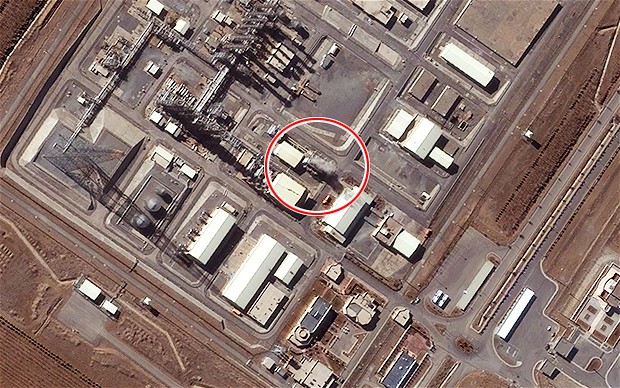
Water vapour, circled, is seen being emitted from forced air coolers at the Arak heavy water production plant earlier this month, showing that the facility is operational Photo: DigitalGlobe Inc/McKenzie Intelligence Ltd
Were Iran to use all of its 3.5 percent inventory, and were it to use all available centrifuges to further enrich this inventory to the 19.75 percent and then up to the military level of 90 percent, it could probably obtain the 25 kilograms of uranium metal for its first nuclear explosive core in less than six months, and subsequent cores in shorter time intervals, obtaining a total of 5-6 cores from the present 3.5 percent inventory. This time estimate will probably be accelerated, since Iran began installing a newer and more efficient type of centrifuge, and if Iran uses any of the 19.75 percent inventory it holds.
By the first quarter of 2014 Iran is expected to complete the construction of the 40 mW heavy water reactor in Arak. This reactor “going critical”, will cross the point of no return in the Iranian plutonium route
Working in parallel to the uranium enrichment route, Iran has advanced considerably in the development of the other route to nuclear weapons – the plutonium route. The construction of the 40 megawatt heavy water natural uranium reactor has progressed, and the Iranians reported to the IAEA that they expected to complete the construction of the reactor in the first quarter of 2014. Were the reactor to “go critical” at that point, this would in effect constitute the point of no return in the plutonium route, since a military attack on an operational reactor is considered to be out of bounds in international norms. Although it would still take some two years to have the nuclear fuel from this reactor ready for reprocessing, and some additional time until a plutonium core could be produced, it would still signal an alarming state of affairs. What piqued the world’s attention was the satellite photograph of steam coming out of the cooling system at the heavy water production plant at Arak. In fact, however, this plant has been operating for some years, and this was no extraordinary observation.
This was the setting for the Almaty talks between the P5+1 and Iran that were held on February 26-27, 2013. Although not all details of the P5+1 offer that was placed on the table are known, it is the first time that certain Security Council demands, e.g., the suspension of uranium enrichment activities, were ignored, and the parallel demand for the suspension of plutonium-related activities was apparently not even mentioned. This is a significant breakthrough for the Iranians, as the other side could gain but little time from the demand that the enrichment activities to the level of 19.75 percent be stopped and the inventory dispersed. From what remains unsaid it seems that Iran could continue to enrich uranium (to 3.5 percent) and continue with the construction of the Arak reactor. In return for an agreement, some sanctions would be eased.
It is difficult to imagine what the P5+1 expect to achieve with such an agreement, except for an optimistic proclamation that apparently “engagement” can work, and that this approach will be pursued further. The Iranian Foreign Minister even said that relationships between Iran and the US could improve considerably as a result of the “melting ice.” This would constitute a major victory for Iran while it proceeds with its nuclear program, since it has already proved that it can withstand the current sanctions. Iran would retain all its technical capabilities and the ability to further develop them, and any agreement would halt the imposition of new and advanced sanctions that could pressure Iran to heed the Security Council demands.
Against this backdrop and precisely at this time, the article by a former British Foreign Minister recommended the approach of “containment.” When reviewing the positions of the members of the P5+1, especially the views of the US, Russia, and China, one cannot but assess that no belligerent action against Iran will likely take place. The world (represented by these countries) does not view the proliferation of nuclear weapons as a casus belli. This is perfectly demonstrated by the advances made by North Korea in the development of nuclear weapons in both routes, with sanctions being the strongest action the world has been willing to take to ameliorate the situation. If one projects the present North Korean situation onto that concerning Iran, one cannot but reach the conclusion that containment is in the air, and that unless drastic action is taken, Iran will become a nuclear-capable state in the not too distant future.
SOURCE: DEFENSE UPDATE


Monday, February 11, 2013

Video From North Korea Depicting Nuclear Bombing of U.S. & Tests Detected


Earthquake detected in North Korea near nuke site

ASSOCIATED PRESS

An earthquake was detected Tuesday in North Korea just north of a site where the country has conducted nuclear tests, providing strong indication that Pyongyang has gone ahead with a highly anticipated third test. There was, however, no confirmation of the test.
The South Korean Defense Ministry, which raised its military alert level after the quake, said it was trying to determine whether it was a test. Nuclear blasts can create tremors but they are distinct from those caused by natural earthquakes.
The U.N. organization monitoring nuclear tests says it has detected an "unusual seismic event" in North Korea.
The U.S. Geological Survey as well as earthquake monitoring stations in South Korea detected an earthquake just north of a site where North Korea conducted its second nuclear test in 2009.
Threat to world peace? A man walks past a display illustrating the damage a 1MT class nuclear weapon would cause if detonated in Seoul, at the War Memorial Museum of Korea in Seoul on February 5
"There is a high possibility that North Korea has conducted a nuclear test," said Chi Heoncheol, an earthquake specialist at the government-funded Korea Institute of Geoscience and Mineral Resources. Chi said a magnitude 3.9 magnitude earthquake and a magnitude 4.5 earthquake were detected in the North's 2006 and 2009 nuclear tests.
"We think it is possible it came about as a result of a nuclear test by North Korea from looking at past cases," Japanese government spokesman Yoshihide Suga said at a news conference Tuesday, noting that they were still gathering information.
The United States and its allies have been on edge since North Korea said last month it will conduct its third nuclear test to protest toughened sanctions over a December rocket launch that the U.N. called a cover for a banned missile test.
'On a war footing': South Korean and U.S. troops began naval drills on Monday in a show of force partly directed at North Korea amid signs that Pyongyang will soon carry out a threat to conduct its third atomic test
North Korea's politburo vowed to continue firing "powerful long-range rockets," but a statement by state media Tuesday made no mention of a nuclear test.
North Korea's National Defense Commission said Jan. 23 that the United States was its prime target for a nuclear test and long-range rocket launches. North Korea accuses Washington of leading the push to punish Pyongyang for its December rocket launch.
Last October, a spokesman from the commission told state media that the country had built a missile capable of striking the United States, but did not provide further details. A missile featured in an April 2012 military parade appeared to be an intercontinental ballistic missile, but its authenticity has not been verified by foreign experts.
source: CLICK HERE

North Korea posts shocking YouTube video of New York in flames after 'nuclear attack' on America... as Michael Jackson's 'We Are The World' plays in the background

  • Footage uploaded to YouTube by the North's official website Uriminzokkiri
  • Depicts man dreaming he is on board space shuttle as it circles the world
  • Shows joyfully united North Korea then switches to U.S. city under attack
  • City is shrouded in U.S. flag, with its skyscrapers either on fire or in ruins
  • North set to conduct third nuclear test in defiant response to UN sanctions

Read more: http://www.dailymail.co.uk/news/article-2273721/North-Korea-nuclear-attack-America-shown-astonishing-dream-sequence-YouTube-video.html#ixzz2KegJu3kT  Follow us: @MailOnline on Twitter | DailyMail on Facebook

North Korea nuclear test suspected as magnitude 4.9 earthquake is recorded

US Geological Survey and South Korea register quake near site of underground facility
Nuclear radiation monitoring in South Korea.Nuclear radiation monitoring in South Korea. North Korea is suspected of carrying out a nuclear test after an earthquake was detected. Photograph: Yonhap/EPA
There are signs that North Korea has conducted its anticipated nuclear test, with an earthquake of magnitude 4.9 detected near the underground site where it was expected to carry out the explosion.
The US Geological Survey said on Tuesday it had detected the earthquake in North Korea but neither Pyongyang nor Seoul confirmed whether the widely anticipated third nuclear test had happened. South Korean reports described the quake as "manmade".
The South Korean defence ministry said it was trying to determine whether North Korea had conducted a nuclear test. Nuclear blasts can create tremors but they are distinct from those caused by natural earthquakes.
The quake occurred at 11.57am Korean time (2.57am GMT) and South Korea's presidential office said that it was "likely" a nuclear test, according to the South's Yonhap news agency.
North Korea is not prone to seismic activity.
The USGS said the epicentre of the quake was a kilometre underground and close to the North's known nuclear test site.
The Reuters news agency quoted a UN security council diplomat as saying: "We've been informed by the South Koreans that there's been a [North Korean] nuclear test."
In Vienna, international monitoring group the Comprehensive Nuclear Test Ban Treaty Organisation (CTBTO) said it was analysing an "unusual seismic event" in North Korea.
The CTBTO is an independent body that monitors for nuclear tests and has 270 facilities around the world that check for quakes, radioactive particles in the atmosphere and other evidence.
North Korea's politburo vowed to continue firing "powerful long-range rockets" in a statement on Tuesday that made no mention of Pyongyang's promise to conduct a nuclear test.
The United States and its allies have been on edge since North Korea said last month it would conduct its third nuclear test in protest at sanctions that were toughened when it launched a rocket in December. The UN called the launch a cover for a banned missile test.
North Korea's powerful National Defence Commission said on 23 January that the United States was its prime target for a nuclear test and long-range rocket launches. North Korea accuses Washington of leading the push to punish Pyongyang for its December rocket launch.
In October 2012 a spokesman from the commission told state media that the country had built a missile capable of striking the United States but he did not provide further details. A missile featured in an April 2012 military parade appeared to be an intercontinental ballistic missile but its authenticity has not been verified by foreign experts.
SOURCE: CLICK HERE
Read more here: http://www.miamiherald.com/2013/02/11/3229387/usgs-earthquake-detected-in-north.html#storylink=cpy

ASSOCIATED PRESS

An earthquake was detected Tuesday in North Korea just north of a site where the country has conducted nuclear tests, providing strong indication that Pyongyang has gone ahead with a highly anticipated third test. There was, however, no confirmation of the test.
The South Korean Defense Ministry, which raised its military alert level after the quake, said it was trying to determine whether it was a test. Nuclear blasts can create tremors but they are distinct from those caused by natural earthquakes.
The U.N. organization monitoring nuclear tests says it has detected an "unusual seismic event" in North Korea.
The U.S. Geological Survey as well as earthquake monitoring stations in South Korea detected an earthquake just north of a site where North Korea conducted its second nuclear test in 2009.
"There is a high possibility that North Korea has conducted a nuclear test," said Chi Heoncheol, an earthquake specialist at the government-funded Korea Institute of Geoscience and Mineral Resources. Chi said a magnitude 3.9 magnitude earthquake and a magnitude 4.5 earthquake were detected in the North's 2006 and 2009 nuclear tests.
"We think it is possible it came about as a result of a nuclear test by North Korea from looking at past cases," Japanese government spokesman Yoshihide Suga said at a news conference Tuesday, noting that they were still gathering information.
The United States and its allies have been on edge since North Korea said last month it will conduct its third nuclear test to protest toughened sanctions over a December rocket launch that the U.N. called a cover for a banned missile test.
North Korea's politburo vowed to continue firing "powerful long-range rockets," but a statement by state media Tuesday made no mention of a nuclear test.
North Korea's National Defense Commission said Jan. 23 that the United States was its prime target for a nuclear test and long-range rocket launches. North Korea accuses Washington of leading the push to punish Pyongyang for its December rocket launch.
Last October, a spokesman from the commission told state media that the country had built a missile capable of striking the United States, but did not provide further details. A missile featured in an April 2012 military parade appeared to be an intercontinental ballistic missile, but its authenticity has not been verified by foreign experts.
Read more here: http://www.miamiherald.com/2013/02/11/3229387/usgs-earthquake-detected-in-north.html#storylink=cpy

ASSOCIATED PRESS

An earthquake was detected Tuesday in North Korea just north of a site where the country has conducted nuclear tests, providing strong indication that Pyongyang has gone ahead with a highly anticipated third test. There was, however, no confirmation of the test.
The South Korean Defense Ministry, which raised its military alert level after the quake, said it was trying to determine whether it was a test. Nuclear blasts can create tremors but they are distinct from those caused by natural earthquakes.
The U.N. organization monitoring nuclear tests says it has detected an "unusual seismic event" in North Korea.
The U.S. Geological Survey as well as earthquake monitoring stations in South Korea detected an earthquake just north of a site where North Korea conducted its second nuclear test in 2009.
"There is a high possibility that North Korea has conducted a nuclear test," said Chi Heoncheol, an earthquake specialist at the government-funded Korea Institute of Geoscience and Mineral Resources. Chi said a magnitude 3.9 magnitude earthquake and a magnitude 4.5 earthquake were detected in the North's 2006 and 2009 nuclear tests.
"We think it is possible it came about as a result of a nuclear test by North Korea from looking at past cases," Japanese government spokesman Yoshihide Suga said at a news conference Tuesday, noting that they were still gathering information.
The United States and its allies have been on edge since North Korea said last month it will conduct its third nuclear test to protest toughened sanctions over a December rocket launch that the U.N. called a cover for a banned missile test.
North Korea's politburo vowed to continue firing "powerful long-range rockets," but a statement by state media Tuesday made no mention of a nuclear test.
North Korea's National Defense Commission said Jan. 23 that the United States was its prime target for a nuclear test and long-range rocket launches. North Korea accuses Washington of leading the push to punish Pyongyang for its December rocket launch.
Last October, a spokesman from the commission told state media that the country had built a missile capable of striking the United States, but did not provide further details. A missile featured in an April 2012 military parade appeared to be an intercontinental ballistic missile, but its authenticity has not been verified by foreign experts.
Read more here: http://www.miamiherald.com/2013/02/11/3229387/usgs-earthquake-detected-in-north.html#storylink=cpy

Monday, August 27, 2012

An Eye Opener. 66 Years After Hiroshima.

I received this in an email and found it really interesting and I think you might find it interesting as well...


This was an eye opener--  
STATEMENT AT THE END SAYS IT ALL !!!!!

66 years later!


What happened to the radiation that
lasts thousands of years?


HIROSHIMA  1945

Description: cid:83E2190FB4BA4EB4B74BC1699B9236C1@VickiePC
 

Description: cid:5B1F95FCB7B047DAADD8000D816E3CAA@VickiePC

Description:                                                                                                                       cid:79849F8B96D04385A6590DC7C18167F7@VickiePC

We all know that  Hiroshima and Nagasaki were destroyed in August 1945
after the explosion of atomic bombs.
However, we know little about the progress made by the people of that land during the past 65 years.


HIROSHIMA - 66 YEARS LATER

Description: cid:AF28BC01FFB6457E826F3834CCEB93FF@VickiePC
Description: cid:D9A8766E77A64BDD80F75D13682F100D@VickiePC

Description: cid:6C0FCEE8DDFC4948B1020CD0EC226DCE@VickiePC
Description: cid:5D09EBACAACB4C56AA3A13E77E05CBAE@VickiePC
Description: cid:0E6AE74D25BA4C749CBDECAE1244E655@VickiePC
Description: cid:B193A9EF11624956BF50C06A2896394F@VickiePC
Description: cid:FF5492370307403999B7900194800637@VickiePC


DETROIT- 6
6  YEARS AFTER  HIROSHIMA


Description: cid:74AC1F51BDFC4D8EBCFB5B7FCC37FB85@VickiePC


Description: cid:7C02616CEBD54A09913645FD1AFF8B4F@VickiePC


Description:   cid:352F6C8596ED4F27B785292AD86E3C03@VickiePC


Description: cid:603946E12C664C24AFE837C613C9E818@VickiePC
Description: cid:EDEDC53C914A4BFBBF752BF74F81B4CC@VickiePC


Description: cid:EE150985CF824B11ABD64FCFB9E6A97C@VickiePC


Description:                                                                                                                       cid:AB0230711EB14A3197EBDDDA75019E57@VickiePC

Description:
 cid:F599DF75FE444F2789D0C8B16AA81537@VickiePC

AMERICA

What has caused more long term destruction ...
-  The A-bomb
OR

-  Government welfare programs created to buy the
votes of those who want someone to take care of them?

--------------------------------------------------------------------------------------------------------------
 JAPAN
-  Japan does not have a welfare system.

-  Work for it or do without. 
---------------------------------------------------------------------------------------------------------- 

 And I don't think there has ever been a better explanation of the importance of incentive than this example

These are possibly the 5 best sentences you'll ever read and all applicable to this experiment:

1. You cannot legislate the poor into prosperity by legislating the wealthy out of prosperity.

2. What one person receives without working for, another person must work for without receiving.

3. The government can't give to anybody anything that it does not first take from somebody else.

4. You cannot multiply wealth by dividing it!

5. When 1/2 of the people get the idea that they don't have to work
because the other 1/2 is going to take care of them & when the other
1/2 gets the idea that it does no good to work because somebody
else is going to get what they work for, that is the beginning of the
end of any nation.

Can you think of a reason for not sharing this?