Ad

Showing posts with label Tehran. Show all posts

Friday, March 15, 2013

Iran. Destroyers. Drone Pursuit. Ballistic Missile Test Fire. Obama's Red Line.


Iran docks Damavand destroyer for test purposes

IRNA - Islamic Republic News Agency
Tehran, March 15, IRNA -- Domestically-made Damavand destroyer was docked for test, Commander of the Iranian navy for research and self-sufficiency jihad Rear Admiral Ali Gholamzadeh said on Friday.
He made the remarks in an exclusive interview with IRNA.
'Damavand destroyer will become operational in the month ahead for dispatch to the international waters,' Rear Admiral Gholamzadeh
Iran's Navy has been transformed into a highly-motivated, well-equipped, and well-financed force and is effectively in control of the world's oil lifeline, the Strait of Hormuz.
Iran's naval power has even been acknowledged by foes. In a September 11, 2008 report, the Washington Institute for the Near East Policy said that in the two decades since the Iraqi-imposed war on Iran, the Islamic Republic has excelled in naval capabilities and is able to wage unique asymmetric warfare against larger naval forces.
Defense analysts and military observers say that Iran's war-game and its advancements in weapons production have proved as a deterrent factor, especially at a time of heightened threats by the US.
In November, Iranian Navy launched the main structure Sina-7 missile launching frigate. Navy also started using two new home-made Qadir-class light submarines and two hovercrafts.
In September, the main structure of the Islamic Republic of Iran Sahand (IRI Sahand) missile destroyer was officially launched by the Iranian Navy in Iran's Southern port city of Bandar Abbas.
Iran's first home-made destroyer, Jamaran, was launched in late February 2010. The Mowdge Class vessel has a displacement of around 14,000 tons and is equipped with modern radars and electronic warfare capabilities and is armed with a variety of anti-ship, surface-to-surface and surface-to-air missiles.
Iranian officials have repeatedly warned the trans-regional states, specially the US, to pull their troops and warships out of the Persian Gulf, underlining the necessity for the establishment of security in the Persian Gulf through extensive and all-out cooperation among the regional states.
In relevant remarks in December, a senior military aide to the Iranian Supreme Leader said that trans-regional powers are trying to confine Iran's power through sparking insecurity around the country.
'The trans-regional enemies are pursuing a certain view (on Iran) and are creating insecurities in the regions around our country in a bid to block the Islamic Republic of Iran's progress and emergence of a mighty Iran,' senior Military Aide to the Supreme Leader of Islamic Revolution Major General Yahya Rahim Safavi said at the time.
He further said that the Persian Gulf region plays a key role in Iran's plans for progress and prosperity, and underlined the necessity for advancement, justice and durable security in the region.
Meanwhile, in recent years, Iran’s Navy has been increasing its presence in international waters to protect naval routes and provide security for Iranian merchant vessels and tankers.
In addition, in line with the international efforts to combat piracy, the Iranian Navy has been conducting anti-piracy patrols in the Gulf of Aden since November 2008 to safeguard the vessels involved in maritime trade, especially the ships and oil tankers owned or leased by Iran.

U.S. Drone Over Persian Gulf Pursued by Iranian Jet


A U.S. military drone operating over international waters in the Persian Gulf was pursued by an Iranian military aircraft on March 12, according to the Pentagon.

The MQ-1 Predator drone, which was accompanied by two manned U.S. military airplanes, was conducting a classified surveillance flight in international airspace when it was approached by an Iranian F-4 jet that came within 16 miles (26 kilometers) of the unmanned plane, Pentagon spokesman George Little said yesterday in an e-mailed statement. After a “verbal warning” from the U.S., the Iranian plane broke off, according to the statement.

The incident is the latest in episodes going back to December 2011, when Iran said it captured a stealthy U.S. drone. In November 2012, the Pentagon said Iranian aircraft had fired on an unarmed Predator drone that was conducting routine surveillance over international waters.

After the incident in November, “the United States communicated to the Iranians that we will continue to conduct surveillance flights over international waters consistent with long-standing practice and our commitment to the security of the region,” Little said in the statement. “We also communicated that we reserve the right to protect our military assets as well as our forces and will continue to do so going forward.”

The latest incident was reported earlier yesterday by CNN.
International tensions over the Persian Gulf have increased as the U.S. and allies have tightened economic sanctions aimed at forcing Iran to abandon elements of its nuclear program they say could be used to develop an atomic bomb. Last year, Iranian officials periodically threatened to close the Strait of Hormuz, which leads into the gulf and through which about 20 percent of the world’s oil transits.
Design By Humans
Iran test fires ballistic missiles

Islamic Republic launches Fajr-5 rockets, used by Hamas to attack Israel, and longer range Nazeat 10

March 14, 2013, 12:30 pm
Members of the Iranian Revolutionary Guard celebrate after launching a missile, July 2012 (photo credit: AP/IRNA, Mostafa Qotbi)

TEHRAN, Iran (AP) — Iranian media said the military has test-fired several short-range missiles, including the type Palestinian militant Hamas group used to attack Tel Aviv last November.
Thursday’s report by the semi-official Fars news agency said the missiles were tested during an army exercise in central Iran. It said the missiles fired were Nazeat-10 and Fajr-5.
During weeks of fighting in November, Gaza’s Hamas rulers fired Iranian-made Fajr-5 rockets that came close to Israel’s heartland, including the cities of Tel Aviv and Jerusalem for the first time.
Later, Iran admitted supplying Hamas with the technology to produce Fajr-5. The missile has a range of 75 kilometers, or 45 miles. The range of the Nazeat-10 missiles is about 100 kilometers, or 62 miles.
Iran regularly holds maneuver to test and promote its military power.

Iran to launch Jamaran 2 destroyer in Caspian Sea: Defense minister

Iran Press TV
Tue Mar 12, 2013 9:40AM GMT
Iranian Defense Minister Brigadier General Ahmad Vahidi says the country plans to launch the indigenous Jamaran 2 destroyer in the Caspian Sea in the near future.
Vahidi said on Monday that the new warship is the symbol of the power of the Defense Ministry’s Marine Industries.
“After being launched and undergoing final tests… this destroyer will be delivered to Iran’s Navy,” Vahidi added.
In recent years, Iran has made great achievements in its defense sector and attained self-sufficiency in producing essential military equipment and systems.
Iran's Navy launched the indigenous Sahand destroyer in the southern port of Bandar Abbas on September 8, 2012 alongside the overhauled super-heavy Tareq 901 submarine.
The Iranian Navy launched its first destroyer, Jamaran, in the waters of the Persian Gulf in February 2010. The 1,420-ton vessel is equipped with modern radar systems and other electronic warfare capabilities.
Tehran has repeatedly assured other countries that its military might poses no threat to other states, insisting that the Islamic Republic’s defense doctrine is entirely based on deterrence.


Design By HumansDesign By Humans

Thursday, March 7, 2013

Iran's Nuclear Program. Talks Stall.


More dates set as Iran nuclear talks stall

Posted Thu Feb 28, 2013 7:10am AEDT
Iranian President Mahmoud Ahmadinejad tours a nuclear facility in Natanz
Iranian officials have talks with world leaders over its nuclear program as "positive", despite the two days of negotiations ending without any breakthroughs.
For the first time in eight months, Iranian negotiators sat down with representatives of six world powers - France, Germany, Britain, the United States, China and Russia - in Almaty, Kazakhstan.
The six powers are said to have offered to ease harsh economic sanctions against Iran if it agrees to stop enriching uranium to near weapons-grade.
Iran says its nuclear program is for peaceful purposes only, but its chief negotiator Saeed Jalili did appear to concede there may be room to compromise.
Mr Jalili said the powers had tried to "get closer to our viewpoint", which he said was positive.
In Paris, US secretary of state John Kerry commented that the talks had been "useful" and that a serious engagement by Iran could lead to a comprehensive deal in a decade-old dispute that has threatened to trigger a new Middle East war.
Western diplomats have set their sights low, making clear that an agreement to meet again soon will be deemed a success.
In particular, they are aware that the closeness of Iran's presidential election in June is raising political tensions in Tehran and makes significant concessions unlikely.
"I hope the Iranian side is looking positively on the proposal we put forward," European Union foreign policy chief Catherine Ashton, who led the talks on behalf of the six powers, said.
"We have to see what happens next."
read more at ABC

INSS: An Updated Assessment of Iran’s Nuclear Program

Posted by 
Email This Page
inss150
INSS Insight No. 409, Published March 4, 2013
By Asculai, Ephraim
The final week of February 2013 was marked by events that may have changed the perception of Iran’s nuclear program and the chances of finding a non-belligerent solution to this problem. First, the periodic IAEA report on the inspections in Iran was published, with some new details on Iran’s nuclear activities. A careful reading of the latest IAEA report reveals that Iran continues relentlessly to further the potential to break out and achieve a nuclear weapons capability quickly. Second, the 2-day talks between the P5+1 and Iran in Almaty, Kazakhstan apparently included new concessions to and fewer demands of Iran. Third, an article by former British Foreign Minister Jack Straw published in the Telegraph recommended that the world recognize the situation and adopt a policy of “containment,” thereby accepting the inevitability of Iran becoming a de facto nuclear weapons state.[1]
The world does not view the proliferation of nuclear weapons as a casus belli
Iran now has about 9,000 uranium enriching centrifuges of the older IR-1 type installed at its facility in Natanz. These centrifuges are enriching uranium hexafluoride to the level of 3.5 percent uranium-235, and so far more than eight tons of this material have been accumulated. Fordow, where some additional enrichment activities have taken place, is another source of concern. At this small well protected facility, installation of some additional 2700 gas centrifuges has neared completion. Of these, some 700 centrifuges were being used to enrich uranium to 19.75 percent, while the other centrifuges were apparently not yet operational. At both enrichment sites, Iran utilized part of the 3.5 percent inventory to produce 280 kilograms of 19.75 percent enriched uranium. 250 kilograms of this material are considered sufficient, through further enrichment to 90 percent, for the production of one core for a nuclear explosive device. Perhaps because of the psychological effect of this surplus, Iran removed some 111 kilograms to Isfahan for the manufacture of nuclear fuel for the Tehran Research Reactor.
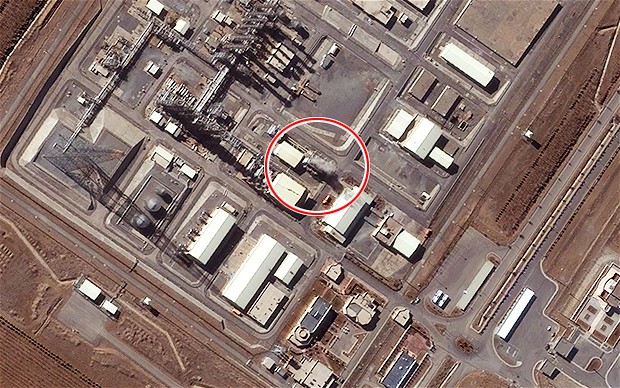
Water vapour, circled, is seen being emitted from forced air coolers at the Arak heavy water production plant earlier this month, showing that the facility is operational Photo: DigitalGlobe Inc/McKenzie Intelligence Ltd
Were Iran to use all of its 3.5 percent inventory, and were it to use all available centrifuges to further enrich this inventory to the 19.75 percent and then up to the military level of 90 percent, it could probably obtain the 25 kilograms of uranium metal for its first nuclear explosive core in less than six months, and subsequent cores in shorter time intervals, obtaining a total of 5-6 cores from the present 3.5 percent inventory. This time estimate will probably be accelerated, since Iran began installing a newer and more efficient type of centrifuge, and if Iran uses any of the 19.75 percent inventory it holds.
By the first quarter of 2014 Iran is expected to complete the construction of the 40 mW heavy water reactor in Arak. This reactor “going critical”, will cross the point of no return in the Iranian plutonium route
Working in parallel to the uranium enrichment route, Iran has advanced considerably in the development of the other route to nuclear weapons – the plutonium route. The construction of the 40 megawatt heavy water natural uranium reactor has progressed, and the Iranians reported to the IAEA that they expected to complete the construction of the reactor in the first quarter of 2014. Were the reactor to “go critical” at that point, this would in effect constitute the point of no return in the plutonium route, since a military attack on an operational reactor is considered to be out of bounds in international norms. Although it would still take some two years to have the nuclear fuel from this reactor ready for reprocessing, and some additional time until a plutonium core could be produced, it would still signal an alarming state of affairs. What piqued the world’s attention was the satellite photograph of steam coming out of the cooling system at the heavy water production plant at Arak. In fact, however, this plant has been operating for some years, and this was no extraordinary observation.
This was the setting for the Almaty talks between the P5+1 and Iran that were held on February 26-27, 2013. Although not all details of the P5+1 offer that was placed on the table are known, it is the first time that certain Security Council demands, e.g., the suspension of uranium enrichment activities, were ignored, and the parallel demand for the suspension of plutonium-related activities was apparently not even mentioned. This is a significant breakthrough for the Iranians, as the other side could gain but little time from the demand that the enrichment activities to the level of 19.75 percent be stopped and the inventory dispersed. From what remains unsaid it seems that Iran could continue to enrich uranium (to 3.5 percent) and continue with the construction of the Arak reactor. In return for an agreement, some sanctions would be eased.
It is difficult to imagine what the P5+1 expect to achieve with such an agreement, except for an optimistic proclamation that apparently “engagement” can work, and that this approach will be pursued further. The Iranian Foreign Minister even said that relationships between Iran and the US could improve considerably as a result of the “melting ice.” This would constitute a major victory for Iran while it proceeds with its nuclear program, since it has already proved that it can withstand the current sanctions. Iran would retain all its technical capabilities and the ability to further develop them, and any agreement would halt the imposition of new and advanced sanctions that could pressure Iran to heed the Security Council demands.
Against this backdrop and precisely at this time, the article by a former British Foreign Minister recommended the approach of “containment.” When reviewing the positions of the members of the P5+1, especially the views of the US, Russia, and China, one cannot but assess that no belligerent action against Iran will likely take place. The world (represented by these countries) does not view the proliferation of nuclear weapons as a casus belli. This is perfectly demonstrated by the advances made by North Korea in the development of nuclear weapons in both routes, with sanctions being the strongest action the world has been willing to take to ameliorate the situation. If one projects the present North Korean situation onto that concerning Iran, one cannot but reach the conclusion that containment is in the air, and that unless drastic action is taken, Iran will become a nuclear-capable state in the not too distant future.
SOURCE: DEFENSE UPDATE


Monday, December 3, 2012

Syrian Internet Outage. Palestine Recognized By U.N. Iran Shuts Schools Down Due To High Pollution.


Syria Internet outage: How it might have happened and what it means

Sunday, November 25, 2012

Egypt Power Grab, Morsi, Jihad, Supremacism

In Egypt, president’s power grab unites those who once battled over Mubarak

Egypt's Mursi to meet judges over 

power grab

Sun Nov 25, 2012 6:04pm EST

* Stocks plunge nearly 10 pct on Mursi decree

* Mursi to meet Supreme Judicial Council
* Activists camp for third day

By Tom Perry and Patrick Werr

CAIRO, Nov 26 (Reuters) - Egyptian President Mohamed Mursi will meet senior judges on Monday to try to ease a crisis over his seizure of new powers which has set off violent protests reminiscent of last year's revolution which brought him to power.

Egypt's stock market plunged on Sunday in its first day open since Mursi issued a decree late on Thursday temporarily widening his powers and shielding his decisions from judicial review, drawing accusations he was behaving like a new dictator.

More than 500 people have been injured in clashes between police and protesters worried Mursi's Muslim Brotherhood aims to dominate the post-Hosni Mubarak era after winning Egypt's first democratic parliamentary and presidential elections this year.

One Muslim Brotherhood member was killed and 60 people were hurt on Sunday in an attack on the main office of the Brotherhood in the Egyptian Nile Delta town of Damanhour, the website of the Brotherhood's Freedom and Justice Party said.

Egypt's highest judicial authority hinted at compromise to avert a further escalation, though Mursi's opponents want nothing less than the complete cancellation of a decree they see as a danger to democracy.

The Supreme Judicial Council said Mursi's decree should apply only to "sovereign matters", suggesting it did not reject the declaration outright, and called on judges and prosecutors, some of whom began a strike on Sunday, to return to work.

Mursi would meet the council on Monday, state media said.

Mursi's office repeated assurances that the measures would be temporary, and said he wanted dialogue with political groups to find "common ground" over what should go in Egypt's constitution, one of the issues at the heart of the crisis.

Hassan Nafaa, a professor of political science at Cairo University, saw an effort by the presidency and judiciary to resolve the crisis, but added their statements were "vague". "The situation is heading towards more trouble," he said.

Sunday's stock market fall of nearly 10 percent - halted only by automatic curbs - was the worst since the uprising that toppled Mubarak in February, 2011.

Images of protesters clashing with riot police and tear gas wafting through Cairo's Tahrir Square were an unsettling reminder of that uprising. Activists were camped in the square for a third day, blocking traffic with makeshift barricades. Nearby, riot police and protesters clashed intermittently.

"BACK TO SQUARE ONE"

Mursi's supporters and opponents plan big demonstrations on Tuesday that could be a trigger for more street violence.

"We are back to square one, politically, socially," said Mohamed Radwan of Pharos Securities, an Egyptian brokerage firm.

Mursi's decree marks an effort to consolidate his influence after he successfully sidelined Mubarak-era generals in August. It reflects his suspicions of a judiciary little reformed since the Mubarak era.

Issued just a day after Mursi received glowing tributes from Washington for his work brokering a deal to end eight days of violence between Israel and Hamas, the decree drew warnings from the West to uphold democracy. Washington has leverage because of billions of dollars it sends in annual military aid.

"The United States should be saying this is unacceptable," former presidential nominee John McCain, leading Republican on the Senate Armed Services Committee, said on Fox News.

"We thank Mr. Mursi for his efforts in brokering the ceasefire with Hamas ... But this is not what the United States of America's taxpayers expect. Our dollars will be directly related to progress toward democracy."

descriptionThe Mursi administration has defended his decree as an effort to speed up reforms that will complete Egypt's democratic transformation. Yet leftists, liberals, socialists and others say it has exposed the autocratic impulses of a man once jailed by Mubarak.

"There is no room for dialogue when a dictator imposes the most oppressive, abhorrent measures and then says 'let us split the difference'," prominent opposition leader Mohamed ElBaradei said on Saturday.

WARNINGS FROM WEST

Investors had grown more confident in recent months that a legitimately elected government would help Egypt put its economic and political problems behind it. The stock market's main index had risen 35 percent since Mursi's victory. It closed on Sunday at its lowest level since July 31.

Political turmoil also raised the cost of government borrowing at a treasury bill auction on Sunday.

"Investors know that Mursi's decisions will not be accepted and that there will be clashes on the street," said Osama Mourad of Arab Financial Brokerage.


Visit NBCNews.com for breaking news, world news, and news about the economy

More Islamic supremacism from jihad central command. Such delusion is necessary to fuel the hate, fury and genocidal aspirations of Islam.
senior Iranian commander says the victory of Palestinian resistance fighters in the eight-day war with Israel marks the second wave of Islamic awaking in the region.

Commander of Iran's volunteer Basij forces Brigadier General Mohammad Reza Naqdi on Friday hailed the unity among Palestinian factions and the contribution of other Muslim nations to end the Israeli aggression on the Gaza Strip.

“Nations realized more than ever before that they need to come on to the stage and exhaust all their power and capacities,” Naqdi told a pro-Palestinian gathering in Tehran.

“The heroic nation of Lebanon and the Gaza Strip gallantly stood up and the people of Syria have well performed their obligation by their intelligence and maintaining the resistance front. Today it is the Egyptian people’s turn to complete the task, and they also have taken high steps,” he stated.

The commander said the ultimate defeat of the Israeli regime would depend on the alertness and further awakening in the West Bank and Jordan, urging the people there to play their “historical role” in the liberation of Palestine. 
read more at http://atlasshrugs2000.typepad.com


Islamic Terrorists Bomb Egyptian-Gaza Border Base

Terrorists destroyed part of an Egyptian base at Rafiah, challenging Cairo’s control over the Sinai after the ceasefire with Israel.


By Tzvi Ben Gedalyahu

Rafiah crossing: Egyptian Troops stand guard

Rafiah crossing: Egyptian Troops stand guard
Flash 90

Islamic terrorists destroyed part of an Egyptian security building at Rafiah Saturday night, challenging Cairo’s control over the Sinai after the ceasefire with Israel. No one was injured in the explosion at the base, under construction on the Egyptians side of Rafiah, the smuggling capital of Gaza.

The attack came 48 hours after Egyptian President Mohammed Morsi granted himself extensive new powers, which were challenged by Cairo's judiciary.

A separate explosion injured three people further south in the Sinai, where Egypt is building a facility to help it protect the pipeline that ships natural gas to Israel and Jordan. Terrorists have bombed the pipeline more than a dozen times the past two years in an effort to scuttle the agreement to sell gas to Israel.

Saturdays night’s bombing underlined Egypt’s difficulty in re-asserting control over the Sinai, where Hamas terrorists from Gaza, along with Bedouin allies and Al Qaeda-linked terrorist cells, have carved out regions of authority. They have staged increasingly frequent terrorist attacks on Israel. Several Israelis have been killed in the attacks.

Maintaining peace and quiet in the Sinai is a primary task for Egypt, experts said; the new government needs to prove to the United States, Israel, and Hamas that it can carry out its promise to protect Israel from terrorists.

Attacks from the Sinai could undermine the truce, moving the field of battle into the Sinai and eventually spreading back into Gaza, even if Hamas abides by the ceasefire that ended the eight-day Pillar of Defense counterterrorist operation.


Egypt clashes escalate over President Morsi's power grab

CAIROSupporters and opponents of Egypt's president on Sunday grew more entrenched in their potentially destabilizing battle over the Islamist leader's move to assume near absolute powers, with neither side appearing willing to back down as the stock market plunged amid the fresh turmoil.
The standoff poses one of the hardest tests for the nation's liberal and secular opposition since Hosni Mubarak's ouster nearly two years ago. Failure to sustain protests and eventually force Mohammed Morsi to loosen control could consign it to long-term irrelevance.
Clashes between the two sides spilled onto the streets for a third day since the president issued edicts that make him immune to oversight of any kind, including that of the courts.
A teenager was killed and at least 60 people were wounded when a group of anti-Morsi protesters tried to storm the local offices of the political arm of the president's Muslim Brotherhood in the Nile Delta city of Damanhoor, according to security officials.
It was the first reported death from the street battles that erupted across much of the nation on Friday, the day after Morsi's decrees were announced. The officials, who spoke on condition of anonymity because they were not authorized to speak to the media, identified the boy as 15-year-old Islam Hamdi Abdel-Maqsood.
The tensions also dealt a fresh blow to the economy, which has suffered due to the problems plaguing the Arab world's most populous nation since Mubarak's ouster.

description

Egypt's benchmark EGX30 stock index dropped 9.59 percentage points Sunday in the first trading session since Morsi issued his decrees. The losses were among the biggest since the turbulent days and weeks immediately after Mubarak's ouster in a popular uprising last year. The loss in the value of shares was estimated at close to $5 billion.

The judiciary, the main target of the edicts, has pushed back, calling the decrees a power grab and an "assault" on the branch's independence. Judges and prosecutors stayed away from many courts in Cairo and other cities on Sunday.
But the nation's highest judicial body, the Supreme Judiciary Council, watered down its opposition to the decrees on Sunday. It told judges and prosecutors to return to work and announced that its members would meet with Morsi on Monday to try to persuade him to restrict immunity to major state decisions like declaring war or martial law or breaking diplomatic relations with foreign nations.
Morsi supporters insist that the measures were necessary to prevent the courts, which already dissolved the elected lower house of parliament, from further holding up moves to stability by disbanding the assembly writing the new constitution, as judges were considering doing. Both the parliament and the constitutional assembly are dominated by Islamists. Morsi accuses Mubarak loyalists in the judiciary of seeking to thwart the revolution's goals and barred the judiciary from disbanding the constitutional assembly or parliament's upper house.
CBS Correspondent Holly Williams reports that Morsi said the new powers would only be temporary, and he'll relinquish them next year when Egyptians elect a new parliament and vote on a new constitution. Many Egyptians accept that.