Ad

Showing posts with label islamic republic. Show all posts

Friday, March 15, 2013

Iran. Destroyers. Drone Pursuit. Ballistic Missile Test Fire. Obama's Red Line.


Iran docks Damavand destroyer for test purposes

IRNA - Islamic Republic News Agency
Tehran, March 15, IRNA -- Domestically-made Damavand destroyer was docked for test, Commander of the Iranian navy for research and self-sufficiency jihad Rear Admiral Ali Gholamzadeh said on Friday.
He made the remarks in an exclusive interview with IRNA.
'Damavand destroyer will become operational in the month ahead for dispatch to the international waters,' Rear Admiral Gholamzadeh
Iran's Navy has been transformed into a highly-motivated, well-equipped, and well-financed force and is effectively in control of the world's oil lifeline, the Strait of Hormuz.
Iran's naval power has even been acknowledged by foes. In a September 11, 2008 report, the Washington Institute for the Near East Policy said that in the two decades since the Iraqi-imposed war on Iran, the Islamic Republic has excelled in naval capabilities and is able to wage unique asymmetric warfare against larger naval forces.
Defense analysts and military observers say that Iran's war-game and its advancements in weapons production have proved as a deterrent factor, especially at a time of heightened threats by the US.
In November, Iranian Navy launched the main structure Sina-7 missile launching frigate. Navy also started using two new home-made Qadir-class light submarines and two hovercrafts.
In September, the main structure of the Islamic Republic of Iran Sahand (IRI Sahand) missile destroyer was officially launched by the Iranian Navy in Iran's Southern port city of Bandar Abbas.
Iran's first home-made destroyer, Jamaran, was launched in late February 2010. The Mowdge Class vessel has a displacement of around 14,000 tons and is equipped with modern radars and electronic warfare capabilities and is armed with a variety of anti-ship, surface-to-surface and surface-to-air missiles.
Iranian officials have repeatedly warned the trans-regional states, specially the US, to pull their troops and warships out of the Persian Gulf, underlining the necessity for the establishment of security in the Persian Gulf through extensive and all-out cooperation among the regional states.
In relevant remarks in December, a senior military aide to the Iranian Supreme Leader said that trans-regional powers are trying to confine Iran's power through sparking insecurity around the country.
'The trans-regional enemies are pursuing a certain view (on Iran) and are creating insecurities in the regions around our country in a bid to block the Islamic Republic of Iran's progress and emergence of a mighty Iran,' senior Military Aide to the Supreme Leader of Islamic Revolution Major General Yahya Rahim Safavi said at the time.
He further said that the Persian Gulf region plays a key role in Iran's plans for progress and prosperity, and underlined the necessity for advancement, justice and durable security in the region.
Meanwhile, in recent years, Iran’s Navy has been increasing its presence in international waters to protect naval routes and provide security for Iranian merchant vessels and tankers.
In addition, in line with the international efforts to combat piracy, the Iranian Navy has been conducting anti-piracy patrols in the Gulf of Aden since November 2008 to safeguard the vessels involved in maritime trade, especially the ships and oil tankers owned or leased by Iran.

U.S. Drone Over Persian Gulf Pursued by Iranian Jet


A U.S. military drone operating over international waters in the Persian Gulf was pursued by an Iranian military aircraft on March 12, according to the Pentagon.

The MQ-1 Predator drone, which was accompanied by two manned U.S. military airplanes, was conducting a classified surveillance flight in international airspace when it was approached by an Iranian F-4 jet that came within 16 miles (26 kilometers) of the unmanned plane, Pentagon spokesman George Little said yesterday in an e-mailed statement. After a “verbal warning” from the U.S., the Iranian plane broke off, according to the statement.

The incident is the latest in episodes going back to December 2011, when Iran said it captured a stealthy U.S. drone. In November 2012, the Pentagon said Iranian aircraft had fired on an unarmed Predator drone that was conducting routine surveillance over international waters.

After the incident in November, “the United States communicated to the Iranians that we will continue to conduct surveillance flights over international waters consistent with long-standing practice and our commitment to the security of the region,” Little said in the statement. “We also communicated that we reserve the right to protect our military assets as well as our forces and will continue to do so going forward.”

The latest incident was reported earlier yesterday by CNN.
International tensions over the Persian Gulf have increased as the U.S. and allies have tightened economic sanctions aimed at forcing Iran to abandon elements of its nuclear program they say could be used to develop an atomic bomb. Last year, Iranian officials periodically threatened to close the Strait of Hormuz, which leads into the gulf and through which about 20 percent of the world’s oil transits.
Design By Humans
Iran test fires ballistic missiles

Islamic Republic launches Fajr-5 rockets, used by Hamas to attack Israel, and longer range Nazeat 10

March 14, 2013, 12:30 pm
Members of the Iranian Revolutionary Guard celebrate after launching a missile, July 2012 (photo credit: AP/IRNA, Mostafa Qotbi)

TEHRAN, Iran (AP) — Iranian media said the military has test-fired several short-range missiles, including the type Palestinian militant Hamas group used to attack Tel Aviv last November.
Thursday’s report by the semi-official Fars news agency said the missiles were tested during an army exercise in central Iran. It said the missiles fired were Nazeat-10 and Fajr-5.
During weeks of fighting in November, Gaza’s Hamas rulers fired Iranian-made Fajr-5 rockets that came close to Israel’s heartland, including the cities of Tel Aviv and Jerusalem for the first time.
Later, Iran admitted supplying Hamas with the technology to produce Fajr-5. The missile has a range of 75 kilometers, or 45 miles. The range of the Nazeat-10 missiles is about 100 kilometers, or 62 miles.
Iran regularly holds maneuver to test and promote its military power.

Iran to launch Jamaran 2 destroyer in Caspian Sea: Defense minister

Iran Press TV
Tue Mar 12, 2013 9:40AM GMT
Iranian Defense Minister Brigadier General Ahmad Vahidi says the country plans to launch the indigenous Jamaran 2 destroyer in the Caspian Sea in the near future.
Vahidi said on Monday that the new warship is the symbol of the power of the Defense Ministry’s Marine Industries.
“After being launched and undergoing final tests… this destroyer will be delivered to Iran’s Navy,” Vahidi added.
In recent years, Iran has made great achievements in its defense sector and attained self-sufficiency in producing essential military equipment and systems.
Iran's Navy launched the indigenous Sahand destroyer in the southern port of Bandar Abbas on September 8, 2012 alongside the overhauled super-heavy Tareq 901 submarine.
The Iranian Navy launched its first destroyer, Jamaran, in the waters of the Persian Gulf in February 2010. The 1,420-ton vessel is equipped with modern radar systems and other electronic warfare capabilities.
Tehran has repeatedly assured other countries that its military might poses no threat to other states, insisting that the Islamic Republic’s defense doctrine is entirely based on deterrence.


Design By HumansDesign By Humans

Sunday, September 16, 2012

U.S. & 27 Other Countries Launch Military Exercise In Strait of Hormuz. Iran To Be Nuclear In Less Than 6 Months.


Iran nuclear threat: Netanyahu goes to the people - the American people, that is

Israeli Prime Minister Benjamin Netanyahu argues his case for establishing 'red lines' on Iran's nuclear program on NBC and CNN today.

By Christa Case Bryant, Staff writer / September 16, 2012
Israeli Prime Minister Benjamin Netanyahu speaks during a joint press conference with his Bulgarian counterpart Boyko Borissov, not seen, in Jerusalem, Tuesday, Sept. 11. On Sunday interviews with Netanyahu will air on NBC and CNN. He will argue the US should establish clear restrictions on Iran's nuclear program.
Gali


Israeli Prime Minister Benjamin Netanyahu is taking his case for stronger action against Iran straight to the American people, after facing stiff opposition from the Obama administration.
“Iran is guided by a leadership with an unbelievable fanaticism,” he told NBC’s Meet the Press. “It’s the same fanaticism that you see storming your embassies today. You want these fanatics to have nuclear weapons?”
Mr. Netanyahu’s interviews with NBC and CNN, airing this morning, coincide with a report that Israeli officials have been trying in vain for months to convince their US counterparts of an increasing radicalization across the Middle East.
Those trends, Israel reportedly warned, concern not only Israel but also US interests in the region, according to an article in Israel’s left-leaning Haaretz newspaper.
"The Americans were constantly trying to supply explanations and excuses for events in the post-revolution Arab states, and simply ignored the problems," a senior Foreign Ministry official is quoted as saying. "Only now, after what happened to their embassies, the Americans are beginning to understand the situation.”
Netanyahu reaffirmed the strength of the US-Israel alliance in a far-ranging interview with the Jerusalem Post published today. But he said that Israel’s location in a rough neighborhood makes it more sensitive to regional security threats than the US. Speaking specifically about the threat from Iran, he said Israel has a “duty, responsibility, and a right to sound the alarm.”
Over the weekend, Iran and its allies made a series of threatening statements toward both the US and Israel.
On Friday, Iranian President Mahmoud Ahmadinejad reiterated his conviction that the "Zionists" would disappear, while a military adviser to Iran’s supreme leader threatened retaliation in the event of an Israeli strike, according to Reuters.


Iran Watching as U.S. Military Launches Exercise in Strait of Hormuz

KUWAIT CITY, Kuwait | The United States, along with more than 27 other countries from four different continents, began Sunday the largest ever military exercise aimed at practicing how to find and destroy sea mines in the waters of the Middle East.
“This is about exercising capabilities that we want to exercise with our partners in the region,” said Pentagon spokesman George Littler this week.” Earlier this summer Little stressed that this training was not aimed at delivering a message to Iran.
However, with tensions heating up with Iran, and Israel threatening to bomb Iran’s nuclear facilities, a number of observers say the maneuvers at sea are aimed at Iran, and could be a dress rehearsal for war with the Islamic Republic.
U.S. Defense Department officials reject that characterization.
“I think it’s a signal to Iran,” countered Scott Truver, an expert on navy operations and mine warfare. “Despite the fact that the Department of Defense indicated that it’s not directed at Iran … it is sending a good signal to potential adversaries that we can deal with any threat that’s thrown at us, particularly if it’s the mine threat.”
Last week, Iran’s Foreign Ministry said the country will closely monitor the exercise. Spokesman Ramin Mehmanparast told reporters that the military maneuvers are a “very sensitive phenomenon” amid rising tensions over Tehran’s nuclear program.
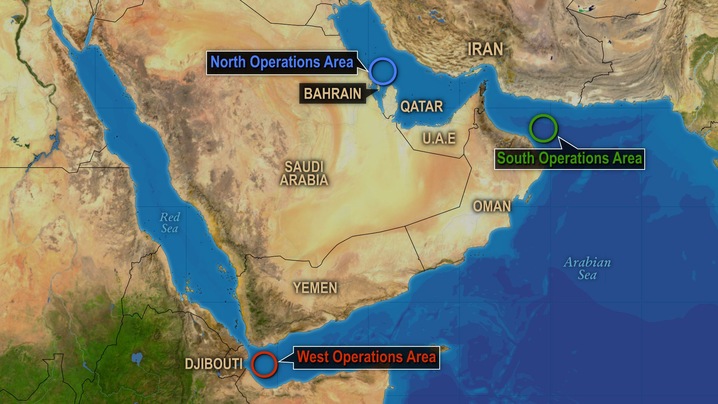
The military command staging the exercise says the military scenario will “focus on a hypothetical threat from an extremist organization to mine the international strategic waterways of the Middle East, including the Red Sea, the Gulf of Aden, the Gulf of Oman, and the Persian Gulf, although exercise activities will not extend into the Strait of Hormuz.”
The Pentagon has beefed up its deployments aimed at countering Iran over the past year. This summer, the Navy doubled from four to eight the number of dedicated mine-hunting ships in the Persian Gulf. It also deployed a newly converted ship, the USS Ponce, to serve as a staging and command post for mine hunting operations. It also has kept two aircraft carrier strike groups in the Persian Gulf, cutting short the home stay of one aircraft carrier in the United States in order to maintain the presence of two such vessels in the Mideast region.
“I think it is fair to say that the current level of U.S. military forces in the Gulf is certainly greater than would be expected simply for operations in Afghanistan,” said Henry Boyd, a research associate for defense and military analysis at the International Institute for Strategic Studies. “The recent additions all seem to be aimed at providing deterrent and-or contingency capabilities against Iran, and reassuring the United States’ existing Gulf allies.”
Over the past year, Washington and its global partners have heightened economic sanctions on Iran in order to pressure the country to curb its nuclear development program. In response, Iran has threatened to mine the Strait of Hormuz. Iran is believed to have 2,000 to 6,000 mines of varying sophistication.
Sea mines are floating devices that explode when they come into contact with ships.
The Strait of Hormuz is one of the world’s most important choke points, according to the U.S. Energy Information Administration. Roughly 20 percent of the world’s oil passes through the narrow sea passageway. Last year, roughly 14 crude oil tankers passed through the Strait of Hormuz every day, carrying 17 million barrels of oil.
At its narrowest point, the strait is 21 nautical miles wide. However, the two shipping channels — one for northbound traffic and the other for southbound — each measure just two miles wide and are separated by a two-mile buffer zone.
Still, Iran is unlikely to mine the Strait of Hormuz at the current time, according to a wide array of analysts interviewed for this article.
“They would be hurting themselves the most because they would be cutting off their main source of revenue, which is oil exports, at a time when they are already being sanctioned heavily and money is tight,” said Karim Sadjadpour, a senior associate at the Carnegie Endowment for International Peace.
In addition, China — Iran’s main customer for oil — would not like to see the flow of oil from the Persian Gulf curtailed, Sadjadpour said. “China is Iran’s key commercial and strategic patron and they would really alienate the Chinese” if Iranians were to mine the strait, he said.
And Tehran relies on the Strait of Hormuz for another reason: imports.
Almost all of its imported goods enter through the strait, according to Alireza Nader, a senior policy analyst at the RAND Corporation. “Unlike a lot of Arab countries — [including] Saudi Arabia and United Arab Emirates, [which] are building pipelines that bypass the strait — they [Iran] don’t have that significant infrastructure,” Nader said. “So closing the strait would be suicidal.”
However, there is one condition under which Iran might be more likely to mine the Strait of Hormuz, according to Iran watchers: if Israel were to bomb Iran’s nuclear facilities.
“In the event of a [Israeli] military attack, there is more than [a] 50 percent chance they would attempt to close the strait or prevent others from passing through freely,” said Sadjadpour. “They don’t have that many options for retaliation. They can try to launch missiles into Saudi Arabia to spike oil prices; they can try to unleash Hezbollah and Hamas; and, if they want to hurt the world, it’s by closing the strait.”
Another scenario under which Iran might mine the Strait of Hormuz is if its ability to export oil is completely cut off, according to Nader. If Iran “can’t sell most or any of its oil,” it might “retaliate by blocking the Strait of Hormuz or impede shipping,” he said.
The PBS NewsHour’s deputy foreign affairs and defense editor Daniel Sagalyn is in the Persian Gulf and will be covering the International Mine Countermeasures Exercise, which runs Sept. 16-27.


U.S. Leads Biggest Gulf Mine Exercise in Signal to Iran
By Tony Capaccio on September 16, 2012

The U.S. and 29 other nations have begun the biggest mine-clearing exercise in the Persian Gulf region, a show of force as tensions escalate over a threatened Israeli attack on Iran’s nuclear facilities.
The 12-day exercise that started yesterday involves Western nations such as the U.K. and France, as well as participants as varied as Japan, Yemen, Jordan, New Zealand and Estonia, according to the U.S. Navy. In an effort to avoid a showdown with the Islamic Republic, it won’t extend into the Strait of Hormuz, the waterway between Iran and Oman through which as much as a fifth of the world’s traded oil is shipped daily.
In addition to serving as a warning to Iran, the display of power will “signal to Israel that the United States has a military option available” and show “U.S. resolve to its Persian Gulf allies, especially in the face of repeated Iranian threats to try to close the Strait of Hormuz,” according to Kenneth Katzman, a Middle East specialist for the nonpartisan Congressional Research Service in Washington.
Participating nations will conduct mine-hunting and mine- countermeasure operations with MH-53E Sea Dragon helicopters, as well as explosive ordnance disposal, diving, and small-boat exercises and port-clearance operations focused on underwater improvised explosive devices, according to the U.S. Navy 5th Fleet, which is headquartered in Bahrain.
The exercise will focus “on a hypothetical threat to mine the international strategic waterways of the Middle East, including the Red Sea, the Gulf of Aden, the Gulf of Oman, and the Persian Gulf,” the U.S. Central Command in Tampa, Florida, said in a statement.

Threats on Strait

Iranian officials have periodically threatened to close the Strait, which is 21 miles (34 kilometers) wide at its narrowest point, in retaliation for tightening international sanctions aimed at dissuading them from developing a nuclear weapon. Laying mines or sinking a ship in the Strait would disrupt tanker traffic and also prompt insurance companies to raise rates on tankers, leading at least temporarily to higher oil prices.
Brent oil for October settlement closed at $116.66 a barrel on Sept. 14 in trading on the London-based ICE Futures Europe exchange. The contract, a benchmark for more than half of the world’s crude, has gained 8.6 percent this year.
On Aug. 30, Iran Oil Minister Rostam Qasemi said he wants global oil prices to rise to at least $130 a barrel, which he called a “reasonable price.”
Iran’s Revolutionary Guard Corps is ready to fight a possible military offensive and “nothing will remain” of the Israeli government if it attacks, Major General Mohammad Ali Jafari, commander-in-chief of the corps, said yesterday, according to the official Islamic Republic News Agency.

‘Red Line’

Israeli Prime Minister Benjamin Netanyahu and Defense Minister Ehud Barak have said Israel may have no choice but to launch a strike against Iran’s nuclear facilities as international negotiations stall over the program.
Iran’s effort to develop nuclear weapons is now in a “red zone,” and the U.S. must set a clear “red line” that Iran can’t cross without risking a military attack, Netanyahu said yesterday on the NBC News program “Meet The Press.”
Netanyahu has become more vocal in demanding that the U.S. define clear limits since Secretary of State Hillary Clinton said in a Bloomberg Radio interview on Sept. 9 that the U.S. is “not setting deadlines” on negotiations with Iran.
In addition to the mine-sweeping exercise, the U.S. has two aircraft carrier strike groups in the region currently, with the USS Enterprise in the Arabian Sea and the USS Dwight D. Eisenhower in the Persian Gulf.

‘Devastating Power’

The carriers’ presence tells Iran the U.S. “can easily project devastating power onto Iranian soil at a moment’s notice,” Katzman of the Congressional Research Service said in an e-mail.
Defense Secretary Leon Panetta told CBS’s “This Morning” on Sept. 11 that “we have the forces in place to be able to not only defend ourselves, but to do what we have to do to try to stop them from developing a nuclear weapon.” Iran says its nuclear program is for civilian purposes.
The mine-clearing exercise’s multinational participation shows “we are not alone -- it’s just not the United States ‘bullying’ Iran,” Michael Eisenstadt, director of military studies at the Washington Institute for Near East Policy, said in a phone interview.

Wednesday, July 4, 2012

Iran 'ready to attack US bases'. Iranians 'were targeting British High Commission in Kenya'.


Iran 'ready to attack US bases'

Iran declared on Wednesday that it can destroy nearby US military bases and strike Israel within minutes of an attack on the Islamic Republic, reflecting tensions over Iran's suspect nuclear programme.

A surface-to-surface missile is launched in Iran
The elite Revolutionary Guards' military drill included the firing of ballistic missiles Photo: AP


The veiled threat came during a military drill that has included the firing of ballistic missiles.
The elite Revolutionary Guards, conducting the war games in Iran's central desert, said that the missiles were aimed at mock-ups of foreign military bases.
Israel and the US have hinted at the possibility of military strikes against Iran if sanctions and diplomacy do not rein in Iran's nuclear development programme. The West suspects Iran may be aiming to build nuclear weapons. Iran insists its programme is for peaceful purposes.
The semiofficial Fars news agency quoted Gen. Ami Ali Hajizadeh of the Revolutionary Guards as saying US bases are in range of Iran's missiles and could be hit in retaliatory strikes. He referred to Israel as "occupied territories."
"Measures have been taken so that we could destroy all these bases in the early minutes of an attack," said Hajizadeh, chief of the Guards' airspace division.

Oil Backed Up, Iranians Put It on Idled Ships


The New York Times
An estimated 65 Iranian tankers are being used to store oil.

Iranians 'were targeting British High Commission in Kenya'

Two Iranians suspected of planning terror attacks in Kenya toured Nairobi surveying the British High Commission, the Israeli embassy and a synagogue in the week before their arrest, police told The Daily Telegraph.

Iranians 'were targeting British High Commission in Kenya'
Ahmad Abolfathi Mohammad and Sayed Mansour Mousavi were arrested last week with 33 pounds of RDX, a powerful explosive, in the coastal city of Mombasa Photo: AP

Kenya cancels oil deal with Iran after warnings


Kenya on Wednesday cancelled a deal to import Iranian oil hours after the U.S. warned the country that it risked being penalized if it sees through the deal which would breach U.S. and European union sanctions, a government official said.

The sanctions are meant to deprive funding for the Iranian government and what is believed to be an effort by Iran to build nuclear weapons.

Kenya's Energy Permanent Secretary Patrick Nyoike said Kenya had not signed an agreement but had a memorandum of understanding with Iran to import its oil and was complying with international sanctions on Iran.
"There is an embargo on Iranian oil and on that note it has been decided that the M.O.U. will be terminated," Nyoike said.

The U.S. announced in December that it would penalize banks that do oil deals with Iran, giving countries and the oil markets until the end of June to adjust.

A statement from the U.S. State Department said Wednesday that sanctions will be implemented fully, and they include sanctions against financial institutions from any country, without an exception, if they are found to conduct sanctionable transactions, including those with the Central Bank of Iran.

Nyoike had been quoted this week saying that Kenya has signed an agreement to buy millions of barrels of Iranian oil.
He said he was not aware of the U.S. warning to Kenya about oil deals with Iran.

Nyoike said the cancellation of the memorandum with Iran had nothing to do with accusations that two men believed to be agents of a secretive unit in the Iranian armed forces were planning to bomb American, Israeli, British and Saudi Arabian targets.

Kenyan security forces arrested the Iranians on June 19 and were then led to 15 kilograms (33 pounds) of RDX, a powerful explosive that could have been used against multiple targets or concentrated in one large bomb. If used together, the explosives could have leveled a medium-sized hotel, officials told AP.

The two suspects — Ahmad Abolfathi Mohammad and Sayed Mansour Mousavi — appeared in a Kenyan court last week, where Mohammad said he had been interrogated by Israeli agents. Israel's embassy said it had no comment.
In Israel, the office of Prime Minister Benjamin Netanyahu told the AP that "there are no limits to the Iranian terror."


Iran State TV Accuses BBC of Hacking Website

TEHRAN, Iran July 4, 2012 (AP)


Iran's state TV charged Wednesday that the BBC hacked its website to change the results of a poll about Iran's nuclear program. The BBC denied the allegation.


The West suspects Iran may be aiming to produce nuclear weapons. Iran insists its nuclear program is for peaceful purposes like energy production. The British broadcaster's Farsi language service reported that the poll showed 63 percent of those who took part favored halting uranium enrichment in exchange for an end to Western economic sanctions. 


The TV report Wednesday said the actual figure was 24 percent, and the rest favored retaliation against the West with measures like closing the strategic Strait of Hormuz, a key to exporting oil from the Gulf. In a statement, the BBC said the claims were "both ludicrous and completely false, and the BBC Persian Service stands by its reporting." 


 "There is a significant audience within Iran which depends on BBC Persian to provide impartial and trusted news, and we are confident they are familiar with the state media's tactics," it said. The poll was taken off Iran TV's website on Tuesday.


source: http://abcnews.go.com/International/wireStory/iran-state-tv-accuses-bbc-hacking-website-16712056