Ad

Showing posts with label armagedeon. Show all posts

Saturday, February 26, 2011

Nuclear War Could Stop Global Warming? And Global Warming Was A Plan Hatched In The 60's?

Could A Small Nuclear War Reverse Global Warming?

Nuclear Bomb Global Warming
The Huffington Post  Dean Praetorius  First Posted: 02/26/11 12:25 PM Updated: 02/26/11 01:04 PM
230
60
Nuclear war is a bad thing.
Right?
Scientists from NASA and a number of other institutions have recently been modeling the effects of a war involving a hundred Hiroshima-level bombs, or 0.03 percent of the world's current nuclear arsenal, according to National Geographic. The research suggests five million metric tons of black carbon would be swept up into the lowest portion of the atmosphere.
The result, according to NASA climate models, could actually be global cooling.
In NASA climate models, this carbon then absorbed solar heat and, like a hot-air balloon, quickly lofted even higher, where the soot would take much longer to clear from the sky.
While the global cooling caused by superpower-on-superpower war could be catastrophic (hence the term "nuclear winter") a small scale war could have an impact on the world climate, saysNational Geographic. Models suggest that though the world is currently in a warming trend, small-scale war could lower global temperatures 2.25 degrees F for two-to-three years following war.
In more tropical areas temperatures could fall 5.4 to 7.2 degrees F.
http://www.huffingtonpost.com/2011/02/26/nuclear-war-global-warming_n_828496.html


Tuesday, February 15, 2011

Large Scale Food Shortages In The US Starting With Produce Now


Food in China: Weather, Wheat and Worry
Posted by KRISTA MAHR Tuesday, February 15, 2011 at 3:18 am
Submit a Comment • Related Topics: china, food, weather , drought, fao, food prices, wheat
China is a nation of superlatives, and its role in weather manipulation is no exception. Beijing runs the world's largest program in cloud seeding – the process of imbuing clouds with silver iodide to generate precipitation, usually in times of drought. China rolled out its cloud seeding technology to clear the skies of dust and pollution before the Beijing Olympics; last week, the rocket launchers and aircraft were mobilized again – this time to battle a drought in the nation's wheat belt.

Evidently, the world's biggest cloud seeding program just got bigger. Yesterday, China's meteorological agency announced that it had received over $1 million from the Ministry of Finance to improve its anti-drought work in rainmaking. Though Beijing's enthusiasm for the technology has been known to go astray, last week's efforts are credited with bringing at least some new snow and moisture to parts of the dessicated region.

For many around the world nervously watching China's wheat crop, that's good news. As the world's largest wheat producer, China is self-sufficient in wheat, but if this year's harvests don't deliver, there is a possibility that Beijing could burn through its significant reserves and have to start importing wheat, driving global prices up even further. (Yesterday, pushed up by floods in Australia and an earlier drought in Russia, wheat prices reached their highest mark since the 2008 record prices.)

How seriously the possibility of large-scale imports in China should be taken has been the subject of much debate in the last few days. Last week, the United Nation's Food and Agriculture Organization (FAO) released a report (the first of its kind on China in 15 years) that the drought in the north, which has been going strong since fall, has affected about up to 60% of the nation's wheat crop. The report reads:

According to official estimates some 5.16 million hectares out of the total of about 14 million hectares under winter wheat may have been affected in these provinces. The drought has reportedly affected some 2.57 million people and 2.79 million livestock due to the shortages of drinking water.

It goes on to say that domestic wheat prices are up 16% over last year, and if the dry weather persists through the spring to affect the next harvest late this year, it could seriously impact global wheat prices.

Chinese officials predictably downplayed the report, estimating that the drought-affected area is closer to 40% — not 60 — and rightly underscoring the fact that the FAO report still predicts that China's wheat output would remain steady at 112 million tons. The FT's Javier Blas also called the UN body alarmist for jumping the gun at a sensitive time: “As the FAO tries to pick up the ball – under huge pressure from the French presidency of the G20 to improve its crop forecasting – it risks creating problems. With global agricultural markets on edge, the world is looking at the FAO for guidance. It needs timely and accurate information, but also nuance and perspective.”

Though trying to stamp out any sense of panic, Beijing itself has not exactly been blasé about the current state of affairs. China's winter wheat crop, harvested in June, yields over 90% of the nation's supply. Over the weekend, China's own drought control agency posted that continuing conditions were “grim” and called for emergency irrigation measures in the wheat belt, according to the New York Times. In addition to its hefty new cloud seeding investment, the government also handed out subsidies this fall to help farmers improve irrigation ditches and reservoirs in the wheat belt. A report from state-run daily Xinhua notes today that if all else fails and no rain comes through this winter or spring, "thousands" of wells could supply water.

Which sounds like a lot, but in the land of superlatives, it ain't. Nor will it be very comforting for the wheat farmers — or the global markets — if the weather doesn't break before the next planting this summer. So let's hope for rain.


Read more: http://ecocentric.blogs.time.com/2011/02/15/food-in-china-weather-wheat-and-worry/#ixzz1E37CT0bq

X-Flare, The Largest Type On The Solar Flare Richter Scale, Headed Towards Earth

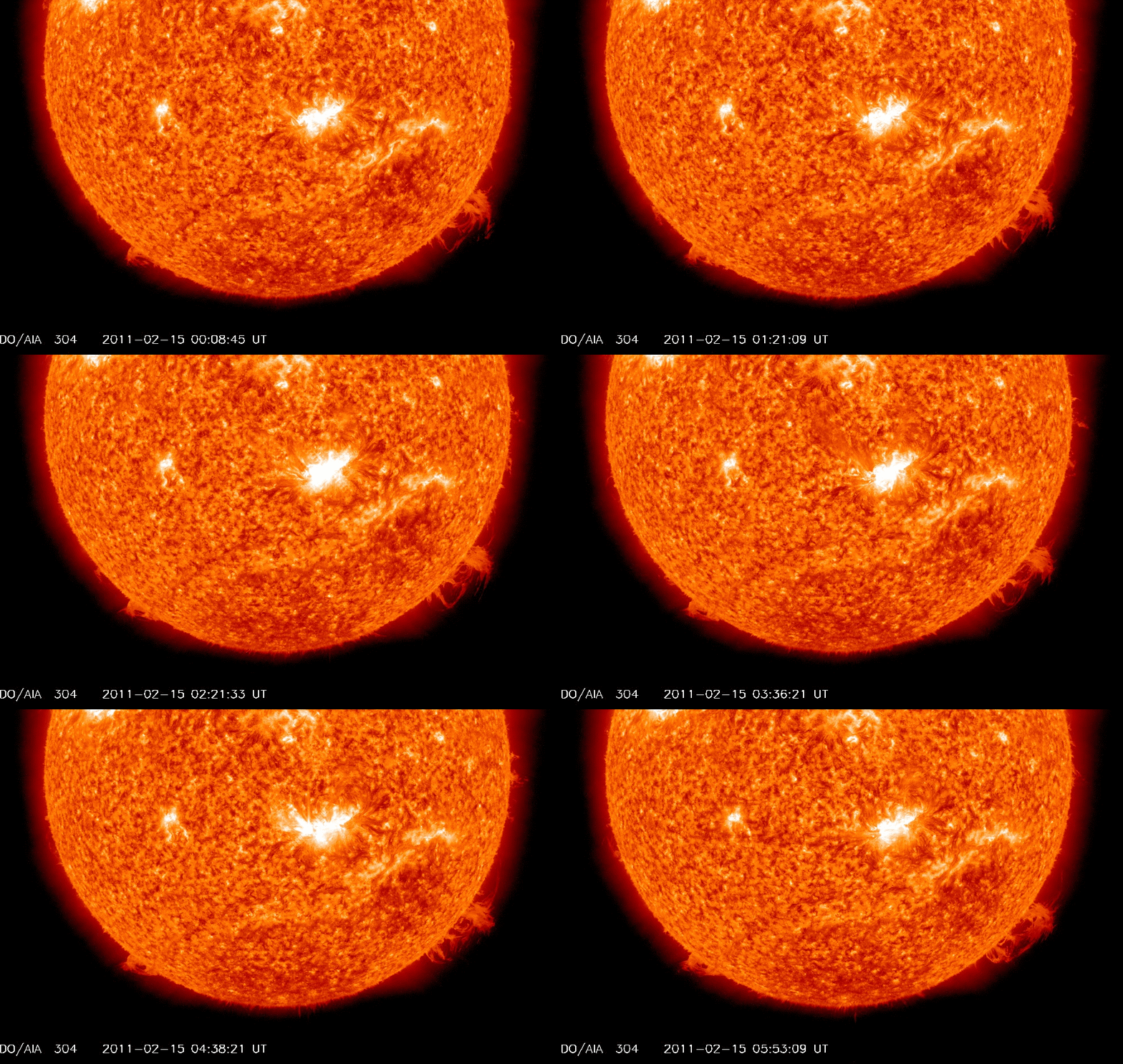
FIRST X-FLARE OF THE NEW SOLAR CYCLE: Sunspot 1158 has unleashed the strongest solar flare in more than four years. The eruption, which peaked at 0156 UT on Feb. 15th, registered X2 on the Richter scale of solar flares. NASA's Solar Dynamics Observatory recorded an intense flash of extreme ultraviolet radiation, circled below:

movie formats: 5 MB gif1.3 MB iPad0.6 MB iPhone
X-flares are the strongest type of solar flare, and this is the first such eruption of new Solar Cycle 24. In addition to flashing Earth with UV radiation, the explosion also hurled a coronal mass ejection (CME) in our direction. The expanding cloud may be seen in this movie from NASA's STEREO-B spacecraft. Geomagnetic storms are possible when the CME arrives 36 to 48 hours hence. Stay tuned for updates.
The Classification of X-ray Solar Flares
or "Solar Flare Alphabet Soup"
A solar flare is an explosion on the Sun that happens when energy stored in twisted magnetic fields (usually above sunspots) is suddenly released. Flares produce a burst of radiation across the electromagnetic spectrum, from radio waves to x-rays and gamma-rays. [more information]
Scientists classify solar flares according to their x-ray brightness in the wavelength range 1 to 8 Angstroms. There are 3 categories: X-class flares are big; they are major events that can trigger planet-wide radio blackouts and long-lasting radiation storms. M-class flares are medium-sized; they can cause brief radio blackouts that affect Earth's polar regions. Minor radiation storms sometimes follow an M-class flare. Compared to X- and M-class events, C-class flares are small with few noticeable consequences here on Earth.
This figure shows a series of solar flares detected by NOAA satellites in July 2000:


Each category for x-ray flares has nine subdivisions ranging from, e.g., C1 to C9, M1 to M9, and X1 to X9. In this figure, the three indicated flares registered (from left to right) X2, M5, and X6. The X6 flare triggered a radiation storm around Earth nicknamed the Bastille Day event.


 Class
Peak (W/m2)between 1 and 8 Angstroms


 B
 I < 10-6


 C
 10-6 < = I < 10-5


 M
 10-5 < = I < 10-4


 X
 I > = 10-4


Tuesday, June 16, 2009

Signs from lack of seasons.

Watch the signs...since the beginning of the year alone there has been a mix-up of the seasons all over the globe.

************************************************************

"Yea," he replied. "The weather has been very weird lately. Just last week we went from 20 degrees on one day to 70 degrees the next. Everybody went from parkas to golfing in 24 hours. Weird."

Weird indeed.

After a terribly uncomfortable night in my Wilmington hotel (they turn all the AC units off in the hotels during winter, because, you see, it is supposed to be COLD in Delaware in winter), I awake to a rainy, humid day. My client picked me up at the hotel and the first thing he said to me as I jumped into his car for the ride to the office... "Weird weather man. Did you bring an umbrella?" I laughed and told him that "Weird weather" was the mantra of the week, and shared my story with him.

Later that day, as I was facilitating a meeting with a group of government employees, I noticed that their attention was no longer on me. Everybody was looking past me, out the windows. I stopped talking and slowly looked outside, and to my surprise noticed that it was snowing! Huge, beautiful white snowflakes fluttering to the ground! And just yesterday I was uncomfortable because of humidity and heat. This morning it wasn't even cold...now it is snowing?

Weird weather!

EnzineArticles

*******************************************************************

Weird weather around the world

In the middle of the desert, snowflakes are falling. Of all places, it was snowing this morning in Baghdad, which made headlines in publications like the New York Times and TIME Magazine. Some people interviewed said they've never heard of snow in Baghdad while others say it's been at least forty years.

That alone is a strange enough incident. But get this. It's spring-time in New York City. How's that for topsy turvy. This week, when New Yorkers should have been bundled up in their wool scarves and rubber boots, they've been walking around in t-shirts.

Gadling.com

*********************************************************************


For the latest Philippine news stories and videos, visit GMANews.TV
*********************************************************************

Twelve dust storms barreled into the southern Rockies from the deserts of Arizona, Utah and New Mexico so far this year. In contrast, four storms hit the mountains all year long in 2003. Eight occurred in each of the last three years.
The Thin Green Line

********************************************************************

NovaNewsNow.com

Meteorologists at Environment Canada are all abuzz about an ominous, dark, fast moving cloud that passed over much of Yarmouth County between 7 and 9 p.m. on April 28.

Meteorologist Serge Deschamps says the cloud seems to be what is known as a roll cloud. The report created quite a stir in the office.

“It is very rare phenomena. All the right conditions have to be set up and I guess you had it set up yesterday,” he said.
Prison Planet

***************************************************************

The forecast this morning was clear skies in the Southland. What did we get? Lightning, hail, and a little rain.

InteractMD

******************************************************************

A rare outbreak of tornadoes moved across the Midwest in January 2008. These tornadoes destroyed homes and caused trains to blow off their tracks.

AllMomReviews

*********************************************************************

The weather has been incredibly strange in the tropics. It has been unusually cool and rainy. Yesterday a violent thunderstorm ripped through and it rained most of the day. Usually rains last ten minutes and they move on.

During the night there were violent winds and the patio was covered with windblown debris.
CosmologicalCabbage

**********************************************************************

We had a tornado on February 18, 2009. The next weekend it snowed. The weekend after we had a deluge of rain. Then sunny weather and in the 70's. I know I'm missing a few weeks in between, but the weather has been from one extreme to the other.

This weekend we had an earthquake, in Georgia! Today the forecast is for snow and temps in the lower 30's to 28.

This is crazy!

Almanac

***********************************************************************
February 2009

In North Korea, Kim's birthday means festivals with singing soldiers, dancing in the street, a few extra handfuls of rice for workers and sweets for children. The North said "a mysterious moon halo" was seen above Mt Jong-il just before the birthday.


Reuters

************************************************************************

After the wettest winter on record and the driest May on record, the kind citizens are experiencing what looks to be the wettest and coolest June on record. Many of them are wondering if they will ever get to put up any hay.

HubbasHouse.com

*************************************************************************

Well now, isn't this interesting! We are to have SNOW in June in the Sierras centered on Lake Tahoe, as seen in the map below. The blue area in northern California is under a snow watch. Who wants to bet that this will be front-page news across the country on main-stream media? California legislators need to be aware of this as they continue writing the AB 32 regulations, which are predicated on a disappearing snow pack due to global warming.

Energy Guys Musings

*************************************************************************
Tuesday, June 16, 2009
Snow In New Jersey Today?

Is it really going to snow in New Jersey today? Yep!!! Enjoy the New Jersey snow today! And watch out for hail. What a weird weather forecast...

Digging The News

************************************************************************
Anyone else want to add?