"Yellowstone, like Hawaii, is believed to lie on top of an area called a hotspot where light, hot, molten mantle rock rises towards the surface. While theYellowstone hotspot is now under the Yellowstone Plateau, it previously helped create the eastern Snake River Plain (to the west of Yellowstone) through a series of huge volcanic eruptions. Although the hotspot's apparent motion is to the east-northeast, the North American Plate is really moving west-southwest over the stationary hotspot in the Earth's mantle.[4]
 Over the past 17 million years or so, this hotspot has generated a succession of violent eruptions and less violent floods of basaltic lava. Together these eruptions have helped create the eastern part of the Snake River Plain from a once-mountainous region. At least a dozen of these eruptions were so massive that they are classified as supereruptions. Volcanic eruptions sometimes empty their stores of magma so swiftly that they cause the overlying land to collapse into the emptied magma chamber, forming a geographic depression called a caldera. Calderas formed from explosive supereruptions can be as wide and deep as mid- to large-sized lakes and can be responsible for destroying broad swaths of mountain ranges."
 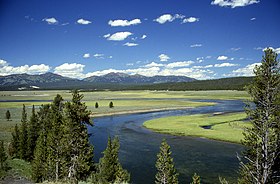 Does this picture look like a deadly volcano to you? Well, pay attention to this post and ask yourself if you need to put together a family preparedness plan in the case of an imminent eruption.
Yellowstone Has Bulged as Magma Pocket Swells
Some places saw the ground rise by ten inches, experts report.
Steam rises from Castle Geyser in Yellowstone National Park (file photo).
Photograph by Mark Thiessen, National Geographic
Published January 19, 2011
Yellowstone National Park's supervolcano just took a deep "breath," causing miles of ground to rise dramatically, scientists report.
 The simmering volcano has produced major eruptions—each a thousand times more powerful than Mount St. Helens's 1980 eruption—three times in the past 2.1 million years. Yellowstone's caldera, which covers a 25- by 37-mile (40- by 60-kilometer) swath of Wyoming, is an ancient crater formed after the last big blast, some 640,000 years ago.
Since then, about 30 smaller eruptions—including one as recent as 70,000 years ago—have filled the caldera with lava and ash, producing the relatively flat landscape we see today.
But beginning in 2004, scientists saw the ground above the caldera rise upward at rates as high as 2.8 inches (7 centimeters) a year.
The rate slowed between 2007 and 2010 to a centimeter a year or less. Still, since the start of the swelling, ground levels over the volcano have been raised by as much as 10 inches (25 centimeters) in places.
"It's an extraordinary uplift, because it covers such a large area and the rates are so high," said the University of Utah's Bob Smith, a longtime expert in Yellowstone's volcanism.
Here is more information about this supervolcano and the possible scenarios of its eruption.
A Big, Big Hole In The Ground - Written by Anthony Kendall on 02 March 2006
 Yellowstone National Park is a wonder of the natural world. Its geysers, hot springs, and bubbling mud pools are some of the most impressive examples of geologic activity, and amaze even those who have never visited the park ...
It wasn’t until the late 1960s that Bob Christiansen, a geologist with the US Geological Survey (USGS) began to realize that the cliffs surrounding the park were really the rim of volcanic caldera. A volcanic caldera forms when the ground collapses because the magma beneath it erupted. Why did it take geologists so long to recognize Yellowstone for what it is? Because usually volcanic calderas are at most 2-4 km in diameter. The cliffs of the Yellowstone caldera stand 65 kilometers apart.
 The Yellowstone Caldera sits next to two more ancient volcanic calderas to the south west. It just so happened that right when Christiansen began to trace out these enormous ancient calderas, other scientists began to use radioactive dating techniques on ash-fall deposits throughout the central United States. Three major ash-falls blanket much of the country from California through Idaho, Iowa, and down to northern Louisiana. These blankets were dated at approximately 2.2 million, 1.3 million, and 640,000 years old; exactly the same age as the three Yellowstone calderas.
The Yellowstone Caldera sits next to two more ancient volcanic calderas to the south west. It just so happened that right when Christiansen began to trace out these enormous ancient calderas, other scientists began to use radioactive dating techniques on ash-fall deposits throughout the central United States. Three major ash-falls blanket much of the country from California through Idaho, Iowa, and down to northern Louisiana. These blankets were dated at approximately 2.2 million, 1.3 million, and 640,000 years old; exactly the same age as the three Yellowstone calderas.By carefully recording the thickness and extent of each ash layer, scientists determined that the three eruptions had released between 300 and 2,500 cubic kilometers of ash. Mt. St Helens released a paltry-by-comparison 1 cubic kilometer. The largest of the three eruptions stands as the fifth largest eruption in all of known geologic history. That is how Yellowstone became known as a supervolcano.
...Given that an average American lives to be about 70 years old, that would put each of our odds of witnessing another giant Yellowstone eruption at about 1 in 13,000. That folks, means you are far more likely witness such an eruption than you are to die in a plane crash.
 ...Since observations began in about 1925, the caldera floor has been slowly rising each year as magma refills the chamber 5 km below the surface. Our abilities to monitor the supervolcano have improved over the decades, and now we can detect the swarms of earthquakes that signal the movement of huge magma flows far below.
From observations of much smaller volcanic eruptions elsewhere, we know that earthquake swarms grow more frequent and intense as an eruption grows near. So geologists expect that any eruption at Yellowstone, even one much smaller than those that formed the three calderas, would show these signs as well. In 2001, the USGS and the University of Utah formed the Yellowstone Volcano Observatory to monitor seismic activity in the area. Hopefully the Observatory can provide enough warning to save the residents of the central United States. But, a nation-wide evacuation order would most certainly not be universally obeyed.
 What would an eruption on the scale of the Yellowstone caldera eruptions be like? First, the eruption itself might last for weeks to years. During that time it would release steam and ash into the atmosphere that would partially block the sun, chilling the entire world. For thousands of miles, a blanket of ash would rain down on the land killing crops, poisoning water, and destroying mechanical and electrical equipment. Unless evacuated beforehand, people across the midwest would probably not get enough warning to leave before they are buried or suffocate on the ash. The casualties would no doubt be in the millions.
Satellite Technologies Detect Uplift in the Yellowstone Caldera
 This image of ground deformation was created using data from several satellite passes from 1996 through 2000. The image shows 125 mm (about 5 in) of uplift centered within the northern end of Yellowstone caldera (black dotted line), about 10 km (6.2 miles) south of Norris. Each full spectrum of color (from red to purple) represents about 28 mm (1 inch) of uplift. The uplift is approximately 35 km x 40 km (22 miles x 25 miles) in size. http://volcanoes.usgs.gov/yvo/2006/uplift.html
Posted by geologist Christopher C. Sanders on January 1, 2009.
"I am advising all State officials around Yellowstone National Park for a potential State of Emergency. In the last week over 252 earthquakes have been observed by the USGS.
We have a 3D view on the movement of magma rising underground. We have all of the pre warning signs of a major eruption from a super volcano. - I want everyone to leave Yellowstone National Park and for 200 miles around the volcano caldera."
What would happen if the supervolcano scenario occurred
If the volcano at Yellowstone were to erupt like it appears to have done some time in the ancient past, we'd love to paint a survival scenario for you. However, beyond getting ready for the cold that might come due to the ash blotting out the sun and life as we know it (and moving away from the center of the eruption as much as possible) a survival scenario really doesn't exist in the traditional sense.
First, anyone within about 100 kilometers of such an explosion would simply be killed by the explosion itself (remember that the eruption in the ancient past emitted 240 cubic miles of material) or the volcanic ash quite quickly.
Next, such an explosion would leave the majority of the North American continent below ash. The ash would be more significant closer to the explosion, but dangerous amounts would still reach three quarters of the continent.
After all, remember that volcanic ash is really very fine rock and mineral particles. Thus, these are dangerous to breath as they tend to cement together (and that's not good in a human body). Further, they are abrasive to the eyes. Last, when ash falls on a structure it will cement and become quite heavy. In other words, a likely consequence of it are millions of destroyed shelters.
Oh yeah, and on top of it all, ash is dangerous to mechanical devices like cars.
Some things to do in the event of volcanic ash that may help you survive
As was indicated earlier, if you're within 100 kilometers of the supervolcano, you're in big trouble. However, there are some precautions one can take in the event of dealing with volcanic ash, and these really start with having the appropriate supplies on hand.
Beforehand you should have (most information taken from the CVO Website)
Extra dust masks
Non-perishable food for three days (see several articles at the site on this)
Drinking water for three days (see articles)
Plastic wrap (for electronics)
First aid kit and medications
Radio with batteries
Flashlights with batteries
Wood for a fireplace or stove
Blankets and warm clothing
Cleaning supplies
Cash (forget credit cards and ATM's in this situation)
Pet food and supplies
Cell phone
Further, it's not a bad idea to know your child's school emergency plan and to have some of the above in your car (though the reality is that if you don't have to drive, then don't when it comes to ash). Beyond that, you should stay indoors and listen for directions from emergency personnel as long as possible. If you do need to leave the house for any reason, wear a mask to protect your eyes.
And hope that the world doesn't turn into a frozen tundra as many think parts of it will.
In the end, there is no definitive evidence that they Yellowstone supervolcano will erupt anytime soon. However, most scientists do believe that it eventually will happen.
So why not be as ready as possible?
http://www.secretsofsurvival.com/survival/yellowstone_supervolcano.html
If the volcano at Yellowstone were to erupt like it appears to have done some time in the ancient past, we'd love to paint a survival scenario for you. However, beyond getting ready for the cold that might come due to the ash blotting out the sun and life as we know it (and moving away from the center of the eruption as much as possible) a survival scenario really doesn't exist in the traditional sense.
First, anyone within about 100 kilometers of such an explosion would simply be killed by the explosion itself (remember that the eruption in the ancient past emitted 240 cubic miles of material) or the volcanic ash quite quickly.
Next, such an explosion would leave the majority of the North American continent below ash. The ash would be more significant closer to the explosion, but dangerous amounts would still reach three quarters of the continent.
After all, remember that volcanic ash is really very fine rock and mineral particles. Thus, these are dangerous to breath as they tend to cement together (and that's not good in a human body). Further, they are abrasive to the eyes. Last, when ash falls on a structure it will cement and become quite heavy. In other words, a likely consequence of it are millions of destroyed shelters.
Oh yeah, and on top of it all, ash is dangerous to mechanical devices like cars.
Some things to do in the event of volcanic ash that may help you survive
As was indicated earlier, if you're within 100 kilometers of the supervolcano, you're in big trouble. However, there are some precautions one can take in the event of dealing with volcanic ash, and these really start with having the appropriate supplies on hand.
Beforehand you should have (most information taken from the CVO Website)
Extra dust masks
Non-perishable food for three days (see several articles at the site on this)
Drinking water for three days (see articles)
Plastic wrap (for electronics)
First aid kit and medications
Radio with batteries
Flashlights with batteries
Wood for a fireplace or stove
Blankets and warm clothing
Cleaning supplies
Cash (forget credit cards and ATM's in this situation)
Pet food and supplies
Cell phone
Further, it's not a bad idea to know your child's school emergency plan and to have some of the above in your car (though the reality is that if you don't have to drive, then don't when it comes to ash). Beyond that, you should stay indoors and listen for directions from emergency personnel as long as possible. If you do need to leave the house for any reason, wear a mask to protect your eyes.
And hope that the world doesn't turn into a frozen tundra as many think parts of it will.
In the end, there is no definitive evidence that they Yellowstone supervolcano will erupt anytime soon. However, most scientists do believe that it eventually will happen.
So why not be as ready as possible?
http://www.secretsofsurvival.com/survival/yellowstone_supervolcano.html


