Ad

Showing posts with label science. Show all posts

Sunday, May 19, 2013

Solar Flare Propels Coronal Mass Ejection Towards Earth and Likely Will Cause Geomagnetic Storms Starting Today, May 19, 2013

CME IMPACT: A CME hit Earth's magnetic field on May 19th at 2250 UT (3:50 PM PDT). Polar geomagnetic storms and high-latitude auroras are possible in the hours ahead. Stay tuned for updates. 

The CME was propelled toward Earth on May 17th by an M3-class solar flare in the magnetic canopy of sunspot AR1748. SOHO took this picture of the CME racing away from the sun at 1500 km/s (3.4 million mph):
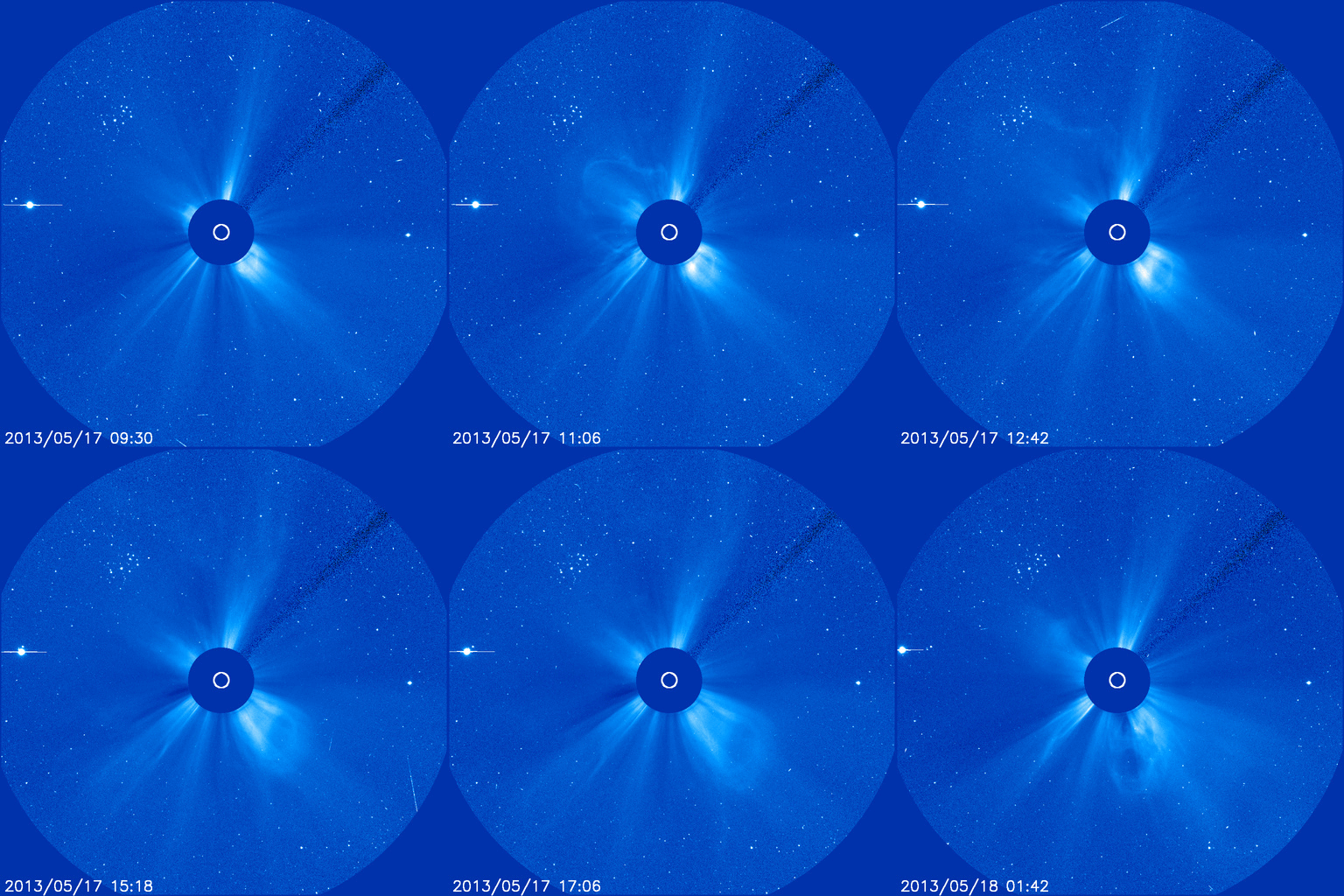

It was hurled into space by an M3-class solar flare in the magnetic canopy of sunspot AR1748. In the video, the CME appears to hit Mercury, but it does not. It is merely passing in front of the innermost planet. The planet in the line of fire is Earth.

AURORAS INVADE THE USA: A CME hit Earth's magnetic field on May 18th at around 0100 UT. Although it was just a glancing blow, the impact was enough to spark a G1-class geomagnetic storm. In the United States, Northern Lights descended as far south as Pawnee Buttes, Colorado:


"The aurora was not visible to the naked eye," says photographer Robert Arn. "Only with a 30 second exposure did I know it was there. As I started to collect data, I noticed an electrical storm in the distance. The juxtaposition of the electrical storm and aurora made for a spectacular image. (The moon near the horizon illuminated the landscape.)"

Elsewhere in the United States, faint auroras were photographed in Michigan, Massachusetts, Washington, Vermont, and Iowa. Browse the aurora gallery for more sightings.


Planetary K-index
Now: Kp= 2 quiet
24-hr max: Kp= 4 
unsettled
explanation | more data
Interplanetary Mag. Field
Btotal13.8 nT
Bz3.3 nT south 
explanation | more data
Updated: Today at 2357 UT

SWPC ACE RTSW MAG 24-hour Updating Plot

3-day Estimated Planetary K-index graph


The K-index

The K-index is a code that is related to the maximum fluctuations of horizontal components observed on a magnetometer relative to a quiet day, during a three-hour interval. The conversion table from maximum fluctuation (nT) to K-index, varies from observatory to observatory in such a way that the historical rate of occurrence of certain levels of K are about the same at all observatories. In practice this means that observatories at higher geomagnetic latitude require higher levels of fluctuation for a given K-index. The conversion table for the Boulder magnetometer is shown below:
K
nT
0
0-5
1
5-10
2
10-20
3
20-40
4
40-70
5
70-120
6
120-200
7
200-330
8
330-500
9
>500
At SWPC, we monitor the preliminary values of the K-index, minute by minute, from a network of observatories that relay data in near-real time. The final K-indices are determined after the end of prescribed three hourly intervals (0000-0300, 0300-0600, ..., 2100-2400). The maximum positive and negative deviations during the 3-hour period are added together to determine the total maximum fluctuation. These maximum deviations may occur anytime during the 3-hour period.


Relationship between Kp and the Aurora [ref]
Right: From thousands of observations, Cornell University scientists have determined geographic subpoints for the southern edges of auroral displays. The curves represent four values of the planetary index (Kp). As this index increases, the aurora's southern edge moves southward

In this article we briefly explain some of the ideas behind the association of the aurora with geomagnetic activity and a bit about how the ‘K-index’ or ‘K-factor’ works. The aurora is understood to be caused by the interaction of high energy particles (usually electrons) with neutral atoms in the earth's upper atmosphere. These high energy particles can ‘excite’ (by collisions) valence electrons that are bound to the neutral atom. The ‘excited’ electron can then ‘de-excite’ and return back to its initial, lower energy state, but in the process it releases a photon (a light particle). The combined effect of many photons being released from many atoms results in the aurora display that you see.

The details of how high energy particles are generated during geomagnetic storms constitute an entire discipline of space science in its own right. The basic idea, however, is that the Earth’s magnetic field (let us say the ‘geomagnetic field’) is responding to a outwardly propagating disturbance from the Sun. As the geomagnetic field adjusts to this disturbance, various components of the Earth’s field change form, releasing magnetic energy and thereby accelerating charged particles to high energies. These particles, being charged, are forced to stream along the geomagnetic field lines. Some end up in the upper part of the earth’s neutral atmosphere and the auroral mechanism begins.

The disturbance of the geomagnetic field may also be measured by an instrument called a magnetometer. At our operations center we receive magnetometer data from dozens of observatories in one minute intervals. The data is received at or near to ‘real-time’ and allows us to keep track of the current state of the geomagnetic conditions. In order to reduce the amount of data that our customers have to deal with we convert the magnetometer data into three-hourly indices which give a quantitative, but less detailed measure of the level of geomagnetic activity. The K-index scale has a range from 0 to 9 and is directly related to the maximum amount of fluctuation (relative to a quiet day) in the geomagnetic field over a three-hour interval.

The K-index is therefore updated every three hours and the information is made available to our customers as soon as possible. The K-index is also necessarily tied to a specific geomagnetic observatory. For locations where there are no observatories, one can only estimate what the local K-index would be by looking at data from the nearest observatory, but this would be subject to some errors from time to time because geomagnetic activity is not always spatially homogenous. Another item of interest is that the location of the aurora usually changes geomagnetic latitude as the intensity of the geomagnetic storm changes. The location of the aurora often takes on an ‘oval-like’ shape and is appropriately called the auroral oval. A useful map of the approximate location of the auroral oval as a function of the Kp-index was published in the June 1968 copy Sky & Telescope (see page 348). The Kp index is derived through by an algorithm that essentially averages the K-indices from several stations. Note that as a storm becomes more intense, the edge of the auroral boundary typically moves to lower latitudes.

For further reading we can recommend a couple of books for you. An old, but classic text is The Polar Aurora, Oxford University Press, 1955, by Störmer. A more modern text is The Physics of Space Plasmas, 1991, by George Parks. If you are interested in real-time reporting of geomagnetic activity please make use of our 24-hour/day, 7 day/week services. We have an internet home page address (/), and a recorded message which is updated every three hours or as major activity occurs (303-497-3235). You can also reach us at 303-497-3204. We hope that you find this information helpful. If you have some further questions please don’t hesitate to let us know. Best wishes ! Chris Balch (cbalch@sec.noaa.gov)


SPACE WEATHER
NOAA Forecasts
Updated at: 2013 May 19 2200 UTC
FLARE
0-24 hr
24-48 hr
CLASS M
65 %
65 %
CLASS X
25 %
25 %
source: source: http://spaceweather.com/


3-day GOES X-ray Plot
The GOES X-ray Flux plot contains 5 minute averages of solar X-ray output in the 1-8 Angstrom (0.1-0.8 nm) and 0.5-4.0 Angstrom (0.05-0.4 nm) passbands. Data from the SWPC Primary and Secondary GOES X-ray satellites are shown. Some data dropouts from the Primary satellite will occur during satellite eclipses.
source: http://www.swpc.noaa.gov/rt_plots/xray_5m.html

SWPC ACE RTSW MAG & SWEPAM 24-hour Updating Plot

source: http://www.swpc.noaa.gov/ace/MAG_SWEPAM_24h.html


Geomagnetic Storms:
Probabilities for significant disturbances in Earth's magnetic field are given for three activity levels:activeminor stormsevere storm

Updated at: 2013 May 19 2200 UTC
Mid-latitudes
0-24 hr
24-48 hr
ACTIVE
35 %
15 %
MINOR
30 %
05 %
SEVERE
20 %
01 %
High latitudes
0-24 hr
24-48 hr
ACTIVE
05 %
15 %
MINOR
20 %
25 %
SEVERE
75 %
25 %


ACTIVE:

Geomagnetic Storm Forecasts
The geomagnetic storm probabilities are the estimated chances of at least one 3-hour K index, at the indicated level, for each of the next 3 days.

Active: K = 4.
Minor storm: K = 5.
Major or Severe storm: K > 6.

The "K index" is a 3-hourly quasi-logarithmic local index of geomagnetic activity relative to an assumed quiet-day curve for the recording site. Range is from 0 to 9. The K index measures the deviation of the most disturbed horizontal component of the magnetic field.
http://spaceweather.com/glossary/geostorm.html

MINOR:

Geomagnetic Storm Forecasts
The geomagnetic storm probabilities are the estimated chances of at least one 3-hour K index, at the indicated level, for each of the next 3 days.

Active: K = 4.
Minor storm: K = 5.
Major or Severe storm: K > 6.

The "K index" is a 3-hourly quasi-logarithmic local index of geomagnetic activity relative to an assumed quiet-day curve for the recording site. Range is from 0 to 9. The K index measures the deviation of the most disturbed horizontal component of the magnetic field.


http://spaceweather.com/glossary/geostorm.html

SEVERE:
Geomagnetic Storm Forecasts
The geomagnetic storm probabilities are the estimated chances of at least one 3-hour K index, at the indicated level, for each of the next 3 days.

Active: K = 4.
Minor storm: K = 5.
Major or Severe storm: K > 6.

The "K index" is a 3-hourly quasi-logarithmic local index of geomagnetic activity relative to an assumed quiet-day curve for the recording site. Range is from 0 to 9. The K index measures the deviation of the most disturbed horizontal component of the magnetic field.

http://spaceweather.com/glossary/geostorm.html


Wednesday, July 4, 2012

God Particle. Higgs Boson. How Did the Universe Get Created?

REPLACING THE IDEA OF GOD?  OR LEARNING HOW TO PLAY GOD?  WHICH IS THE GOAL HERE?


PARTICLE 'CONSISTENT' WITH HIGGS BOSON DISCOVERED


Cms-higgs
The discovery of a particle consistent with the Higgs boson has been announced by physicists from the Large Hadron Collider's CMS and ATLAS detectors.
The discovery was detailed at a major conference to update the world on the continuing efforts by CERN scientists to find the last remaining piece of the Standard Model that underpins the foundations of our Universe. The Higgs boson mediates the "Higgs field" that ultimately endows all matter with mass -- finding the Higgs is therefore imperative for physicists to understand what gives the Universe substance.
When reports first surfaced that Peter Higgs -- one of the six physicists who, in the 1960s, developed the theory behind Higgs boson -- had been invited to CERN for this morning's announcement, the event became hard to ignore: something historic was about to happen...
This "new boson" revealed itself in the CMS data as a "bump" at 125 GeV/c2, a value that places it at over 130 times more massive than a proton.
After combining all the results gathered over many different channels in the CMS, the level of certainty -- 4.9-sigma -- came tantalizingly close to the "Gold Standard" (5-sigma) for subatomic particle discovery. This means there is a one-in-2 million chance of the result being a random fluctuation, or noise. For all intents and purposes, this is a discovery of a particle that acts very much like a Higgs boson...
However, more work needs to be done to figure out if this is indeed a Higgs boson or some unexpected renegade particle that just acts like the Higgs (although the latter is highly unlikely). Also, if it is a Higgs boson, is it a part of a larger Higgs family of particles?...
"I think we have it," said CERN Director-General Rolf Heuer. "We have discovered a particle that is consistent with a Higgs boson."


Physicists Find Elusive Particle Seen as Key to the Universe


'God particle' find sets scene for one hell of a row 


Ian Sample
July 5, 2012 - 11:02AM


It was announced less than 24 hours ago, but rows over who deserves credit have already broken out. 


It’s good news for physicists, but a big headache for the Nobel committee. 


The discovery - or near discovery - of the Higgs boson, will see someone win a Nobel prize, but deciding who deserves credit for the work is a minefield. Traditionally, the science Nobel prizes are given to a maximum of three people, whose contributions are judged to be the most important. 


British physicist Peter Higgs congratulates the experiment team after last night's announcment.
British physicist Peter Higgs congratulates the experiment team after last night's announcment. Photo: Reuters

The rule is archaic in that it harks back to a time when much of science was done by individuals or smaller groups. Two teams of scientists at Cern, amounting to thousands of people, carried out the painstaking work of spotting traces of the particle amid the subatomic debris of more than a thousand trillion collisions inside the Large Hadron Collider. All deserve credit for that effort. 


 But this is the least of the Nobel committee’s problems. The prize is more likely to go to theoretical physicists who worked on the theory almost 50 years ago. Here the parentage becomes more muddled. 


 Six physicists published the theory within four months of each other in 1964. They built on the work of others. 


Physicists applaud the announcement last night in Melbourne.
Physicists applaud the announcement last night in Melbourne. Photo: Angela Wylie


Physicists applaud the announcement last night in Melbourne. Photo: Angela Wylie The first to publish, that August, were Robert Brout and Francois Englert at the Free University of Brussels. Brout died in 2011, and the award cannot be given posthumously. 


Second to publish was Peter Higgs, with two papers on the theory in September and October 1964. In his second, he became the first to mention explicitly that the theory demanded a new particle in nature, which was given the name Higgs boson in 1972. 


Third to publish was a group of three theorists, including two US researchers, Dick Hagen and Gerry Guralnik, and a British physicist, Tom Kibble. Their work was published in November. 


Professor Geoffrey Taylor. Photo: Angela Wylie All three teams worked independently. 


So there are at least five living physicists who can lay claim to the Nobel prize. If the particle discovered at Cern is confirmed to be the Higgs boson, then Higgs is certain to be honoured. That leaves four physicists competing for two places. Englert published first, and would be hard to dismiss. That leaves one place. 


Rows over who deserves credit have already broken out. In 2010, the US physicists complained when the organisers of a conference in Paris on the Higgs particle credited only Higgs, Englert and Brout for the theory. 


The quandary raises a familiar issue for the Nobel committee. Restricting those honoured with a Nobel helps maintain their prestige. But in modern science, few discoveries are born in final form from so few parents.


SOURCE: http://www.theage.com.au/technology/sci-tech/god-particle-find-sets-scene-for-one-hell-of-a-row-20120705-21ike.html

Monday, June 25, 2012

6-25-2012 Update: Spacequakes OR Skyquakes By Scientists. Trumpet Sounds. Humming Sounds. Booms. Earth's Core Destabilizing. Pole Shift.

Earthquake Booms, 'Seneca Guns', and Other Sounds - Earthquake "booms" have been reported for a long time, and in the US they tend to occur more in the Northeastern US and along the East Coast. There have been many reports of "booms" that cannot be explained by man-made sources. No one knows for sure, but scientists speculate that these "booms" are probably small shallow earthquakes that are too small to be recorded, but large enough to be felt by people nearby. In New Madrid, Missouri, there are accounts of "artillery-like" sounds that were said to have occurred before or during the New Madrid earthquakes of 1811-1812. [Mystery booms coming from deep in the plate boundary were reported in Indonesia for many months before the December 2004 quake and tsunami.]

Meteors exploding in the atmosphere are a possible cause of other unexplained booms, which are sometimes described as skyquakes.


There does not appear to be any agreement on what causes the booms of the 'Seneca guns'. They have been occurring in several places around the eastern U.S. and in India for at least a century or two.

2/06/2011


NORTH CAROLINA - 2/5/11 - Something is shaking the southeast and has been for quite some time. A Carolina Beach resident was enjoying a Saturday morning when she felt and heard a 'boom.' Many people in her neighborhood ran outside in hopes of finding the source of the noise. "It feels like a Mack truck driving by and it just shakes your whole house."

"It's a shaking feeling. More than thunder and more than a truck going by. Initially that is what it sounded like but it turned into something more than that and I guess more movement. I went to Facebook and I asked, 'Did anyone else just feel a small earthquake?' And within minutes people were posting from all over town saying, 'I felt it in Mayfaire,' 'I felt it in Pine Valley.'" Dozens posted on her wall and thousands have reported the noises up and down the coast on various websites from Georgia to Virginia. With speculative explanations ranging from the ordinary, like military aircraft to the outrageous like ghosts and aliens.

"I don't think it's ghosts, and I don't think it's aliens," said a geophysicist with the United States Geological Service in Menlo Park, California. "I think it's likely to be small earthquakes." An earthquake produces audible sound by making the "ground around the person listening seem like they are in a big woofer. The ground is vibrating and that sound is transmitted up into the atmosphere and you hear a low rumbling sound."

But on the east coast another prominent Geophysicist says earthquakes have nothing to do with it. "There are earthquakes occurring all around the world that we are recording here in North Carolina,. If we had a local earthquake it would be impossible for us not to record that." Of all the loud booms heard, recorded and studied there has never been any direct relationship discovered between any seismic activity. "It's just very unlikely that we could have humans observe this and not have our very sensitive instruments making these observations."

But the California scientist strongly disagrees saying, "Magnitude twos and smaller could produce an audible sound that and shaking that wouldn't be recorded on the seismic stations."
There are a number of aircraft and submarine testing and bombing ranges off the coast stretching from Florida to New Jersey, with more than a dozen off the Carolina coastline. And supersonic flight can certainly make a boom. But no military instillation is taking credit for the booms, and no exercises were scheduled at the time.

"We know that these things were reported long before people were flying around at the speed of sound." In fact the term Seneca Guns, which is often used to describe these sounds comes from a James Fenimore Cooper story explaining the same phenomenon published in 1851, 50 years before man even learned to fly.

"It just doesn't make sense how nothing could show up. How could nothing at all show up if all these people definitely felt and heard something that wasn't thunder, that wasn't a plane, and wasn't a truck driving by the house?" Rven the most experienced scientists can't agree on an answer. You could eliminate some theories by installing a seismometer and sensitive microphones along the Carolina coastline. But, since the booms do little more than rattle windows finding someone to foot the $10,000 to $20,000 bill in our current economy will likely keep the public guessing as to what is causing the mysterious booms. It's just bizarre."

6/09/2010


MYSTERY BOOMS -
IDAHO - 6/7/10 - Monday boom mystifies. At about 3:10 p.m. Monday, people across Twin Falls thought something heavy landed on their roofs. It was thought at the mall. It was thought downtown. It was even thought at the Twin Falls Police dispatch center. Despite all the startled residents, the boom remains a mystery. Twin Falls city police dispatchers originally called out over the police scanner that there might have been an explosion in the area of Fourth and Fifth streets North. 
Their phone lines lit up “like Christmas trees,” one dispatcher said, with reports of the noise. But no one who called had seen its cause. Officials at Joslin Field, Magic Valley Regional Airport didn’t hear the boom or know of anything that would have caused it. Aircraft flying from Mountain Home Air Force Base can cause loud sonic booms. Monday evening F-15 fighter jets were conducting training exercises in nearby airspace at the time “while adhering to established airspace and altitude restrictions.”
TEXAS
- June 2010 - West Dallas residents seek answers about mysterious booms at night. What is it? From where does it come? "It's scary because we don't know what it is. Sometimes it's loud, and sometimes it's real loud." "It was kind of like a little earthquake, a trembling.": "It was loud enough, it shook the house." "It" would be the Mystery Booms of West Dallas. "We've been having these big explosions and no one knows where it's coming from. The window-rattling, wake-up surprises have been random, often occurring late at night, but not always. People have reported the sounds with varying degrees of imprecision and little sense of direction. "I'm thinking it's some kind of explosion, and then you get up and don't see anything. We need to know what's going on." "People have a right to know when they hear a boom it's not bad. And this is approaching the level of a nuisance." From descriptions, "it sounds like a pressure blast of some kind, a manufacturing process of some sort. ... From what I'm hearing, it's not a railroad sound, not a large metallic clang." One resident is targeting an industrial area after speaking with neighboring workers.
Comments from the article - "What kind of power we're talking about that rattles windows for up to 2 miles in all directions... you think it sounds scary inside your house, step outside and listen." 

"There is talk of a catastrophe occurring in 2012. I think the explosions you are hearing are the result of underground construction. The elite in Dallas are creating underground bunkers to protect them from imminent disasters."

3/29/2010


OREGON - 3/28/10 - Authorities still don't know the cause of a Southeast Portland boom. It was the second mysterious explosion-like sound to hit the area in two weeks. 

Portland authorities have no idea what caused the Sunday night boom that shook a number of residents' homes in Southeast Portland about 8:05 p.m. Many calls came in from the Sellwood neighborhood, but residents from Happy Valley to the Hillsdale area also reported hearing the ruckus. Portland Fire and Rescue sent several crews out, but "nobody could find anything." Portland Fire contacted the airport, but no causes were found there. Police were similarly stumped. 
There were no reports to confirm that a sonic boom occurred, which some Portland authorities guessed to be the cause. Residents reported a similar incident March 15, and no authorities ended up pinpointing the cause. Some pointed to fireworks as an explanation, but it was never confirmed. 
The latest one was much louder, and it was "very sudden, very quick." The mystery had the Portland area Twitterverse abuzz, as tweet after tweet referenced the "pdxboom."

3/11/2010


MYSTERY BOOMS reported in March 2010


LOUISIANA
- 3/8/10 - A loud sound similar to an explosion that rattled windows in the region late Monday afternoon was most likely a sonic boom caused by high-speed aircraft or a meteor coming through the atmosphere. The apparent sonic boom happened just before 5 p.m. and affected the area southwest of Shreveport to around Vidalia. "Looking at the path of the reports, there's a definite linear path." There was no irregular seismic activity in the area during the period immediately before and after the apparent sonic boom. "If indeed there was a meteor, they can come in at supersonic speeds." There have been no reports of area residents seeing a meteor, but seeing one was unlikely because of overcast and daytime conditions. "If it was an airplane, somebody's in trouble." Some residents reported seeing two planes. A spokesman for the Federal Aviation Administration did not return a call and an e-mail seeking comment. "There's a lot of questions and few answers." 

An enormous "boom" heard across parts of Louisiana
on Monday remains a mystery. Lots of people are still wondering what caused the earth to shake. The boom was heard across 6 parishes in north central Louisiana. A science professor said a sonic boom is a possibility and could be heard over such a large area. He also is not ruling out a meteorite. "Did we have an explosion? Yes. 
Where was it? Don't think it was at ground level, based upon seismic data. So, probably something that was airborne; possibly a military jet or the meteor possibility, as it was entering the atmosphere coming from northwest to southeast." An earthquake has been ruled out, since there was no seismic activity.

MYSTERY BOOMS reported in 2009 -

CANADA - 4/17/09 - Vancouver residents report mysterious, very loud, sound - Much of Vancouver got an ear-splitting wakeup call Friday morning. Was it an explosion? A volcanic eruption? A thunderclap? No one had an definitive explanation, despite many theories about the big bang that shook Vancouver shortly after 6 a.m. "We did have a weather front move through the area in the early-morning hours. But there were no lightning strikes at all in the area." Seismic monitors registered nothing out of the ordinary.

U.S. EAST COAST
- 3/29/09 - The flashing lights and booming sounds seen over parts of the East Coast Sunday night were not a result of a man-made space object, according to the United States Air Force. It was first believed that the lights and sounds were caused by space junk related to the Russian rocket Soyuz docking with the International Space Stations Saturday. Whatever flashed through the sky followed the exact path the space junk was traveling over the eastern seaboard. 

Witnesses describe the flashes in the sky as being colored with yellows and oranges. Fireballs usually throw sparks that appear green followed by trains of blue and red. The loud explosion accompanying the balls of fire in the sky could be explained if the object was a rocket tank with residual amounts of booster fuel. The flashes and booms that people heard prompted calls to 911 and the National Weather Service late Sunday night. The calls were numerous enough for the National Weather Service to release this statement late Sunday night: 

"Numerous reports have been called in to this office and into local law enforcement concerning what appeared to be flashes of light in the sky over the Suffolk/Virginia Beach area. We are confident in saying that this was not lightning...and have been in contact with military and other government agencies to determine the cause. So far...we have not seen or heard of any damage from this and will continue to inquire as to the cause." 

The bright fireball Sunday evening was UNUSUAL
even by fireball standards. So far we've heard of sightings from Maryland to North Carolina. "At precisely 9:40 p.m. EDT... Suddenly the ground lit up a bright green color. Gazing skyward we saw what appeared to be brilliant fireball meteor. As it moved across the sky NNE between Ursa Minor and Ursa Major it turned from a green color to a brilliant orange, with a white core. Two and a half minutes later we heard a low-pitched rumbling sound. I've been observing more than 40 years but have never seen a meteor this bright. It was absolutely spectacular!" Meteor specialists perk up especially at reports of rumbling or booming in the minute or two after a fireball. If a meteoroid penetrates deep enough into the atmosphere that sounds can reach the ground (as opposed to being refracted upward), it's a sign that the meteoroid survived low enough that it likely dropped fragments on the ground. The fireball reportedly lasted only about 5 to 8 seconds. Re-entering satellites move more slowly, last much longer,
and generally cross the whole sky. So the hunt for fallen meteorites is back on.


more here : MysteryBooms


San Diego Booms: Earthquake or skyquake?


Posted on Wednesday, December 30, 2009 3:22:19 PM by TaraP

Strange booms from the sky have San Diego residents on edge. And they're not alone.
Mysterious booms were also heard this week in Arkansas City, Kansas and in parts of Oklahoma. The booms were loud enough to shake the earth and register on the Richter Scale. "Experts" were quick to blame them on military airplanes despite zero evidence for this assertion.

But these roars from the sky are nothing new and have been occurring since long before there were aircraft to blame.

Legendary anomalist Charles Fort called them "skyquakes" and gives many examples of them in his books. Some famous (and recurring) booms are the Moodus Noises of Moodus, Connecticut. Horror writer H.P. Lovecraft even used them in his famous short story, the Dunwich Horror

Fort mentions one case in particular that resembles recent events in San Diego. In 1839, in Comrie, Scotland, a series of "quakes in the sky" were felt and heard by residents. Ultimately, on October 23, a massive boom was felt above Comrie and for many miles around. A witness noted: "The noises heard first seemed to be in the air, and the rumbling sound in the earth."

Other international examples include the Barisal Guns of Bangladesh and the Guns of Seneca, heard around Seneca Lake in New York State. In the Netherlands they are known as mistpoeffers. They are also sometimes called "fog guns."

Many explanations have been put forward to explain the noises but no current theory satisfies as an explanation. They seem to be linked to seismic activity but it is difficult to ascertain as the booms themselves could be causing the earth to shake. If shifting tectonic plates are to blame for the booming the mechanism has yet to be explained.

The Iroquois told early settlers that they were the sound of the Great Spirit continuing his work shaping the earth. For now that will have to do.

Source: FreeRepublic

Here is a sight that gives you reports on Sky Quakes.