Ad

Sunday, November 25, 2012

Egypt Power Grab, Morsi, Jihad, Supremacism

In Egypt, president’s power grab unites those who once battled over Mubarak

Egypt's Mursi to meet judges over 

power grab

Sun Nov 25, 2012 6:04pm EST

* Stocks plunge nearly 10 pct on Mursi decree

* Mursi to meet Supreme Judicial Council
* Activists camp for third day

By Tom Perry and Patrick Werr

CAIRO, Nov 26 (Reuters) - Egyptian President Mohamed Mursi will meet senior judges on Monday to try to ease a crisis over his seizure of new powers which has set off violent protests reminiscent of last year's revolution which brought him to power.

Egypt's stock market plunged on Sunday in its first day open since Mursi issued a decree late on Thursday temporarily widening his powers and shielding his decisions from judicial review, drawing accusations he was behaving like a new dictator.

More than 500 people have been injured in clashes between police and protesters worried Mursi's Muslim Brotherhood aims to dominate the post-Hosni Mubarak era after winning Egypt's first democratic parliamentary and presidential elections this year.

One Muslim Brotherhood member was killed and 60 people were hurt on Sunday in an attack on the main office of the Brotherhood in the Egyptian Nile Delta town of Damanhour, the website of the Brotherhood's Freedom and Justice Party said.

Egypt's highest judicial authority hinted at compromise to avert a further escalation, though Mursi's opponents want nothing less than the complete cancellation of a decree they see as a danger to democracy.

The Supreme Judicial Council said Mursi's decree should apply only to "sovereign matters", suggesting it did not reject the declaration outright, and called on judges and prosecutors, some of whom began a strike on Sunday, to return to work.

Mursi would meet the council on Monday, state media said.

Mursi's office repeated assurances that the measures would be temporary, and said he wanted dialogue with political groups to find "common ground" over what should go in Egypt's constitution, one of the issues at the heart of the crisis.

Hassan Nafaa, a professor of political science at Cairo University, saw an effort by the presidency and judiciary to resolve the crisis, but added their statements were "vague". "The situation is heading towards more trouble," he said.

Sunday's stock market fall of nearly 10 percent - halted only by automatic curbs - was the worst since the uprising that toppled Mubarak in February, 2011.

Images of protesters clashing with riot police and tear gas wafting through Cairo's Tahrir Square were an unsettling reminder of that uprising. Activists were camped in the square for a third day, blocking traffic with makeshift barricades. Nearby, riot police and protesters clashed intermittently.

"BACK TO SQUARE ONE"

Mursi's supporters and opponents plan big demonstrations on Tuesday that could be a trigger for more street violence.

"We are back to square one, politically, socially," said Mohamed Radwan of Pharos Securities, an Egyptian brokerage firm.

Mursi's decree marks an effort to consolidate his influence after he successfully sidelined Mubarak-era generals in August. It reflects his suspicions of a judiciary little reformed since the Mubarak era.

Issued just a day after Mursi received glowing tributes from Washington for his work brokering a deal to end eight days of violence between Israel and Hamas, the decree drew warnings from the West to uphold democracy. Washington has leverage because of billions of dollars it sends in annual military aid.

"The United States should be saying this is unacceptable," former presidential nominee John McCain, leading Republican on the Senate Armed Services Committee, said on Fox News.

"We thank Mr. Mursi for his efforts in brokering the ceasefire with Hamas ... But this is not what the United States of America's taxpayers expect. Our dollars will be directly related to progress toward democracy."

descriptionThe Mursi administration has defended his decree as an effort to speed up reforms that will complete Egypt's democratic transformation. Yet leftists, liberals, socialists and others say it has exposed the autocratic impulses of a man once jailed by Mubarak.

"There is no room for dialogue when a dictator imposes the most oppressive, abhorrent measures and then says 'let us split the difference'," prominent opposition leader Mohamed ElBaradei said on Saturday.

WARNINGS FROM WEST

Investors had grown more confident in recent months that a legitimately elected government would help Egypt put its economic and political problems behind it. The stock market's main index had risen 35 percent since Mursi's victory. It closed on Sunday at its lowest level since July 31.

Political turmoil also raised the cost of government borrowing at a treasury bill auction on Sunday.

"Investors know that Mursi's decisions will not be accepted and that there will be clashes on the street," said Osama Mourad of Arab Financial Brokerage.


Visit NBCNews.com for breaking news, world news, and news about the economy

More Islamic supremacism from jihad central command. Such delusion is necessary to fuel the hate, fury and genocidal aspirations of Islam.
senior Iranian commander says the victory of Palestinian resistance fighters in the eight-day war with Israel marks the second wave of Islamic awaking in the region.

Commander of Iran's volunteer Basij forces Brigadier General Mohammad Reza Naqdi on Friday hailed the unity among Palestinian factions and the contribution of other Muslim nations to end the Israeli aggression on the Gaza Strip.

“Nations realized more than ever before that they need to come on to the stage and exhaust all their power and capacities,” Naqdi told a pro-Palestinian gathering in Tehran.

“The heroic nation of Lebanon and the Gaza Strip gallantly stood up and the people of Syria have well performed their obligation by their intelligence and maintaining the resistance front. Today it is the Egyptian people’s turn to complete the task, and they also have taken high steps,” he stated.

The commander said the ultimate defeat of the Israeli regime would depend on the alertness and further awakening in the West Bank and Jordan, urging the people there to play their “historical role” in the liberation of Palestine. 
read more at http://atlasshrugs2000.typepad.com


Islamic Terrorists Bomb Egyptian-Gaza Border Base

Terrorists destroyed part of an Egyptian base at Rafiah, challenging Cairo’s control over the Sinai after the ceasefire with Israel.


By Tzvi Ben Gedalyahu

Rafiah crossing: Egyptian Troops stand guard

Rafiah crossing: Egyptian Troops stand guard
Flash 90

Islamic terrorists destroyed part of an Egyptian security building at Rafiah Saturday night, challenging Cairo’s control over the Sinai after the ceasefire with Israel. No one was injured in the explosion at the base, under construction on the Egyptians side of Rafiah, the smuggling capital of Gaza.

The attack came 48 hours after Egyptian President Mohammed Morsi granted himself extensive new powers, which were challenged by Cairo's judiciary.

A separate explosion injured three people further south in the Sinai, where Egypt is building a facility to help it protect the pipeline that ships natural gas to Israel and Jordan. Terrorists have bombed the pipeline more than a dozen times the past two years in an effort to scuttle the agreement to sell gas to Israel.

Saturdays night’s bombing underlined Egypt’s difficulty in re-asserting control over the Sinai, where Hamas terrorists from Gaza, along with Bedouin allies and Al Qaeda-linked terrorist cells, have carved out regions of authority. They have staged increasingly frequent terrorist attacks on Israel. Several Israelis have been killed in the attacks.

Maintaining peace and quiet in the Sinai is a primary task for Egypt, experts said; the new government needs to prove to the United States, Israel, and Hamas that it can carry out its promise to protect Israel from terrorists.

Attacks from the Sinai could undermine the truce, moving the field of battle into the Sinai and eventually spreading back into Gaza, even if Hamas abides by the ceasefire that ended the eight-day Pillar of Defense counterterrorist operation.


Egypt clashes escalate over President Morsi's power grab

CAIROSupporters and opponents of Egypt's president on Sunday grew more entrenched in their potentially destabilizing battle over the Islamist leader's move to assume near absolute powers, with neither side appearing willing to back down as the stock market plunged amid the fresh turmoil.
The standoff poses one of the hardest tests for the nation's liberal and secular opposition since Hosni Mubarak's ouster nearly two years ago. Failure to sustain protests and eventually force Mohammed Morsi to loosen control could consign it to long-term irrelevance.
Clashes between the two sides spilled onto the streets for a third day since the president issued edicts that make him immune to oversight of any kind, including that of the courts.
A teenager was killed and at least 60 people were wounded when a group of anti-Morsi protesters tried to storm the local offices of the political arm of the president's Muslim Brotherhood in the Nile Delta city of Damanhoor, according to security officials.
It was the first reported death from the street battles that erupted across much of the nation on Friday, the day after Morsi's decrees were announced. The officials, who spoke on condition of anonymity because they were not authorized to speak to the media, identified the boy as 15-year-old Islam Hamdi Abdel-Maqsood.
The tensions also dealt a fresh blow to the economy, which has suffered due to the problems plaguing the Arab world's most populous nation since Mubarak's ouster.

description

Egypt's benchmark EGX30 stock index dropped 9.59 percentage points Sunday in the first trading session since Morsi issued his decrees. The losses were among the biggest since the turbulent days and weeks immediately after Mubarak's ouster in a popular uprising last year. The loss in the value of shares was estimated at close to $5 billion.

The judiciary, the main target of the edicts, has pushed back, calling the decrees a power grab and an "assault" on the branch's independence. Judges and prosecutors stayed away from many courts in Cairo and other cities on Sunday.
But the nation's highest judicial body, the Supreme Judiciary Council, watered down its opposition to the decrees on Sunday. It told judges and prosecutors to return to work and announced that its members would meet with Morsi on Monday to try to persuade him to restrict immunity to major state decisions like declaring war or martial law or breaking diplomatic relations with foreign nations.
Morsi supporters insist that the measures were necessary to prevent the courts, which already dissolved the elected lower house of parliament, from further holding up moves to stability by disbanding the assembly writing the new constitution, as judges were considering doing. Both the parliament and the constitutional assembly are dominated by Islamists. Morsi accuses Mubarak loyalists in the judiciary of seeking to thwart the revolution's goals and barred the judiciary from disbanding the constitutional assembly or parliament's upper house.
CBS Correspondent Holly Williams reports that Morsi said the new powers would only be temporary, and he'll relinquish them next year when Egyptians elect a new parliament and vote on a new constitution. Many Egyptians accept that.

Thursday, November 22, 2012

How's the Israel and Hamas Ceasefire?


Naftali Bennett: Tear Gaza in two

Habayit Hayehudi chairman harshly criticizes government, advocates ground invasion into Gaza
Ynet
Amid growing signs of a ceasefire, Habayit Hayehudi Chairman Naftali Bennett harshly criticized the government on Wednesday. "They've lost all common sense," he said on Ynet's TV studio.

The newly-elected chairman called on the government to expand Operation Pillar of Defense and "tear the Gaza Strip in two."

"We can postpone the elections if that's what it takes to protect the people of the south," Bennett said. He added that a "country that cannot protect its residents is degrading itself in the eyes of the world. A country that protects its residents is respected.

"I think there is weakness of spirit a loss of fighting spirit, Jewish spirit, Zionist spirit on the part of the government."
Asked what he would do in Benjamin Netanyahu's place he said, "I would seize an open strip of land, create a buffer zone between Egypt and Gaza and stay there to prevent launchers from entering. If we're not going for a decisive blow, I'm against deploying even one soldier."

The Habayit Hayehudi chairman stated that Israel faces an historic opportunity. "The people, the army, the reservists are all saying 'Netanyahu, give us the order.' We're right behind you.'"

IDF Spokesman Yoav Mordechai told Ynet that Hamas is stressed. "The organization has been very badly hit. All of its leaders are in a state of crisis.

"There are many terrorist groups in Gaza and Hamas has reached a crossroads and needs to make a decision." Mordechai said that if Hamas fails to impose its authority, the Gaza Strip may fall to pieces.

He said that 160 Palestinians were killed, including 30 in the past 24 hours. The Palestinians however reported that 140 were killed in Gaza.


Hamas emerges with major gains from hits bloodiest battle with Israel in 4 years


Israel Lauds Strikes as Hamas Says Invasion Threat Ended


Israel’s Defense Minister Ehud Barak said its eight-day aerial campaign preceding the Gaza cease-fire destroyed all Hamas heavy rockets, as the Palestinian group said the truce had ended a threat of invasion.
The attacks also removed as many as 40 percent of Hamas’s medium-range projectiles, Barak told Israel’s Channel 2 television a day after the fighting ended. Some of the 75,000 reservists called up for a possible ground assault are gradually being released from duty, an army spokeswoman said by phone, speaking anonymously according to regulations.
Hamas leader Ismail Haniyeh said in a televised speech that “the idea of invading Gaza after this victory has ended and will not return, God willing” according to a video posted on the Guardian website.
If it holds, the cease-fire will give Israeli Prime Minister Benjamin Netanyahu, who is running for a third term in January, the success of stopping Hamas rockets targeted at Israeli civilians. It also will bolster Egyptian President Mohamed Mursi’s stature as a regional player and leave the moderate Palestinian Authority in the shadow of an ascendant Islamist Hamas, which is considered a terrorist organization by Israel, the U.S. and the European Union.
“This operation’s targets have been accomplished,” Israeli Deputy Prime Minister Dan Meridor told journalists yesterday in Jerusalem. “Whether we have reached our goal of maintaining peace in our territory is yet to be seen. We hope that the lesson has been learned, and the price has been paid.”

Military Blockade

Announcing the truce in Cairo Nov. 21 alongside Egypt’s foreign minister, Secretary of StateHillary Clinton promised U.S. assistance in seeking to “improve conditions for the people of Gaza and provide security for the people of Israel.” Egypt and the U.S. helped to broker the agreement.
Hamas said the truce would result in the lifting of a military blockade of the territory, which it took control of in 2007. Israeli officials were vague about that part of the agreement, which says the issue will be “dealt with” 24 hours after the truce starts, according to a version published by the foreign ministries of Israel and Egypt.
The agreement halted Israeli air strikes that killed 163 people in Gaza, including 43 children, Ashraf al-Qedra, a spokesman for the Hamas-run Ministry of Health, said yesterday. More than 1,200 were wounded, about 70 percent of them civilians, he said. Palestinians launched more than 1,400 missiles during the conflict, killing five Israelis, while Israel hit more than 1,500 targets in Gaza and threatened a ground invasion.

‘Very Fragile’

The cease-fire reflects the willingness of both sides to impose restraints on themselves, Barak told Army Radio earlier yesterday, though he cautioned that previous accords have failed to hold.
“You should never be too optimistic about these types of cease-fires because they’re very fragile,” said Shadi Hamid, director of research at the Brookings Doha Center in Qatar. “The Israeli government is going to come under pressure to do more if there’s any resumption of rocket attacks.”
Palestinians danced in the streets in Gaza City and fired machine guns at the sky after the truce officially took effect at 9 p.m. local time on Nov. 21.
“Israel can only be dealt with through wars and they accept conditions by force, not by negotiations,” said Rafat Hijazi, 39, who joined the celebrations. “We’re so happy now.”
In the West Bank, the Israeli army arrested 55 people it described in an e-mailed statement as “terror operatives.” Suspects in the Nov. 21 bombing of a bus in Tel Aviv that injured 30 were also arrested, Haaaretz newspaper reported late yesterdat.

‘Right Step’

Israel’s shekel extended gains yesterday, strengthening 0.7 percent to 3.8767 per dollar at 9:24 p.m. local time. The benchmark stock index rose 0.2 percent.

Israel-Hamas talks leave future of Gaza blockade cloudy

Gaza residents and smugglers are left to ponder vague promises to discuss easing restrictions on the movement of goods and people at a later date.


Gaza Strip family assesses damage
Members of the Attar family, displaced during the Hamas-Israel conflict, return to the remains of their home in the northern Gaza Strip. (Marco Longari / AFP/Getty Images / November 22, 2012)


RAFAH, Gaza Strip — Seated on a muddy hill, Sulieman Masri glumly scanned the giant crater that was once a smuggling tunnel used to support his family.
After the Israeli airstrikes of the last week, Thursday morning was the first safe time to venture out. He discovered his tunnel was among 140 Israel destroyed. Now it's now a massive sand pit coated with gray explosives residue. It would take two months to rebuild at the cost of $20,000.
"But I've heard that they are going to open the borders, which could put the tunnels out of business," he said. "Now I don't know what to do."
Masri isn't the only one wondering what will happen next with Israel's 5-year-old blockade of the Gaza Strip's border and coastline.
Hamas, the Islamist group that controls the coastal strip, persuaded Gazans to support its confrontation with Israel in part by vowing repeatedly that it would keep fighting until the controversial blockade was lifted.
So many were surprised Wednesday night when the Egyptian-brokered cease-fire included only vague promises to discuss easing restrictions on goods and people at a later date.
A Hamas official, speaking on condition of anonymity because of the sensitivity of the issue, said the group received private assurances from Egypt that the Rafah crossing to the Sinai Peninsula, which currently permits limited movement of people, will be expanded to include goods, and that Israel agreed not to object.
Israelis, who are worried that opening the borders will allow Hamas to rearm itself, don't want to talk about the subject until after it's clear that the cease-fire is holding.


Cease-Fire Announced in Israel-Gaza Conflict


November 21, 2012 


U.S. Secretary of State Hillary Clinton and Egyptian Foreign Minister Mohamed Kamel Amr announced a cease-fire between Israel and Hamas during a Nov. 21 news conference in Cairo. The cease-fire is expected to begin at 9 p.m. local time. Israeli Prime Minister Benjamin Netanyahu reportedly told U.S. President Barack Obama that he is willing to give the Egyptian-brokered cease-fire a chance. 


This cessation of violence is likely highly tenuous. Israel will only agree to a truce if it has guarantees from Egypt -- overseen by the United States -- that the Palestinian arsenal of Fajr-5 long-range rockets will be neutralized and that measures will be taken to prevent future weapons transfers to Gaza. It remains to be seen what details surface on this core Israeli demand, especially given its incompatability with Hamas' demand for the blockade on Gaza to be lifted. 


There is also the outstanding issue of Iran, which Israel has pointed to as the center of gravity in the conflict. The Fajr-5 rockets are Iranian-made, and Iran facilitated the movement of those weapons into Gaza. Iran may have an interest in prolonging the conflict and could try to use militant levers in Gaza to derail the truce. Israel must also contend with the broader dilemma of future Iranian attempts to smuggle advanced weaponry into Gaza. This is where Egyptian cooperation with Israel on border security becomes crucial. 


If the cease-fire holds, Hamas is within reach of a major symbolic victory. It will have avoided devastation of the group in Gaza and can claim a capability to strike the Israeli heartland. 

We must watch now if Hamas honors the cease-fire and if the organization will have the authority to enforce the cease-fire among other groups, namely the Palestinian Islamic Jihad. Until Israel has a guarantee on the Fajr-5s and a cessation of rocket fire, it is unlikely to forgo the option of a military ground operation. 

read more at https://www.stratfor.com


Ahmadinejad: Israel has 'childish' desire to attack Iran, Tehran can defend itself

Iranian president says Israel knows Iran won't 'attack anybody'; world powers agree to seek renewed talks with Iran as soon as possible.

By Reuters Nov.22, 2012

Iran's President Mahmoud Ahmadinejad
Iran's President Mahmoud Ahmadinejad after a meeting with Vietnam's National Assembly's Chairman Nguyen Sinh Hung in Hanoi November 10, 2012. 

Israel has a "childish" desire to attack Iran and Tehran is capable of defending itself, Iranian President Mahmoud Ahmadinejad said on Thursday.

"They wish to hurt the Iranian nation. They are waiting for the chance. They know that Iran does not attack anybody and they know that Iran knows how to defend itself," he told a news conference in the Pakistani capital Islamabad.

"We don't accept the hegemony of Israel. They wish to attack Iran but it is like a childish desire," the Iranian president said.

He was speaking after attending a summit of developing nations.

Six world powers agreed on Wednesday to seek renewed talks with Iran as soon as possible, reflecting a heightened sense of urgency to resolve a long rift over Tehran's disputed nuclear activity and avert the threat of war.

Their call coincided with growing evidence of Iran expanding nuclear capacity in an underground bunker virtually impervious to attack and follows the Nov. 6 re-election of U.S. President Barack Obama, which has cleared the way for new contacts.

Senior diplomats from the six countries - the United States, Russia, China, France, Britain and Germany - met in Brussels on Wednesday to consider new negotiating tactics despite abiding scepticism that a deal with Tehran can be reached.

Analysts warn that a window of opportunity for a negotiated solution is narrowing because of growing alarm over Tehran's nuclear course in Israel, the Middle East's only nuclear power which has threatened to bomb the atomic sites of its arch-enemy.

source: http://www.haaretz.com/news/diplomacy-defense/ahmadinejad-israel-has-childish-desire-to-attack-iran-tehran-can-defend-itself-1.479936

Wednesday, November 21, 2012

Solar Activity Increasing Extensively.


Visit NBCNews.com for breaking news, world news, and news about the economy

This intense period of solar activity isn't unexpected; it's all part of the natural solar cycle that ebbs and flows over an approximate 11-year cycle. The peak of this cycle, called "solar maximum," is expected in 2013, but in the run-up to the crescendo, the sun has been increasingly active.
Solar max represents a period when the sun's magnetic field is at its most stressed, so magnetic features like coronal loops and prominences are often observed in the sun's atmosphere (the corona). Explosive events like CMEs and flares also become commonplace. The solar wind -- a stream of charged particles that constantly flow into interplanetary space -- also becomes amplified.
All of these factors can impact our planet's magnetic field, increasing the chances of radiation and geomagnetic storms -- magical light shows in the form of aurorae are often a result of this geomagnetic battle. Solar storms can also impact our increasingly high-tech society, a fact not lost on the world's space weather prediction efforts.
source: http://news.discovery.com/space/will-the-sun-unleash-a-thanksgiving-flare-121121.html


Fire in the Sky

Scientists warn of a solar flare large enough to paralyze our electrified world

By Joan Trossman Bien 11/21/2012
If you have never heard of an electromagnetic pulse, or EMP, then you have not spent any time worrying about an EMP causing the end of civilization as we know it.
  
But scientists and some policymakers worry about such a thing happening, and for very good reason.
 
If an EMP were to occur over the United States, caused either by a particularly violent solar storm or by a small nuclear device detonated many miles above the ground, chances are high that the country’s entire electrical grid would fail, as a massive surge of electricity would fry the huge transformers that keep the grid humming. Satellites we rely on for navigation and communication would be damaged beyond repair, and society would crumble into a dysfunctional scramble for survival. The very necessities of life, such as clean water, food, medications, transportation, even government, would all either disappear or be in very short supply. 
 
There are sharp differences of opinion among experts regarding the likelihood of an EMP occurring anytime soon. But, nuclear attack aside, given the fact that extreme solar events happen once or twice a decade, “It is just a question of not if, but when the Earth happens to be in the path of these kinds of [solar] storms,” according to Dan Baker, director of Laboratory for Atmospheric and Space Physics (LASP) at the University of Colorado.

Big changes
What exactly is a solar flare and why should anyone care? 
 
Marco Velli, a senior researcher at NASA’s Jet Propulsion Laboratory whose expertise is in solar research, has been named principal investigator for NASA’s Solar Probe Plus, scheduled to launch in 2018. The project will place a satellite into orbit around the sun — inside its corona, far closer than ever before — as part of a mission to study solar weather.
 
“A solar flare is essentially an explosion,” Velli explained, adding that it sends out a huge amount of plasma or high-energy gas from the sun called coronal mass ejections (CMEs). “The energy is equivalent to several thousand atomic bombs … accelerating high energy particles to very high speeds, like cosmic rays.”
 
The potential damage, Velli added, depends on where the blast actually hits.
 
“When one of these big CMEs takes off and is directed toward Earth, it can cause big changes in the Earth’s magnetic field. This can induce currents in the Earth’s ionosphere and also in things on the ground, like big power stations, and it can disrupt the grid. It is the kind of thing that can fry the transformers so they cannot be used again. That’s bad,” he said.
 
Dr. Edwin Krupp, director of the Griffith Observatory in Griffith Park, put this fairly common event of solar flares into perspective. 
 
“For thousands of years, the only impact was the display of the aurora borealis. It didn’t have much of an influence on life on Earth until the era of high technology,” Krupp said.
 
Baker described how our lives have changed so quickly. 
 
“I like to say that modern humans have embedded us within a cyber-electric cocoon that surrounds the entire Earth. In many ways, every one of our modern technologies can be affected by solar storms,” he said.
 
Experts agree that the most damaging aspects of a solar storm are large CMEs, which, Baker said, “are very large blobs of material that are expelled from the sun and can be huge in dimension. It is often noted that the largest of these can be moving at many millions of miles an hour.”
 
Explaining how CMEs damage electronics, Baker said, “When one of these big CMEs takes off, when it is directed towards the Earth, it can cause big changes in the Earth’s magnetic field. It can charge up the Earth’s magnetosphere with strong, high-energy particles as well. This can induce currents in the Earth’s ionosphere and also in things on the ground, like big power stations, and it can disrupt the grid.”

Solar superstorm
The Big Daddy of modern solar storms, called the Carrington Event for well-known British amateur astronomer Richard Carrington, occurred on Sept. 1, 1859.
 
At the time, Carrington was just setting up his London solar observatory to chart an active solar storm. The telescope aimed at the sun projected an image that Carrington could trace on paper.  As he was drawing the sunspots, according to modern-day accounts from a number of Web sites covering the subject, “two patches of intensely bright and white light” appeared on his screen. They were located in one large group of sunspots. Carrington left the room to notify another scientist, but by the time he returned about five minutes later, the event had ended. Another amateur astronomer, Roger Hodgson, also observed the phenomenon. Over at Kew Observatory in London, a magnetometer needle dangled from a thread. It began to flail and bounce. They had just observed the beginnings of a solar super storm. 
Fire in the Sky 
Before dawn the next morning, the skies went psychedelic with auroras as far south as Hawaii and Panama. Bright swirls of reds, greens and purples lit up the still-dark early morning skies. Baker reported at a geophysics meeting in 2010 that the light was so bright, “people in the northeastern US could read newspaper print just from the light of the aurora.”
 
The Charleston Mercury ran a first-person account from a woman on Sullivan’s Island in South Carolina. “The eastern sky appeared of a blood red color,” she wrote. “It seemed brightest exactly in the east, as though the full moon, or rather the sun, was about to rise. It extended almost to the zenith. The whole island was illuminated. The sea reflected the phenomenon, and no one could look at it without thinking of the passage in the Bible, which says, ‘the sea was turned to blood.’ The shells on the beach, reflecting light, resembled coals of fire.”
 
The New York Times reported that people stood on rooftops and gathered on sidewalks to watch “the heavens … arrayed in a drapery more gorgeous than they had been for years.”
 
The most sophisticated mode of communication at the time was the telegraph, and when the supercharged CME hit the Earth’s magnetic field, telegraph wires surged with the electrical currents. It blew out the machines at some places. At others, the sparks caused fires. When operators turned off their batteries, the telegraph machines continued to work. 
The Carrington Event was extraordinarily huge. Ice core samples have revealed it was double the size of any other solar storm in the preceding 500 years. And scientists say it will happen again, possibly soon.

Dodging bullets
Solar flares are not unusual.  On March 13, 1989, a CME blew out power in Quebec, leaving 6 million people in the dark. In 1921, a solar storm hit, but didn’t cause much damage. Today, such an occurrence would have darkened half of North America. 
 
Last summer, Baker said there was a very close call. “Just on July 22, there was a very ugly, mean-looking active region on the sun that had moved across the face of the sun. A satellite was watching it. A huge flare, and then a CME, came at the spacecraft and it was moving at the highest recorded speed that has been seen in the modern Space Age. It reached the satellite in 17 hours. That’s an hour faster than the Carrington Event, and it led to extremely intense magnetic fields in the interplanetary medium. For all intents and purposes, that was a Carrington Event that just missed us. We dodged the proverbial bullet there. Now we know there have been others like this.”
 
Can it happen again? “Some people say that the Carrington Event is a moldy old event and these things happen only once in 1,000 years,” Baker said. “I think recent work has suggested quite the contrary. The probability of any of these occurring during one 11-year cycle of solar storms is like 10 percent, a pretty significant probability. It’s not a rare thing.”
 
Ultimately, whether triggered by a rogue nation’s high-altitude detonation of a small nuclear weapon or set off by a rare but possible extremely strong solar flare, the result will be the same if we continue to do nothing. 

A perfect solar storm
Not all experts agree with Baker about the chances of a Carrington Event-type of CME causing the lights to go out. In fact, there has been some recent commentary about the analysis of solar flares that have occurred over the past 50 years. 
 
Solar storms occur in cycles of about 11 years. We are now entering what has been described as a very active part of the 11 year cycle. It is called the solar maximum, and the scientific community believes that it could be quite potent.
Baker described a worst-case scenario:
 
“When these huge clouds of material move out at such high speeds, a powerful shockwave can form in front of them. The CMEs can also have embedded within them much stronger magnetic fields, and this entire cloud can, in turn, lead to the acceleration of charged particles. It is sort of the perfect solar storm that’s headed directly at Earth. Those currents get coupled into very long power lines on a continental scale, the power grid. That is the one thing that we worry about most from solar storms — the effect these CMEs can have on the power grid.”


M-CLASS SOLAR FLARES: The magnetic canopy of big sunspot AR1618 is crackling with M-class solar flares. This image taken by NASA's Solar Dynamics Observatory shows the extreme ultraviolet flash from one of them, an M1.6-class flare on Nov. 20th at 1928 UT:
This eruption, and another one like it about 7 hours earlier, might have propelled faint coronal mass ejections (CMEs) toward Earth. If so, the impacts would likely commence on Nov. 23rd, with a chance of high-latitude geomagnetic storms following their arrival. Stay tuned for updates. Aurora alerts: textvoice.
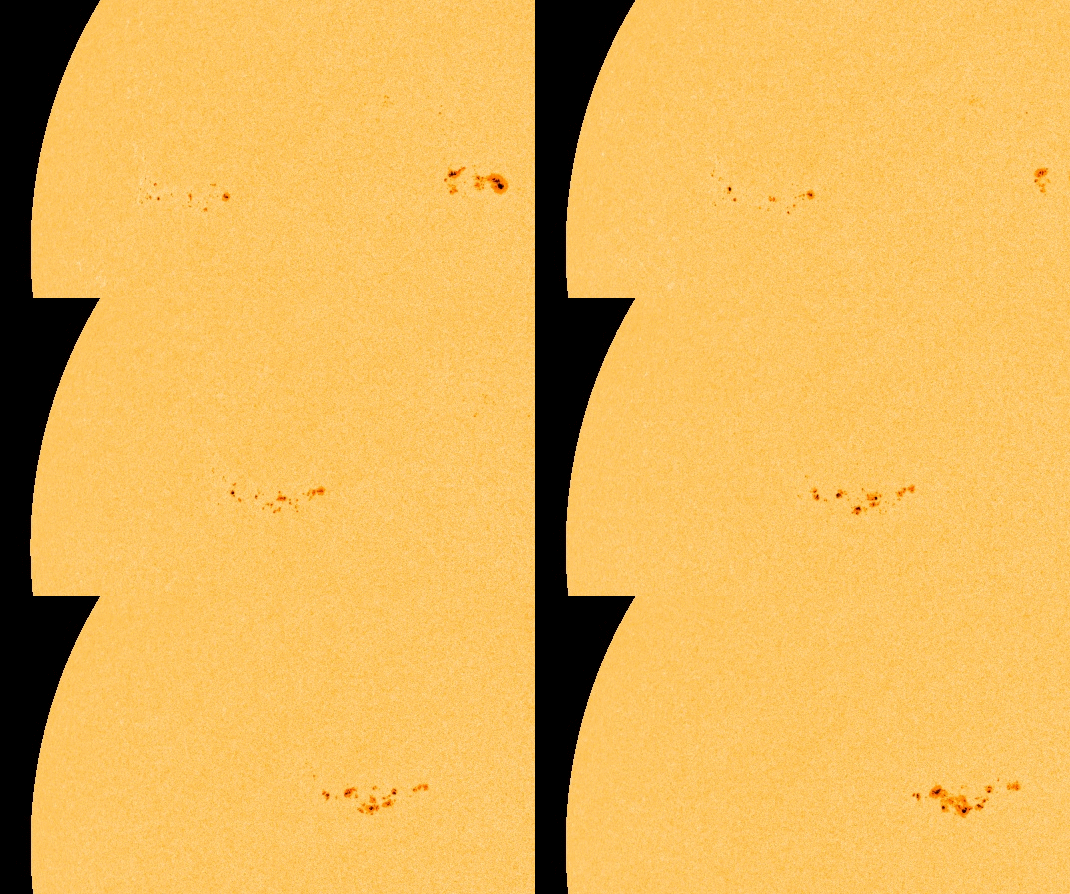
FAST-GROWING SUNSPOT (Updated Nov. 21): Only a few days ago, sunspot AR1618 was almost invisible. Now it is a behemoth more than 10 times wider than Earth. A movie from NASA's Solar Dynamics Observatory shows the sunspot's development on Nov. 20-21:
As the sunspot evolves, so does its intense magnetic field--and this means strong flares are in the offing. Fast-changing magnetic fields on the sun have a tendency toreconnect and erupt. NOAA forecasters estimate a 70% chance of M-class flares and a 15% chance of X-flares during the next 24 hours. Because of the sunspot's nearly central location on the solar disk, any eruptions will likely be Earth-directed.Solar flare alerts: textvoice.


SPACE WEATHERNOAA Forecasts
Updated at: 2012 Nov 21 2200 UTC
FLARE
0-24 hr
24-48 hr
CLASS M
70 %
70 %
CLASS X
30 %
30 %


source: http://spaceweather.com/

latest solar x-ray graph

source: http://www.swpc.noaa.gov/

Double Prominence Eruptions

Double Prominence Eruptions
The Sun erupted with two prominence eruptions, one after the other over a four-hour period (Nov. 16, 2012). The action was captured in the 304 Angstrom wavelength of extreme ultraviolet light. It seems possible that the disruption to the Sun's magnetic field might have triggered the second event since they were in relatively close proximity to each other. The expanding particle clouds heading into space do not appear to be Earth-directed.