Ad

Showing posts with label Cairo. Show all posts

Thursday, November 22, 2012

How's the Israel and Hamas Ceasefire?


Naftali Bennett: Tear Gaza in two

Habayit Hayehudi chairman harshly criticizes government, advocates ground invasion into Gaza
Ynet
Amid growing signs of a ceasefire, Habayit Hayehudi Chairman Naftali Bennett harshly criticized the government on Wednesday. "They've lost all common sense," he said on Ynet's TV studio.

The newly-elected chairman called on the government to expand Operation Pillar of Defense and "tear the Gaza Strip in two."

"We can postpone the elections if that's what it takes to protect the people of the south," Bennett said. He added that a "country that cannot protect its residents is degrading itself in the eyes of the world. A country that protects its residents is respected.

"I think there is weakness of spirit a loss of fighting spirit, Jewish spirit, Zionist spirit on the part of the government."
Asked what he would do in Benjamin Netanyahu's place he said, "I would seize an open strip of land, create a buffer zone between Egypt and Gaza and stay there to prevent launchers from entering. If we're not going for a decisive blow, I'm against deploying even one soldier."

The Habayit Hayehudi chairman stated that Israel faces an historic opportunity. "The people, the army, the reservists are all saying 'Netanyahu, give us the order.' We're right behind you.'"

IDF Spokesman Yoav Mordechai told Ynet that Hamas is stressed. "The organization has been very badly hit. All of its leaders are in a state of crisis.

"There are many terrorist groups in Gaza and Hamas has reached a crossroads and needs to make a decision." Mordechai said that if Hamas fails to impose its authority, the Gaza Strip may fall to pieces.

He said that 160 Palestinians were killed, including 30 in the past 24 hours. The Palestinians however reported that 140 were killed in Gaza.


Hamas emerges with major gains from hits bloodiest battle with Israel in 4 years


Israel Lauds Strikes as Hamas Says Invasion Threat Ended


Israel’s Defense Minister Ehud Barak said its eight-day aerial campaign preceding the Gaza cease-fire destroyed all Hamas heavy rockets, as the Palestinian group said the truce had ended a threat of invasion.
The attacks also removed as many as 40 percent of Hamas’s medium-range projectiles, Barak told Israel’s Channel 2 television a day after the fighting ended. Some of the 75,000 reservists called up for a possible ground assault are gradually being released from duty, an army spokeswoman said by phone, speaking anonymously according to regulations.
Hamas leader Ismail Haniyeh said in a televised speech that “the idea of invading Gaza after this victory has ended and will not return, God willing” according to a video posted on the Guardian website.
If it holds, the cease-fire will give Israeli Prime Minister Benjamin Netanyahu, who is running for a third term in January, the success of stopping Hamas rockets targeted at Israeli civilians. It also will bolster Egyptian President Mohamed Mursi’s stature as a regional player and leave the moderate Palestinian Authority in the shadow of an ascendant Islamist Hamas, which is considered a terrorist organization by Israel, the U.S. and the European Union.
“This operation’s targets have been accomplished,” Israeli Deputy Prime Minister Dan Meridor told journalists yesterday in Jerusalem. “Whether we have reached our goal of maintaining peace in our territory is yet to be seen. We hope that the lesson has been learned, and the price has been paid.”

Military Blockade

Announcing the truce in Cairo Nov. 21 alongside Egypt’s foreign minister, Secretary of StateHillary Clinton promised U.S. assistance in seeking to “improve conditions for the people of Gaza and provide security for the people of Israel.” Egypt and the U.S. helped to broker the agreement.
Hamas said the truce would result in the lifting of a military blockade of the territory, which it took control of in 2007. Israeli officials were vague about that part of the agreement, which says the issue will be “dealt with” 24 hours after the truce starts, according to a version published by the foreign ministries of Israel and Egypt.
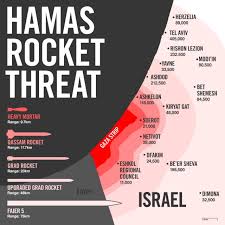
The agreement halted Israeli air strikes that killed 163 people in Gaza, including 43 children, Ashraf al-Qedra, a spokesman for the Hamas-run Ministry of Health, said yesterday. More than 1,200 were wounded, about 70 percent of them civilians, he said. Palestinians launched more than 1,400 missiles during the conflict, killing five Israelis, while Israel hit more than 1,500 targets in Gaza and threatened a ground invasion.
‘Very Fragile’

The cease-fire reflects the willingness of both sides to impose restraints on themselves, Barak told Army Radio earlier yesterday, though he cautioned that previous accords have failed to hold.
“You should never be too optimistic about these types of cease-fires because they’re very fragile,” said Shadi Hamid, director of research at the Brookings Doha Center in Qatar. “The Israeli government is going to come under pressure to do more if there’s any resumption of rocket attacks.”
Palestinians danced in the streets in Gaza City and fired machine guns at the sky after the truce officially took effect at 9 p.m. local time on Nov. 21.
“Israel can only be dealt with through wars and they accept conditions by force, not by negotiations,” said Rafat Hijazi, 39, who joined the celebrations. “We’re so happy now.”
In the West Bank, the Israeli army arrested 55 people it described in an e-mailed statement as “terror operatives.” Suspects in the Nov. 21 bombing of a bus in Tel Aviv that injured 30 were also arrested, Haaaretz newspaper reported late yesterdat.

‘Right Step’

Israel’s shekel extended gains yesterday, strengthening 0.7 percent to 3.8767 per dollar at 9:24 p.m. local time. The benchmark stock index rose 0.2 percent.

Israel-Hamas talks leave future of Gaza blockade cloudy

Gaza residents and smugglers are left to ponder vague promises to discuss easing restrictions on the movement of goods and people at a later date.


Gaza Strip family assesses damage
Members of the Attar family, displaced during the Hamas-Israel conflict, return to the remains of their home in the northern Gaza Strip. (Marco Longari / AFP/Getty Images / November 22, 2012)


RAFAH, Gaza Strip — Seated on a muddy hill, Sulieman Masri glumly scanned the giant crater that was once a smuggling tunnel used to support his family.
After the Israeli airstrikes of the last week, Thursday morning was the first safe time to venture out. He discovered his tunnel was among 140 Israel destroyed. Now it's now a massive sand pit coated with gray explosives residue. It would take two months to rebuild at the cost of $20,000.
"But I've heard that they are going to open the borders, which could put the tunnels out of business," he said. "Now I don't know what to do."
Masri isn't the only one wondering what will happen next with Israel's 5-year-old blockade of the Gaza Strip's border and coastline.
Hamas, the Islamist group that controls the coastal strip, persuaded Gazans to support its confrontation with Israel in part by vowing repeatedly that it would keep fighting until the controversial blockade was lifted.
So many were surprised Wednesday night when the Egyptian-brokered cease-fire included only vague promises to discuss easing restrictions on goods and people at a later date.
A Hamas official, speaking on condition of anonymity because of the sensitivity of the issue, said the group received private assurances from Egypt that the Rafah crossing to the Sinai Peninsula, which currently permits limited movement of people, will be expanded to include goods, and that Israel agreed not to object.
Israelis, who are worried that opening the borders will allow Hamas to rearm itself, don't want to talk about the subject until after it's clear that the cease-fire is holding.


Cease-Fire Announced in Israel-Gaza Conflict


November 21, 2012 


U.S. Secretary of State Hillary Clinton and Egyptian Foreign Minister Mohamed Kamel Amr announced a cease-fire between Israel and Hamas during a Nov. 21 news conference in Cairo. The cease-fire is expected to begin at 9 p.m. local time. Israeli Prime Minister Benjamin Netanyahu reportedly told U.S. President Barack Obama that he is willing to give the Egyptian-brokered cease-fire a chance. 


This cessation of violence is likely highly tenuous. Israel will only agree to a truce if it has guarantees from Egypt -- overseen by the United States -- that the Palestinian arsenal of Fajr-5 long-range rockets will be neutralized and that measures will be taken to prevent future weapons transfers to Gaza. It remains to be seen what details surface on this core Israeli demand, especially given its incompatability with Hamas' demand for the blockade on Gaza to be lifted. 


There is also the outstanding issue of Iran, which Israel has pointed to as the center of gravity in the conflict. The Fajr-5 rockets are Iranian-made, and Iran facilitated the movement of those weapons into Gaza. Iran may have an interest in prolonging the conflict and could try to use militant levers in Gaza to derail the truce. Israel must also contend with the broader dilemma of future Iranian attempts to smuggle advanced weaponry into Gaza. This is where Egyptian cooperation with Israel on border security becomes crucial. 


If the cease-fire holds, Hamas is within reach of a major symbolic victory. It will have avoided devastation of the group in Gaza and can claim a capability to strike the Israeli heartland. 

We must watch now if Hamas honors the cease-fire and if the organization will have the authority to enforce the cease-fire among other groups, namely the Palestinian Islamic Jihad. Until Israel has a guarantee on the Fajr-5s and a cessation of rocket fire, it is unlikely to forgo the option of a military ground operation. 

read more at https://www.stratfor.com


Ahmadinejad: Israel has 'childish' desire to attack Iran, Tehran can defend itself

Iranian president says Israel knows Iran won't 'attack anybody'; world powers agree to seek renewed talks with Iran as soon as possible.

By Reuters Nov.22, 2012

Iran's President Mahmoud Ahmadinejad
Iran's President Mahmoud Ahmadinejad after a meeting with Vietnam's National Assembly's Chairman Nguyen Sinh Hung in Hanoi November 10, 2012. 

Israel has a "childish" desire to attack Iran and Tehran is capable of defending itself, Iranian President Mahmoud Ahmadinejad said on Thursday.

"They wish to hurt the Iranian nation. They are waiting for the chance. They know that Iran does not attack anybody and they know that Iran knows how to defend itself," he told a news conference in the Pakistani capital Islamabad.

"We don't accept the hegemony of Israel. They wish to attack Iran but it is like a childish desire," the Iranian president said.

He was speaking after attending a summit of developing nations.

Six world powers agreed on Wednesday to seek renewed talks with Iran as soon as possible, reflecting a heightened sense of urgency to resolve a long rift over Tehran's disputed nuclear activity and avert the threat of war.

Their call coincided with growing evidence of Iran expanding nuclear capacity in an underground bunker virtually impervious to attack and follows the Nov. 6 re-election of U.S. President Barack Obama, which has cleared the way for new contacts.

Senior diplomats from the six countries - the United States, Russia, China, France, Britain and Germany - met in Brussels on Wednesday to consider new negotiating tactics despite abiding scepticism that a deal with Tehran can be reached.

Analysts warn that a window of opportunity for a negotiated solution is narrowing because of growing alarm over Tehran's nuclear course in Israel, the Middle East's only nuclear power which has threatened to bomb the atomic sites of its arch-enemy.

source: http://www.haaretz.com/news/diplomacy-defense/ahmadinejad-israel-has-childish-desire-to-attack-iran-tehran-can-defend-itself-1.479936

Thursday, October 18, 2012

Libya Suspects Islamist Group In Consulate Attack As U.S. Prepares Retaliation


Posted By Mary Casey, Jennifer Parker     Share

Libyan authorities have said they suspect Ahmed Abu Khattala, the leader of Libya's Islamist militant group Ansar al-Sharia, to have led the September 11 attack on the U.S. consulate in Benghazi. Witnesses have reported seeing Abu Khattala at the site, but his exact role is unclear, as is whether or not he shared leadership with others. But, the allegations provide the most direct link yet between Ansar al-Sharia and the assault. The F.B.I. has been investigating the attack from Tripoli, almost 400 miles from Benghazi, and a U.S. official said they had been tracking Abu Khattala who remains at large. Having not yet established central control of security since last year's revolution, Libyan authorities rely on local militias for law enforcement. The government-allied militias say that haven't been directed to arrest Abu Khattala, and the government is concerned about exacerbating tensions between rival militia groups.
Syria
Syrian human rights groups say that at least 28,000 people have "disappeared" in Syria since the beginning of the 19-month long uprising, and some estimate the number of missing to be as high as 80,000. According to a director at the online activist group Avazza, "Syrians are being plucked off the street by Syrian security forces and paramilitaries and being ‘disappeared' into torture cells. Whether it is women buying groceries or farmers going for fuel, nobody is safe." The group plans to request an investigation by the U.N. Human Rights Council. Damascus has started to feel the strain of the country's civil war, from which  it had been relatively isolated until recently. Meanwhile, U.N. and Arab League envoy to Syria, Lahkdar Brahimi, has warned of regional spillover of the conflict. After meeting with Lebanese officials seeking international support for a ceasefire over an upcoming holiday, which Turkey and Iran have backed, he said, "The crisis cannot remain within Syrian borders indefinitely. Either it will be addressed or it will increase ... and be all-consuming." Brahimi's remarks came shortly before reports of Syrian and Lebanese border clashes.

US Consulate attack in Benghazi: America ponders a strike over Libya attack
The White House, under political pressure to respond forcefully to the Sept. 11 attack on the U.S. Consulate inBenghazi, is readying strike forces and drones but first has to find a target.

And if the administration does find a target, officials say it still has to weigh whether the short-term payoff of exacting retribution on al-Qaida is worth the risk that such strikes could elevate the group's profile in the region, alienate governments the U.S. needs to fight the group in the future and do little to slow the growing terror threat in North Africa.

Details on the administration's position and on its search for a possible target were provided by three current and one former administration official, as well as an analyst who was approached by the White House for help. All four spoke on condition of anonymity because they were not authorized to discuss the high-level debates publicly.

In another effort to bolster Libyan security, the Pentagon and State Department have been developing a plan to train and equip a special operations force in Libya, according to a senior defense official.

The efforts show the tension of the White House's need to demonstrate it is responding forcefully to al-Qaida, balanced against its long-term plans to develop relationships and trust with local governments and build a permanent U.S. counterterrorist network in the region.
Vice President Joe Biden pledged in his debate last week with Republican vice presidential nominee Paul Ryan to find those responsible for the Sept. 11 attack on the U.S. Consulate in Benghazi that killed U.S. Ambassador Chris Stevens and three others.

"We will find and bring to justice the men who did this," Biden said in response to a question about whether intelligence failures led to lax security around Stevens and the consulate. Referring back to the raid that killed Osama bin Laden last year, Biden said American counterterror policy should be, "if you do harm to America, we will track you to the gates of hell if need be."

The White House declined to comment on the debate over how best to respond to the Benghazi attack.

The attack has become an issue in the U.S. election season, with Republicans accusing the Obama administration of being slow to label the assault an act of terrorism and slow to strike back at those responsible. Secretary of State Hillary Rodham Clinton said Monday night that the security of State Department operations was her responsibility.

The White House is "aiming for a small pop, a flash in the pan, so as to be able to say, 'Hey, we're doing something about it,'" said retired Air Force Lt. Col. Rudy Attalah, the former Africa counterterrorism director for Defense Department under President George W. Bush.
US consulate in Benghazi was attacked over anti-Islam film
US consulate in Benghazi was attacked over anti-Islam film in September 2012.
Attalah noted that in 1998, after the embassy bombing in Nairobi, the Clinton administration fired cruise missiles to take out a pharmaceutical factory in Sudan that may have been producing chemical weapons for al-Qaida.

"It was a way to say, 'Look, we did something,'" he said.

On the subject of developing a special operations unit, U.S. officials received approval from Congress well before the Benghazi attack to reprogram some funding in the budget that could be used for the commando program in Libya. But the details are still being discussed with the Libyans and also must get final approval from Congress, according to the defense official, who spoke on condition of anonymity because he was not authorized to discuss the matter publicly.
The initial cost is estimated at about $6.2 million.

The defense official said U.S. leaders have recognized the need to train Libyan commando forces, but details such as the size, mission and composition of the forces are still being finalized.

A Washington-based analyst with extensive experience in Africa said administration officials have approached him for help in connecting the dots to Mali, whose northern half fell to al-Qaida-linked rebels this spring. They wanted to know if he could suggest potential targets, which he says he was not able to do.

"The civilian side is looking into doing something and is running into a lot of pushback from the military side," the analyst said. "The resistance that is coming from the military side is because the military has both worked in the region and trained in the region. So they are more realistic."

Islamists in the region are preparing for a reaction from the U.S.

Possible US Attack in Libya Faces Opposition

The United States consulate in Benghazi, Libya is seen in flames during an attack that killed four U.S. staffers, including Ambassador Christopher Stevens on September 11, 2012.

White House reportedly preps strike team to take out terrorists tied to Libya attack


The White House has put special operations strike forces on standby and moved drones into the skies above Africa, ready to strike militant targets from Libya to Mali — if investigators can find the Al Qaeda-linked group responsible for the death of the U.S. ambassador and three other Americans in Libya.

But officials say the administration, with weeks until the presidential election, is weighing whether the short-term payoff of exacting retribution on Al Qaeda is worth the risk that such strikes could elevate the group's profile in the region, alienate governments the U.S. needs to fight it in the future and do little to slow the growing terror threat in North Africa.

Details on the administration's position and on its search for a possible target were provided by three current and one former administration official, as well as an analyst who was approached by the White House for help. All four spoke on condition of anonymity because they were not authorized to discuss the high-level debates publicly.

The dilemma shows the tension of the White House's need to demonstrate it is responding forcefully to Al Qaeda, balanced against its long-term plans to develop relationships and trust with local governments and build a permanent U.S. counterterrorist network in the region.

Vice President Joe Biden pledged in his debate last week with Republican vice presidential nominee Paul Ryan to find those responsible for the Sept. 11 attack on the U.S. Consulate in Benghazi that killed Ambassador Chris Stevens and three others.
"We will find and bring to justice the men who did this," Biden said in response to a question about whether intelligence failures led to lax security around Stevens and the consulate. Referring back to the raid that killed Osama bin Laden last year, Biden said American counterterror policy should be, "if you do harm to America, we will track you to the gates of hell if need be."

The White House declined to comment on the debate over how best to respond to the Benghazi attack.

The attack has become an issue in the U.S. election season, with Republicans accusing the Obama administration of being slow to label the assault an act of terrorism early on, and slow to strike back at those responsible.

"They are aiming for a small pop, a flash in the pan, so as to be able to say, 'Hey, we're doing something about it,'" said retired Air Force Lt. Col. Rudy Attalah, the former Africa counterterrorism director for the Department of Defense under President George W. Bush.

Attalah noted that in 1998, after the embassy bombing in Nairobi, the Clinton administration fired cruise missiles to take out a pharmaceutical factory in Sudan that may have been producing chemical weapons for Al Qaeda.
"It was a way to say, 'Look, we did something,'" he said.

A Washington-based analyst with extensive experience in Africa said that administration officials have approached him asking for help in connecting the dots to Mali, whose northern half fell to Al Qaeda-linked rebels this spring. They wanted to know if he could suggest potential targets, which he says he was not able to do.

"The civilian side is looking into doing something, and is running into a lot of pushback from the military side," the analyst said. "The resistance that is coming from the military side is because the military has both worked in the region and trained in the region. So they are more realistic."

Islamists in the region are preparing for a reaction from the U.S.

"If America hits us, I promise you that we will multiply the Sept. 11 attack by 10," said Oumar Ould Hamaha, a spokesman for the Islamists in northern Mali, while denying that his group or Al Qaeda fighters based in Mali played a role in the Benghazi attack.

Finding the militants who overwhelmed a small security force at the consulate isn't going to be easy.

The key suspects are members of the Libyan militia group Ansar al-Shariah. The group has denied responsibility, but eyewitnesses saw Ansar fighters at the consulate, and U.S. intelligence intercepted phone calls after the attack from Ansar fighters to leaders of Al Qaeda in the Islamic Maghreb, or AQIM, bragging about it. The affiliate's leaders are known to be mostly in northern Mali, where they have seized a territory as large as Texas following a coup in the country's capital.

But U.S. investigators have only loosely linked "one or two names" to the attack, and they lack proof that it was planned ahead of time, or that the local fighters had any help from the larger Al Qaeda affiliate, officials say.

If that proof is found, the White House must decide whether to ask Libyan security forces to arrest the suspects with an eye to extraditing them to the U.S. for trial, or to simply target the suspects with U.S. covert action.

U.S. officials say covert action is more likely. The FBI couldn't gain access to the consulate until weeks after the attack, so it is unlikely it will be able to build a strong criminal case. The U.S. is also leery of trusting the arrest and questioning of the suspects to the fledgling Libyan security forces and legal system still building after the overthrow of Moammar Gadhafi in 2011.

The burden of proof for U.S. covert action is far lower, but action by the CIA or special operations forces still requires a body of evidence that shows the suspect either took part in the violence or presents a "continuing and persistent, imminent threat" to U.S. targets, current and former officials said.

"If the people who were targeted were themselves directly complicit in this attack or directly affiliated with a group strongly implicated in the attack, then you can make an argument of imminence of threat," said Robert Grenier, former director of the CIA's Counterterrorism Center.

But if the U.S. acts alone to target them in Africa, " it raises all kinds of sovereignty issues ... and makes people very uncomfortable," said Grenier, who has criticized the CIA's heavy use of drones in Pakistan without that government's support.

Even a strike that happens with permission could prove problematic, especially in Libya or Mali where Al Qaeda supporters are currently based. Both countries have fragile, interim governments that could lose popular support if they are seen allowing the U.S. unfettered access to hunt Al Qaeda.

The Libyan government is so wary of the U.S. investigation expanding into unilateral action that it refused requests to arm the drones now being flown over Libya. Libyan officials have complained publicly that they were unaware of how large the U.S. intelligence presence was in Benghazi until a couple of dozen U.S. officials showed up at the airport after the attack, waiting to be evacuated — roughly twice the number of U.S. staff the Libyans thought were there. A number of those waiting to be evacuated worked for U.S. intelligence, according to two American officials.

In Mali, U.S. officials have urged the government to allow special operations trainers to return, to work with Mali's forces to push Al Qaeda out of that country's northern area. AQIM is among the groups that filled the power vacuum after a coup by rebellious Malian forces in March. U.S. special operations forces trainers left Mali just days after the coup. While such trainers have not been invited to return, the U.S. has expanded its intelligence effort on Mali, focusing satellite and spy flights over the contested northern region to track and map the militant groups vying for control of the territory, officials say.


Read more: http://www.foxnews.com/politics/2012/10/15/white-house-wrestles-with-how-where-to-strike-back-if-libya-consulate-attackers/#ixzz29fRyR07q

Turkey's Challenge and the Syrian Negotiation


Syrian Information Minister Omran al-Zubi harshly criticized the Turkish government early last week over Ankara's proposal that an interim government succeed the al Assad regime, saying that "Turkey isn't the Ottoman Sultanate; the Turkish Foreign Ministry doesn't name custodians in Damascus, Mecca, Cairo and Jerusalem." Being the spokesman for a pariah regime requires a mastery of propaganda. Al-Zubi has not disappointed in this regard, mounting a strong rhetorical offensive against Syria's powerful northern neighbor.
While his latest rebuke of Turkey will not save the al Assad regime (much less his own career), he is tapping into a powerful narrative in the region, one that will have stronger and stronger resonance in the Arab world as Turkey is forced to play a more assertive role in the region.

Great Expectations in Ankara

As Ankara is discovering, the resurgence of a nation can be an awkward and rocky process. Things were simpler for Turkey in the early part of the past decade when the regional climate allowed Turkey to re-emerge cautiously, with a white flag in hand and phrases like "zero problems with neighbors" on its lips. The region has since become far more unforgiving, with violent political transformations nipping at Anatolia's borders, Iran putting up stiff competition for regional influence, Russia's resurgence proceeding apace and the United States increasingly losing interest in the role of global policeman. The region is pushing Turkey into action regardless of whether Ankara is ready to take on the responsibility.
Visit our Syria page for related analysis, videos, situation reports and maps.
The past week offered several glimpses into Turkey's growing pains. Turkish and Syrian border troops shelled each other after Syrian mortar fire killed five Turkish civilians. Turkish fighter jets scrambled after the Syrian air force attacked a town along the Syrian side of the border. Turkish-Russian tensions also flared when Turkey intercepted a Syria-bound plane from Moscow allegedly carrying radar equipment. And a nervous Ankara watched as a coalition of Kurdish groups from Syria, northern Iraq, Iran and Turkey gathered in Paris to brainstorm ways to exploit the shifting regional landscape and propel a campaign for Kurdish statehood.

The Basis for a Negotiation

The conflict in Syria offers both a threat and an opportunity for Ankara. Turkey took a risk when it became the most ardent and visible backer of the Syrian rebellion. Now, tens of thousands of refugees are flowing across the border into Turkey. The threat of sectarian warfare spreading past Syria's borders looms. And the exposure of Turkey's regional competition with Iran has elevated the Kurdish militant threat from a domestic sore point to a weakness that regional competitors like Iran can exploit.
Turkey is also closely monitoring a critical force that has begun to shape the region: the rise of Islamist movements and the discrediting of Arab secularist police states. The transition from secular autocracy will be tumultuous, but the more leverage Turkey has with this Pan-Arab Islamist movement, the better prepared it will be to manage its neighborhood. An opportunity is thus developing for Turkey in which it can assert its Islamist credentials alongside its ability to compete effectively with Iran and to deal with the West. Turkey is uniquely positioned to steer the Islamist movement while the Arab street still requires a regional backer in its challenge to the old regimes and to keep Iran at bay. But Arab attitudes toward Turkey will shift with time as Turkey's expectations of a growing sphere of influence in the Arab world inevitably clash with the Muslim Brotherhood's vision of a Pan-Arab Islamist movement following its own course, as opposed to one set by Ankara.
Turkey has several immediate challenges. First, it is attempting to prevent a power vacuum from expanding in Syria that would fuel Kurdish separatism. Second, it is trying to push back the Iranian sphere of influence while expanding its own into the Arab world. Third, it wants to be taken seriously as a regional leader. Heavily constrained as it is, Ankara appears to have chosen to tackle this array of issues primarily through dialogue.
Turkey wants to avoid regime change in Syria, and it is not alone. Neither the states trying to retain influence in Syria, like Iran and Russia, nor the states trying to force a political transformation in the Levant, like Turkey, the United States, Saudi Arabia, France and Qatar, are prepared to weather the consequences of debaathification, which would dismantle the state machinery, sideline the Alawite minority and plunge the country more deeply into civil war. A growing consensus centered on removing the al Assads while largely maintaining the regime has created an opportunity for dialogue between the United States and Turkey on one side and Russia and Iran on the other. Tehran and Moscow have used the monthslong stalemate in the Syrian conflict to edge their way into discussions over a post-al Assad government. The Russians and Iranians have positioned themselves for a possible agreement that facilitates an exit for the al Assads while requiring a prominent space for the Alawites in a new government, something that would preserve Russian and Iranian influence in Syria.
The urgency to negotiate the Syrian transition is escalating just as one of the key pillars Stratfor identified from the start of the conflict, the cohesion of the Alawites, appears to be breaking down. Recently, clashes have erupted between Alawite clans in the coastal Alawite strongholds of Latakia and Qardaha, the birthplace of former President Hafiz al Assad. Evidence also has emerged supporting claims that a handful of Alawite military officers have recently defected from the regime. Critical Alawite defections could accelerate in the coming weeks as fewer Alawites see the survival of the al Assads as necessary to their own survival.
As the al Assad clan continues to weaken, Turkey has sought to stitch together negotiations already fraught with complications. One look at the participants in the discussion over a post-al Assad Syria explains the difficulty.

The U.S.-Iranian Dynamic

The first major dialogue for Turkey to mediate is between the United States and Iran. The United States has no interest in initiating a military intervention in Syria, though it is preparing for the possibility that U.S. intelligence assets and special operations forces will have to secure Syrian chemical weapons stockpiles in the event of a regime meltdown. The United States also does not want to engage in a military confrontation with Iran over its nuclear program. Washington thus has elected a strategy whereby Turkey does the bulk of the work on Syria while Washington focuses on weakening Iran through sanctions pressure, covert operations and building up a credible military threat in the Persian Gulf. Washington hopes to coerce Iran into negotiations where it can extract hefty concessions from Tehran on issues ranging from Syria to the Iranian nuclear program.


Read more: Turkey's Challenge and the Syrian Negotiation | Stratfor