72 Fusion Centers are an intricate nationwide web of shared data collection, and set in place to snoop into our cellphones and e-mails while local law enforcement and neighborhood spies feed that confidential information to those powers at be. Don’t forget, it is all for your own “security” so just relax. Relax? I thought that we all had the right to feel secure in our own person or homes, however, having a Fusion Center in Sacramento isn’t exactly making me feel all that secure. No, I’m actually feeling the opposite for there is something here that is telling me that our government isn’t quite giving us the WHOLE truth about a lot of things. That is obvious. So then, what do we have? We’ve got a lot more than just your friendly neighborhood watch group looking after you, and for those of you who didn’t know, there is a mega Data Center being built in Bluffdale, Utah which is a, not so secret, NSA project, and it can house all of the personal and PRIVATE INFORMATION of every person in the U.S. Well, that’s just fine and dandy. The center is 1,000,000 square feet and is code named the “BUMBLEHIVE.” As for the amount of information that can be stored, it will have an astounding storage capacity of 1,000,000,000,000,000 gigabytes and it’s all for the “good” of the nation. NSA is on a path towards building this first exaflop machine (1 quintillion instructions per second) by 2018. Naturally, NSA denies that they have any interest in “tracking” every citizen even though they do have the capability of eaves dropping on every American. Let’s reverse gears. Does anyone remember 9/11 when President Bush said they were “only” eaves dropping on international calls, while all along, warrantless domestic calls were in the mix? At that time the CEO of Quest Communications said that he would not comply with warrantless wiretaps. Presently, he is in prison for “insider trading.” Shall we connect the dots? He is presumably the wealthiest person behind bars in America. Here’s a footnote; The U.S. Government stopped doing business with Quest after they refused to do warrantless wiretaps.
As for the ongoing surveillance that is happening today, in their own words, NSA gives us a snapshot of their data collection efforts which is for the “protection” of the nation. “For security reasons, it is unrealistic to expect a complete list of information we collect for our national citizen database. In the spirit of openness and transparency however, here is a partial list:”
* internet searches * websites visited * e-mails sent and received * social media activity (Facebook, Twitter, etc) * blogging activity including posts read, written, and commented * videos watched and/or uploaded online * photos viewed and/or uploaded online * music downloads * mobile phone GPS-location data * mobile phone apps downloaded * phone call records * text messages sent and received * online purchases and auction transactions * bookstore receipts * credit card/ debit card transactions * bank statements * cable television shows watched and recorded * commuter toll records * parking receipts * electronic bus and subway passes / Smartpasses * travel itineraries * border crossings * surveillance cameras * medical information including diagnoses and treatments * prescription drug purchases * guns and ammunition sales * educational records * arrest records * driver license information
Bumblehive is the alleged code name for the NSA’s new multi-billion dollar spy center in Utah although the official name appears to be Stellar Wind. . It is the mother of all data collection. Bumblehive most likely is a spin off from this word. Who says the feds don’t have a sense of humor? Today is the reported day of some kind of ribbon cutting ceremony. Since there’s little info to be found on the ceremony, it must be assumed it’s a secret one and not many will get close enough to spy on the spies.
I’ve been trying to put myself in the shoes of the NSA to figure out what’s going on. If I had to hire contractors to do the most sensitive, most secretive jobs in the inner workings of the facility, who would I get? Well, that’s a no brainer. Of course it would be some shady companies with ties to Israel with a history of corruption and staffed with mostly unstable individuals. Backdoor men hanging the backdoor that leads straight to Tel Aviv. Why should we expect otherwise?
Submitted by From the Trenches on Fri, 05/31/2013 - 05:36
What we know about the NSA's secret data warehouse in Utah
Published June 13, 2013
Associated Press
The nation's new billion-dollar epicenter for fighting global cyberthreats sits just south of Salt Lake City, tucked away on a National Guard base at the foot of snow-capped mountains. The long, squat buildings span 1.5 million square feet, and are filled with super-powered computers designed to store massive amounts of information gathered secretly from phone calls and emails.
Two small, weathered signs in the sagebrush greet interlopers to this place with a stark warning: "Military reservation. No trespassing." But there is no visible marker bearing the facility's name and operator: The Utah Data Center, brought to you courtesy of the National Security Agency.
When it opens this fall, the facility will be the NSA's largest data storage center in the U.S. Just don't ask Utah officials, and certainly not the residents of tiny Bluffdale, just north of the new center, to tell you exactly what will go on inside. They either don't know, or aren't saying. And the NSA is famously tight-lipped.
"We know it's a spy center. But who are they spying on?" said Connie Robbins, an upholstery shop owner who lives in Bluffdale, a community of 8,000 some 25 miles south of Salt Lake City that is known for its rodeo and annual Old West Days.
The dearth of information has perpetuated a mystery that has spawned dozens of theories and a spoof website that even includes a phony code name for the facility: "Bumblehive," a play on Utah's nickname of the "Beehive State."
Last week's revelation that the NSA is collecting millions of U.S. phone records along with digital communications stored by nine major Internet providers illustrates how aggressively personal information is being congregated and analyzed -- and shines a brighter light on what will be going on in secret at the Utah facility, scheduled to open in October.
NSA officials say the center will play a key role in the nation's effort to protect national security networks, and allow U.S. authorities to monitor for potential cyberthreats. In an email, agency spokeswoman Vanee Vines said that "many unfounded allegations have been made about the planned activities" of the center.
"NSA would like to confirm, on the record, that the Utah Data Center is a state-of-the-art data facility designed to support the U.S. intelligence community's efforts to further strengthen and protect the nation. Its operations will be lawfully conducted in accordance with U.S. laws and policies," Vines wrote.
She provided no additional details, however.
'It's just a big file cabinet out in the Western area.'
- Richard "Dickie" George, who retired from the NSA in 2011 after 40 years
Richard "Dickie" George, who retired from the NSA in 2011 after 40 years, said the facility isn't nearly as interesting or mysterious as some think. He calls it little more than a giant storeroom. Inundated with increasing volumes of secretly taped phone calls, intercepted emails and poached records of online purchases, the NSA needed a mega-warehouse to put it all, he said.
"It's just a big file cabinet out in the Western area," said George, once a senior technical leader at the agency. "There is no spying going on there."
NSA agents elsewhere will comb through the data stored in Utah as the agency attempts to understand how terrorist groups operate and who plays what roles, George said. Emails, articles, websites and videos on the Internet may hold clues about such activities, he said.
The Utah Data Center, code-named Bumblehive, is the first Intelligence Community Comprehensive National Cyber-security Initiative (IC CNCI) data center designed to support the Intelligence Community's efforts to monitor, strengthen and protect the nation. NSA is the executive agent for the Office of the Director of National Intelligence (ODNI) and will be the lead agency at the center.
The steady rise in available computer power and the development of novel computer platforms will enable us to easily turn the huge volume of incoming data into an asset to be exploited, for the good of the nation.
The Utah Data Center is currently under construction and is expected to open in October 2013. Our 1.5 billion-dollar one million square-foot Bluffdale / Camp Williams facility will house a 100,000 sq-ft mission critical data center. The remaining 900,000 SF will be used for technical support and administrative space. Other supporting facilities include water treatment facilities, chiller plant, power substations, vehicle inspection facility, visitor control center, and sixty diesel-fueled emergency standby generators and fuel facility for a 3-day 100% power backup capability.
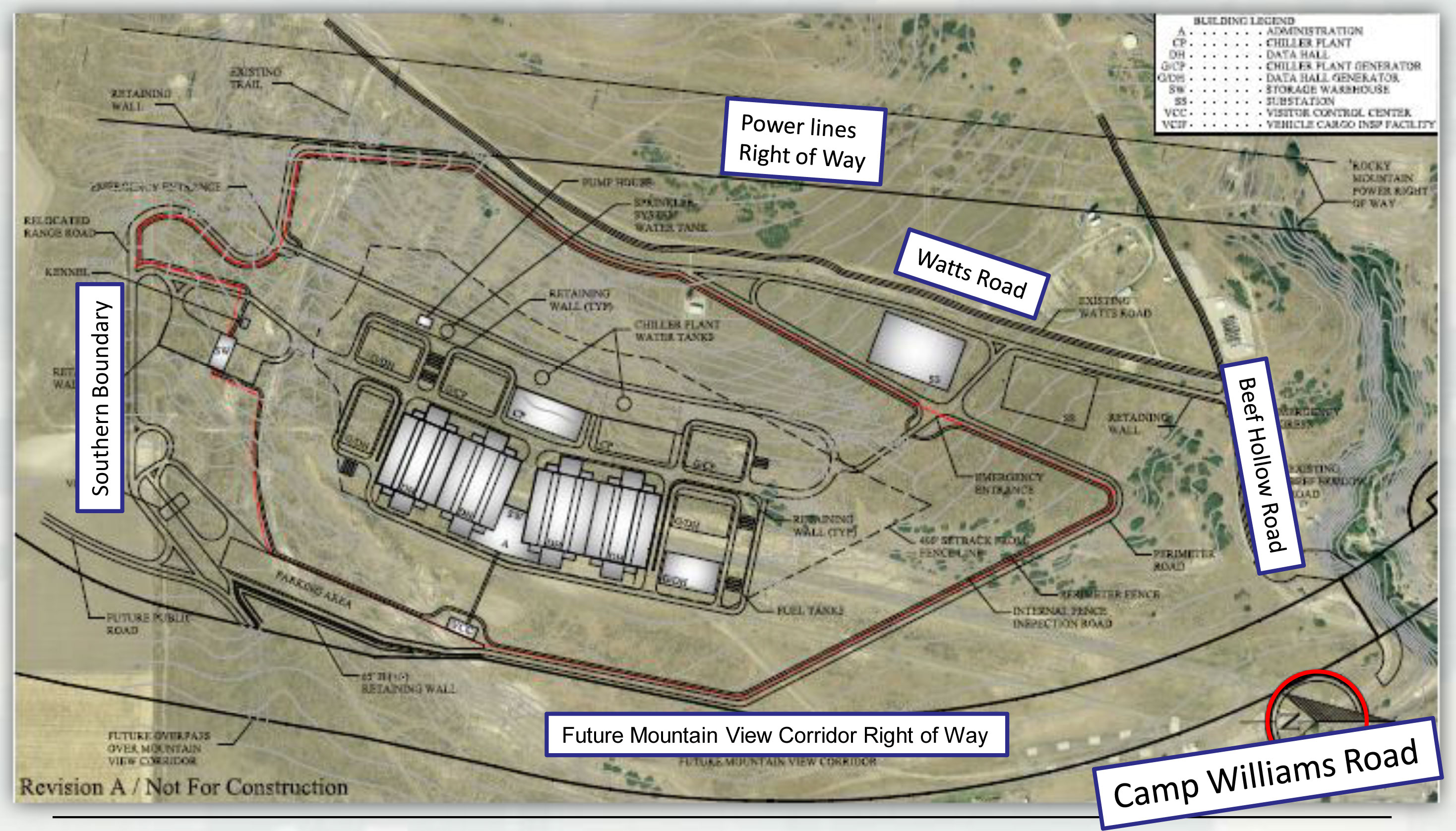
Utah Data Center Site Plan
The site plan below shows the location of the administration building, chiller plant, data halls, generators, fuel storage tanks, storage warehouse, power substations, visitor control center, and vehicle inspection facility. View the full-size Utah Data Center Site Plan
Utah Data Center Technical Specifications
Data Storage Capacity
The storage capacity of the Utah Data Center will be measured in "zettabytes". What exactly is a zettabyte? There are a thousand gigabytes in a terabyte; a thousand terabytes in a petabyte; a thousand petabytes in an exabyte; and a thousand exabytes in a zettabyte. Some of our employees like to refer to them as "alottabytes".
Learn more about the domestic surveillance data we plan to process and store in the Utah Data Center. Also, view our strategy for using the PRISM data collection program, nationwide intercept stations, and the "Boundless Informant" mapping tool to gather and track this data.
Code-Breaking Supercomputer Platform
In October 2012, the U.S. Department of Energy's (DOE) Oak Ridge National Laboratory launched the Titan Supercomputer, which is capable of churning through more than 20,000 trillion calculations each second or 20 petaflops. (1 petaflop = 1 quadrillion instructions per second).
Our Target: 256-bit AES
The Advanced Encryption Standard (AES) algorithm is used worldwide to encrypt electronic data on hard drives, email systems, and web browsers. The AES 256-bit encryption key is the standard for top-secret US government communications. Computer experts have estimated it would take longer than the age of the universe to break the code using a trial-and-error brute force attack with today's computing technology.
In 2004, the NSA launched a plan to use the Multiprogram Research Facility in Oak Ridge, Tennessee to build a classified supercomputer designed specifically for cryptanalysis targeting the AES algorithm. Recently, our classified NSA Oak Ridge facility made a stunning breakthrough that is leading us on a path towards building the first exaflop machine (1 quintillion instructions per second) by 2018. This will give us the capability to break the AES encryption key within an actionable time period and allow us to read and process stored encrypted domestic data as well as foreign diplomatic and military communications.
Visitor Control Center
Construction Status
We're using a Critical Path Method (CPM) schedule to track the cost and resource data for over 26,000 activities. The project initially required over a million cubic yards of earthwork and nearly seven miles of new roadways. The massive twenty-building complex is being completed in three phases. The first phase was completed last Fall and includes the first of four data halls (Data Center Module DCM 1); the Administration Building; Data Center Loading and Storage; Chiller Plant #1 and storage tanks; Generator Plant #1 with fuel system storage; Visitor Control Center; Vehicle Cargo Inspection Facility; kennel; perimeter warehouse; and fire pump building.
The second phase, completed early in 2013 includes the second data hall (DCM 2) along with Generator Plant #2 with fuel system storage.
The final phase is scheduled to be completed by October 2013 and includes the remaining two data halls (DCM 3 and 4); Generator Plants 3 and 4 with fuel system storage; and Chiller Plant #2 and storage tanks. Because of the national security implications of an on-time opening of this critical facility, the NSA has already begun the installation of classified equipment in the first two data halls (DCM 1 and 2).
Secret Ribbon Cutting Ceremony
We held a closed-press ribbon cutting ceremony and tour on May 30th, 2013 in celebration of the completion of the exterior building construction. We invited our most loyal partners at the local, state, and federal level who have had the vision and fortitude to enable us to build this powerful Intelligence Community data center "for the good of the Nation". We are on track to open in October!
Global Privacy Has Been Made Obsolete – Bumblehive
June 3, 2013
A massive new NSA data centre in Utah will begin collecting electronic information from citizens all around the world, regardless of the country they reside in.
The facility, code name “Bumblehive”, is 1.5-million-square-ft, has cost almost $2-billion and can store 1 trillion terabytes of information, creating the largest spy centre known to man.
The NSA plans to collect electronic information, everything from emails to cellphone records and even purchasing receipts from all over the world. They will store the information to identify threatening patterns, they claim.
So far, not one single country has moved to litigate against this level of domestic surveillance.
The data centre is able to capture all forms of communication, including the complete contents of private emails, cell phone calls and Internet searches, as well as all sorts of personal data trails—parking receipts, travel itineraries, bookstore purchases, and other digital “pocket litter”, though its precise purpose is secret.
Bumblehive will also use satellites, tap into undersea cables and pick up microwave links.
In 2012 Wired reported that the data centre is:
In essence, like a cloud, a digital cloud, so that agency employees, analysts from around the country at NSA headquarters and their listening posts in different parts of the U.S.—in Georgia, Texas, Hawaii and Colorado—can all access that information held in Bluffdale in that data center. And that’s pretty much a summary of what that data center is all about.
The NSA is much different from the CIA. First of all, it’s about three times the size. It costs far more. It’s tremendously more secret than the CIA. And what it does is very different. It’s focused on eavesdropping, on tapping into major communications links, on listening to what people around the world and, to some degree, in the United States say on telephones, email, communications . . . And NSA is really the most powerful intelligence agency, not only in the U.S., but in the world today.
OKAY. WHY WOULD THE STATE DEPARTMENT BLOCK LAWYERS FROM REPRESENTING BENGHAZI WHISTLEBLOWERS?
IF THERE IS NOTHING TO HIDE, WHY WOULD THEY BE STANDING IN THE WAY OF THOSE WHO CAN BRING MORE INFORMATION AND TRUTH TO THIS INVESTIGATION AND PUT IT AWAY IN A NICE NEAT PACKAGE OF TRUTH?
WHY? BECAUSE THEY DON'T WANT THESE PEOPLE TO TELL THE TRUTH. THIS WOULD BREAK APART WHAT THEY HAVE CLAIMED THE SITUATION TO BE THUS FAR. THIS WOULD GIVE THE FAMILIES OF THOSE THAT WERE KILLED SOME CLOSURE, AS THEY HAVE NOT BEEN GIVEN HARDLY INFORMATION.
"The Department of State is refusing to grant clearances to Victoria (Toensing) and other people who want to represent the whistleblowers in an attempt to prevent the testimony," DiGenova said, referring to the upcoming hearing before Rep. Darrel Issa's House Oversight Committee. -- SOURCE: http://specialoperationsspeaks.com
NOT ONLY ARE THERE A MULTITUDE OF ISSUES WITH BENGHAZI, BUT SYRIA IS A HUGE ISSUE AND IT SEEMS THAT WASHINGTON (MEANING OBAMA) CANNOT LEAD ON THIS SUBJECT.
NOW, HIZBULLAH (OR HEZBOLLAH) TERRORISTS ARE HELPING ASSAD'S ARMIES IN SYRIA AND THAT THE UNREST AND FIGHTING THAT HAS BEEN GOING ON FOR A YEAR IN SYRIA IS NOW LEAKING OVER TO LEBANON.
Hundreds of Hizbullah terrorists are now said to be in Syria, stationed in the many Shi'ite villages in bordering Syria. The terrorists act as "security guards" for the government, tamping down incidents of anti-Assad activity, and joining fighting in battles that take place in the area. Many terrorists have been killed in these battles, reports said...
There were several other instances of organized activity against Hizbullah; a group calling itself "The Free Al-Baqa Brigades" declared that it would work against Hizbullah's activities in Syria, threatening to move the center of their activities from Lebanon's Al-Baka region to Syria. The group called on Sunni Lebanese soldiers to leave their posts, given the control Hizbullah has over the army and the increased activity of Lebanese soldiers sympathetic to Hizbullah in Lebanon, under the direct orders of Iran and with the assistance of the terror group. -- SOURCE: http://virtualjerusalem.com/news.php?Itemid=9732
Michael P. Noonan is the director of the Program on National Security at the Foreign Policy Research Institute in Philadelphia and is a veteran of Operation Iraqi Freedom.
The problem with sketching out red lines is that they can sometimes back one into a corner. Increasingly this looks to be the case in Syria where the use of chemical weapons by pro-regime forces there has seemingly – “seemingly” because the Obama administration are claiming that there is “varying degrees of confidence” that sarin gas had been used against rebel forces – crossed the line that President Obama laid out as a trigger for a more direct U.S. involvement in the conflict. Now the administration is left to do one of two things: nothing or something.
The “nothing” option is certainly a possibility, but it will inflict both domestic and international political damage on the president. The international reputation of the U.S., in particular, will be hurt and inaction could complicate interactions with other international actors such as North Korea.
The “something” option is more likely, although it gets very complicated on what exactly to do. A few permutations of what “something” might look like would be:
Status quo-plus. Basically continue to vet and support elements of rebels that we are comfortable with in a scalable fashion – from humanitarian aid to more lethal assistance. This might be the most prudent option in the long-run, but it also would appear to be a rather underwhelming response at a time when much of the world’s attention is on Syria.
Surgical strike(s). Reliance on aircraft or cruise missile delivering precision-guided munitions to hit crucial Syrian regime targets ould certainly send a message – both kinetically through the physical damage caused and informationally through the imagery of the attacks. This option would also be domestically palatable for being a “no boots on the ground” approach. But there would also be complications with this option. Syria maintains a robust air defense network (subscription required) and U.S. doctrine in the past has been to knock out an enemy’s air defenses before conducting an air war of imited (e.g., Libya 2011) or extended (e.g., Kosovo 1999) duration. The Syrian regime will also be keen to highlight actual or invented collateral damage to undermine international support for such strikes.
Status quo-plus plus surgical strike(s). This would blend options one and two to build a solution for the long term while also being seen to do something in the short term. This would seem to be a distinct possibility depending upon the evidence uncovered on the ground and particularly if chemical weapons are used further.
Special operations forces plus surgical strikes. This option would put American boots on the ground to either conduct raids against Syrian chemical weapons factories or storage areas or to link-up with and conduct unconventional warfare activities with factions of the Syrian rebels with the assistance of U.S. airpower (think of Afghanistan in 2001 or northern Iraq in 2003). They might also conduct operations against particularly nasty groups of foreign fighters fighting the Assad regime. While this seems to be unlikely even members of President Obama’s own party have begun to suggest that a boots on the ground option is not off the table (e.g., Missouri Democratic Sen. Claire McCaskill).
Decisive action. This option would see a wider use of U.S. boots on the ground plus air- and naval-power to help the rebels remove the government of Bashar al-Assad. This option seems very unlikely.
THEN THERE IS STILL THE DILEMMA OF THE BOSTON MARATHON BOMBINGS. NOW THEY ARE SEARCHING THROUGH THE WIDOW'S (Tamerlan Tsarnaev ) HOUSE AND CHECKING INTO THE MENTOR OR THE "MISHA" OF TSARNAEV, WHO WAS A SPIRITUAL ADVISER.
THIS WHOLE THING IS STILL SOMETHING THAT I HAVE QUESTIONS AND CONCERNS ABOUT. THERE ARE PIECES...A LOT OF PIECES THAT DON'T FIT.
Russell has not been named as a suspect in the April 15 bombing, which killed three and injured more than 200. A home health aide, she reportedly worked up to 80 hours per week and did not know her radical Muslim husband's plans to carry out a terror plot allegedly with his younger brother, Dzhokhar Tsarnaev, who is in a federal medical facility for prisoners. The widow has kept a low profile since the attack, and is believed to have been living with her parents in West Kingston, R.I., since her husband was exposed as a terrorist and then killed in a police shootout.
Meanwhile, an attorney for the family of a man who some of Tsarnaev's family members say is the mysterious "Misha" who radicalized Tamerlan Tsarnaev said his parents are under extreme stress and fearful of all the publicity the case has brought them. They confirmed their son, Mikhail Allakhrdov, is the Misha who was a spiritual tutor of Tsarnaev's some years ago. But in an interview with The New York Times, Allakhrdov, a Ukrainian Christian who converted to Islam, said he had not had contact with Tsarnaev for several years and that he never encouraged him to take up violence. Read more: FOX NEWS
WHAT DO YOU THINK ABOUT THESE ISSUES? DO YOU THINK THAT THEY ARE BEING HANDLED CORRECTLY BY THE UNITED STATES GOVERNMENT OFFICIALS?
“They kept making announcements on the loud speaker that it was just a drill and there was nothing to worry about,” Coach Ali Stevenson told Local 15. “It seemed like there was some sort of threat, but they kept telling us it was just a drill.” -- http://www.globalresearch.ca
"... it was odd there were bomb sniffing dogs at the start and finish lines.
“They kept making announcements to the participants do not worry, it’s just a training exercise,” Coach Ali Stevenson told Local 15.
Stevenson said he saw law enforcement spotters on the roofs at the start of the race. He’s been in plenty of marathons in Chicago, D.C., Chicago, London and other major metropolitan areas but has never seen that level of security before." -- http://www.globalresearch.ca
"Talking to people about that day, I was struck by how ready and almost rehearsed they were for this event." -- http://www.newyorker.com
Notice anything from the following screen shot of The Boston Globe on Twitter? How about the tweets regarding controlled explosions...planned controlled explosions.
Newtown Families Reportedly Seated Near Boston Marathon Explosions
Mon, April 15, 2013
"Last Mile Of Boston Marathon Dedicated To Newtown Families
Mile 26, the last mile, of the Boston Marathon was dedicated to the families of Newtown in honor of the 26 lives lost during the tragic shooting at Sandy Hook Elementary School on April 11, just days before the iconic race. A moment of silence — 26 seconds — was also held before the marathon in honor of the victims.
The families of Newtown were also reportedly seated in the VIP section of the race, which was near the end of the finish line — right where the explosions went off." -- http://hollywoodlife.com
"The official story sounds like nothing more than a cover story.
Here are some of the facts we know so far
1) Bomb-sniffing dogs were present at the start of the race and the finish line, even before bombs went off.
2) The reported arrest of a "Saudi national" has now been retracted. Apparently that was a mistake published by the NY Post.
3) Instead, the mainstream media is pushing a new narrative that blames "right-wing extremists" for the bombing, even without a shred of evidence to back that up.
4) It is impossible for a bomb squad to have located, analyzed, rigged and detonated the third bomb in under an hour, especially when it was located one mile away, at the Kennedy Presidential Library."
"For the record, the explosions seemed relatively small for a false flag, and most false flags target children in order to maximize the emotional leverage after the event. That these explosions did not target children is yet more evidence that it may not have been a false flag at all.
Either way, terrorism always works in the favor of the state. It makes presidents look presidential, and it gives the government an excuse to crack down on civil liberties all across the country.
Be wary of who ultimately gets blamed for this, especially if it's a veteran or patriot."
Regardless of what you might think is behind this right now, the real proof will be found in what Obama calls for in response to the bombings.
If he calls for TSA on the streets of America to "keep everybody safe" at sporting events, then it's all clearly a false flag rolled out for a political purpose. It was all a pretext to justify a TSA lockdown.
If the bombing is used to frame and blame veterans, patriots or "right-wing extremists," then it's clearly a false flag, too. Veterans and patriots have been severely demonized by the Obama administration as well as the leftist media.
If the administration avoids using the bombings to roll out its political agenda, then it might have legitimately been a random terrorist attack by a deranged individual. We'll have to wait and see what Obama calls for in reaction to the attacks in order to know their true political purpose.
CAIRO — Supporters of former Egyptian leader Hosni Mubarak and the human rights advocates who dedicated themselves to toppling the longtime autocrat never dreamed they would find themselves chanting the same slogans.
But with Egyptian President Mohamed Morsi’s decision on Thursday to assume near-absolute power over his country, at least for now, secularists of all stripes have mobilized in ways unimaginable just a week ago. With Islamists largely backing Morsi, a battle is quickly taking shape over the degree to which religion will play a role in post-revolutionary Egypt’s government.
On Sunday, despite a nascent rebellion among the judiciary, Morsi’s office said he would hold firm to his decisions. He also flexed his newly expanded powers for the first time, changing several labor laws by fiat. In a sign of fear about instability to come, Egypt’s main stock index plunged by almost 10 percent on the first trading day since Morsi’s announcement. It was the steepest drop since the turbulent days immediately after the revolution.
But Morsi also announced he would meet with the Egypt’s judges group on Monday, laying the possibility for concessions.
Morsi’s Muslim Brotherhood allies and his opposition plan to hold dueling demonstrations across the country on Tuesday in a bid to rally support, pro and con, in the biggest test yet of the power of each side to mobilize. With a new constitution set to be approved in the coming months, Tahrir Square — the heart of the revolution that toppled Mubarak — has in recent days become a rallying place for both liberal secularists and those who have scorned them as naive.
Members of the long-suppressed Muslim Brotherhood, meanwhile, have been marshalling themselves in front of the very institutions once used against them. With many judges and prosecutors threatening a strike, Egypt has quickly been embroiled in a crisis that may threaten the democratic ideals of the revolution more than any other development in the tumultuous 21 months since Mubarak was deposed.
CAIRO, Nov 26 (Reuters) - Egyptian President Mohamed Mursi will meet senior judges on Monday to try to ease a crisis over his seizure of new powers which has set off violent protests reminiscent of last year's revolution which brought him to power.
Egypt's stock market plunged on Sunday in its first day open since Mursi issued a decree late on Thursday temporarily widening his powers and shielding his decisions from judicial review, drawing accusations he was behaving like a new dictator.
More than 500 people have been injured in clashes between police and protesters worried Mursi's Muslim Brotherhood aims to dominate the post-Hosni Mubarak era after winning Egypt's first democratic parliamentary and presidential elections this year.
One Muslim Brotherhood member was killed and 60 people were hurt on Sunday in an attack on the main office of the Brotherhood in the Egyptian Nile Delta town of Damanhour, the website of the Brotherhood's Freedom and Justice Party said.
Egypt's highest judicial authority hinted at compromise to avert a further escalation, though Mursi's opponents want nothing less than the complete cancellation of a decree they see as a danger to democracy.
The Supreme Judicial Council said Mursi's decree should apply only to "sovereign matters", suggesting it did not reject the declaration outright, and called on judges and prosecutors, some of whom began a strike on Sunday, to return to work.
Mursi would meet the council on Monday, state media said.
Mursi's office repeated assurances that the measures would be temporary, and said he wanted dialogue with political groups to find "common ground" over what should go in Egypt's constitution, one of the issues at the heart of the crisis.
Hassan Nafaa, a professor of political science at Cairo University, saw an effort by the presidency and judiciary to resolve the crisis, but added their statements were "vague". "The situation is heading towards more trouble," he said.
Sunday's stock market fall of nearly 10 percent - halted only by automatic curbs - was the worst since the uprising that toppled Mubarak in February, 2011.
Images of protesters clashing with riot police and tear gas wafting through Cairo's Tahrir Square were an unsettling reminder of that uprising. Activists were camped in the square for a third day, blocking traffic with makeshift barricades. Nearby, riot police and protesters clashed intermittently.
"BACK TO SQUARE ONE"
Mursi's supporters and opponents plan big demonstrations on Tuesday that could be a trigger for more street violence.
"We are back to square one, politically, socially," said Mohamed Radwan of Pharos Securities, an Egyptian brokerage firm.
Mursi's decree marks an effort to consolidate his influence after he successfully sidelined Mubarak-era generals in August. It reflects his suspicions of a judiciary little reformed since the Mubarak era.
Issued just a day after Mursi received glowing tributes from Washington for his work brokering a deal to end eight days of violence between Israel and Hamas, the decree drew warnings from the West to uphold democracy. Washington has leverage because of billions of dollars it sends in annual military aid.
"The United States should be saying this is unacceptable," former presidential nominee John McCain, leading Republican on the Senate Armed Services Committee, said on Fox News.
"We thank Mr. Mursi for his efforts in brokering the ceasefire with Hamas ... But this is not what the United States of America's taxpayers expect. Our dollars will be directly related to progress toward democracy."
The Mursi administration has defended his decree as an effort to speed up reforms that will complete Egypt's democratic transformation. Yet leftists, liberals, socialists and others say it has exposed the autocratic impulses of a man once jailed by Mubarak.
"There is no room for dialogue when a dictator imposes the most oppressive, abhorrent measures and then says 'let us split the difference'," prominent opposition leader Mohamed ElBaradei said on Saturday.
WARNINGS FROM WEST
Investors had grown more confident in recent months that a legitimately elected government would help Egypt put its economic and political problems behind it. The stock market's main index had risen 35 percent since Mursi's victory. It closed on Sunday at its lowest level since July 31.
Political turmoil also raised the cost of government borrowing at a treasury bill auction on Sunday.
"Investors know that Mursi's decisions will not be accepted and that there will be clashes on the street," said Osama Mourad of Arab Financial Brokerage.
A senior Iranian commander says the victory of Palestinian resistance fighters in the eight-day war with Israel marks the second wave of Islamic awaking in the region.
Commander of Iran's volunteer Basij forces Brigadier General Mohammad Reza Naqdi on Friday hailed the unity among Palestinian factions and the contribution of other Muslim nations to end the Israeli aggression on the Gaza Strip.
“Nations realized more than ever before that they need to come on to the stage and exhaust all their power and capacities,” Naqdi told a pro-Palestinian gathering in Tehran.
“The heroic nation of Lebanon and the Gaza Strip gallantly stood up and the people of Syria have well performed their obligation by their intelligence and maintaining the resistance front. Today it is the Egyptian people’s turn to complete the task, and they also have taken high steps,” he stated.
The commander said the ultimate defeat of the Israeli regime would depend on the alertness and further awakening in the West Bank and Jordan, urging the people there to play their “historical role” in the liberation of Palestine.
Terrorists destroyed part of an Egyptian base at Rafiah, challenging Cairo’s control over the Sinai after the ceasefire with Israel.
By Tzvi Ben Gedalyahu
Rafiah crossing: Egyptian Troops stand guard
Flash 90
Islamic terrorists destroyed part of an Egyptian security building at Rafiah Saturday night, challenging Cairo’s control over the Sinai after the ceasefire with Israel. No one was injured in the explosion at the base, under construction on the Egyptians side of Rafiah, the smuggling capital of Gaza.
The attack came 48 hours after Egyptian President Mohammed Morsi granted himself extensive new powers, which were challenged by Cairo's judiciary.
A separate explosion injured three people further south in the Sinai, where Egypt is building a facility to help it protect the pipeline that ships natural gas to Israel and Jordan. Terrorists have bombed the pipeline more than a dozen times the past two years in an effort to scuttle the agreement to sell gas to Israel.
Saturdays night’s bombing underlined Egypt’s difficulty in re-asserting control over the Sinai, where Hamas terrorists from Gaza, along with Bedouin allies and Al Qaeda-linked terrorist cells, have carved out regions of authority. They have staged increasingly frequent terrorist attacks on Israel. Several Israelis have been killed in the attacks.
Maintaining peace and quiet in the Sinai is a primary task for Egypt, experts said; the new government needs to prove to the United States, Israel, and Hamas that it can carry out its promise to protect Israel from terrorists.
Attacks from the Sinai could undermine the truce, moving the field of battle into the Sinai and eventually spreading back into Gaza, even if Hamas abides by the ceasefire that ended the eight-day Pillar of Defense counterterrorist operation.
Egypt clashes escalate over President Morsi's power grab
CAIROSupporters and opponents of Egypt's president on Sunday grew more entrenched in their potentially destabilizing battle over the Islamist leader's move to assume near absolute powers, with neither side appearing willing to back down as the stock market plunged amid the fresh turmoil.
The standoff poses one of the hardest tests for the nation's liberal and secular opposition since Hosni Mubarak's ouster nearly two years ago. Failure to sustain protests and eventually force Mohammed Morsi to loosen control could consign it to long-term irrelevance.
Clashes between the two sides spilled onto the streets for a third day since the president issued edicts that make him immune to oversight of any kind, including that of the courts.
A teenager was killed and at least 60 people were wounded when a group of anti-Morsi protesters tried to storm the local offices of the political arm of the president's Muslim Brotherhood in the Nile Delta city of Damanhoor, according to security officials.
It was the first reported death from the street battles that erupted across much of the nation on Friday, the day after Morsi's decrees were announced. The officials, who spoke on condition of anonymity because they were not authorized to speak to the media, identified the boy as 15-year-old Islam Hamdi Abdel-Maqsood.
The tensions also dealt a fresh blow to the economy, which has suffered due to the problems plaguing the Arab world's most populous nation since Mubarak's ouster.
Egypt's benchmark EGX30 stock index dropped 9.59 percentage points Sunday in the first trading session since Morsi issued his decrees. The losses were among the biggest since the turbulent days and weeks immediately after Mubarak's ouster in a popular uprising last year. The loss in the value of shares was estimated at close to $5 billion.
The judiciary, the main target of the edicts, has pushed back, calling the decrees a power grab and an "assault" on the branch's independence. Judges and prosecutors stayed away from many courts in Cairo and other cities on Sunday.
But the nation's highest judicial body, the Supreme Judiciary Council, watered down its opposition to the decrees on Sunday. It told judges and prosecutors to return to work and announced that its members would meet with Morsi on Monday to try to persuade him to restrict immunity to major state decisions like declaring war or martial law or breaking diplomatic relations with foreign nations.
Morsi supporters insist that the measures were necessary to prevent the courts, which already dissolved the elected lower house of parliament, from further holding up moves to stability by disbanding the assembly writing the new constitution, as judges were considering doing. Both the parliament and the constitutional assembly are dominated by Islamists. Morsi accuses Mubarak loyalists in the judiciary of seeking to thwart the revolution's goals and barred the judiciary from disbanding the constitutional assembly or parliament's upper house.
CBS Correspondent Holly Williams reports that Morsi said the new powers would only be temporary, and he'll relinquish them next year when Egyptians elect a new parliament and vote on a new constitution. Many Egyptians accept that.