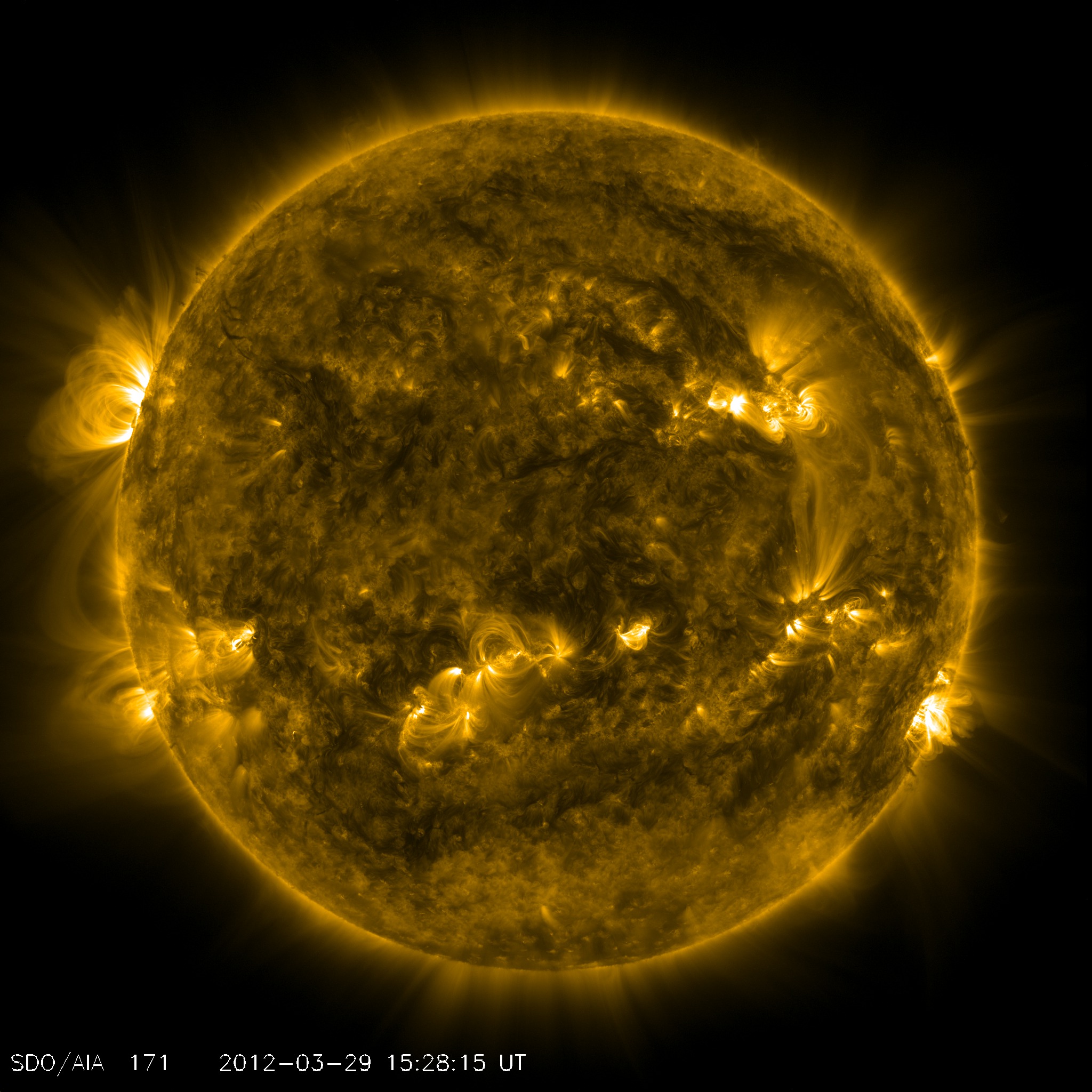
RETURN OF THE SUNSPOT: Sunspot AR1429, the source of many strong flares and geomagnetic storms earlier this month, is about to re-appear following a two-week trip around the backside of the sun. Magnetic loops towering over the sun's NE limb herald the sunspot's approach:
Earlier today, NASA's Solar Dynamics Observatory photographed plumes of plasma rising and falling over the limb: movie. Moreover, a pair of solar flares (C5- and C7-class) in the sunspot's towering magnetic canopy caused waves of ionization to ripple through the high atmosphere over Europe. These events suggest the region is still active.
| Laukvik, Lofoten, Norway. |
| Today,March 29, 2012,I had a recording from a solar x-ray event,C7.7 as a sudden ionospheric disturbance on my instruments,at 09.53 UTC. This is possibly the first SID of the old active sunspot group AR1429,at the moment over the eastern edge of the Sun.A few hours later followed by another event,C5.0 from the same region.Good prospects. |

The Classification of X-ray Solar Flares
or "Solar Flare Alphabet Soup"
A solar flare is an explosion on the Sun that happens when energy stored in twisted magnetic fields (usually above sunspots) is suddenly released. Flares produce a burst of radiation across the electromagnetic spectrum, from radio waves to x-rays and gamma-rays.
Scientists classify solar flares according to their x-ray brightness in the wavelength range 1 to 8 Angstroms. There are 3 categories: X-class flares are big; they are major events that can trigger planet-wide radio blackouts and long-lasting radiation storms. M-class flares are medium-sized; they can cause brief radio blackouts that affect Earth's polar regions. Minor radiation storms sometimes follow an M-class flare. Compared to X- and M-class events, C-class flares are small with few noticeable consequences here on Earth.
This figure shows a series of solar flares detected by NOAA satellites in July 2000:

Each category for x-ray flares has nine subdivisions ranging from, e.g., C1 to C9, M1 to M9, and X1 to X9. In this figure, the three indicated flares registered (from left to right) X2, M5, and X6. The X6 flare triggered a radiation storm around Earth nicknamed the Bastille Day event.
| Class | Peak (W/m2)between 1 and 8 Angstroms
|
B | I < 10-6 |
C | 10-6 < = I < 10-5 |
M | 10-5 < = I < 10-4 |
X | I > = 10-4 |