Ad

Showing posts with label neo. Show all posts

Thursday, May 9, 2013

Ring of Fire Solar Eclipse Today. Solar Forecast


RING OF FIRE SOLAR ECLIPSE--TODAY! On May 9-10, the Moon will pass directly in front of the sun over the South Pacific, producing a "ring of fire" solar eclipse. At greatest eclipse, more than 95% of the sun's surface will be covered. The Coca-Cola Space Science Center is hosting a live webcast of the event from Australia! Tune in on May 9th beginning at 5 pm EDT. More: animationmap,details.

MAGNETIC ACTIVITY: A ragged, dynamic filament of magnetism is dancing along the sun's southwestern limb today. It is so large, more than 250,000 km from end to end, that amateur astronomers are able to see it in great detail using backyard solar telescopes. John Stetson sends this snapshot from Falmouth, Maine:
The magnetic underpinnings of this arching prominence may be connected to nearby sunspot AR1736, which is itself unstable and poses a threat for M-class solar flares. If the anchor is unstable, the overlying structure could collapse. Observers with solar telescopes are encouraged to monitor the southwestern limb for developments.

Solar wind
speed: 451.5 km/sec
density: 3.4 protons/cm3
explanation | more dataUpdated: Today at 0037 UT
X-ray Solar Flares
6-hr max: C9 
2316 UT May09 
24-hr: C9 
2316 UT May09 
explanation | more dataUpdated: Today at: 2359 UT


Near Earth Asteroids
Potentially Hazardous Asteroids (PHAs) are space rocks larger than approximately 100m that can come closer to Earth than 0.05 AU. None of the known PHAs is on a collision course with our planet, although astronomers are finding new ones all the time.
On May 10, 2013 there were 1397 potentially hazardous asteroids.
Recent & Upcoming Earth-asteroid encounters:
Asteroid
Date(UT)
Miss Distance
Size
2013 JR7
May 10
9.1 LD
18 m
2004 BV102
May 25
69.9 LD
1.4 km
1998 QE2
May 31
15.2 LD
2.1 km
2009 FE
Jun 4
9.6 LD
230 m
2000 FM10
Jun 5
50.3 LD
1.3 km
2002 KL3
Jun 6
66.4 LD
1.1 km
1999 WC2
Jun 12
39.2 LD
1.9 km
2006 RO36
Jun 18
70.9 LD
1.2 km
2001 PJ9
Jul 17
29.2 LD
1.1 km
2006 BL8
Jul 26
9.3 LD
48 m
2003 DZ15
Jul 29
7.6 LD
153 m
2005 WK4
Aug 9
8.1 LD
420 m
Notes: LD means "Lunar Distance." 1 LD = 384,401 km, the distance between Earth and the Moon. 1 LD also equals 0.00256 AU. MAG is the visual magnitude of the asteroid on the date of closest approach.

Source:  SpaceWeather.com

3-day GOES X-ray Plot
The GOES X-ray Flux plot contains 5 minute averages of solar X-ray output in the 1-8 Angstrom (0.1-0.8 nm) and 0.5-4.0 Angstrom (0.05-0.4 nm) passbands. Data from the SWPC Primary and Secondary GOES X-ray satellites are shown. Some data dropouts from the Primary satellite will occur during satellite eclipses.
Other plots of interest: A black background version of this plot; GOES 1-min X-rays; SWPC Real-time Monitors. 
SWPC X-ray alerts are issued at the M5 (5x10E-5 Watts/m2) and X1 (1x10E-4 Watts/m2) levels, based upon 1-minute data. Large X-ray bursts cause short wave fades for HF propagation paths through the sunlit hemisphere. Some large flares are accompanied by strong solar radio bursts that may interfere with satellite downlinks.
source: http://www.swpc.noaa.gov/rt_plots/xray_5m.html


List Of The Potentially Hazardous Asteroids (PHAs)


Tuesday, September 25, 2012

Close Encounter With 101.706 Foot Space Rock Approx. September 28, 2012

Space rock 2012 SY49 "close encounter" with Earth -- September 28, 2012

Miss distant (AU) : 0.0067, Miss distant (LD) : 2.6, H (mag) : 25.7, Relative velocity (km/s) : 15.84, Estimated diameter : 19 m -- 42 m neo.jpl.nasa.gov Orbit diagram_ ssd.jpl.nasa.gov (H) -- Absolute magnitude 1 AU = ~150 million kilometers (neo.jpl.nasa.gov 1 LD = Lunar Distance = ~384000 kilometers 34 total observations over interval_ 2012 09 22.26616 -- 2012 09 25.06808 www.minorplanetcenter.net Credit_ NASA/JPL


Source: http://www.firstpost.com/topic/organization/nasa-space-rock-2012-sy49-close-encounter-with-earth-septemb-video-uzBiTqrrTGI-35946-1.html

Another Source: http://spaceweather.com/

THIS OBJECT IS 
101.706 FEET.

THIS OBJECT IS 2.6 LUNAR DISTANCES FROM THE EARTH...... 
618.8000000000001 miles

THE MOON IS 1 LUNAR DISTANCE FROM THE EARTH.......
238,900 miles


25 September 2012

NEO Asteroids Update Again Late SEP2012

NEO Asteroids Update Again Late SEP2012
Near Earth Objects, asteroids (2012 SY49) and (2012 SJ32) , are due to pull by Earth on 28SEP2012 and we can expect a continued increase in meteor activity here on Earth 2-3 days before/after their passing as there will be accompanying debris.  Get outside and watch, have your cameras ready and make a capture or witness a meteor.
Best in your viewing - LunarMeteorite*Hunter, Tokyo, Japan
UPCOMING CLOSE APPROACHES TO EARTH
AU = ~150 million kilometers
1 LD = Lunar Distance = ~384,000 kilometers
Object
Name
Close
Approach
Date
CA
Distance*
(AU)
CA
Distance*
(LD)
Estimated
Diameter**
H
(mag)
Relative
Velocity
(km/s)
333578 (2006 KM103) 2012-Sep-250.062624.4270 m - 600 m20.08.54
(2012 SM8) 2012-Sep-260.037614.615 m - 33 m26.35.57
334412 (2002 EZ2) 2012-Sep-260.192274.8270 m - 600 m20.06.76
(2012 QF42) 2012-Sep-270.109542.6130 m - 280 m21.68.67
(2012 SY49) 2012-Sep-280.00672.619 m - 42 m25.715.84
(2012 SJ32) 2012-Sep-280.029711.626 m - 59 m25.08.11
(2009 SB170) 2012-Sep-290.178969.6200 m - 440 m20.732.39
(2011 OJ45) 2012-Sep-290.133952.118 m - 39 m25.94.24
(2012 JS11) 2012-Sep-300.071227.7260 m - 580 m20.012.60
Table Source: NASA/JPL - http://neo.jpl.nasa.gov/ca/

source:http://lunarmeteoritehunters.blogspot.com/search/label/2012%20SY49


Wednesday, June 27, 2012

UPDATE: HUGE CORONAL HOLE TURNING TOWARD EARTH...Strong Solar Activity Turning Toward Earth. Asteroid and Planetary Alignments Cause Higher Ocean Levels.

UPDATE:  6-27-2012

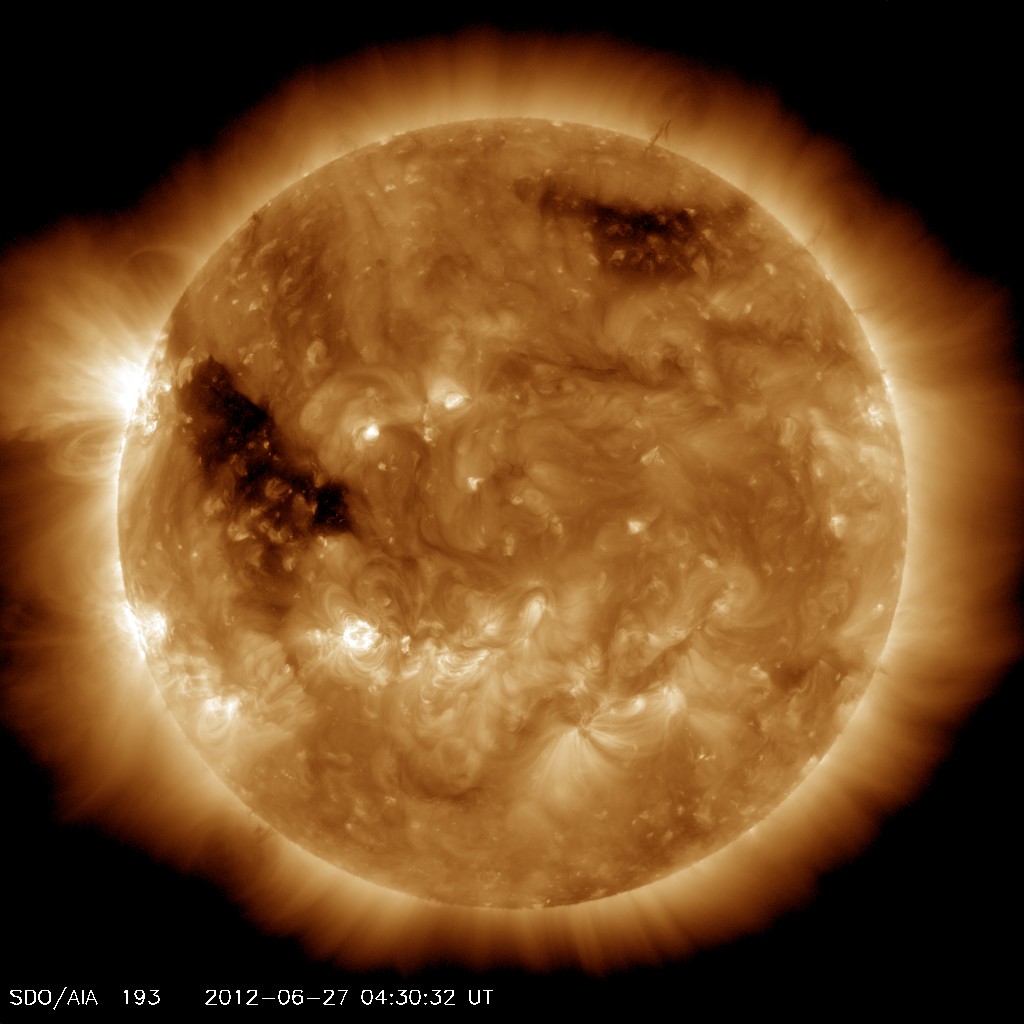
CORONAL HOLE: Spewing a stream of high-speed solar wind, a dark gap in the sun's atmosphere is turning toward Earth. NASA's Solar Dynamics Observatory photographed the coronal hole during the early hours of June 27th:
Coronal holes are places where the sun's magnetic field opens up and allows solar wind to escape. A stream of solar wind flowing from this particular opening should reach Earth on July 1-2. High-latitude sky watchers should be alert for auroras on those dates. Magnetic storm alerts: textvoice.

---------END UPDATE-------------------

HERE'S WHAT'S UP IN SPACE, SUN, EARTH...YOU KNOW...THAT SORT OF STUFF...

COMING ATTRACTION? An active sunspot on the farside of the sun is only days away from showing itself. During the late hours of June 25th, NASA's Solar Dynamics Observatory recorded an explosion which heralds the sunspot's approach:
The farside blast hurled a cloud of plasma over the sun's southeastern limb. Earth was not in the line of fire, but Mars might be. The Solar and Heliospheric Observatory saw a coronal mass ejection (movie) heading in the general direction of the Red Planet. The rover Curiosity, en route to Mars now, might detect something as the cloud passes by. A glancing blow to Mars itself is possible on June 29th or 30th.


2012 MY2 Asteroid 30 Jun 2012 East Side Earth Distance 0.0038 AU Sun Distance 1.016 AU

JUNE 24, 2012


2012 MY2 Asteroid 30 Jun 2012 East Side Earth Distance 0.0038 AU Sun Distance 1.016 AU
the idea girl says
this one's going to be 1.3 LD from earth, gravitational pull combined with other planetary alignments this month can cause ocean levels to rise…

this one just flew by...
Asteroid 2012 MF7 discovered. Flyby Jun 21 at 02:40 UT. Dist: 0.83 LD (0.81 LD from Earth surface). Size: 8-26 m. http://www.minorplanetcenter.net/db_search/show_object?object_id=2012+MF7&commit=Show

JUST FOUND THIS...DON'T KNOW IF I WAS SUPPOSED TO, BUT HERE IS A LIST OF NEAR-EARTH ASTEROIDS THAT ARE RATED BY NASA AS TARGETS FOR EXPLORATION VIA SPACECRAFT RENDEZVOUS...

Near-Earth Asteroid Delta-V for Spacecraft Rendezvous

Delta-V is computed following the approach described by Shoemaker and Helin (1978), 
Earth-approaching asteroids as targets for exploration, NASA CP-2053, pp. 245-256.

Last update: Mon Jun 25 13:31:01 PDT 2012
Source for NEA orbits: Minor Planet Center
http://www.minorplanetcenter.org/iau/lists/Atens.html
http://www.minorplanetcenter.org/iau/lists/Apollos.html
http://www.minorplanetcenter.org/iau/lists/Amors.html

Calculations by Lance A. M. Benner
Jet Propulsion Laboratory, California Institute of Technology
http://echo.jpl.nasa.gov/~lance/delta_v/delta_v.rendezvous.html

N = 8963

For comparison, delta-v for transferring from low-Earth orbit to rendezvous
with the Moon and Mars:
   Moon: 6.0 km/s
   Mars: 6.3 km/s
                                                                DELTA-V (ASTEROID)/
                                           PROVISIONAL  DELTA-V    DELTA-V FOR 
RANK  PERCENTILE ASTEROID NAME             DESIGNATION  (KM/S)    THE MOON MARS   H (mag) a (AU)   e     i (deg)
====  ========== =============             ===========  =======   ======== ====   ======= ======   =     =======
   1   99.99                                2006 RH120   3.820    0.637   0.606    29.5   1.033  0.024    0.6  RADAR
   2   99.98                                2007 UN12    3.823    0.637   0.607    28.7   1.054  0.060    0.2
   3   99.97                                2010 UE51    3.829    0.638   0.608    28.3   1.055  0.060    0.6
   4   99.96                                2009 BD      3.870    0.645   0.614    28.1   1.062  0.052    1.3
   5   99.94                                2010 VQ98    3.924    0.654   0.623    28.2   1.023  0.027    1.5
   6   99.93                                2008 HU4     3.927    0.654   0.623    28.2   1.093  0.073    1.3
   7   99.92                                2012 EC      3.953    0.659   0.627    23.4   1.153  0.138    0.9
   8   99.91                                2008 EA9     3.962    0.660   0.629    27.7   1.059  0.080    0.4
   9   99.90                                1991 VG      3.998    0.666   0.635    28.5   1.027  0.049    1.4
  10   99.89                                2008 UA202   4.029    0.672   0.640    29.4   1.033  0.068    0.3

THE LIST IS MASSIVE....

http://echo.jpl.nasa.gov/~lance/delta_v/delta_v.rendezvous.html

Tuesday, May 29, 2012

Near Earth Asteroid, 85 Foot 2012 KP24 Passing Approx. 1/5th The Distance To The Moon

UPDATE: 5/29/2012
HERE IS THE INFORMATION I COULD PULL FROM THIS INTERNET TODAY TO UPDATE YOU ON THE 6TH CLOSEST NEAR EARTH OBJECT THAT HAS EVER BEEN RECORDED...


SMALL ASTEROID BUZZES EARTH: Newly-discovered asteroid 2012 KT42 is flying past Earth today (May 29th) only ~14,000 km above the planet's surface. This means 2012 KT42 will actually fly inside the Clark Belt of geosynchronous satellites. The 3- to 10-meter wide asteroid ranks # 6 on the top 20 list of closest-approachers to Earth. According to the asteroid's orbit, there is no danger of a collision. Even if it did hit, this space rock is too small to cause significant damage. It would likely disintegrate almost entirely in the atmosphere, peppering the ground below with relatively small meteorites. Flyby images: #1#2.
source: spaceweather.com


2012 KT42 - Close Approach


May 29, 2012 at about 07:07 UT, the asteroid designated2012 KT42 will pass only ~14,000 km (8,700 miles) or about ~0.05 lunar distance (or 0.0001379 AU) above the Earth's surface. The asteroid was discovered by A. R. Gibbs in the course of Mt. Lemmon Survey with a 1.5-m reflector + CCD on May 28, 2012 at magnitude ~18.1.


According to its absolute magnitude (H=28.8) this asteroid has an estimated size of roughly 3-10 meters, so it is a small object. We have been able to follow-up this object soon after his discovery while it was still on the neocp, from the Siding Spring-Faulkes Telescope South on 2012, May 28.4, through a 2.0-m f/10.0 Ritchey-Chretien + CCD.

At the moment of our images from FTS, "2012 KT42" was moving at about ~3.63 "/min and its magnitude was ~17.5. At the moment of its close approach around 07UT of tomorrow, 2012 KT42 will be bright as magnitude ~12.0 and moving at ~11021"/min.

Below you can see an image (stack of 5x5-second exposures) showing the asteroid. Click on the thumbnail to see a bigger version:


Below you can see an animation showing the motion of 2012 KT42. Each frame is a 5-second exposure through the FTS 2.0-m telescope. Click on the thumbnail to see a bigger version:


While there is no cause for concern, this is one of the closest approaches recorded. The table below shows the top 20 closest approaches by NEOs (Near-Earth Objects) sorted by nominal distance. The table has been computed on the NASA/Neo-JPL website. 2012 KT42 is the sixth closer approach to date. (2011 CQ1 is the closest non-impacting object in the asteroid catalog to date. The event that took 2008 TC3 into the earth's atmosphere is not included). Click on the thumbnail to see a bigger version:


On mpml mailing list, Andrew Lowe pointed out that on May 29 at about 10:10 UT,  2012 KT42 the minimum geocentric elongation from the center of the sun will be 0.1 degrees, so given the parallax there will be a transit across the sun. But with a diameter of about 5m, the object could be only about 0.07" across against the solar disk. Aldo Vitagliano provided this map of the transit (computed by his software Solex). Click on the thumbnail to see a bigger version:


According to calculation made by P. Tricarico, 2012 KT42 has experienced a partial eclipse while approaching Earth on May 28, 2012 between 14:05 UTC and 21:45 UTC, before the flyby. See animation below (click on it for a bigger version). Probably the first case ever of an approaching asteroid experiencing an eclipse and a transit during the same flyby with Earth. More info about this on Tricarico's website.


by Ernesto Guido, Nick Howes & Giovanni Sostero 
source: http://remanzacco.blogspot.com/2012/05/2012-kt42-close-approach.html


2012 KT42, a newly found asteroid buzzes past Earth


NEW DELHI: A newly-discovered asteroid passed in close proximity to the Earth, just 14,000 km above the planet's surface, today but caused no damage to the orbiting communication satellites. 

The asteroid " 2012 KT42," which entered the Clark Belt of geosynchronous satellites, passed by Earth at around 1230 hours, S N Raghunandan Kumar of Planetary Society of India told PTI. 

The 3 to 10-metre wide asteroid ranks in the list of top ten of closest asteroid approaches to Earth. In fact, this is the sixth closest approach till date, which makes it significant despite its small size. 

The asteroid was not visible to the unaided eye. According to the asteroid's orbit, there was no danger of a collision. Even if it did hit, the space rock is too small to cause significant damage. It would have possibly disintegrated almost entirely in the atmosphere, peppering the ground below with relatively small meteorites, Kumar said. 

Asteroids are a class of solar system bodies in the orbit around the sun. The larger asteroids are been called planetoids.

source: http://economictimes.indiatimes.com/news/news-by-industry/et-cetera/2012-kt42-a-newly-found-asteroid-buzzes-past-earth/articleshow/13634407.cms


-----------------------------------------end update-------------------------------------------------------


Yes, another asteroid, another near earth object.  This one is approximately 85 feet large and will come within an estimated 40389 mile distance to Earth.   Therefore, this object will come between the Earth and the Moon, between which the distance is 238,900 miles.  This means, the large object will be really close to Earth.  Here is the information that I scoured from the Internet on the subject.  I cannot vouch for all of the validity because of it coming from the Internet.  However, be aware that the magnetic pull during the next few days may cause further and larger earthquake activity, as well as volcanic activity.  This object is code condition 8, which means UNCERTAIN.  This was found only yesterday and observed since then.  Therefore, there is not much data on this body.  According to what I can pull from the Internet, the approximate day of closest passing will be between May 28-29, 2012.  


Object Information:
The Newly Discovered Asteroid 2012 KP24, other NEOs & Night Sky
2012 KP24 JPL: http://ssd.jpl.nasa.gov/sbdb.cgi?sstr=2012%20KP24;orb=1;cov=0;log=0;cad=1#cad
2012 KP24 MPC: http://www.minorplanetcenter.net/db_search/show_object?object_id=2012+KP24&am...
NEO Earth Close Approaches: http://neo.jpl.nasa.gov/ca/
HORIZONS: http://ssd.jpl.nasa.gov/horizons.cgi
Purdue University, Impact Earth: http://www.purdue.edu/impactearth/


Asteroid 2012 KP24 0.1 LD 26 M Close to Earth on 29 May 2012 alignment of earth venus sun mercury mars gravitational pull earthquakes tsunami hurricanes earth distance 0.0024 AU sun distance 1.012 AU

Asteroid 2012 KP24 on 29 May 2012 aligns earth venus sun mercury mars gravitational pull earthquakes tsunami hurricanes earth distance 0.0024 AU sun distance 1.012 AU

Asteroid 2012 KP24 on 29 May 2012 aligns earth venus sun mercury mars gravitational pull earthquakes tsunami hurricanes earth distance 0.0024 AU sun distance 1.012 AU
Asteroid 2012 KP24 0.1 LD 26 M Close to Earth on 29 May 2012 alignment of earth venus sun mercury mars gravitational pull earthquakes tsunami hurricanes earth distance 0.0024 AU sun distance 1.012 AU
the idea girl says
it may not be a true alignment but to the eye it sure looks like one in this graph..
NOT GOOD!
it’s bad enough having Cuno 4183 asTEROID 7.8 km CLOSE TO EARTH AND THEN OVER 1293 OTHER’S KICKING CLOSE TO EARTH, DID YOU NOTICE THE NUMBERS WHEN UP FOR THAT TOO?
source: ClickHere


Tuesday, May 22, 2012

Newly Discovered Near Earth Asteroid 2012 KT12 Coming May 23, 2012


On May 23, 2012 there were 1293 potentially hazardous asteroids.
Recent & Upcoming Earth-asteroid encounters:
Asteroid
Date(UT)
Miss Distance
Mag.
Size
2012 KA
May 17
0.6 LD
--
9 m
2010 KK37
May 19
2.3 LD
--
31 m
4183 Cuno
May 20
47.4 LD
--
5.7 km
2012 KW
May 21
3.4 LD
--
19 m
2012 JV11
May 22
6.7 LD
--
68 m
2012 KT12
May 23
1.4 LD
--
25 m
2002 VX94
May 26
72.8 LD
--
1.1 km
2002 AC
Jun 16
62.2 LD
--
1.2 km
1999 BJ8
Jun 16
68.8 LD
--
1.1 km
2005 GO21
Jun 21
17.1 LD
--
2.2 km
2003 KU2
Jul 15
40.2 LD
--
1.2 km
2004 EW9
Jul 16
46.8 LD
--
2.1 km
2002 AM31
Jul 22
13.7 LD
--
1.0 km
Notes: LD means "Lunar Distance." 1 LD = 384,401 km, the distance between Earth and the Moon. 1 LD also equals 0.00256 AU. MAG is the visual magnitude of the asteroid on the date of closest approach.


source: http://spaceweather.com/
.............................................................................................................................................................


.....................................................................................................................................................
Newly discovered 2012 KT12 is a small 15-35 meter Apollo class near-Earth asteroid which will fly 0.0037 AU or 1.4 LD to both Earth and Moon on May 23. JPL Orbit: [link to ssd.jpl.nasa.gov]  
Condition Code or orbit uncertainty estimate is a on a scale of 0-9, with 0 being good, and 9 being highly uncertain. 
Was first spotted May 19 but just added to NASA site today, and not yet posted on SpaceWeather list [link to spaceweather.com
source: http://www.godlikeproductions.com/forum1/message1876893/pg1 
...................................................................................................................................................


For the following video poster:
Phil Plait is an astronomer, author, and science advocate. His blog, Bad Astronomy, is hosted by Discover Magazine, and he writes about news and current issues facing science. A common topic is astronomical doomsday: ways mythical and real the world can end. He's fascinated by asteroid and comet impacts, and is a big supporter of finding, tracking, and ultimately deflecting any dangerous rocks heading our way. 

About TEDx, x = independently organized event  

In the spirit of ideas worth spreading, TEDx is a program of local, self-organized events that bring people together to share a TED-like experience. At a TEDx event, TEDTalks video and live speakers combine to spark deep discussion and connection in a small group. These local, self-organized events are branded TEDx, where x = independently organized TED event. The TED Conference provides general guidance for the TEDx program, but individual TEDx events are self-organized.* (*Subject to certain rules and regulations)