WARNING: NEVER look at the Sun without proper protection! A good protection is an eclipse glasses, or a special solar filter. Looking through a stain glass or black film is harmful , because it leaves the invisible, harmful ultraviolet radiation. This you can not see and feel, but you notice later, when you no longer see.
VENUS TRANSFORMED: Something special is happening to Venus in the evening sky. The second planet is diving toward the sun for a much-anticipated transit on June 5-6. As Venus turns its night side toward Earth, the planet is transforming into a beautifully slender and colorful crescent:
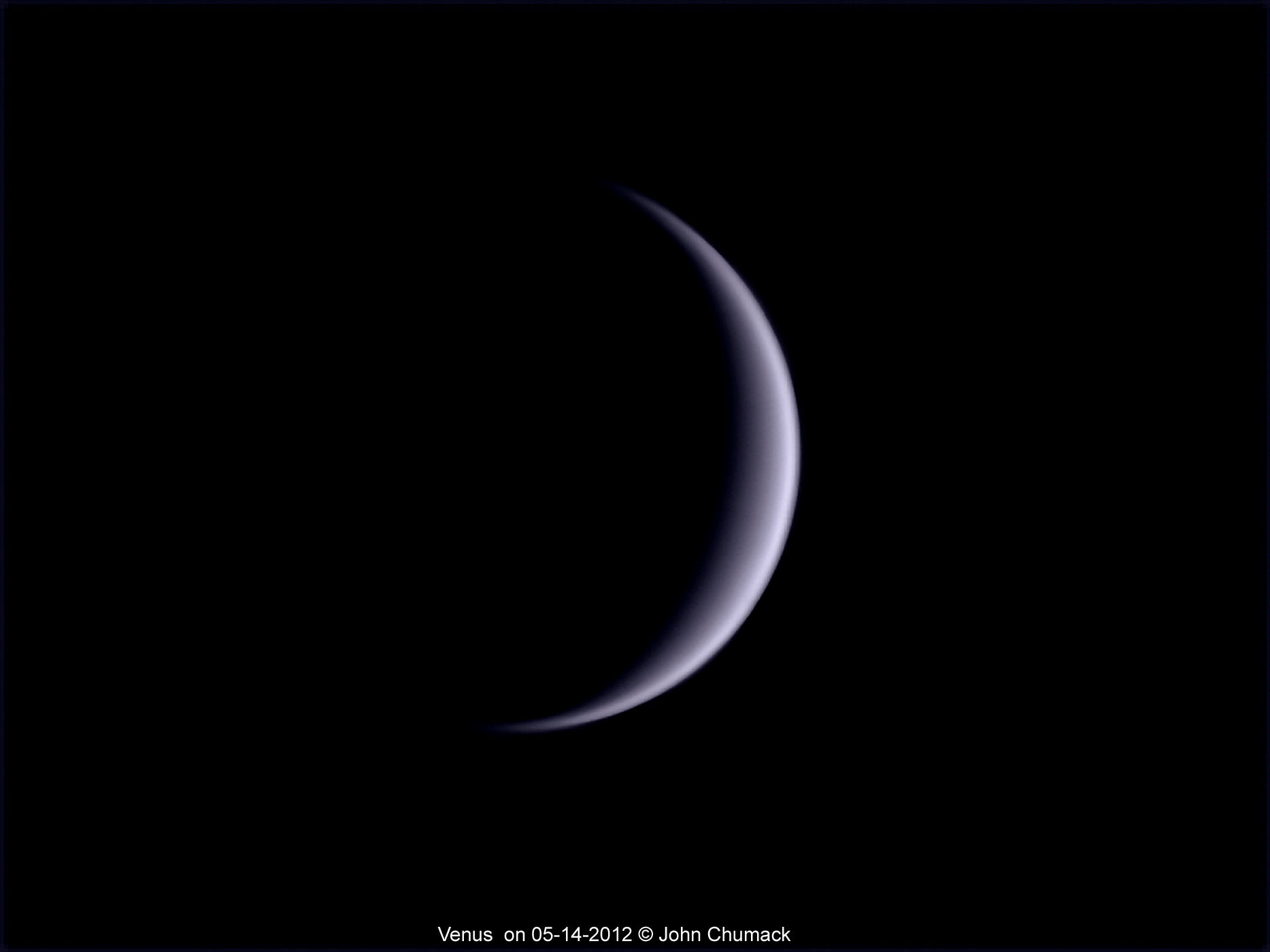
John Chumack of Dayton, Ohio, took the picture on May 14th using a 10-inch telescope. "I was blown away by the sight of Venus," he says. "The planet was 14% illuminated, 47 arcseconds in diameter, and blazing at -4.43 magnitude."
The crescent shape of Venus is easy to see in good binoculars or small telescopes. No special observing experience is required. Just find Venus in the western sky after sunset (you can't miss it), point and look. A good tripod to hold the optics steady is recommended.
As the evening wears on and Venus sinks toward the horizon, the refractive effect of Earth's atmosphere splits the crescent into the colors of the rainbow. Kevin R. Witman of Cochranville, Pennsylvania, observed the phenomenon on May 11th: "Earth's atmospheric refraction of Venus's ample light made a beautiful imagethrough my 10-inch telescope."
more images: from Sadegh Ghomizadeh of Tehran, Iran;
Source: http://www.spaceweather.com
The Venus Transit of June 6, 2012 |
Introduction
On Wednesday, June 6, 2012 finds a transit of Venus on the Sun site. Venus then moves between the Sun and the Earth, so much so that the contours of the planet can be seen against the bright surface of the Sun. This is a fairly rare event, this example is only the twenty-sixth venus transition since the beginning of our era. Unfortunately, this transition occurs to us, especially at night, so we in Belgium and the Netherlands early in the morning only the last part of the transition can be seen. Venus moves about once every 584 days between the Earth and the Sun by. This is called a lower conjunction . Venus is usually at a lower conjunction, however, not seen on the solar disk.This is because the orbital plane which Venus orbits the Sun at an angle to the ecliptic , so the plane in which the Earth orbits the Sun. Venus rotates in nearly 225 days once around the Sun (a venus year) and is one half of that time above the ecliptic, the other half below it. Twice a year, Venus is Venus crosses the ecliptic from north to south or from south to north movement.We then say that Venus is in the declining or ascending node of its orbit is. Only when the lower conjunction of Venus takes place in (or very close to) one of the nodes, we see on Earth Venus transition. In all other cases, Venus seen from Earth moves above or below the Sun along. This is similar to the reason why not every full moon a lunar eclipse poses .
At this time (between the years 1518 and 2984) are venus transitions in pairs, between which the two transitions in a pair is about 8 years. Note that in eight years, five benedenconjuncties made, because 8 × 365 days is equal to 5 × 584 days. The transition of 2012 is the second of a pair, the previous changeover took place on June 8, 2004 and was completely visible in our regions. The last couple of transitions was in 1874 and 1882, both in December. At this moment, Venus in the descending node in June and the ascending node in december. Two transitions of a pair are always at the same node, the 2004 and 2012 are thus in the descending nodes (see the downward movement of Venus across the solar disk in the figures and animations on this page), and so in June, the transitions from 1874 and 1882 were in the ascending node.
The Venus Transit of 2012
On June 6, 2012 Venus moves as said on the solar disk, and only the end of this transition is, in clear weather, visible from the Netherlands and Belgium. The whole event takes place between 0:03 am and 6:55 am and lasts nearly seven hours. Below are the exact time for transition tips as well as to find images that the path of Venus across the Sun show. The images chosen for two different coordinate systems: ecliptic coordinates, the plane of the solar system as axis and thus the most logical choice for events in the solar system, and horizontal (azimuthal) coordinates, the position above the horizon display, and so very well suited for an observer at a particular place on Earth. The exact figures are for Utrecht. Times for other places in the Netherlands and Belgium to deviate up to 15 seconds on this. The times are rounded to the whole second, because the unpredictable fluctuations in the rotational speed of the Earth is a Contributing uncertainty (The difference dT between Terrestial Time and Universal Time (UT) . This dT can only be establish in retrospect, I use here the estimate 66.6s).
For the beginning and the end of the transition time, two dots indicated. These are time match which the outer edge of the Sun by Venus are 'touched' and so the first or last bite from the Sun is taken, and when the inner edge of the Sun is touched and thus the beginning or end of the period covered Venus is completely visible to the Sun. The maximum occurs when the distance between the center of Venus and the center of the Sun is minimal. (See Figure 1a and 2a, and Table 1).
Data of the transition
 |  |
| Figure 1a: the beginning, maximum and end of the transition in ecliptic coordinates | Figure 1b: the position of Venus on the hour in ecliptic coordinates |
 |  |
| Figure 2a: the beginning, maximum and end of the transition in horizontal coordinates | Figure 2b: the position of Venus on the hour in horizontal coordinates |
| Phenomenon | Time | Azimut | Height | Distance center | Distance edge |
| 1: early entry | 0:03:55 | 337.8 ° | -12.5 ° | 16'14 .8 " | +00'29 .1 " |
| 2: end entry | 0:21:43 | 341.9 ° | -13.4 ° | 15'16 .5 " | -00'29 .1 " |
| 3: Maximum | 3:29:56 | 26.2 ° | -11.3 ° | 08'53 .1 " | -06'52 .6 " |
| 4: early exit | 6:37:20 | 64.3 ° | 8.9 ° | 15'16 .5 " | -00'29 .1 " |
| 5: end exit | 6:54:59 | 67.6 ° | 11.4 ° | 16'14 .8 " | +00'29 .1 " |
Table 1 shows the main data show. For each of the five symptoms, the time indicated in hours, minutes and seconds Central European summer time ( CEST ). Then the azimuth indicated, the place where the two above / below the horizon, in degrees, 0 ° = 360 ° = North, 90 ° east and 180 ° is south. Then, the height of the two degrees above the horizon, the distance between the center of Venus and the center of the Sun, and the distance from the center of Venus to the edge of the Sun. A negative edge distance means that the center of Venus in front of the solar disk.
Other data for the maximum of the transition are:
| Diameter of the Sun: | 31'31 .3 " |
| Diameter of Venus: | 58.3 " |
| Distance to the Sun: | 1.01475 AE |
| Distance to Venus: | 0.28871 AE |
2012 TRANSITS OF VENUS
Geographic Visibility of 2012 June 06
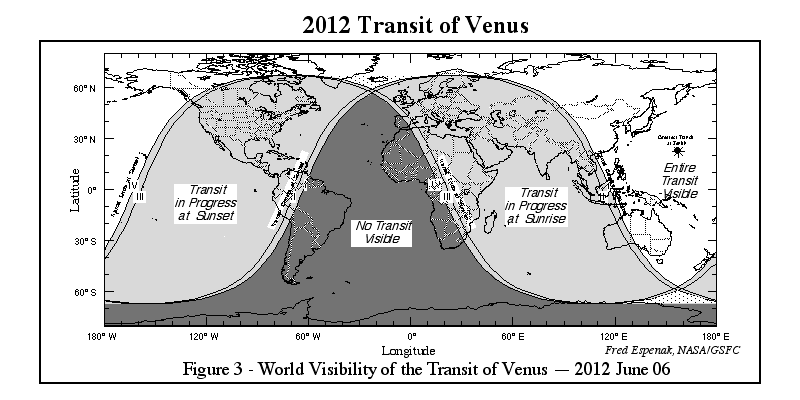
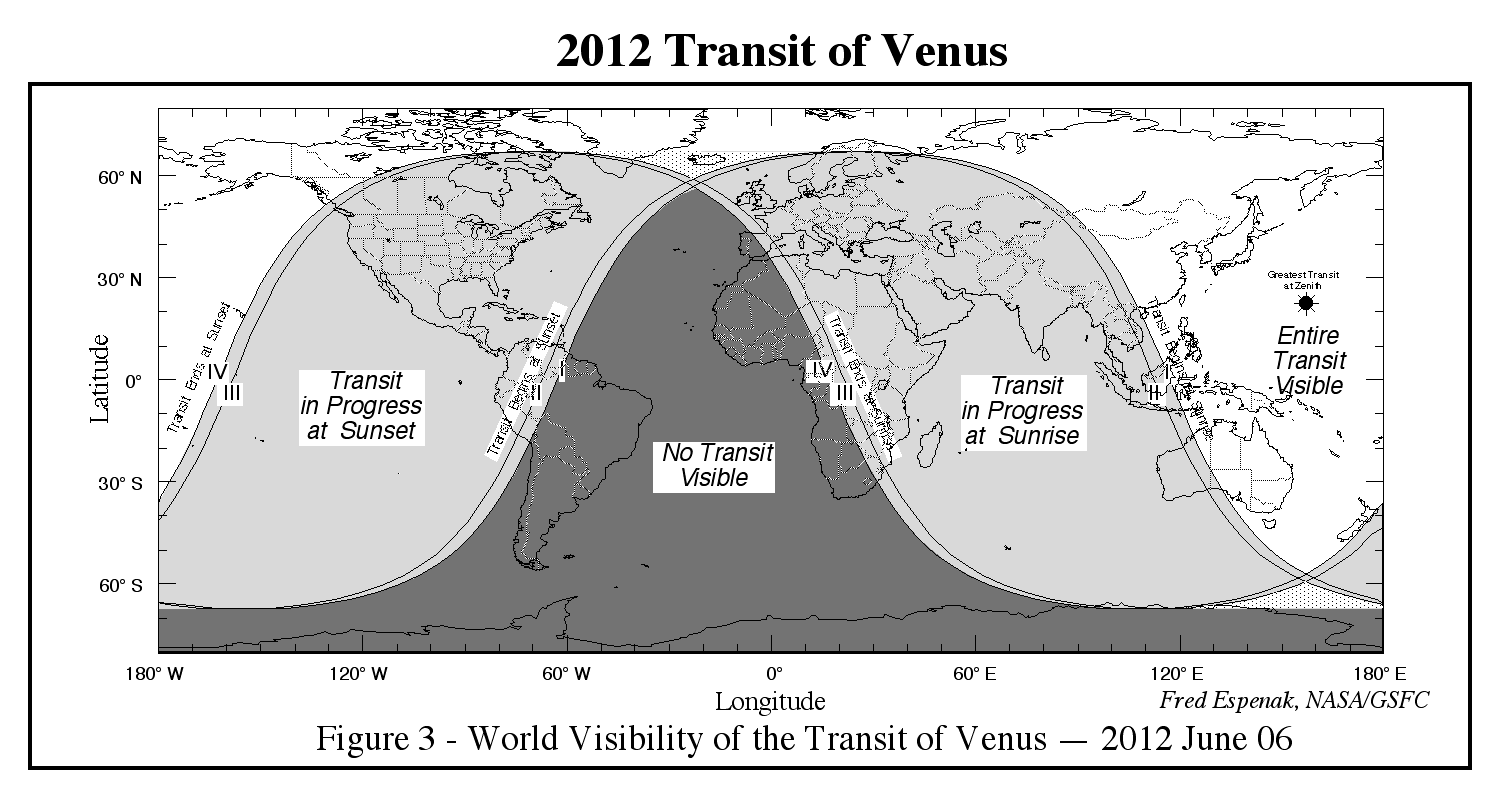
The global visibility of the 2012 transit is illustrated with the world map in Figure 3 (Low Res or High Res). The entire transit (all four contacts) is visible from northwestern North America, Hawaii, the western Pacific, northern Asia, Japan, Korea, eastern China, Philippines, eastern Australia, and New Zealand. The Sun sets while the transit is still in progress from most of North America, the Caribbean, and northwest South America. Similarly, the transit is already in progress at sunrise for observers in central Asia, the Middle East, Europe, and eastern Africa,. No portion of the transit will be visible from Portugal or southern Spain, western Africa, and the southeastern 2/3 of South America.
Note that due to the International Date Line the Western Hemisphere will see the transit on June 5.
The horizontal parallax of Venus (~30 arc-sec) introduces a topocentric correction of up to ±7 minutes with respect to the geocentric contact times for observers at different geographic locations. Topocentric contact times (Universal Time) and corresponding altitudes of the Sun are presented for over one hundred cities in Table 2A (international) and Table 2B (USA).
Frequency of Transits
Transits of Venus are only possible during early December and early June when Venus's orbital nodes pass across the Sun. If Venus reaches inferior conjunction at this time, a transit will occur. Transits show a clear pattern of recurrence at intervals of 8, 121.5, 8 and 105.5 years. The next pair of Venus transits occur over a century from now on 2117 Dec 11 and 2125 Dec 08.
Edmund Halley first realized that transits of Venus could be used to measure the Sun's distance, thereby establishing the absolute scale of the solar system from Kepler's third law. Unfortunately, his method proved impractical since contact timings of the desired accuracy are impossible due to the effects of atmospheric seeing and diffraction. Nevertheless, the 1761 and 1769 expeditions to observe the transits of Venus gave astronomers their first good value for the Sun's distance.
The planet Mercury can also transit the Sun. Since Mercury orbits the Sun more quickly than does Venus, it undergoes transits much more frequently. There are about 13 or 14 transits of Mercury each century. All Mercury transits fall within several days of 8 May and 10 November. During November transits, Mercury is near perihelion and exhibits a disk only 10 arc-seconds in diameter. By comparison, the planet is near aphelion during May transits and appears 12 arc-seconds across. However, the probability of a May transit is smaller by a factor of almost two. Mercury's slower orbital motion at aphelion makes it less likely to cross the node during the critical period. November transits recur at intervals of 7, 13, or 33 years while May transits recur only over the latter two intervals. The next two transits of Mercury are on 2003 May 07 and 2006 Nov 08. For details on the first event, see: