One dead, three injured in Arkansas nuclear plant accident
By Sofia Perpetua, NBCNews.com
An accident at an Arkansas nuclear power plant at 7:45 a.m. local time resulted in the death of one worker and left three injured, but did not cause radiation and it is not a public health risk, according to the Arkansas Department of Health.
"There was no nuclear release of any kind," said Ed Barham, a spokesman for the Arkansas Health Department.
The accident took place in Russellville, a city with 28,000 residents, about 81 miles from Little Rock.
“There is no danger to the public,” said Entergy Operations, Inc, owner of the plant, Arkansas Nuclear One, in a statement.
KTHV, a Little Rock television station, reported that residents heard a large boom at the time of the incident.
According to Entergy, part of generator fell as it was being moved and the plant automatically shut down.
The injured workers have been transported to a nearby hospital.
“Our greatest sympathy is with the family and friends of the employee who lost his life, and with those who sustained injuries,” said Jeff Forbes, executive vice president and chief nuclear officer.
The accident is classified as an "unusual event," the lowest of four emergency classifications by the Nuclear Regulatory Commission, Entergy said.
The company delivers electricity to 2.8 million customers in Arkansas, Louisiana, Mississippi and Texas, has annual revenues of more than $10 billion and has approximately 15,000 employees.
Arkansas Nuclear One provides 30 percent of the state’s energy, according to the plant’s website.
Arkansas Hit with Nuclear Accident and Major Oil Spill
Arkansas Nuclear One Reactor and ExxonMobil Pipeline Both Suffer Major Accidents
The Arkansas Nuclear One nuclear reactor – operated by Entergy – suffered an accident yesterday which killed one and injured 8 workers.
The plant vented steam to cool the reactor. Air detection teams have been deployed to the area, and local residents are worried. See this, this and this.
Only 40 miles from the nuclear plant, Arkansas was hit with a major oil spill.
NBC News is reporting that an ExxonMobil pipeline rupture near Little Rock Friday evening has resulted in a “major oil spill,” according to the Environmental Protection Agency. And see this.
Why are nuclear and fossil fuel disasters happening at the same time? Because the accidents are caused by the exact same thing: greed.
March 21, 2013 – SOUTHERN NEW JERSEY - Just after 3 o’clock Tuesday afternoon residents in Atlantic, Cape May, and Cumberland counties say they felt multiple earthquake-like tremors that rattled their homes and offices. Absecon resident, Kay Stadlmeir, said, “I don’t think it would be an earthquake, but what could it be? It’s just really odd.” Somers Point resident, Bob Mower, explained, “There was a rattling of my windows and I felt the house shake just a little bit – it was unusual.” Stadlmeir told NBC40, “It has to be something really big to be witnessed in such a widespread area of South Jersey.” The reports vary from region to region. Atlantic county emergency management officials confirmed with the U.S. Geological Survey that it was not an earthquake. The next thought was that military training or an aircraft flying by might have caused the shakes. Both the 177th Fighter Wing in Egg Harbor Township and Joint Base McGuire-Dix-Lakehurst confirmed none of their aircrafts were in the area at that time. Joint Base McGuire-Dix-Lakehurst is still working to confirm whether or not any ground training was happening at the time, although it is unlikely that would cause such a widespread shake. Stadlmeir said, “I really don’t think it’s a sonic boom because, you know as I said before, I’ve experienced them before and this is nothing like that.” Mower told NBC40, “That was real unusual. I almost wondered if I was dreaming on that one.” After initial reports of the shakes came in, NBC40 put the word out on Facebook to see who else felt it. Immediately we received hundreds of responses from all over South Jersey. Concerned Egg Harbor Township resident, Oliana Collado, said, “I just think it’s weird because some people didn’t feel it and it’s like in random spots, and it’s very spread out. Yeah it was scary, but I’m just glad it wasn’t worse than what it was.” When we reached out to New Jersey State Police Headquarters, we were told that our call marked the first time they had heard about possible tremors and they were unable to tell us anything further. NBC40 will continue to investigate the cause of these mysterious tremors. –NBC40
The mystery of the “loud boom” heard in parts of the region over the weekend may go unsolved as efforts to find the source of the boom proved a bust Monday.
Hundreds of people in at least four counties — Franklin, Hamilton, Saline and Williamson — flocked to social media to report hearing a windows-rattling, earth-shaking boom between 1 and 2 p.m. Saturday.
No damages or injuries were reported as a result of the boom.
“I have no way of knowing exactly what occurred but it was not likely an earthquake,” geophysicist Don Blakeman of the National Earthquake Information Center said. “There is nothing on our lists, only the last one on the 11th (near Benton).”
Some earthquakes are heard as well as felt, he said, but if it was so widespread as to be heard in four counties, “We would be able to locate it as an earthquake,” he said. “Typically, when loud booms are heard it turns out to be a sonic boom, although I’m not saying that’s what it was in this instance.”
However, if the boom was sonic in nature, it wasn’t caused by military action. Neither Scott Air Force Base nor the North American Aerospace Defense Command reported activity taking place in the region Saturday.
“We were not in that area with any of our assets,” a NORAD spokesman said.
A Scott Air Force spokeswoman confirmed no Scott or military-related activities or exercises took place in Southern Illinois over the weekend.
The boom was not weather-related, according to meteorologist Robin Smith of the National Weather Service in Paducah said.
Nor was it related to any coal mining activity, a spokeswoman for the Illinois Office of Mines and Minerals said.
The swarm of social media postings caused Franklin County Emergency Management Agency Director Ryan Buckingham to make his own post on the agency’s Facebook page.
“Residents in Franklin County are reporting what was described as a ‘ground-shaking loud boom’ during the day on Saturday 3/16/2013. USGS (U.S. Geological Survey) has not reported any earthquake activity in our area during that time, leaving the cause of these reports as somewhat of a mystery,” Buckingham wrote.
The mystery was not cleared up by Monday, he said.
“We picked it up first on social media. A lot of people heard it but didn’t have a source for it,” Buckingham said. “I put a feeler out on Facebook because if there is a threat to public safety, that’s something we need to know about it, but no one had any idea what caused it.”
While the source of the boom has yet to be traced, Buckingham said it should serve as a reminder for residents to have a plan in place in case of emergency.
Back in October, I wrote an article entitled “Numerous Reports of Mysterious Booms and Strange Lights Over South Carolina,” in which I described the sounds and vibrations heard and felt all across the Pee Dee region of South Carolina with some witnesses even describing strange lights in the sky at the time of the event.
But while the incidents in Michigan and New Jersey were researched from a distance, it just so happens that this writer was in the Pee Dee region of South Carolina when the two “mysterious booms” in the first article took place. At the time, I described the incidents as follows:
[The incidents] spann[ed] the entire Pee Dee region and all the way into North Carolina. On the evening of November 5, around 7:30-7:45 p.m., various law enforcement and local news agencies were contacted by individuals living in the Pee Dee region of South Carolina in reference to a loud “boom” that was large enough to shake their houses.
The reports were numerous around Pamplico, Johnsonville, Marion, Hemingway, Aynor, Nichols, Hannah, and Mullins. However, as stated earlier, reports also came from as far away as Evergreen, North Carolina.
Marion County dispatchers alone received more than 100 calls in ten minutes related to the “booms.”
The US Geological Society has publicly stated that there was no seismic activity in the region on these dates and emergency dispatchers confirmed that there had been no plane crash.
Very soon after the event, Johnsonville Police Chief, Ron Douglas, claimed the “booms” were “from a handful of military aircraft” that had broken the speed of sound. However, this explanation, which was rapidly adopted by the local media, does not hold water. For one thing, most of the individuals I have spoken to (as well as myself) have heard jets break the sound barrier before and both the sound and the impact of the mysterious “booms” were much different than that of jets breaking the sound barrier.
Secondly, if the jets were the cause of the sound and of the heavy vibrational impact that shook so many houses, the jets themselves would have had to be flying very low. But, if the jets were flying low enough for this type of effect to be achieved, witnesses would have also been able to hear the jets.
This writer can personally attest to the intensity of the “booms” as I, myself, was in the area at the time of the incident. The sound, much like what Bob Powell described sounded much more like artillery than any other comparable sound. There was no lead up to the shaking, it was simply as if one was experiencing the vibrations of an explosion.
The impact was so strong that one way to describe hearing and feeling the impact from inside the house, it would be if one could imagine a full grown adult climbing on top of the back of a couch or recliner and leaping off, landing full force on the living room floor. Much like this scenario, the impact was sudden and short-lived. The sound, however, was extremely similar to the firing of artillery, much as Powell described it in Michigan.
The above incident occurred, as mentioned earlier, on November 5. However, one week prior, a similar, albeit weaker, explosion was heard in the same locations. Reports were made to this writer from both Marion and Mullins in terms of the noticeable impacts and sounds of this separate explosion. Like the first, the sound was similar to artillery, the impact was also distinct but sudden and brief.
To my knowledge, there have been no mainstream local reports of the earlier “explosion.” Also as in the second incident, I can personally attest to the nature of the first.
After the initial curiosity surrounding the incidents subsided, news coverage and local talk expectedly subsided as well. Yet, on January 6, 2013, South Carolina residents again began hearing these booms and feeling the vibrations powerful enough to “rattle windows.” This time, the location was not the Pee Dee region but in the Red Bank area of Lexington County. Interestingly enough, around the same time period (between January 2- 6 2013), these “booms” were heard and felt in other locations across the country including in Alaska, Oklahoma, Massachusetts, and Indiana.
The Pee Dee region was not to be overlooked, however, as on March 2, 2013, more reports were published regarding booms and vibrations powerful enough to shake houses. As with the other instances of booms and vibrations, there was no seismological activity in the area at the time. [1] However, since the first set of occurrences in the Pee Dee region, two individuals have been paying special notice to the incidents of the mysterious booms, detailing and recording the dates of their occurrence as felt in the Conway/Myrtle Beach area. read more at http://www.activistpost.com
New York Earthquake May Have Caused Mysterious Boom
Residents of Little Compton, Tiverton and Westport might have felt seismic activity from a relatively small earthquake in upstate New York on Wednesday evening.
Randy Smith said he has been hearing loud booms near his house for about two years and most recently last week three booms shook his house and startled his dog, Sandy. (Scott DeSmit/Daily News)
Posted: Saturday, March 16, 2013 12:06 am | Updated: 3:18 pm, Sat Mar 16, 2013.
ALABAMA — It was about midnight on a night last week when Randy Smith took his dog outside and for the third time this year, heard the mysterious booms.
“Three times in a row I heard it,” Smith said. “It sounds as loud as a sonic boom. Maybe louder. As soon as it goes off, the dog starts growling and gets startled.”
Smith and his father, Laverne Smith, live at 748 Lewiston Rd. (Route 77) and have been hearing the booms for nearly two years now.
They cannot pinpoint the source of the noise.
“You can’t tell what direction it’s coming from,” Laverne Smith, 76, said. “The last good weather we had I was out near the shed and heard it.”
Last year they heard the booms about 10 times, sometimes during the day and sometimes at night.
“It seems to be just around here,” Randy Smith said. “I asked my sister who lives in Alabama Center and she hasn’t heard it.”
It is a phenomena that has sparked curiosity throughout the country for several years now.
The booms, however, have grown more frequent.
In December, people in Rhode Island, Alabama, Georgia, Texas and Oklahoma reported hearing unusual booms and explosions.
Newspaper reports revealed no unusual seismic activity in those regions and all the noises have yet to be explained.
In January, hundreds of people in northern Utah called emergency dispatchers reporting booms and shaking of the earth.
The cause remains a mystery, though the Air Force said it had done training exercises, dropping bombs in the desert.
Locally, 911 dispatchers in Chautauqua County were inundated with calls on Jan. 13, all reporting hearing a loud boom that shook houses.
Police eventually determined the noise came from a 20-year-old man using an explosive called Tannerite, a legal compound that when struck with a bullet explodes.
A few days later, on Jan. 16, residents in Gorham, Ontario County, reported a series of booms.
“It was just a loud, explosion-like sound,” Janet Koller told the Canandaigua Messenger Post. “We saw nothing. It was dark by then. It was hard to even tell what direction it came from. It shook the house.”
Ontario County sheriff’s officials said several people called to report the still unexplained booms.
Booms also were reported in Le Roy.
Former Daily News editor Ben Beagle said he was in his living room about 9 p.m. March 9 when he heard “some booms.”
“I thought it was just neighbors, maybe shutting doors or something. Then, about 9:09 p.m., a series of boom-boom-booms that I thought must be thunder.”
He checked the weather radar and all was clear, he said.
Genesee County Senior Dispatcher Gary Diegelman said the county’s 911 system did not receive any reports of booms.
He offered a few possible explanations for booms, at least those heard during the day.
Diegelman said the federal Bureau of Alcohol, Tobacco and Firearms often uses stone quarries in Le Roy and Alabama for training and detonating explosives.
“We’ve had them coming in the past few years and they probably make a good-sized blast,” he said. “At night, it’s possible it’s propane cannons they use on farms to scare away animals.”
Those, however, are usually heard during the spring and early summer when crops are planted are in various stages of growth.
Three farmers contacted this week reported they do not use propane cannons and weren’t aware of any local farmers that do, at least at this time of year.
So what’s going on?
Dr. Mark Castner, director of Braun-Ruddick Seismograph Station at Canisius College, told WIVB-TV in Buffalo that booms can be associated with an earthquake, quarry blasts, building implosions or sonic booms.
Seismographic records reported no unusual activity, however, and officials at Niagara Falls Air Reserve have had no aircraft flying in the area during the times of the reported booms.
The Smiths live near National Fuel’s Empire Pipeline for natural gas.
Could that be an explanation?
No, says spokeswoman Karen Merkel.
“I checked and we have no issues with the pipeline, we’re not doing any testing and we have no reported leaks,” she said. “We have nothing going on but we do want to be aware of it.”
The Smiths have no idea what causes the booms around their house.
“It doesn’t sound like gunfire or an explosion,” Randy Smith, 53, said. “It’s huge and it rattles everything in the house. I’ve looked around for lights or aircraft but I never see anything. I wish I could tell you I’ve seen lights for an aircraft but I can’t.”
Mysterious Boom Shakes Houses Across Tiverton, Little Compton, Westport
Residents across the three seaside communities reported hearing a loud boom that shook their entire houses last night.
A number of Little Compton, Tiverton and Wesport residents reported hearing - and feeling - a loud mysterious boom at about 8:40 p.m. on Wednesday.
Little Compton Police Chief Sidney Wordell received two 911 calls about the mystery boom.
"We did receive a couple of calls last night and and we checked in with Westport and Tiverton as well," said Wordell. "They had similar reports as they received a couple of calls as well."
Wordell noted that neither Little Compton or its neighboring police departments received any reports of explosions, and callers who experienced the mysterious boom also noted a lack of noise associated with the brief shaking feeling.
"We were sitting there watching TV and it felt like a full size tree landed right outside the window." said Chris S. Pinkerton, who lives in north Little Compton by the Stone Church. "It was one big boom, there wasn't any noise, but the entire house shook."
At first, Pinkerton and his wife speculated the wind was to blame - that was until a friend who lives five miles away near the Little Compton Commons posted a message on Facebook. She too was wondering what just caused her house to shake.
"I wouldn't have thought anything about it, but between ourselves and our friends, living so far apart - and no noise with it - I've heard a sonic boom before and it was nothing like that," said Pinkerton.
Pinkerton described it as a quick thump and said he felt his whole house shake for a moment.
"My guess is it either had to be some kind of earthquake or fighter jet that broke sound barrier," said Pinkerton.
"We live in So. Tiverton off Crandall Rd. It was a muffled boom and house shook for a second," saidCathleen Ronayne Oblinger. "Too short to be a quake. My daughter and I looked at each other and both said 'What was that!'"
Another Crandall Road resident, Robin Marshall, however, said she didn't feel a thing.
"I'm near the high school off of Brayton Road," said Michelle Maczka. "For speculation, that type of sound/shaking is usually associated with an explosion of some sort."
Within 30 minutes, more than a half dozen readers responded to Tiverton-Little Compton Patch's post about the mysterious boom.
In another attempt to protect security human rights of Assumption Parish people in the vicinity of the Louisiana state emergency sinkhole disaster, Louisiana state officials on Monday issued more orders to Texas Brine Co. LLC to minimize risks of potential exposure to natural gas under the Bayou Corne community where the large sinkhole has reached the size of seven football fields.
“The steps outlined in this directive will give us an added layer of protection in ensuring public safety and move the response effort closer to bringing the lives of the residents of the Bayou Corne area back to normal,” Department of Natural Resources (DNR) Conservation Commissioner James Welsh said in a news release about the unprecedented sinkhole disaster event.
The community, increasingly plagued with methane gas leaks and earthquakes, has been under a mandatory evacuation order for over 100 days. Louisiana is under a declared state of emergency due to the Bayou Corne sinkhole disaster.
Few experts dispute that this oil and gas industry-related disaster is a man-made one. The state office that issues oil and gas drilling and storage permits, the Department of Natural Resources (DNR), blames Houston-based Texas Brine company for the sinkhole, methane leaks and seismic activity.
"These events are connected to the failure of Texas Brine’s abandoned brine cavern on the western side of the Napoleonville Salt Dome," the DNR release states.
Commissioner Welsh ordered Texas Brine to install in-home methane detectors and upgrade ventilation systems for slab-foundation homes and buildings located above the gas caught in an aquifer and even shallower sediments underground.
Texas Brine is also ordered to assume responsibility for installing and operating networks of wells — both vent wells and pressure wells — and monitoring equipment under his office’s specifications.
Welsh said that some "vent wells” the state had ordered the company to dig are already burning gas, designed to remove the gas from the Mississippi River Alluvial Aquifer.
Parish officials have stated in blog posts on Sunday and Monday that one “vent well” on the south side of La. 70 South Highway and east of Bayou Corne began burning gas Sunday.
Another previously clogged vent well north of La. 70 began accumulating gas Monday and could start burning gas Tuesday afternoon once equipment is installed, according to local officials.
Those two wells have been developed under direction of Shaw Environmental and Infrastructure, DNR’s contracted agent in the sinkhole disaster response.
A third well, that has been flaring gas non-stop since Nov. 5 has now burned 224,000 cubic feet of gas, Texas Brine spokesperson Sonny Cranch estimates.
Two other wells, developed by Shaw group and located north of La. 70 and east of Bayou Corne and south of La. 70 and west of Bayou Corne, are clogged.
The Assumption Parish sheriff stated that methane ignition and explosion are possible in the Bayou Corne sinkhole area, refuting naysayers about such an explosion and spotlighting grave human rights issues related to the "history-making event" and "environmental nightmare,’ according to aKLFY Channel 10 three-part special televised report aired Friday.
The possibility exists that Louisiana's sinkhole-related methane, percolating in over a dozen sites near and miles away from the sinkhole area, could ignite and cause an explosion, according to Assumption Parish Sherriff Michael J. Waguespack, interviewed about the unprecedented Bayou Corne event unfolding in South Louisiana's swampland.
Waguespack, lover of south Louisiana people and culture, made the statement toKLFY reporter Chuck Huebner about the massive amount of methane known to be trapped below the Assumption Parish sinkhole area surface, continually leaking and bubbling to the surface.
“If it finds a source, an oil well, a water well, it will basically come to the surface. If that’s inside of a shed, or something off the ground and it’s captured, it’s an ignition source," stated Waguespack.
"Then 'Boom,' and you have an explosion,” he said.
Numerous comments about the impossibility of methane igniting have been posted on Deborah Dupré's Examiner.com article pages about the Bayou Corne sinkhole disaster.
This week, methane in tap water of a Napoleonville man's home was reportedly bubbling and flammable but claimed to be unrelated to methane leaks in the expanding sinkhole area of Napoleonville Salt Dome and not unusual in Louisiana, according to the Louisiana Department of Environmental Quality on Wednesday.
Locals were not publicly advised about that DHH notice. Only about 150 of the 350 residents under mandatory evacuation have heeded the order, some saying they will be notified in time to leave if the situation is really life-threatening.
“Crazy,” Huebner says in his report, The History of the Assumption Parish Sinkhole. “What else can you call it when part of your parish is disappearing into the Earth?”
The sinkhole developed after two months of methane bubbling in Bayou Corne and Grand Bayou, according to locals and subsequent news reports. The methane bubbles were occurring as thousands of earthquakes were also occurring, according to USGS later reports.
“It’s almost like a live animal, everyday," Waguespack told Huebner. "It seems to grow and there’s a new issue that develops.”
Huebner says that for Waguespack, the most immediate problem has been the continued mandatory evacuation of some 150 people in the area.
"The problem is, nobody knows when it will end."
Experts are telling John Boudreaux, Assumption Parish Director of Homeland Security and Emergency Preparedness that "this is new science," Huebner says.
“The experts have never seen anything like this before.”
“Nobody expected anything like this to happen," local businessman Dennis Landry says.
Scientists working on the sinkhole “really have their hands full,” Huebner reports. “Although it appears only "one of 67 salt caverns has collapsed," it still has created an environmental nightmare that experts are still struggling to get a handle on.”
The report highlights that one big problem is that the aquifer beneath the dome is now "contaminated with natural gas and maybe possibly even oil."
"Fortunately, the area’s drinking water does not come from the aquifer. It comes from Bayou Lafouche," according to the KLFY report out of nearby Lafayette, Louisiana.
Unfortunately, according to this new report, Assumption Parish's Bayou Corne/Grand Bayou sinkhole problem began with a series of bubbles that began not there, but in nearby Bayou Lafourche.
This means that local sinkhole area people are getting their water from a source known to have methane in it.
Until a way can be found to stop the methane, nobody under the mandatory evacuation will be able to return to their home, the report highlights.
“The experts have never really seen anything like this before," Waguespack told Huebner. "This is really new science, and that’s what’s taking so long."
Waguespack says they need to get some 3-D seismic done.
Approximately three million cubic feet of material has gone into this cavern, according to Waguespack. He explained that the sinkhole itself only accounts for approximately 550,000 cubic feet of that material.
"So there is approximately 2. 7 million cubic feet of material that’s entered the cavern that’s unaccounted for,” said Waguespack.
If and when the voids settle, the volume of the sinkhole could be expected to be six times its current size.
“They may be pockets and voids, and that might be one reason the sinkhole continues to grow as things settle down,” said Waguespack.
“The problem that remains is how to get rid of the natural gas that scientists say believe is still down there,” Huebner stated.
Four vent wells have been installed. The casing that is about 200 feet down has been perforated to try to get the natural gas vented out, but so far, this has been un successful, according to Waguespack.
Sinkhole area flammable methane tap water unrelated to disaster says DEQ
Methane in tap water that is bubbling and flammable in the home of a Napoleonville man is unrelated to methane leaks in the expanding sinkhole area of Napoleonville Salt Dome and not unusual in Louisiana, said Louisiana Department of Environmental Quality on Wednesday.
"If I can light the water in my faucet, something is wrong," said Napoleonville resident Ronald Pate, who has lived there sixteen years.
Napoleonville is approximately five miles from the Bayou Corne sinkhole disaster area that is over the collapsing 1-mile by 3-mile Napoleonville Salt Dome plaguing nearby waterways with methane and earthquakes.
Last week, an outer edge of the dome collapsed, not long after earthquakes jolted locals. The outer edge is now “gone,” according to officials. Six days after more hard jolts from earthquakes last week, the sinkhole grew again, now reaching the size of six football fields.
A state of emergency and mandatory evacuation were declared in early August, two months after methane was bubbling in nearby bayous and soon after the sinkhole was observed. The disaster has continued negatively impacting the lives of at least 350 people in the area under mandatory evacuation and hundreds of others in the area, their human rights to water and personal security violated.
Not until the sinkhole formed in early August did Pate see his tap water bubbling.
"I noticed more bubbles in the water," said Pate. "I mean, it wasn't like that before."
(Watch Can You Do This With Your Tap Water? YouTube video on this page.)
Geologists report that the Louisiana oil and gas-related sinkhole is a historical event globally, unprecedented. Last week, Dr. Gary Hecox, a geologist with Shaw Environmental Group contracted by the state's Department of Natural Resources, urged locals to heed the evacuation order declared by Governor Bobby Jindal.
Water at Pate's Napoleonville home, not in the evacuation zone, is from a private well on his property. He asked the Louisiana Department of Environmental Quality (LDEQ) to investigate.
LDEQ says methane in water not unusual
The LDEQ found increased levels of methane gas in Pate’s watershed, according to NBC33 TV.
LDEQ reports Pate's water problem is not connected with the Bayou Corne methane problem. Since June, methane has been causing bayous to bubble in up to 20 sites, some miles from the giant sinkhole. Methane has seeped into the local aquifer.
In September, a report made to the National Response Center revealed that one facility alone,Stolthaven, released over 191,000 gallons of benzene, styrene, toluene, xylene and other chemicals into the floodwaters near Braithwaite.
The DEQ had reassured there were no dangerous chemicals released. People Hurricane Isaac’s aftermath saw from their rooftops chemicals.
They “know what they smelled, something very horrible, saw chemicals on the water, and have serious concerns because of it," said Attorney Dominick Impastato, who filed a class action lawsuit on behalf of residents impacted by the chemical release.
Stolthaven failed to prepare for Hurricane Isaac and “and our state Department of Environmental Quality failed to make them do so,” said Anne Rolfes, founding director of the non-government watchdog organization, Louisiana Bucket Brigade (LABB).
The LABB is an environmental health and justice organization supporting neighborhoods’ use of grassroots action to create informed, sustainable communities free from industrial pollution. LABB has called for the U.S. Environmental Protection Agency to take over the state's Department of Environmental Quality and has also called for DEQ’s press secretary Rodney Mallett to resign. LABB said Mallett was responsible for false assurances to the public about the recent Stolhaven chemical disaster.
"Methane producing micro biological activity occurs near shallow aquifers that may not be suitable for drinking water use," said Chris Piehler with the LDEQ.
According to Piehler, it is not unusual for shallow water aquifers in Louisiana to contain methane.
"He just happened to have stuck a well into the water and is pulling water out of the ground in a very natural state and it has methane gas in it," said Piehler.
Pate’s not too sure about that and contends gas in water shouldn't happen.
"I don't think it's natural if you got enough methane to come out in your water to be safe, if you can light it like that," said Pate.
Department of Health and Hospitals officials tested the water for chemicals and found higher levels of arsenic and barium in the water. Pate was advised not to consume the water.
“Methane contamination of drinking water wells has been a common complaint among people living in gas drilling areas across the country,” reported Pro Publica in 2011 about the Duke scientists' research report.
“The average concentration of the methane detected in the water wells near drilling sites fell squarely within a range that the U.S. Department of Interior says is dangerous and requires urgent “hazard mitigation” action, according to a peer-reviewed Duke University scientists’ study report published in May of 2011 in Proceedings of the National Academy of Sciences.
The scientists “were alarmed by what they described as a clear correlation between drilling activity and the seepage of gas contaminants underground, a danger in itself and evidence that pathways do exist for contaminants to migrate deep within the earth.”
“We certainly didn’t expect to see such a strong relationship between the concentration of methane in water and the nearest gas wells. That was a real surprise,” said Robert Jackson, a biology professor at Duke and one of the report’s authors.
Pro Publica had said the report, that focused on drilling and fracking, “stands to shape thecontentious debate over whether drilling is safe and begins to fill an information gap that has made it difficult for lawmakers and the public to understand the risks.”
To determine the source of methane in wells they tested, the researchers ran it through a molecular fingerprinting process called isotopic analysis.
“Water samples furthest from gas drilling showed traces of biogenic methane—a type of methane that can naturally appear in water from biological decay,” according to Pro Publica.
“But samples taken closer to drilling had high concentrations of thermogenic methane, which comes from the same hydrocarbon layers where gas drilling is targeted. That—plus the proximity to the gas wells—told the researchers that the contamination was linked to the drilling processes.”
Assumption Parish officials have recently expressed worries about possible voids or gaps underground leading to more problems. They expressed worries that the giant Napoleonville areasinkhole is irreparable.
The 2011 research report noted as much as a mile of rock separates the bottom of shallow drinking water wells from deep zones and identified several ways that fluids or gas contaminants can move underground.
“The substances could be displaced by the pressures underground; could travel through new fractures or connections to faults created by the hydraulic fracturing process; or could leak from the well casing itself somewhere closer to the surface.”
The researchers noted “leaky well casings were the most likely cause of the contamination but couldn’t rule out long-range underground migration, which they said “might be possible due to both the extensive fracture systems reported for these formations and the many older, uncased wells drilled and abandoned.”
Texas Brine, an oil and gas service company, abandoned its storage facility in Napoleonville Salt Dome after problems in early 2011. The state blames the Houston-based company for the sinkhole disaster.
Last week, Assumption Parish officials said there is no end in site to the sinkhole disaster in Bayou Corne that has cost the state over $2 million for emergency response efforts so far, according to Louisiana State Department of Natural Resources.
The sinkhole developed in the 1-mile by 3-mile oil and gas industry Napoleonville Salt Dome area after two months of methane gas bubbling in bayous and thousands of earthquakes, according to USGS contractor at University of Memphis, Dr. Stephen Horton, on the sinkhole's team of experts.
A massive sinkhole that has swallowed more than 5 acres of land in Assumption Parish and contaminated an aquifer has cost the Louisiana Department of Natural Resources more than $2 million for response efforts.
And there’s no estimate of when the emergency response needs will end.
A department spokesman said the state will seek reimbursement for the spending from Texas Brine Co. LLC, which it blames for causing the sinkhole. But there are no assurances the company will cover the costs.
“Texas Brine has received no accounting of those costs, but when we do, we will address that issue in an appropriate manner,” Sonny Cranch, a company spokesman, said Monday.
photo credit: Assumption Parish Police Jury
In August, the sinkhole opened up near a community along Bayou Corne, a sparsely populated area of swampland about 40 miles south of Baton Rouge. Residents in the area had reported strange bubbling in their waterways and tremors before the sinkhole emerged. Officials issued a voluntary evacuation order to about 350 people living in the area that remains in effect.
State officials have been testing, monitoring and trying to determine what caused the sinkhole and what threat it poses since August. Patrick Courreges, a spokesman for the Department of Natural Resources, released data showing the agency’s costs have reached about $2.2 million so far.
“DNR is using money from its own response budget to ensure swift action to protect the community; however, we will seek reimbursement from the responsible party and will hold Texas Brine accountable for all costs associated with the problems caused by its failed cavern,” Courreges said in an email.
Much of the department’s spending on the sinkhole, about $1.6 million, has been paid to Baton Rouge-based Shaw Environmental and Infrastructure Inc., for area testing and for overseeing drilling operations to remove gas from the aquifer.
The Shaw contract, which Gov. Bobby Jindal’s administration handled through an emergency procurement process and not through a regular competitive bid structure, started at less than $50,000 in September but has been amended twice and could grow even larger.
Courreges said the natural resources department doesn’t have a timeline for declaring the sinkhole stable or an estimate for what its final response costs might be.
“Those are not yet possible to estimate, because the fact gathering on the extent of the natural gas in the aquifer and the mechanics of the zone of collapse underground is still ongoing,” he said.
The state says data shows the sinkhole is linked to the collapse of a side wall of an underground salt cavern that Houston-based Texas Brine operated. The company extracted brine and piped it to nearby petrochemical facilities.
The company has acknowledged a relationship between the sinkhole, the breached cavern and gas and oil found in both. But the company has suggested geologic tremors in the area may have caused the cavern breach.
The sinkhole in Assumption Parish is quite a bit larger. Natural gas has entered a nearby aquifer from the Texas Brine cavern. Cleanup continues, but it’s dangerous because of the instability of the cavern.
When originally measured in mid-August, the sinkhole near Bayou Corne was 370 feet wide. It’s now grown to 550 feet wide after a series of edge collapses. Cleanup is continuing on the surface of the water in the sinkhole, but no boats are allowed because of the unpredictability of the cavern underneath.
The cause of the sinkhole has been determined by the Louisiana Office of Conservation and their contractor Shaw Environmental and Infrastructure to be a collapse of the west wall of the Texas Brine Company’s cavern. As a result of the collapse, crude oil and natural gas from a naturally-occurring formation was able to reach the surface and contaminate a nearby aquifer.
The collapse likely happened when pressure in the cavern wasn’t high enough. Texas Brine Company is required by the Office of Conservation to monitor the pressure and report on any changes immediately. Texas Brine will also be required to continue to collect data to determine the exact structure of the cavern and how that will affect the surface and subsurface.
Texas Brine Company has started to pump brine into the cavern. This will keep the pressure at a level that will prevent the cavern from collapsing further. At the same time, it will remove the oil and gas from the cavern.
A flyover video from 15 Oct 2012 is below. The trees are no longer visible in the sinkhole. The yellow lines are booms to prevent oil from spreading into the water beyond the sinkhole.
Emergency leaders in Assumption Parish said they saw improvements at the Bayou Corne sinkhole site Friday afternoon in terms of crude-soaked vegetation, but admit there is still no solution or cause of the disaster. . . .
WAFB -Business sinking in Bayou Corne< has VIDEO — Remarkable B.S. effort (!!)
We are sequestering the Minden explosion news onto their own pages …. BUT …. there’s new film of clean up efforts and it’s added to out post “Sinkhole Expands – Idahopicker Video + PHOTOS”. AND we added to the Oddities at Minden page this video that has space weapon theory about the explosion that also looks plausible.
On the SIDEBAR we added a site to the BLOGROLL that shows live Meteor and Meteorite data.Meteorites are the ones that don’t all burn up entering the atmosphere. We added the live RSS feed to it with the others on the sidebar too.
With the sinkhole expanding at this alarming rate be aware some others may have news faster than we post it – so check the sidebar for the headlines.
Louisiana residents have filed a class action lawsuit against Texas Brine Company, LLC claiming that a possibly radioactive sinkhole swallowed an acre of cypress trees and forced 150 home evacuations. Lisa LeBlanc alleges the company was using a salt cavern to store radioactive byproducts from its drilling. The plaintiffs claim that Texas Brine knew the cavern walls were responsible to breach as early as January 2011, but failed to inform the public. The class seeks compensatory, statutory, and punitive damages, as well as medical monitoring.
Not So Crazy – The Minden Explosion / Sinkhole Connection
•October 19, 2012 • 9 Comments
The Examiner -
La. sinkhole methane caused Minden explosions is possibility physicists say
“Citizens, however, are not buying those explanations. Digging only a little deeper, one sees the connection between north Louisiana’s Monday night explosion area and south Louisiana’s sinkhole area: The areas are joined by that water system of interconnected aquifers.”
Everyone in downtown Hutchinson, a city of 40,000 in central Kansas, heard or felt the natural gas explosion Wednesday morning, Jan. 17. City Manager Joe Palacioz was meeting with his department heads at City Hall, four blocks away, when they heard the blast and felt the shock wave shake the building. The fire and police chiefs rushed towards the sound of the explosion. Palacioz headed to the city’s emergency operations center and would stay there for many days as the crisis unfolded. This sudden release of natural gas burst from the ground under Woody’s Appliance store and the adjacent Décor Shop, blowing out windows in nearby buildings. Customers and workers staggered out into the street from both stores, remarkably only shaken and dazed. Within minutes, the two businesses were ablaze.
. . . Eight miles northwest of Hutchinson on Wednesday morning, technicians at the Yaggy underground natural gas storage field saw a dramatic drop in pressure in one underground, manmade salt cavern or “jug” that they had been filling with natural gas.
“Crosstex Energy to Move Huge Volume of Butane to Another Dome” by Cajun-Pete
“. . . I think it is in the right direction to avert a potentially EXTREMELY serious situation should the sink hole continue to grow, possibly threatening the integrity of this HUGE butane storage dome. What I have feared the most from this mess is the risk of the sink hole damaging the integrity of the nearby huge butane jug. Should that happen, and butane begin to escape to the surface, it would have the potential for a HUGE CATASTROPHIC EVENT! I have worked in the oil and petrochemical industry for over 32 years before retirement.I’ve seen several vapor cloud explosions during my career. The damage such an explosion could create is HUGE. With the volume of butane in this jug, should it begin leaking, it could potentially create a vapor cloud explosion that could affect communities for many, many miles away, and burn uncontrolled for weeks to months before emptying the jug should Crosstex not be able to somehow transfer it elsewhere.”
Texas Brine has advised that they continue to remove hydrocarbons from the cavern as well as skimming at the sinkhole site.
Being there was no flyover today, we have been in touch with State Police and expect the helicopter to arrive this morning. A video will be posted as soon as it is available.
The resident briefing will be held on Tuesday, October 23, 2012 at 6:00 p.m.
Assumption Parish – NEXT MEETING TUES. Oct. 23 - (with no time allotted for questions no doubt!)
- The resident briefing will be held on Tuesday, October 23, 2012, at 6:00 p.m. at the St. Joseph the Worker Catholic Church Hall in Pierre Part. The time was inadvertently left out on yesterday’s post.
“On Oct. 10, this author highlighted some public dismay over lack of national news reports on Bayou Corne’s sinkhole disaster, causing the state’s emergency and mandatory evacuation declarations. Some readers’ statements referring to this media near-blackout . . . “
[snip] . . . Scientists think the cavern’s side wall was too close to the edge of the dome and a “side breach” happened on the lower part of the wall, according to Welsh’s order. This “side breach” allowed an estimated 3.3 million cubic yards of material into the cavern, as well as crude oil and gas from natural underground formations next to the dome, the order says.
Courreges said the movement of this material into the cavern released pressure from the tightly compacted underground formations outside the dome, allowing earth to shift and causing the sinkhole.
Oil and gas from those formations also were able to rise to the surface. In addition to crude on the sinkhole’s surface, gas has been found in an underground aquifer in the area and in area waterways.
It is not clear is whether any more oil and gas from the formations outside the dome might continue to enter the cavern once the crude oil is removed by Texas Brine.
Meteor’s sonic boom shakes Devon, police inundated with calls
Police in Devon were inundated with calls after a loud bang shook the earth and left people frightened just after 4pm on Thursday. Police say they initially thought there had been a mini-earthquake, but calls to the British Geological Survey proved that wasn’t the case. The BGS suggested it was more likely to have been the sonic boom caused by a meteor passing through the earth’s atmosphere. A police spokesman said: “We received a number of calls just after 4pm on Thursday from people reporting a loud bang and shaking. “There were reports of crockery shaking and similar disturbance. “According to the BGS it is likely to have been caused by a meteor sonic boom.” According to the BBC, doors were blown open at a police station in South Devon. . . .
We don’t know what to call this event and in ‘tags’ we use NW Louisiana as a common name. This page will carry all the strange speculation on the event. The original news post of Oct. 16 will get added on to with the regular news. And we’ll make an index page for easier navigation to be on the sidebar. This blog is about the Bayou Corne sinkhole … not about every happening in Louisiana. BUT . . . this strange event may later tie into the sinkhole so we’re following it.
END UPDATE---------------------------------------------------------------------------- update 8-24-2012
Crosstex plans to transfer butane
BY DAVID J. MITCHELL
River Parishes bureau
August 21, 2012
BAYOU CORNE — Crosstex Energy LP of Dallas plans to begin on Tuesday shifting liquid butane from one underground storage cavern to another in the Napoleonville Salt Dome, moving the flammable product 1,000 feet farther away from a large sinkhole in northern Assumption Parish, company officials said.
Jill McMillan, Crosstex spokeswoman, said Friday that although the company believes the liquid butane in the cavern has not been affected by the sinkhole and poses no threat to the public, Crosstex is making the shift to the more distant location to address any community concerns.
“In an abundance of caution, we have decided to make some piping changes and move product from the well closest to the slurry to the well farthest from slurry to further alleviate any concerns from public,” McMillan said.
Crosstex has two caverns at its salt dome facility south of La. 70 South between Bayou Corne and Grand Bayou.
The cavern now holding the 940,000 barrels of liquid butane is 1,500 feet from the sinkhole.
The cavern Crosstex plans to move the butane into is 2,500 feet from the sinkhole, McMillan said.
Labeled “Well #1,” that cavern is filled with brine and empty of hydrocarbons, company officials told state regulators.
The cavern has a capacity of 1.7 million barrels and had held propane early this year, according to filings with the U.S. Securities and Exchange Commission.
The sinkhole emerged from the swamps in the same general area south of La. 70 South, swallowing up earth and trees along the way, and was found Aug. 3 about 200 feet from a plugged and abandoned cavern operated by Texas Brine Co. LLC of Houston.
Authorities quickly imposed an evacuation order covering about 150 residences in the Bayou Corne community.
DNR scientists suspect the Texas Brine cavern may have failed and caused the sinkhole and natural gas releases in the area, sometimes visible as bubbles surfacing in waterways.
The Crosstex and Texas Brine caverns were carved from the Napoleonville Dome, a 1-by-3-mile solid salt deposit steadily used for brine production and the kind of hydrocarbon storage Crosstex employs for its customers.
The large underground salt formation was pushed up vertically from ancient sea beds and, for decades, industry has used the dome for brine production.
The perimeter has also been the focus of intensive oil and gas exploration.
Hollowed from the solid salt formation, caverns left by brine production are often used later for storage of natural gas, butane and other hydrocarbons.
Brine is used for several industrial processes.
The liquid butane has been a source of community concern and focus of some media accounts — which some state regulators say were far overstated — that the sinkhole could damage the cavern or its related infrastructure and result in a large release of butane in gaseous form, possibly leading to a massive explosion.
Louisiana Department of Environmental Quality Secretary Peggy Hatch asked Crosstex last week to provide a more detailed analysis of a possible worst-case scenario involving the cavern.
In an Aug. 15 letter to Hatch, a Crosstex official wrote that the liquid product is more than a half-mile underground and is under downward pressures and gravitational and other forces holding the butane inside the cavern.
Due to these pressures, wrote Sean Atkins, Crosstex vice president of compliance, the liquid butane “will not free-flow upward to the surface without a mechanical means for doing so, such as pumping.”
Atkins added later in the letter to Hatch, “Again, there has never been a catastrophic failure of a salt dome storage cavern resulting in an instantaneous release of butanes at the surface.”
Atkins’ letter says the worst-case scenario would be, in fact, a pipe failure releasing 8,400 gallons of butane that could lead to a level of pressure change, at nearly 1,600 feet, that parish officials have said would break windows.
John Boudreaux, director of the Assumption Parish Office of Homeland Security and Emergency Preparedness, said that pressure change could result from an ignition of the butane.
But the caverns are in remote swamplands away from residences.
Despite assurances of safety by Crosstex and state regulators, some residents said they want to see the butane removed from the entire area.
Alicia Heilig said in an interview Friday that there are too many unknowns to take risks with the cavern, noting the widely suspected connection between the sinkhole and the Texas Brine cavern remains an unconfirmed theory.
“They don’t know is my point,” said Heilig, 27, who lives just outside the evacuation zone with her two young children.
John Achee Jr., 35, community activist who has become a fixture at the Bayou Corne command post and operates two Facebook pages that have become forums on the sinkhole, said many residents are concerned about the butane cavern’s proximity to the sinkhole and the possibility of a catastrophic explosion.
But he said in an email Saturday that while many may still think the butane should be removed from the area, Crosstex’s plan to move the butane to a cavern farther from the sinkhole will ease some concerns.
“We applaud Crosstex for taking this precautionary action,” Achee wrote.
In a separate development Saturday afternoon, people at the command post could hear the rhythmic hammering of well casing in the distance.
Crews were driving the casing into the ground in preparation for an observational well that DNR has ordered Texas Brine to drill.
DNR wants Texas Brine to use the well to carry out diagnostic testing for a better understanding of the company’s possibly failed salt cavern.
Sonny Cranch, spokesman for Texas Brine, said crews with Riceland Drilling Co. of Lafayette must to drive about 400 feet of metal casing until it halts at the 300-foot-thick caprock overlying the Napoleonville Dome.
The Louann Salt is more than 200 million years old,
and is located at great depths along the Gulf of Mexico's shoreline. In some
places, however, this salt has moved due to the enormous pressure being put on
it from the rocks above. The map below shows us exactly where the Louann
Salt is located below the surface (south of the blue line), and where structures
(dark green "blobs" on the map) have been created by its underground
movement.
Louisiana Sinkhole Spurs Evacuations, Lawsuits and a Resignation
Posted: 08/22/2012 12:43 pm
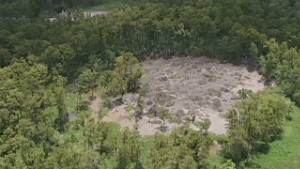
After a sinkhole formed in Assumption Parish early this month, hundreds of neighbors fled, lawsuits were filed and Louisiana Dept. of Natural Resources Secretary Scott Angelle resigned. A hole on the edge of a salt dome near Pierre Part, La. -- about 80 miles northwest of New Orleans -- has grown to 400 feet wide and over 400 feet deep in spots. The salt water or "slurry" within it contains diesel fuel.
Underground salt domes, used to mine brine, salt and sulphur, dot the area. Natural gas pipelines crisscross the region. And because caverns mined for brine are also used to store natural gas, propane and butane, residents are worried about possible fires and explosions. They fear the sinkhole may be radioactive.
A couple of companies and possibly more are involved. A well owned by Texas Brine Co., LLC, located at the sinkhole, began producing brine in the early 1980s, but was plugged and sealed with cement to a depth of 2,500 feet in mid-2011.
Authorities say they're also keeping an eye on a nearby cavern that's full of butane."The sinkhole is about 1,600 feet from a cavern containing over 900,000 barrels of liquid butane," operated by Crosstex Energy of Dallas, according to Assumption Parish Sheriff Mike Waguespack. Butane turns into a highly flammable vapor when it's released.
Last week, Sonny Cranch, spokesman for Texas Brine, said "the site is not radioactive. That's been confirmed by Louisiana Dept. of Environmental Quality tests and by the state Dept. of Natural Resources. There's no radioactive material there, beyond what might be naturally occurring. For instance, if you live in a brick and concrete house, you'll have some radioactivity."
Attorney Daniel Becnel Jr. in Reserve, who filed a class action suit on behalf of neighbors, said "the reason residents worry about radioactivity is because companies store radioactive material at the bottom of these caverns. All the companies around here inject pollution into deepwater wells, hoping it will never surface. Gas, however, has started bubbling up from this sinkhole."
Becnel's class action suit, filed in U.S. District Court in New Orleans on August 10, claims that Texas Brine knew the cavern's walls were vulnerable as early as January of last year but didn't warn the public. A Baton Rouge attorney and other lawyers in the area have also filed suits for property owners.
Last week, Rodney Mallet, spokesman for the Louisiana Dept. of Environmental Quality, said "we began our monitoring on July 13" of this year. "The Dept. of Natural Resources was involved with the bubbling before us," he said. "We tested before the sinkhole formed, and sampled air and bubbles before the slurry hole appeared." DEQ has taken radiation, water and air samples, and has examined nearly a hundred private properties.
Mallett said that DEQ's Mobile Air Monitoring Lab is testing air by the sinkhole, while Texas Brine removes diesel fuel. Texas Brine is ridding the sinkhole's slurry of diesel. "No samples to date have indicated any risks to human health from air pollution and water pollution," Mallett said. "All sampling data is available at DEQ."
Mallett said "rumors of explosions seem to be alarmist and unfounded. However, we have asked Crosstex, which owns the nearest cavern, to provide a risk-management plan and its worst-case scenario. We're operating out of an abundance of caution and making decisions based on sound science."
Within the area, 150 homes and 350 residents are under mandatory evacuation, Sheriff Waguespack said last week. "People are staying with relatives and friends," he said. "They'll remain evacuated for at least another thirty days until the source of the bubbling is determined."
Governor Bobby Jindal declared a state of emergency in the area on August 3. Five days later, DNR Secretary Scott Angelle suddenly resigned, and was replaced on an interim basis by Stephen Chustz, assistant secretary of the state's Office of Coastal Management. Jindal praised Angelle as the "state's point person on federal oil and gas permitting issues," without mentioning his oversight of the mess at the sinkhole.
Becnel said "Angelle always supports big business. He was at the DNR when more than 40,000 fish died in the Pearl River a year ago. He was going to let the paper mill polluter in that case off with a sIap on the hand until the media and attorneys made a big stink about it." A discharge from a Temple-Inland plant in Bogalusa, La. caused the August 2011 fishkill.
"Angelle was at the DNR when the sinkhole opened up," Becnel said.
This month, Jindal appointed Angelle to the Louisiana State University Board of Supervisors.
Angelle is also running for a position on the state's Public Service Commission this fall.
But Becnel said "it's hard to believe there was an urgent need to fill that Board of Supervisors vacancy."
On August 9, Louisiana Office of Conservation Commissioner Jim Welsh ordered Texas Brine to drill a relief well to assess the integrity of the cavern. Texas Brine contracted Riceland Drilling of Lafayette to do the job.
Last Wednesday, Sheriff Waguespack said "Riceland will start bringing in equipment today and it will take three days to set it up. They will drill from a location that's about 500 feet from the suspect cavern location" on Texas Brine's 40-acre site south of La. 70 South.
Drilling was expected to begin on August 19, Waguespack said last week. "They have to drill down at least 3,000 feet and directly into the cavern to try to find the source of the bubbling," he said.
Cranch said "drilling will take 40 days, give or take a few days. The well will be used to relieve any natural gas pressure in the cavern, and then imaging equipment with a sonar device will examine whether the cavern's wall was breached." The well will not be used for brine or natural gas production.
Cranch also said that matted, vegetative matter is being pulled from the slurry now so that the diesel sheen on the sinkhole can be removed.
Before the sinkhole developed on August 3, residents of the Bayou Corne and Grand Bayou areas said they'd seen natural gas bubbles and felt tremors for over two months. Texas Brine officers met with DNR officials in late July, four days before the sinkhole formed. According to U.S. Geological Survey data, tremors appeared to center on the western edge of the Napoleonville Dome.
Waguespack said the last, similar incident occurred in late 2003 when Grand Bayou residents were evacuated because of a gas leak from the salt dome. The salt cavern that's being monitored now passed its last federally-required, mechanical integrity test or MIT in October 2010.
But this summer, "theories are that the salt dome below the surface may have been breached or that it collapsed," Waguespack said. "Recent tests taken by DEQ from the sinkhole at various depths showed high salinity, suggesting a breach and escape from the cavern."
As for diesel fuel odors, Cranch said diesel was used as a sealing agent, especially at the top of the dome when the well was closed last year. Waguespack said "diesel fuel is used as a pad in these wells to stop corrosion of the casing."
Cranch said the well is on land leased from Occidental Chemical Corp. in Dallas. "Oxy is one of our customers for brine, which is used in sodium chloride to make plastics found in consumer products, including CDs and DVDs," he said.
Meanwhile, Texas Brine has worked with state and local officials to set up a relief fund for evacuees. The company has agreed to pay for residents' expenses dating to the start of the evacuation and began issuing housing assistance checks last week.
Boiling bubbles in the waters of Bayou Corne, in Assumption Parish, about 50 miles south of Baton Rouge in Louisiana, US, concerned residents in mid-May. Then, suddenly a massive sinkhole appeared on August 3. It forced the closure of nearby highway 70 after a gas line along that route bent and led to fears of an explosion. Officials believe the sinkhole could give off radiation or cause explosions that would harm local residents. Nearly 150 residences were asked to evacuate their homes on August 13 after the sinkhole swallowed nearby trees. Assumption Parish Police Jury continues monitoring Bayou Corne and Grand Bayou waterway bubbles.
Officials with GOHSEP say the sinkhole has grown and it is now 145 meters (476 feet) by 195 meters (640 feet). As expected, the surface of the sinkhole that has formed in Bayou Corne has grown over the past few days as the land on the outer edge of the area is sloughing off into the sinkhole. The sinkhole sits on top of an underground mountain of salt and residents of Bayou Corne have been reporting tremors and gas bubbles for weeks.
Potentially radioactive sinkhole in Louisiana swallowed trees and forced mandatory evacuation (Credit: Inquisitr)
Dr. Madhurendu Kumar, DNR director of the state’s oil and gas division, said the sinkhole could have been caused by structural problems in Texas Brine’s salt dome beneath it. Salt cavern is part of Napoleonville salt dome - a massive ancient structure that Texas Brine Company mines for use with mining petroleum, salt and sulphur. Texas Brine has mined the salt dome since 1973 for brine used by industry, using water to wash out salt deep in the dome and selling the resulting brine mix, company and DNR officials have said. DNR has ordered the Texas Brine Company to drill a well and see if it is the cause of the dark gray water-filled hole nearby. It will take at least 40 days to drill the well.
The potentially failed cavern may also be the source of natural gas that has bubbled up on nearby bayous and from an abandoned water well, emergency preparedness officials said. Texas Brine and other salt dome operators use salt-dome cavities left behind from mining operations to store hydrocarbons such as natural gas for companies that lease the wells. Texas Brine ceased operating the cavern in 2011 and plugged and abandoned the well used to access it, state officials said.
This is an aerial view of the sinkhole that emerged recently near Bayou Corne. The Texas Brine Co. LLC facility well pad for a plugged and abandoned salt cavern is at right; Crosstex Energy LP facility is in upper left, while the pipeline corridor is at far lower left. (Credit: Bill Feig/Advocate)
The 1.5 million barrels of liquid butane well and fear of radioactivity
The sinkhole could breach a nearby well that contains 1.5 million barrels of highly volatile liquid butane, which could easily turn into a highly flammable vapor. The 1.5 million barrels of liquid butane 458 meters (1500 feet) from the sinkhole has an explosive capacity of 100 Hiroshima nuclear bombs, 1.5 times the explosive force of the largest thermonuclear weapon in current service in the U.S.
Inhalation of butane can cause euphoria, drowsiness, narcosis, asphyxia, cardiac arrhythmia, temporary memory loss and frostbite, which can result in death from asphyxiation and ventricular fibrillation.
napoleonsvile Salt Dome area (Credit: DNR Louisiana)
Local residents and sheriff point that the Louisiana Department of Natural Resources knew for months that the cavern mined by Texas Brine had integrity problems but that they didn’t tell authorities or do anything about it. Landowners near the sinkhole filed a lawsuit against DNR and Texas Brine claiming that their drinking water in Grand Bayou system is now contaminated because authorities didn’t do anything to prevent the appearance of the sinkhole. DNR and Texas Brine officials stated that the cavern may be closer to the outer wall of the dome than thought, that it could have failed and created the sinkhole.
The Department of Environmental Quality (DEQ) put air-monitoring stations around the area to measure LELs (lower explosive limits) and say no radiation danger exists, although all test sample results will not be available until later this week. The Department of Natural Resources (DNR) had quietly permitted Texas Brine Company LLC to pump radioactive waste into its now failing cavern near the sinkhole DNR also hid documents showing that cavern may have had problems since 2010. DNR’s Office of Conservation had authorized Texas Brine in 1995 to dispose of naturally occurring radioactive material in the now-possibly failed cavern. Initial readings taken by state testers have not revealed any initial radiation.
“Based on the first round of data, we are confident that the potential exposure of citizens to NORM is not a problem in this matter,” DEQ Secretary Peggy Hatch said in the news release.
Louisiana Environmental Action Network (LEAN) reports that, in addition to over twelve areas in and around Bayou Corne and Grand Bayou having “waters rolling from escaping methane, ethane, and propane,” locals have also reported tremors and houses shifting. USGS maps show extra movement and stress from oil and gas operations are susceptible to present pressure of a series of earthquakes west of Louisiana, each being where fracking and frack waste injection storage are ongoing. There has been exploration for oil and gas in that area in the past, which would make the presence of low levels of naturally occurring radioactive material (NORM) possible. The material, called NORM, is often a by-product of oil and gas exploration and production. According to the U.S. Environmental Protection Agency’s website, radioactivity can vary widely, from background amounts to much higher levels.
Seismic activity
Seismometers picked up thousands of quakes in the Assumption Parish disaster area since June, according to seismologist Dr. Stephen Horton. He and colleagues had installed four instruments underground to record quake activities, and since then, two more, each monitored daily. People reported quakes on June 8 and July 3. Quakes ended when bubbling sinkhole developed but seismic signals continue from sinkhole area. There are seismic signals that appear to emanate from the vicinity of the in the Napoleonville salt dome, in the low amplitude range.
Lake Peigneur example
Eighty miles west of Bayou Corne is Lake Peigneur that balances above a salt dome that collapsed in 1980 when a drilling rig punctured a protective layer in the salt mine wall, causing the entire lake, including a drilling rig, several larger barges and large chunks of surrounding land to be pulled down into the cavern. Pressure was so great, the bayou ran backwards, created a large waterfall, and was sucked back into the puncture hole. The event permanently affected the ecosystem of the lake by changing the lake from freshwater to saltwater and increasing the depth of part of the lake.
The lake drained into the hole, expanding the size of that hole as the soil and salt were washed into the mine by the rushing water, filling the enormous caverns left by the removal of salt over the years. The resultant whirlpool sucked in the drilling platform, eleven barges, many trees and 260,000 m2 (65 acres) of the surrounding terrain. So much water drained into those caverns that the flow of the Delcambre Canal that usually empties the lake into Vermilion Bay was reversed, making the canal a temporary inlet. This backflow created, for a few days, the tallest waterfall ever in the state of Louisiana, at 164 feet (50 m), as the lake refilled with salt water from the Delcambre Canal and Vermilion Bay. The water downflowing into the mine caverns displaced air which erupted as compressed air and then later as 400-foot (120 m) geysers up through the mineshafts.
Since 1994 AGL Resources has been using Lake Peigneur’s underlying salt dome as a Storage and Hub facility for pressurized natural gas.There is currently concern from local residents to the safety of storing the gas under the lake and nearby drilling operations.
A 400-foot deep sinkhole in Louisiana is expanding and today swallowed the boat of two cleanup workers who had to be rescued from the hole. Officials are still fearful of the possibility of explosions from nearby gas-filled caverns.
"It has expanded 50 feet and during that expansion there were workers that were working on the cleanup of the diesel," Kim Torres, spokeswoman for the Office of Emergency Preparedness, told ABCNews.com today.
The two workers were in a boat tied to a tree when the area where the tree grew fell into the sinkhole.
The workers were rescued by airboat. They were uninjured but their boat disappeared into the sinkhole. The cleanup process has been halted.
The gaping hole measures about 526 feet from northeast to southwest and 640 feet from northwest to southeast. It is in Assumption Parish, La., about 50 miles south of Baton Rouge.
The sinkhole sits in the middle of a heavily wooded space where it has consumed all of the soaring cypress trees that had been there. Flyover photos show some of the treetops still visible through the mud.
Authorities enacted a mandatory evacuation for residents of about 150 homes in the area. Last week, Torres said that most residents chose to stay in their homes. But as of today, 60 percent of those homes have been evacuated even though the mandatory evacuation order was not escalated to a forced evacuation, when authorities remove residents.
"I think everyone realized it was serious even though they felt it was contained [before]," Torres said. "When you put human lives in...it just becomes more serious and maybe people are heeding the warning a little bit more."
Sinkhole Swallows Up Two Florida Homes Watch Video
Minibus Swallowed by Sinkhole in China Watch Video
Torres said she expects that the 60 percent will increase after the incident with the cleanup workers.
While officials are not certain what caused the massive sinkhole, they believe it may be have been related to a nearby salt cavern owned by the Texas Brine Company.
After being used for nearly 30 years, the cavern was plugged in 2011 and officials believe the integrity of the cavern may have somehow been compromised, leading to the sinkhole.
Louisiana's Department of Natural Resources required that Texas Brine drill a well to investigate the salt cavern as soon as possible, obtain samples from the cavern and provide daily reports on the findings.
The sinkhole is on the outside edge of the salt dome where this particular brine well is located.
"There are some indications that it very well may have been connected, but there's just indications," Texas Brine Company spokesman Sonny Cranch told ABCNews.com. "There's nothing concrete that has connected the sinkhole to the cavern."
The exploratory rig is being assembled but parts of it are still being shipped. It could take 40 days for the actual drilling to begin, even with an expedited process, Torres said.
In the meantime, officials and residents are left to worry about the possibility of an explosion.
All of the neighboring natural gas pipelines that were of concern last week have been depressurized and emptied, but the nearby caverns are still causing concern.
One cavern that contains 940,000 gallons of butane is of particular concern, Torres said. It's about 2,000 feet from the sinkhole.
Authorities are concerned about the massive explosion that could result from the butane's release to the surface if the sinkhole were to expand far enough to reach it.
There was bubbling in the water and the sinkhole is near areas where there has been exploration for oil and gas in the past. This would make the presence of low levels of naturally occurring radioactive material (NORM) possible.
---------------end update-------------------------------------------------- update 8-14-2012 Mysterious Louisiana Sinkhole Raises Concerns of Explosions and Radiation By CHRISTINA NG | ABC News
A nearly 400-foot deep sinkhole in Louisiana has swallowed all of the trees in its area and enacted a mandatory evacuation order for about 150 residences for fear of potential radiation and explosions.
The 400-square-foot gaping hole is in Assumption Parish, La., about 50 miles south of Baton Rouge.
The sinkhole sits in the middle of a heavily wooded space where it has consumed all of the soaring cypress trees that had been there. Flyover photos show some of the treetops still visible through the mud.
Authorities enacted a mandatory evacuation for between 100 and150 homes in the area, but most people have chosen to stay, according to the Mayor's Office of Emergency Preparedness. If any of the dangers seem to become more imminent, the order will be escalated to a forced evacuation.
While officials are not certain what caused the massive sinkhole, they believe it may be have ben caused by a nearby salt cavern owned by the Texas Brine Company.
After being used for nearly 30 years, the cavern was plugged in 2011 and officials believe the integrity of the cavern may have somehow been compromised, leading to the sinkhole. On Thursday, Louisiana's Department of Natural Resources required that Texas Brine drill a well to investigate the salt cavern as soon as possible, obtain samples from the cavern and provide daily reports on their findings. It could take up to 10 days to set up the drilling process, even with an expedited process.
"We have to arrange for the driller. We have to pick a location. We have to be very careful to not be in a point that's too close to the sinkhole because of the weight of the rig," Texas Brine Company spokesman Sonny Cranch told ABCNews.com today. "We don't want to aggravate the situation."
The sinkhole is on the outside edge of the salt dome where this particular brine well is located.
"There are some indications that it very well may have been connected, but there's just indications," Cranch said. "There's nothing concrete that has connected the sinkhole to the cavern."
There was bubbling in the water and the sinkhole is near areas where there has been exploration for oil and gas in the past, which would make the presence of low levels of naturally occurring radioactive material (NORM) possible.
The state's Department of Environmental Quality said water samples from the sinkhole showed oil and diesel on its surface, but initial readings did not detect radiation.
In the days after the sinkhole opened up on Aug. 3, nearby Highway 70 was closed down because officials discovered that the sinkhole caused a 36-inch natural gas pipeline to bend and feared the possibility of an explosion, according to ABC News' Baton Rouge affiliate WBRZ.
"That's why the mandatory evacuation is going to stay on, because there is a risk for explosion," John Boudreaux of from Assumption Parish Emergency Preparedness said at a meeting with residents on Tuesday, WBRZ reported.
"We are determined to do everything we can to find the answer," president of Texas Brine Mark Cartwright told the residents.
Some community members were visibly frustrated with the situation and lack of answers.
"You can give us a straight answer because that's all we want," one woman said at the meeting. "We want to know when we can come home and be safe. Because you all go home after a days work. You're safe, but we're not."
Gov. Bobby Jindal issued a declaration of emergency allowing the Governor's Office of Homeland Security to assist in the efforts if necessary.
"This is extremely serious and it's been going on for too long to still be at this point," Kim Torres, spokeswoman for the Office of Emergency Preparedness, told ABCNews.com today. "The people are very aware of how serious this is."
Louisiana sinkhole roils local natural gas network
By Jeanine Prezioso
NEW YORK | Wed Aug 8, 2012 5:57pm EDT
NEW YORK (Reuters) - A sinkhole the size of a football field in southern Louisiana has forced energy companies to halt nearby natural gas pipeline activity and draw down fuel from a local storage cavern. Chevron Corp's subsidiary Bridgeline Holdings declared force majeure on new injections into its salt dome storage facility near the sinkhole and the town of Napoleonville, through the rest of the year, according to notice to customers posted on its website.
Customers were also asked to begin reducing their current storage inventory to 40 percent of each of their currently contracted amount, according to the Bridgeline filing.
Natural gas traders said Chevron's move to purge the gas could push an additional 4 billion to 5 billion cubic feet of gas on the market. U.S. September and October futures prices settled lower, while winter months settled higher on Wednesday, and traders said companies could be scrambling to sell supplies while locking in winter gas to meet heating demand.
"Chevron Pipeline Co has elected to take the step of drawing down the NS1 cavern as a precaution to ensure that we are doing everything possible to protect public safety and the environment," said Gareth Johnstone, a Chevron spokesman.
The sinkhole, which local media reported was 372-feet wide, was discovered near the cavern on Friday, and has consumed full-grown trees. Sinkholes occur when underground spaces or caverns become so large they can no longer support the land above them, causing a collapse.
There is no indication that gas is leaking from the facility, Johnstone said, adding there was no evidence that the integrity of the cavern was at risk.
Louisiana Commissioner of Conservation James Welsh issued a Declaration of Emergency on Friday due to the sinkhole, located in a region of wooded swamp in Bayou Corne. The Texas Brine Company, which has a plugged salt cavern within 100 yards of the sinkhole, was ordered to investigate the site.
"The objective is to determine if the cavern has a direct relationship to this event," said Mark Cartwright, president of subsidiary Texas Brine Company Saltville, LLC. "The obvious conclusion is of course it does, but we don't know yet."
"This is very puzzling."
Unexplained bubbles discovered in the region in recent months had been under investigation by state, local, and federal agencies.
Tremors were also reported in the area before the sinkhole appeared, state officials said, but the cause was still being investigated.
PIPELINES SHUT Enterprise Product Partners, owner of the Arcadian Gas Pipeline System, said it was forced to shut two 20-inch gas pipelines near the area, according to a spokesman. The gas has been rerouted so the company has been able to continue deliveries to customers, he added.
A spokeswoman for Crosstex Energy said the company shut a portion of its 36-inch natural gas pipeline near the sinkhole taking about 150 million cubic feet a day of supply offline.
Customers have made other arrangements to source other supplies, the spokeswoman said. Chevron has three natural gas salt dome storage caverns in the area with a total capacity to hold 12.7 billion cubic feet of gas, according to the company website. The storage sites connect with Acadian Gas Pipeline Company, Gulf South Pipeline Company, and Florida Gas Transmission. Maximum withdrawal was listed as 1.1 bcf per day.
"They are worried about the cavern integrity and the slurry breaching the salt dome that they have," said Genscape senior natural gas analyst Andy Krebs.
Authorities are investigating the cause of the slurry-filled hole, which is roughly the size of a football field.
Specifically, they are looking into whether a nearby salt cavern could be to blame and have ordered the company that is responsible for that cavern to drill a relief well.
The process is expected to take up to 40 days, said Assumption Parish President Martin Triche. Until the well is drilled, authorities do not anticipate lifting the evacuation order that affects approximately 150 homes.
"We won't feel a level of confidence to lift the evacuation until we have more answers from that well," Triche told reporters.
Roughly half of the residents told to leave heeded the call, he said.
Louisiana officials have reached out to Texas Brine Company, urging it to provide affected residents with some type of assistance while it investigates whether a breach in its cavern might have caused the sinkhole 100 yards away.
The situation is made all the worrisome because the hole is believed to be close to a well containing 1.5 million barrels of liquid butane, a highly volatile liquid that turns into a highly flammable vapor upon release. A breach of that well, Assumption Parish Sheriff Mike Waguespack has said, could be catastrophic.



 March 21, 2013