TOKYO (AP) – Two strong earthquakes rattled northern Japan on Thursday, but neither caused any apparent damage or a tsunami.
Japan's Meteorological Agency said a magnitude-6.1 quake struck Thursday evening south of the northern island of Hokkaido.
It hit about 465 miles northeast of Tokyo and 19 miles below the sea surface. The agency did not issue a tsunami warning.
The shaking was not felt in Tokyo, though the morning quake was.
That magnitude-6.0 temblor struck just off the coast near the nuclear power plant damaged by the March 11 earthquake and tsunami.
The two shakings are believed unrelated and did not affect the crippled Fukushima Dai-ichi plant or other nuclear plants in the region.
The March 11 magnitude-9.0 earthquake and tsunami wiped out large parts of Japan's northeastern coast and left nearly 20,000 people dead or missing. The twin disasters also triggered a nuclear crisis, forcing about 100,000 people to flee their homes due to leaking radiation.
Was HAARP involved in this newest edition of earthquakes...My guess is that Japan is being put through a nuclear war without knowing they are in a nuclear war. I base this on the O.S.S. papers that I posted in earlier posts and on the HAARP abilities and the symptoms of their work.
Good lord. Look at the crap they’re reporting in the Sun:
Mass exodus from Tokyo
By VIRGINIA WHEELER, RHODRI PHILLIPS, KEVIN SCHOFIELD and BEN JACKSON, Environment Editor
A MASS exodus from Tokyo is under way as those left behind pray for the wind to save them from a new radiation nightmare.
The airport of Japan’s quake-hit capital was besieged as levels of the invisible killer soared to ten times the normal level there.
And that was before a FOURTH explosion and a fire at a stricken nuclear plant sparked fresh terror – that of a poison cloud of nuclear rain.
The leaking station was officially abandoned this morning after radiation levels around the plant “increased rapidly”.
Other international mediasources are reporting similar stories of the masses fleeing from Tokyo. They based on internet hearsay or interviews with foreign residents of Japan.
Reality check:
There is no “mass exodus” being reported anywhere in the Japanese media. According to the Wall Street Journal, the only people rushing to the airport to flee the country are foreigners. (Could it have to do with the fact that they’re getting their information from sources like the Sun?)
Ten times the normal level of radiation is still insignificantly small and harmless.
Radiation levels in the immediate area around the plant increased today. Nobody has measured a dangerous increase outside of the 30km evacuation zone and there is no information about any “poison cloud of nuclear rain.”
The plant was not “officially abandoned” – workers temporarily left one area, but work has resumed.
Possible spread of radioactivity / ZAMG now supports the emergency activities of the IAEA (Update: March 15, 2011, 12 clock)
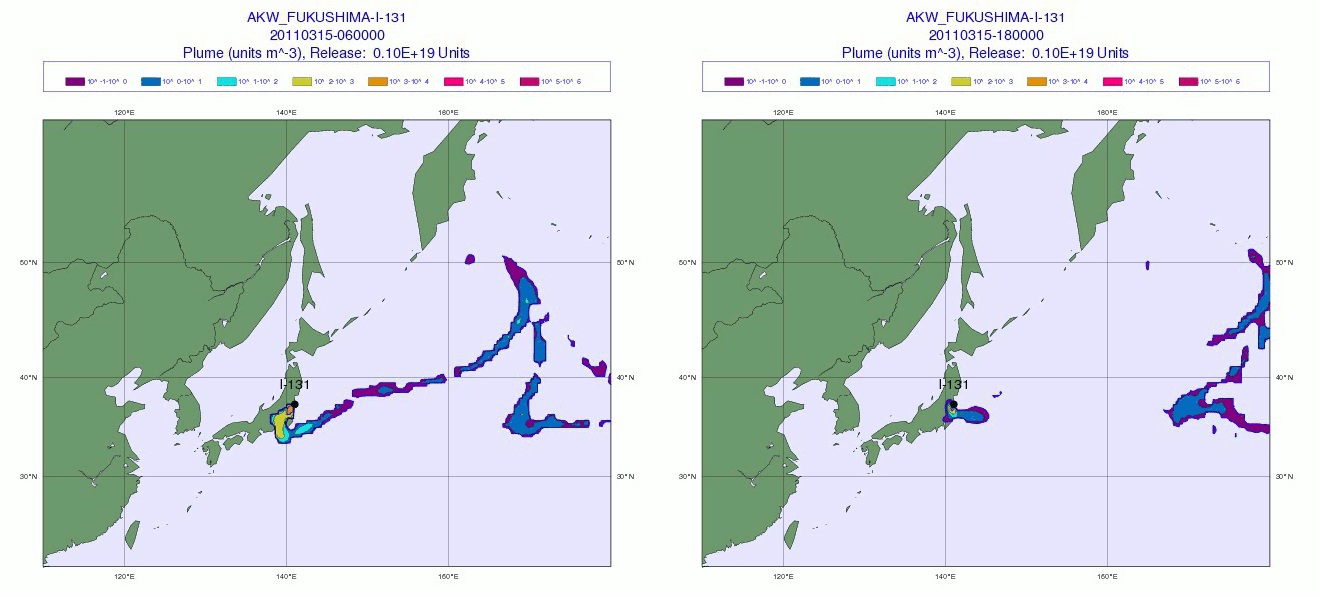
After the severe earthquake in Japan has occurred in the blocks of the Japanese nuclear power plant Fukushima to repeated explosions.The calculated since Saturday 12 ZAMGMarch, the spread of a possible radioactive cloud.
On behalf of the WMO ZAMG has supported today the "Incident and Emergency Centre of the International Atomic Energy Agency (IAEA) in Vienna with detailed simulations for the propagation of radiation in Japan and with meteorological expertise.
According to the current model calculations of the ZAMG revolves currently a low pressure area over Japan, which could transport possible radiation clouds to the south and thus towards Tokyo.At the same time are possible in the next few hours, light rain on the east coast of Japan.In rainfall areas, it could lead to increased radiation coming on the ground.The latest forecasts show that today at 20:00 UTC the large-scale flow again turns to West.Currently, the wind is blowing slightly in Tokyo from the east and so far today it was dry in the Japanese capital.
A neat air masses arrived from Japan to Europe and Austria is still excluded by the meteorology.
Posted by: JeffMasters, 2:16 PM GMT on March 16, 2011
If there is going to be a major nuclear disaster with massive release of radioactivity into the atmosphere from Japan's stricken Fukushima nuclear plant, today would be the best day meteorologically for this to occur. The low pressure system that brought rain and several inches of snow to Japan yesterday has moved northeastwards out to sea, and high pressure is building in. The clockwise flow of air around the high pressure system approaching Japan from the southwest is driving strong northwesterly winds of 10 - 20 mph over the region. These winds will continue through Thursday, and will take radiation particles emitted by the stricken reactors immediately out to sea, without lingering over Japan. Since high pressure systems are regions of sinking air, the radiation will stay close to the ocean surface as the air spirals clockwise over the Pacific. The contaminated air will remain over the ocean for at least five days, which is plenty of time for the radiation to settle out to the surface.
Figure 1. Surface weather map for 8am EDT today, taken from the 6-hour forecast from this morning's 6 UTC run of the GFS model. A high pressure system to the southwest of Japan, in combination with a low pressure system to the northeast are driving strong northwesterly surface winds over the country. Image is from our wundermap with the "Model" layer turned on. The lines are sea-level pressure (blue contours, 4 mb interval) and 1000 to 500 mb thickness (yellow contours, 60 m interval). Thickness is a measure of the temperature of the lower atmosphere, and a thickness of 5400 meters is usually close to where the dividing line between rain and snow occurs.
Thursday night and Friday morning (U.S. time), the high pressure system moves over Japan, allowing winds to weaken and potentially grow calm, increasing the danger of radioactivity building up over regions near and to the north of the nuclear plant. On Friday, the high departs and a moist southwesterly flow of air will affect Japan. These southwesterly winds will blow most of the radiation out to sea, away from Tokyo. Southwesterly winds will continue through Sunday, when the next major low pressure system is expected to bring heavy precipitation to the country. Beginning Thursday night, the sinking airmass over Japan will be replaced a large-scale area of rising air, and any radiation emitted late Thursday through Friday will be carried aloft towards Alaska and eastern Russia by this southwesterly flow of rising air.
Ground-level releases of radioactivity are typically not able to be transported long distances in significant quantities, since most of the material settles to the ground a few kilometers from the source. If there is a major explosion with hot gases that shoots radioactivity several hundred meters high, that would increase the chances for long range transport, since now the ground is farther away, and the particles that start settling out will stay in the air longer before encountering the ground. Additionally, winds are stronger away from ground, due to reduced friction and presence of the jet stream aloft. These stronger winds will transport radioactivity greater distances. I've made trajectory plots for the next three days assuming two possible release altitudes--a surface-based release near 10 meters, which should be the predominant altitude in the current situation, and a higher release altitude of 300 meters, which might occur from an explosion and fire from a Chernobyl-style incident. Given that the radioactivity has to travel 3000 miles to reach Anchorage, Alaska, and 5000 miles to reach California, a very large amount of dilution will occur, along with potential loss due to rain-out. Any radiation at current levels of emission that might reach these places may not even be detectable, much less be a threat to human health. A Chernobyl-level disaster in Japan would certainly be able to produce detectable levels of radiation over North America, but I strongly doubt it would be a significant concern for human health. The Chernobyl disaster only caused dangerous human health impacts within a few hundred miles of the disaster site, and the distance from Japan to North America is ten times farther than that.
REGARDING THE NUCLEAR ISSUE: "For several days, authorities have attempted to reassure the public. Now, they are pleading for help.
Arnold Gundersen: I think that the probability of a large scale release is about 50-50, and I don’t call that small. You’ve got three reactors involved. Two, you’re already picking up radiation on aircraft carriers a hundred miles away at sea, on helicopters 60 miles to the north, and in town. So clearly, as these plants become more and more difficult to control, it becomes quite likely that a containment now will have a gross failure. And a gross failure will release enormous amounts of radiation quickly.
...But the radioactive isotopes are still decaying away. They’ll decay for at least a year. So you have to release the pressure from that containment pretty much every day. With releasing the pressure will come releasing radioactive isotopes as well.
The Times is right that every plant ...will be opening up valves every day to make sure the pressure is down...for at least a year.
Within 90 days, the iodine health risks will disappear, because that will decay away. But the nasty isotopes — the cesium and strontium will remain for 30 years. And they’re volatile.
After Three Mile Island, strontium was detected 150 miles away from the reactor. That ends up in cow’s milk and doesn’t go away for 300 years. The releases from these plants will last for a year, and will contain elements that will remain in the environment for 300 years, even in the best case.
If we have a meltdown, it will be even worse than that.
It’s important to know that this steel containment is about an inch thick...The reactor is already open, because the pressure relief valves have to stay open.
These containments have already breached. We saw iodine and cesium in the environment before the first unit exploded. When you see that, that’s clearly an indication that the containment has breached.
Now, is it leaking 1 percent a day? Probably. Is it leaking 100 percent a day? No. I think for the neighboring towns out to 2 miles, they won’t have anybody back in them for five years. Out to 15 miles, I doubt you’re going to see anyone back for six months. And that’s in the best case, without a meltdown.
If we have a meltdown, I don’t think anyone will be back within 20 miles for 10 or 15 years.
There would be higher incidence of cancer. The groundwater would be contaminated.With a meltdown, you’re worried about surface contamination of everything within miles of the plant, and groundwater contamination as well.
Chernobyl had a meltdown, and that groundwater wedge is gradually working its way toward Kiev, which is a very large city [about 80 miles away]. That groundwater contamination lingers for 300 years. It’s not something that’s easy to mitigate.
We’re seeing iodine and cesium in the environment. That’s an indication that the containments are leaking...
I can’t understand how officials can say that the releases are low, when they don’t have any instruments that are working. Their batteries have failed, and when the batteries fail, all of the instruments stop working...
...My experience is that, after Three Mile Island and after Chernobyl, everybody said there wasn’t a problem...So I really don’t put much faith in official pronouncements the first week of an accident.
... the officials don’t want to provoke a panic. So there’s a financial long term interest to try to minimize the impact. The flip side of that is that in the process you lose transparency. There is no transparency right now...
I understand from one source that the second unit cannot be vented, because the vent is jammed...
The venting system is jammed and that means that pressure will keep building up until something catastrophic happens.
The control rooms have become almost uninhabitable. The operators would have to be in Scott air packs, because the ventilation failed. Otherwise they would be breathing contaminated air. The control room is very close to these reactors...It’s very difficult to get anything done if you’re wearing an air pack and a bubble suit.
They’ll send someone out to manually open a valve. And then that person will go back out to manually close a valve. In a high radiation field, there are only so many trips you can make before you’ve exceeded what they call emergency limits. So these people are picking up very large doses in very short periods of time. For their personal health, you can’t send them out again.
...The probability of these workers getting cancer is dramatically increasing, because the doses they receive in a day are higher than what they get in a year...
The radiation is being diluted by the wind and spread out. Tokyo is a long way away. Germany is a long way from Chernobyl, and the ground in Germany is so contaminated that they are still prohibiting the hunting of wild boars, 25 years later.
...There’s a U.S. aircraft carrier 100 miles away, and the workers on that aircraft carrier received in one hour the dose they would normally get in one month.
Chernobyl reached the U.S. The question is how much radiation (will reach the U.S. this time)? There’s not a lot of data to make that determination right now.
I’ve gone out and bought potassium iodine pills, and I plan to take potassium iodine starting in about 10 days, just because I’m concerned about food contamination. That’s a personal choice right now. My experience says that it would be prudent to get potassium iodine pills and take them, to avoid any of the iodine that might come over. But there’s not a lot of data to support whether or not potassium iodine really helps." To get the full interview, click here http://www.globalpost.com/dispatch/news/regions/asia-pacific/japan/110314/japan-nuclear-meltdown-disaster?page=0,1
Prime Minister Naoto Kan said radiation had spread from the four stricken reactors of the Fukushima Dai-ichi nuclear plant along Japan's northeastern coast.
Unease remained in the island nation as it tried to recover from the magnitude-9.0 earthquake and subsequent tsunami believed to have killed more than 10,000 people and battered the world's third-largest economy. The confirmed death toll was 3,300.
Some 450,000 people remained in shelters and 150 people tested positive for exposure to radiation.
There was a bit of positive news in terms of the radiation level when officials from the International Atomic Energy Agency reported that the levels of radiation at the site came down a little bit. But later, an official told ABC News that the data was constantly changing.
Officials are wondering if the wind is to blame for the up and down readings.
The official told ABC News that as long as there are hot fuel rods and no water pumps circulating consistently, there is no sign that the situation was moving in a positive direction.
The agency said the amount of radiation that's safe to ingest a year is about 2.4 mSv. Earlier on Tuesday, the Fukushima plant was leaking 11.9 mSv per hour. But in six hours, that level dropped to 0.6 mSv per hour.
There is a no-fly zone over a 20-mile radius around the nuclear power plant due to fears that radioactive particles leaking from the complex into the atmosphere could enter passing aircraft.
Officials ordered 140,000 people living within a 19-mile radius of the Fukushima Dai-ichi nuclear plant to shelter in place. Residents are being told to stay inside, close their windows, turn off their air conditioning and take down all their outside laundry.
Evacuation orders are in effect for 800 workers at the plant. Only 50 remain to do essential work.
Here is a link to a video that shows people in Japan getting checked for radiation. Just absolutely nerve racking! What happens if they find someone with radiation?